The Hornady SST 12 gauge slug fires a 300-grain polymer-tipped sabot projectile with a muzzle velocity of 2,000 feet per second and a massive 2,664 ft-lbs of muzzle energy. Designed exclusively for fully rifled shotgun barrels, this specialized hunting ammunition extends the effective range of a 12-gauge shotgun out to 200 yards. The Super Shock Tip (SST) bullet initiates rapid, controlled expansion upon impact, making it highly effective for medium to large game animals like whitetail deer, wild hogs, and black bear. Because it utilizes a sabot sleeve to engage the barrel’s rifling, this load provides exceptional accuracy that bridges the performance gap between traditional shotgun foster slugs and modern centerfire rifle cartridges.
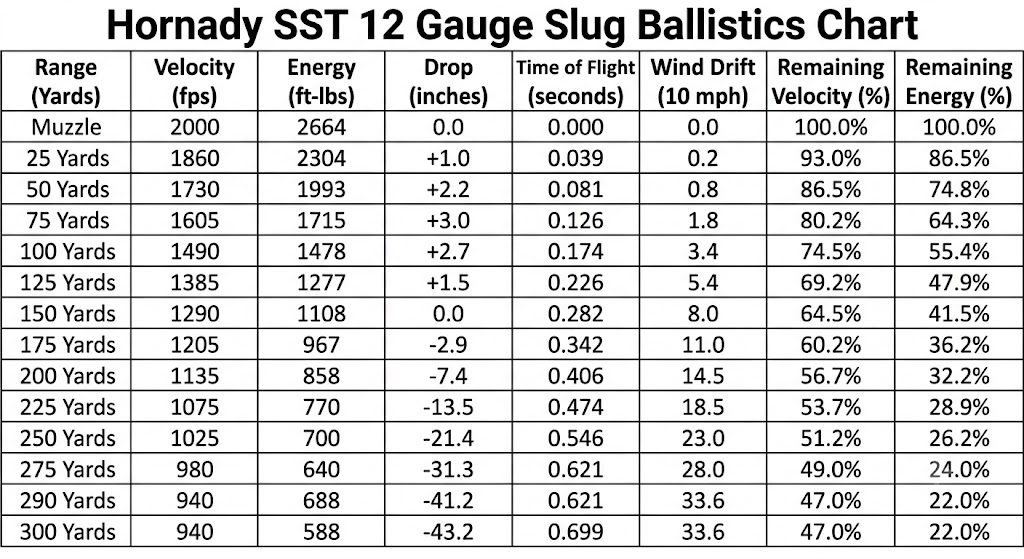
Hornady SST 12 Gauge Slug Ballistics Chart
| Range (Yards) | Velocity (fps) | Energy (ft-lbs) | Drop (inches) | Time of Flight (seconds) | Wind Drift (10 mph) | Remaining Velocity (%) | Remaining Energy (%) |
| Muzzle | 2000 | 2664 | -1.5 | 0.000 | 0.0 | 100.0% | 100.0% |
| 25 | 1860 | 2304 | +0.6 | 0.039 | 0.2 | 93.0% | 86.5% |
| 50 | 1730 | 1993 | +2.2 | 0.081 | 0.8 | 86.5% | 74.8% |
| 75 | 1605 | 1715 | +3.0 | 0.126 | 1.8 | 80.2% | 64.3% |
| 100 | 1490 | 1478 | +2.7 | 0.174 | 3.4 | 74.5% | 55.4% |
| 125 | 1385 | 1277 | +1.5 | 0.226 | 5.4 | 69.2% | 47.9% |
| 150 | 1290 | 1108 | 0.0 | 0.282 | 8.0 | 64.5% | 41.5% |
| 175 | 1205 | 967 | -2.9 | 0.342 | 11.0 | 60.2% | 36.2% |
| 200 | 1135 | 858 | -7.4 | 0.406 | 14.5 | 56.7% | 32.2% |
| 225 | 1075 | 770 | -13.5 | 0.474 | 18.5 | 53.7% | 28.9% |
| 250 | 1025 | 700 | -21.4 | 0.546 | 23.0 | 51.2% | 26.2% |
| 275 | 980 | 640 | -31.3 | 0.621 | 28.0 | 49.0% | 24.0% |
| 300 | 940 | 588 | -43.2 | 0.699 | 33.6 | 47.0% | 22.0% |
Ballistic Data Specifications:
- Zero Distance: 150 Yards
- Bullet Weight: 300 Grains
- Bullet Type: SST (Super Shock Tip) Sabot Slug
- Ballistic Coefficient (G1): 0.200
- Barrel Length: 24 inches (Rifled)
- Sight Height: 1.5 inches
- Atmospheric Conditions: Standard sea level (59°F, 29.92 inHg)
1. Overview of the Ammunition
The Hornady SST 12 gauge slug represents a major evolutionary step in shotgun hunting ammunition. Unlike traditional lead Foster slugs designed to be fired through smoothbore shotgun barrels, the Hornady SST is a highly engineered sabot slug. It features a 300-grain FTX (Flex Tip eXpanding) bullet encased in a plastic sleeve, or sabot. This sabot grips the lands and grooves of a fully rifled shotgun barrel, imparting a spin to the projectile that stabilizes it in flight much like a traditional rifle cartridge.
Hornady designed this factory ammunition specifically for hunters operating in “shotgun-only” hunting zones who demand rifle-like accuracy and extended range. The red polymer tip serves a dual purpose. First, it protects the bullet’s meplat from deformation while seated in a tubular magazine, eliminating the risk of chain-fires. Second, upon impact, the polymer tip drives backward into the hollow cavity of the lead core, initiating massive, controlled expansion even at lower downrange velocities. Because the projectile is fundamentally a heavy, aerodynamic .50 caliber bullet encased in a 12-gauge sabot, it requires a dedicated slug gun or a specialized rifled barrel attachment to function correctly and achieve its intended ballistic performance.
2. Understanding the Ballistics Chart
Reading a ballistics chart correctly allows a hunter to predict exactly how the projectile will behave in the field. The Range column dictates the distance from the muzzle to the target in yards. Velocity measures the speed of the 300-grain bullet in feet per second (fps). Energy is a measurement of the bullet’s destructive potential, expressed in foot-pounds (ft-lbs), which directly translates to its knockdown power on game animals.
Drop illustrates the trajectory of the bullet relative to the shooter’s line of sight. Assuming a 150-yard zero and a scope mounted 1.5 inches above the bore, the drop column shows where the bullet will strike at various distances. Positive numbers indicate the bullet is traveling above the crosshairs, while negative numbers mean the bullet has dropped below them. Time of Flight tracks how many seconds it takes the bullet to reach a specific distance, which is critical for calculating lead on moving targets. Wind Drift calculates how far a 10 mph crosswind will push the bullet off its target horizontally. Finally, Remaining Velocity and Remaining Energy percentages provide a clear picture of how rapidly the aerodynamic drag strips the bullet of its speed and power as it travels downrange.
3. Velocity Performance
The muzzle velocity of the Hornady SST 12 gauge slug is an impressive 2,000 feet per second. Pushing a 300-grain projectile to this speed requires modern propellant technology and generates substantial recoil. This initial velocity is what gives the SST its relatively flat trajectory across the first 100 yards of flight. However, velocity retention is a major challenge for shotgun slugs.
Despite having a more aerodynamic profile than standard shotgun slugs, the 300-grain SST bullet still has a relatively low ballistic coefficient of 0.200. Because of this blunt profile, the bullet experiences significant atmospheric drag. By the time it reaches 100 yards, the velocity has dropped to 1,490 fps, meaning it has lost over 25% of its initial speed. As the bullet approaches 200 yards, the velocity falls to 1,135 fps, bringing it dangerously close to the transonic zone where aerodynamic instability can negatively impact accuracy. Understanding this rapid loss of downrange speed is crucial for hunters, as the bullet’s ability to reliably expand upon impact is directly tied to the velocity it maintains when it strikes the target.
4. Energy Performance
Energy performance is where the Hornady SST 12 gauge slug truly dominates. With a staggering muzzle energy of 2,664 ft-lbs, this factory load hits harder at the muzzle than many standard centerfire rifle cartridges, including the popular .308 Winchester. This massive energy transfer is responsible for the devastating terminal ballistics this load is famous for in the hunting woods.
Because the bullet sheds velocity quickly, retained energy also drops at a rapid rate. At 100 yards, the load delivers 1,478 ft-lbs of energy, which is still more than enough to ethically harvest any North American big game animal. A common benchmark among hunters is that 1,000 ft-lbs of energy is required for a clean, ethical kill on whitetail deer. The ballistics chart reveals that the Hornady SST maintains this 1,000 ft-lb threshold out to approximately 165 yards. The large diameter of the expanded bullet combined with this massive kinetic energy ensures wide wound channels, extreme tissue disruption, and rapid blood loss. This energy profile rarely results in over-penetration, meaning the majority of the projectile’s force is dumped directly into the vitals of the game animal.
5. Trajectory and Bullet Drop
The trajectory of a 12-gauge slug is inherently curved, but the high muzzle velocity of the SST load flattens this arc considerably compared to traditional Foster slugs. To maximize the point-blank range of this hunting ammunition, a zero distance of 150 yards is highly recommended.
With a 150-yard zero, the bullet’s path rises gradually, peaking at exactly 3.0 inches high at the 75-yard mark. At 100 yards, the bullet is 2.7 inches high. This means that for any target between the muzzle and 150 yards, a hunter can place the crosshairs directly on the center of the animal’s vitals without needing to hold high or low. The bullet will strike within a 6-inch vital zone. However, the bullet drop accelerates aggressively past the 150-yard zero mark. At 175 yards, the bullet drops nearly 3 inches, and by 200 yards, it plummets to 7.4 inches below the line of sight. Hunters attempting shots at the 200-yard mark must know their exact yardage and apply the correct holdover, as estimating distance incorrectly at this range will result in a miss or a non-lethal wound.
6. Wind Drift Performance
Wind deflection is the Achilles’ heel of all large-caliber, low-BC projectiles, and the Hornady SST 12 gauge slug is no exception. While the velocity and energy numbers look impressive out to 200 yards, the wind drift values require careful attention from any shooter operating in open terrain or agricultural fields.
In a standard 10 mph full-value crosswind, the heavy 300-grain bullet gets pushed 3.4 inches off target at 100 yards. While this is easily manageable and will still result in a lethal hit on the vitals of a deer, the drift compounding past 100 yards becomes severe. At 150 yards, that same 10 mph wind pushes the bullet 8 inches horizontally. By 200 yards, the wind drift reaches a massive 14.5 inches. Failing to compensate for wind drift at these extended ranges is the primary reason hunters miss targets with modern slug guns. Practical field shooting requires hunters to carry a wind meter or develop a keen ability to read environmental wind indicators before taking a shot beyond the 100-yard line.
7. Effective Hunting Range
The practical effective range of the Hornady SST 12 gauge slug is dictated by a combination of retained energy, bullet drop, and wind drift. For whitetail deer and wild hogs, the absolute maximum effective range under ideal, calm weather conditions is 200 yards. At this distance, the bullet retains 858 ft-lbs of energy and expands reliably.
However, for most hunters, the ethical shooting distance should be capped at 150 yards. Keeping shots inside 150 yards eliminates the need for complex holdovers and minimizes the severe effects of wind drift, resulting in much higher success rates. When pursuing larger, tougher game such as black bear or elk, hunters should limit their shots to 100 yards or less to guarantee the deep penetration required to reach the vitals through thick hide, fat, and heavy bone. Shot placement remains the most critical variable. Even with a large .50 caliber expanding bullet, a shot poorly placed outside the cardiopulmonary system will result in a long, difficult tracking job.
8. Accuracy and Real-World Performance
When paired with a high-quality, fully rifled shotgun barrel, the accuracy of this factory ammunition is outstanding. Modern bolt-action slug guns, such as the Savage 220 or 212, or pump-action shotguns with heavy cantilever rifled barrels, routinely shoot groups of 2 inches or less at 100 yards with the Hornady SST. This sub-2 MOA performance rivals many entry-level hunting rifles.
Barrel length and twist rate significantly influence this real-world performance. A barrel twist rate of 1:28 or 1:35 is ideal for stabilizing the 300-grain sabot. It is critical to understand that firing this ammunition through a smoothbore barrel—even one equipped with a rifled choke tube—will result in erratic bullet flight, keyholing, and terrible accuracy. The sabot relies entirely on the full-length rifling of the barrel to shed the plastic sleeve evenly and spin the projectile. Furthermore, because of the heavy recoil generated by the 2,000 fps launch, shooter skill and proper benchrest technique are necessary to realize the maximum mechanical accuracy of the weapon system.
9. Advantages and Limitations
The primary advantage of this rifle cartridge alternative is its ability to turn a standard 12-gauge shotgun into a precision 200-yard hunting tool. It delivers massive energy transfer, creates devastating wound channels, and complies completely with the strict “slug-only” hunting regulations enforced by many Midwestern states and municipal zones. The polymer tip ensures reliable expansion, preventing the terminal failures sometimes seen with hard-cast lead slugs.
Conversely, the limitations must be acknowledged. The ammunition produces punishing recoil that can induce flinching in inexperienced shooters. It is exceptionally expensive per round compared to traditional shotgun shells, which can limit the amount of practice a hunter is willing to put in before the season. Furthermore, the ballistic coefficient limits its capabilities in windy conditions, making shots past 150 yards highly susceptible to environmental interference. Finally, the absolute requirement for a fully rifled barrel means hunters cannot use their standard bird-hunting smoothbore shotgun without investing in a specialized barrel or a dedicated slug gun.
10. Choosing This Ammunition
Hunters living in jurisdictions that restrict the use of centerfire rifles for big game hunting will find the Hornady SST 12 gauge slug to be one of the best factory loads available on the market. It is specifically tailored for whitetail deer hunters setting up over large agricultural fields, right-of-ways, or expansive food plots where shots regularly stretch past 100 yards.
If your typical hunting environment consists of dense swamps or thick timber where visibility is limited to 50 yards, traditional, less expensive Foster slugs may serve you just as well. However, if you want the absolute maximum range, flattest trajectory, and highest energy transfer possible out of a 12-gauge shotgun, this load is a premium choice. Recreational shooters will likely find the recoil and cost prohibitive for casual target practice, but for the dedicated sportsman looking to maximize their harvest opportunities during the brief hunting season, the performance characteristics of the Hornady SST are incredibly difficult to beat.
Hornady Sst 12 Gauge Slug Ballistics Chart