The main difference between the .223 Remington and the .300 Blackout is that the .223 Remington utilizes a lighter, high-velocity projectile optimized for a flat trajectory and long-range precision, whereas the .300 Blackout employs a heavy .30-caliber bullet designed for superior kinetic energy transfer, barrier penetration, and optimal suppression at close-to-medium ranges. The .223 is generally better for varmint hunting, high-volume target shooting, and long-range engagements, while the .300 Blackout is the superior choice for home defense, short-range hunting, and suppressed tactical operations. Both cartridges are highly versatile platforms that share common AR-15 components, allowing users to switch between them with only a barrel change.
223 vs 300 Blackout Ballistics Chart
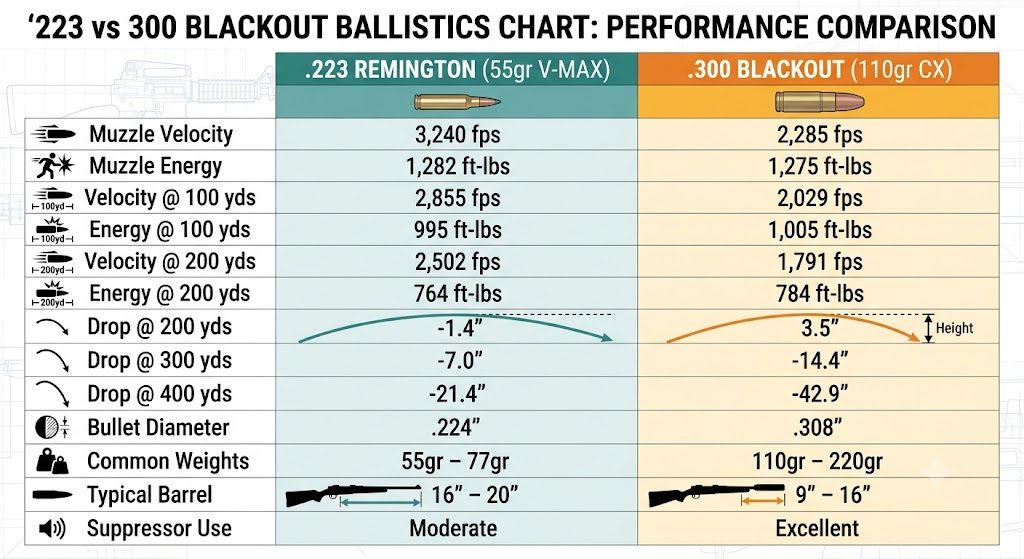
The following table compares standard factory loads: the Hornady Varmint Express .223 Rem (55gr V-MAX) and the Hornady Custom .300 Blackout (110gr CX).
| Specification | .223 Rem (55gr V-MAX) | .300 Blackout (110gr CX) |
| Muzzle Velocity | 3,240 fps | 2,285 fps |
| Muzzle Energy | 1,282 ft-lbs | 1,275 ft-lbs |
| Velocity @ 100 yds | 2,855 fps | 2,029 fps |
| Energy @ 100 yds | 995 ft-lbs | 1,005 ft-lbs |
| Velocity @ 200 yds | 2,502 fps | 1,791 fps |
| Energy @ 200 yds | 764 ft-lbs | 784 ft-lbs |
| Drop @ 200 yds | -1.4″ | 3.5″ |
| Drop @ 300 yds | -7.0″ | -14.4″ |
| Drop @ 400 yds | -21.4″ | -42.9″ |
| Bullet Diameter | .224″ | .308″ |
| Common Weights | 55gr – 77gr | 110gr – 220gr |
| Typical Barrel | 16″ – 20″ | 9″ – 16″ |
| Suppressor Use | Moderate | Excellent |
DETAILED COMPARISON
Muzzle Velocity Comparison
The .223 Remington is substantially faster than the .300 Blackout. With a smaller bullet and higher case capacity relative to the bore, it achieves velocities often exceeding 3,200 fps. This speed is critical for its “flat-shooting” nature, minimizing the need for holdover adjustments at extended ranges. The .300 Blackout, conversely, is built for a heavier projectile; it reaches supersonic speeds between 2,100 and 2,400 fps, which is significantly slower but provides a heavier impact at the target.
Muzzle Energy Comparison
Interestingly, while their velocities differ wildly, the muzzle energy of these two cartridges is often comparable at the muzzle. However, because the .300 Blackout fires a much heavier bullet (110gr to 220gr) compared to the .223 (55gr to 77gr), the .300 Blackout often retains its energy more efficiently at short-to-medium distances. The larger frontal diameter of the .300 Blackout also provides more “frontal area,” which is often credited with improved terminal performance in defensive scenarios.
Bullet Weight and Ballistic Coefficient
The .223 Remington uses light, fast bullets that are highly aerodynamic, providing a high ballistic coefficient for long-range stability. The .300 Blackout uses heavy 30-caliber bullets. While the 110-grain supersonic loads offer decent flight characteristics, the 200+ grain subsonic loads are designed specifically for silence, not distance. This makes the .223 the clear winner for precision shooting, while the .300 Blackout wins in versatility regarding specialized applications.
Trajectory and Drop
The .223 Remington holds a distinct advantage in trajectory. Because of its high velocity, a standard 100-yard zero results in minimal bullet drop out to 300 yards. The .300 Blackout, due to its slower speed and lower ballistic coefficient on typical defensive projectiles, drops significantly faster. At 400 yards, you might see roughly 21 inches of drop for the .223, whereas the .300 Blackout could drop nearly 43 inches, requiring much more experienced range estimation.
FINAL VERDICT
Which Is Better?
- Best for Hunting: The .300 Blackout is excellent for deer and medium game within 150 yards due to the .30-caliber terminal performance. The .223 is better for small game and varmints at longer ranges.
- Best for Home Defense: The .300 Blackout is widely considered the superior choice for home defense, especially in short-barreled rifles, as it maximizes energy within close quarters.
- Best for Suppressed Shooting: The .300 Blackout is the industry leader for suppressed shooting, particularly when using heavy subsonic ammunition.
- Best for Long-Range Shooting: The .223 Remington is vastly superior for target shooting and engagement beyond 300 yards.
- Best Overall Value: The .223 Remington is the most cost-effective and available ammunition for high-volume practice.
FAQ
Can I shoot .300 Blackout in a .223 magazine?
Yes. The .300 Blackout case is derived from the .223 case, meaning they share identical rim dimensions and feed reliably from standard AR-15 magazines.
Why is .300 Blackout more expensive?
It is a more specialized round with lower production volume compared to the massive scale of .223 Remington/5.56 NATO manufacturing.
What is the effective range for .300 Blackout?
Most ballistic experts recommend limiting the .300 Blackout to 300 yards or less for hunting and precision work due to significant bullet drop beyond that distance.
Is .223 dangerous for home defense?
At high velocities, .223 rounds can penetrate multiple layers of drywall, but they are also known for rapid fragmentation, which can reduce the risk of over-penetration depending on the specific load used.