A ballistics chart by caliber is a reference tool that tracks a bullet’s velocity, energy, and trajectory as it travels downrange. Shooters compare calibers to match the precise ballistic performance to their specific application, whether that is ethical big game hunting or precision long-range competition. In this guide, you will find a comprehensive comparison of modern factory loads, explaining exactly how different cartridges perform in the real world.
Ballistics Chart by Caliber – Ballistic Chart Comparison by Caliber
| Caliber | Bullet Weight (gr) | Muzzle Velocity (fps) | Muzzle Energy (ft-lbs) | Velocity @100 yd | Energy @100 yd | Velocity @200 yd | Energy @200 yd | Velocity @300 yd | Energy @300 yd | Approximate Drop @300 yd (100-yard zero) | Effective Hunting Range | Common Game | Typical Recoil |
| .17 HMR | 17 | 2550 | 245 | 1902 | 137 | 1379 | 72 | N/A | N/A | N/A | 150 yds | Varmints | Low |
| .22 LR | 40 | 1070 | 102 | 890 | 70 | N/A | N/A | N/A | N/A | N/A | 75 yds | Small Game | Low |
| .22 WMR | 40 | 1910 | 324 | 1300 | 150 | N/A | N/A | N/A | N/A | N/A | 125 yds | Varmints | Low |
| .223 Remington | 55 | 3240 | 1282 | 2840 | 985 | 2470 | 745 | 2130 | 554 | -7.5 in | 300 yds | Varmints | Low |
| 5.56 NATO | 62 | 3020 | 1255 | 2650 | 965 | 2310 | 735 | 2000 | 550 | -8.0 in | 300 yds | Varmints | Low |
| .243 Winchester | 95 | 3100 | 2027 | 2850 | 1713 | 2610 | 1435 | 2380 | 1195 | -5.5 in | 400 yds | Deer | Low |
| 6mm Creedmoor | 103 | 3050 | 2127 | 2870 | 1883 | 2690 | 1655 | 2520 | 1450 | -5.2 in | 500 yds | Deer | Low |
| 6.5 Creedmoor | 140 | 2710 | 2283 | 2560 | 2037 | 2410 | 1805 | 2270 | 1600 | -7.8 in | 600 yds | Deer / Elk | Medium |
| 6.5 Grendel | 123 | 2580 | 1818 | 2380 | 1547 | 2190 | 1310 | 2010 | 1100 | -9.5 in | 400 yds | Deer | Low |
| 6.8 SPC | 110 | 2550 | 1588 | 2250 | 1236 | 1970 | 948 | 1710 | 714 | -11.0 in | 300 yds | Deer / Hogs | Low |
| .270 Winchester | 130 | 3060 | 2702 | 2820 | 2295 | 2590 | 1935 | 2370 | 1620 | -6.0 in | 500 yds | Deer / Elk | Medium |
| 7mm-08 Remington | 140 | 2860 | 2542 | 2650 | 2182 | 2450 | 1865 | 2260 | 1588 | -7.5 in | 500 yds | Deer / Elk | Medium |
| 7mm Rem Mag | 150 | 3110 | 3221 | 2900 | 2800 | 2700 | 2428 | 2510 | 2100 | -5.5 in | 700 yds | Elk / Moose | High |
| .308 Winchester | 150 | 2820 | 2648 | 2600 | 2251 | 2390 | 1902 | 2190 | 1597 | -8.5 in | 500 yds | Deer / Elk | Medium |
| 30-30 Winchester | 150 | 2390 | 1902 | 2000 | 1332 | 1650 | 906 | 1360 | 616 | -18.0 in | 200 yds | Deer | Medium |
| .30-06 Springfield | 180 | 2700 | 2913 | 2510 | 2517 | 2330 | 2169 | 2150 | 1847 | -8.2 in | 600 yds | Elk / Moose | Medium |
| 300 Win Mag | 180 | 2960 | 3501 | 2770 | 3066 | 2590 | 2680 | 2410 | 2321 | -6.5 in | 800 yds | Elk / Moose | High |
| 300 PRC | 212 | 2860 | 3850 | 2720 | 3482 | 2580 | 3132 | 2450 | 2825 | -6.8 in | 1000 yds | Elk / Moose | High |
| .338 Lapua Mag | 250 | 2860 | 4540 | 2720 | 4106 | 2580 | 3694 | 2450 | 3332 | -6.8 in | 1200 yds | Big Game | High |
| .350 Legend | 170 | 2200 | 1827 | 1850 | 1292 | 1540 | 895 | 1280 | 618 | -22.0 in | 200 yds | Deer | Medium |
| 450 Bushmaster | 250 | 2200 | 2686 | 1840 | 1880 | 1520 | 1282 | 1260 | 881 | -24.0 in | 250 yds | Bear / Elk | High |
| .50 BMG | 750 | 2820 | 13241 | 2710 | 12228 | 2600 | 11252 | 2490 | 10325 | -7.0 in | 1500 yds | Extreme | Very High |
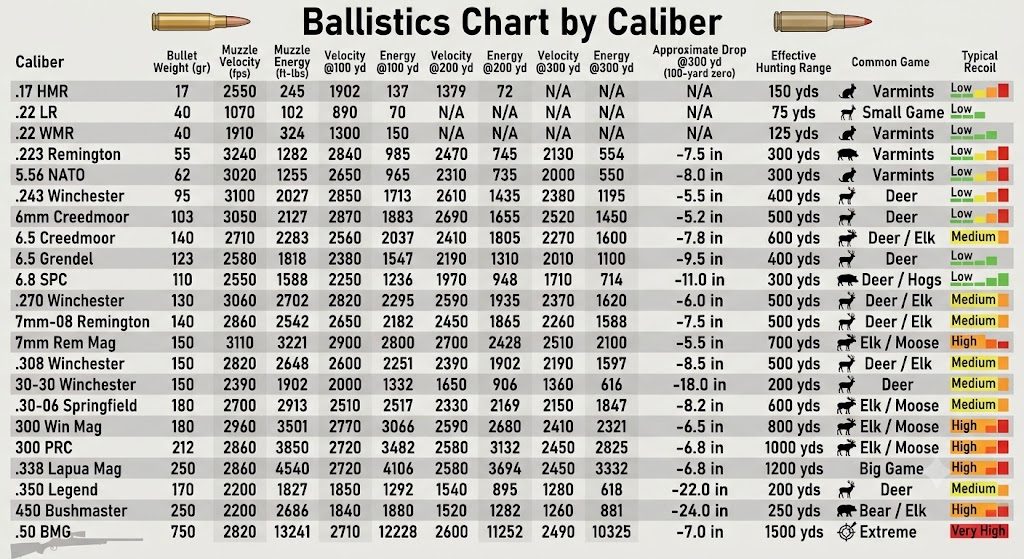
How to Read This Ballistics Chart
Understanding a rifle caliber comparison requires breaking down the individual metrics that dictate performance in the field. The columns provided represent the universal standard for measuring a cartridge’s raw capability.
The Caliber column identifies the specific cartridge. It is crucial to remember that a caliber designation is simply a name; a .308 Winchester and a .30-06 Springfield fire the exact same diameter projectile (.308 inches), but the case capacity and resulting ballistics are entirely different.
Bullet Weight (gr) is measured in grains. There are 7,000 grains in a single pound. Heavier bullets typically carry more energy downrange and resist wind deflection better, but they start at a slower initial velocity. Lighter bullets achieve blistering speeds but shed energy much faster due to lower mass and aerodynamic drag.
Muzzle Velocity (fps) indicates how fast the bullet is traveling in feet per second the exact moment it leaves the barrel. This is the peak speed of the projectile. High muzzle velocity contributes to a flatter trajectory, meaning the shooter does not have to adjust for elevation as drastically at unknown distances.
Muzzle Energy (ft-lbs) is the raw kinetic energy generated by the cartridge, measured in foot-pounds. This is the primary metric for evaluating knockdown power. A higher foot-pound rating translates to more terminal force delivered to the target. However, it is the retained energy at specific distances (100, 200, and 300 yards) that determines a caliber’s actual effective hunting range.
The Approximate Drop @ 300 yd column operates as a fundamental bullet drop chart. Assuming you have zeroed your rifle perfectly at 100 yards, this negative number indicates exactly how many inches the bullet will fall below your line of sight by the time it reaches the 300-yard mark. Gravity affects all bullets equally, but faster bullets reach the target sooner, giving gravity less time to act upon them.
Fastest Rifle Calibers
When analyzing a velocity chart, speed is often the most sought-after metric for varmint hunters and long-range precision shooters alike. Velocity dictates how flat a bullet shoots, effectively expanding the “point blank” range where a shooter can aim dead-center on a target without calculating holdovers.
Cartridges like the .223 Remington and the .243 Winchester dominate the speed categories among standard short-action rifles. A 55-grain .223 Remington easily clears 3,200 fps, making it incredibly flat-shooting out to 300 yards. This speed creates massive hydrostatic shock on impact, which is why lightweight, hyper-fast bullets are exceptionally lethal on coyotes and prairie dogs despite their low overall mass.
The 6mm Creedmoor is another masterclass in velocity, pushing a highly aerodynamic 103-grain bullet over 3,000 fps. This combination of speed and modern bullet design allows it to cheat the wind better than traditional legacy cartridges.
Magnum centerfire cartridges like the 7mm Remington Magnum and 300 Winchester Magnum push heavy hunting projectiles at speeds normally reserved for light varmint bullets. Pushing a 150-grain bullet past 3,100 fps, the 7mm Rem Mag shoots incredibly flat while maintaining enough mass to ethically harvest elk across a canyon. However, these blistering velocities come at the cost of accelerated barrel wear, higher recoil, and the need for premium, heavily constructed bullets that won’t fragment prematurely upon high-speed impact.
Highest Energy Cartridges
Muzzle energy dictates the sheer physical force a projectile delivers. For large, dangerous game, a high-energy cartridge is non-negotiable. Kinetic energy is calculated using a formula where velocity is squared, meaning a small increase in speed can drastically increase energy. However, true deep-penetrating knockdown power requires mass.
The .50 BMG exists in a class of its own, generating over 13,000 ft-lbs of muzzle energy. This is a specialized military and extreme long-range cartridge that is completely unnecessary for standard sporting applications.
For the civilian hunter, the .338 Lapua Magnum and 300 PRC stand at the top of the practical energy spectrum. The .338 Lapua pushes a massive 250-grain bullet to retain over 3,300 ft-lbs of energy at 300 yards—more energy than a traditional .308 Winchester produces right at the muzzle. This makes it a premier choice for engaging thick-skinned game like moose or brown bear at extended distances.
The 300 Winchester Magnum and the classic .30-06 Springfield also represent top-tier energy producers for the everyday hunter. By utilizing a 180-grain bullet, the .30-06 consistently delivers over 2,900 ft-lbs of muzzle energy. More importantly, it retains almost 1,850 ft-lbs at 300 yards. Since ethical hunting standards generally require 1,500 ft-lbs of energy for taking elk, this cements these cartridges as highly capable large-game performers.
Best Calibers for Deer Hunting
Selecting the right round for deer hunting involves balancing manageable recoil with sufficient terminal performance. A whitetail deer is considered thin-skinned, medium-sized game, meaning you do not need magnum levels of energy to ensure a quick, ethical harvest. In fact, standard centerfire cartridges are often vastly superior choices.
The .30-06 Springfield remains the absolute gold standard by which all other hunting calibers are measured. When loaded with a 180-grain projectile, the .30-06 ballistics chart reveals an incredibly versatile performer. It strikes with devastating authority, ensuring deep penetration from any angle, yet remains flat-shooting enough for a 400-yard shot across an open bean field. Its capability to seamlessly drop down to a 150-grain bullet for lighter recoil, or step up to a 220-grain bullet for heavy timber, makes it virtually unmatched in flexibility.
The .243 Winchester is widely regarded as the ultimate low-recoil deer cartridge. By pushing a 95-grain bullet at over 3,000 fps, it delivers fantastic shock value and a flat trajectory. It is the perfect entry-level cartridge for young hunters, yet highly respected by veterans.
The 6.5 Creedmoor and .308 Winchester represent the modern ideal for short-action hunting rifles. The 6.5 Creedmoor uses high sectional density to penetrate deeply despite a relatively modest muzzle velocity of 2,710 fps. The .308 Winchester offers slightly more initial energy and a larger frontal diameter, resulting in excellent blood trails and massive tissue damage at typical woodland hunting distances.
For dense brush and deep woods, the venerable 30-30 Winchester remains a legend. While its blunt-nosed bullets bleed velocity quickly—dropping 18 inches at 300 yards—it shines inside of 100 yards where its 150-grain payload reliably anchors game without destroying excessive meat.
Best Long-Range Calibers
Long-range shooting requires cartridges that can defeat the two greatest enemies of precision: gravity and wind. While velocity fights gravity, it is the Ballistic Coefficient (BC) of the bullet that fights the wind. Long range calibers must utilize long, sleek, heavy-for-caliber bullets that retain their momentum well past the 500-yard line.
The 6.5 Creedmoor was purpose-built from the ground up for this exact application. By firing long, aerodynamic 140-grain bullets at moderate velocities, the cartridge remains supersonic out to 1,200 yards in standard atmospheric conditions. It achieves this with very mild recoil, allowing the shooter to stay in the scope and spot their own impacts.
When the goal is both long-range target shooting and long-range hunting, the 300 Precision Rifle Cartridge (PRC) has redefined the magnum landscape. Traditional magnums like the 300 Win Mag are limited by standard action lengths, forcing long, modern bullets to be seated deeply into the powder column. The 300 PRC was designed with a longer overall chamber throat, allowing massive 212-grain bullets to sit perfectly outside the powder space. This results in incredibly consistent velocities and the ability to maintain over 2,800 ft-lbs of retained energy at 300 yards.
The 7mm Remington Magnum remains a historic giant in this category. A 150-grain 7mm projectile boasts an exceptional ballistic coefficient. Because of this, it shoots flatter than a .308 Winchester and retains energy better than a .270 Winchester, making it a perennial favorite for western hunters pursuing mule deer across vast canyons.
Best Low-Recoil Calibers
Recoil is the enemy of accuracy. Anticipating the physical kick of a rifle causes shooters to flinch, pulling their shots off target. Finding a caliber that performs effectively while remaining soft on the shoulder is essential for beginner training, high-volume target practice, and ethical hunting for those sensitive to recoil.
The .223 Remington is the undisputed king of low-recoil centerfire cartridges. Generating mere fractions of the recoil produced by a standard hunting rifle, it allows shooters to comfortably practice all day. While it is generally considered too small for ethical deer hunting in many jurisdictions, it is the premier choice for predator control and defensive applications.
The 6.5 Grendel offers a fascinating middle ground. Designed to fit within an AR-15 platform, it pushes a 123-grain bullet with excellent aerodynamics. It offers drastically better ballistics than a .223 Remington and carries enough energy to ethically harvest deer out to 300 yards, yet generates only half the recoil of a .308 Winchester.
In regions where straight-wall cartridges are mandated by hunting regulations, the .350 Legend has taken the market by storm. Pushing a 170-grain bullet at 2,200 fps, it delivers more energy than the classic 30-30 Winchester but does so with roughly 20% less recoil. It is an exceptionally mild-shooting cartridge that hits with absolute authority inside of 200 yards, making it the premier choice for midwestern whitetail hunters looking for a shoulder-friendly option.
Factors That Affect Ballistics
Understanding a ballistics chart by caliber requires acknowledging that the numbers printed on an ammunition box are generated in highly controlled laboratory environments using specific test barrels. Real-world performance is dictated by a massive matrix of shifting variables.
Barrel Length
The longer the barrel, the more time the expanding propellant gases have to push the projectile. As a general rule of thumb, centerfire cartridges lose between 20 to 30 fps for every inch of barrel length removed. A .30-06 Springfield factory load that advertises 2,700 fps is likely tested in a 24-inch barrel. If you fire that exact same cartridge through a specialized 18-inch mountain rifle, your actual muzzle velocity will drop significantly, entirely altering your bullet drop chart downrange.
Bullet Weight and Sectional Density
Heavier bullets require more pressure to accelerate, resulting in lower initial muzzle velocities. However, a heavier bullet of the same caliber will have a higher sectional density—a calculation of its weight relative to its diameter. High sectional density translates directly to superior deep-driving penetration on heavy bone and muscle. An 180-grain bullet will consistently out-penetrate a 150-grain bullet of the same design simply due to its momentum and mass.
Bullet Design and Aerodynamics
Not all bullets are created equal. A traditional flat-nosed soft point, like those used in lever-action 30-30s, acts like a parachute in the air. It bleeds velocity rapidly. Conversely, modern bullets utilizing polymer tips and boat-tail rear designs (where the base of the bullet tapers inward) drastically reduce aerodynamic drag. This higher Ballistic Coefficient ensures that the bullet retains its velocity and energy over much longer distances.
Altitude and Air Density
Air resistance physically slows a bullet down. At higher elevations, the air is thinner and less dense. A rifle zeroed at sea level in Florida will exhibit a noticeably flatter trajectory when taken on an elk hunt at 10,000 feet in Colorado. The bullet simply has less atmospheric friction to fight through, meaning it stays supersonic longer and drops less at 500 yards than the charts predict.
Temperature
Temperature affects the burn rate of gunpowder. In extreme cold, powder burns slower, resulting in a measurable loss of muzzle velocity. A load that functions perfectly at 80 degrees Fahrenheit might suddenly drop 2 inches lower than expected at 300 yards when fired in sub-zero hunting conditions. Modern, temperature-stable powders have mitigated this, but it remains a critical factor for precision shooters.
Ammunition Manufacturer
Finally, factory ammunition varies wildly between brands. The exact same 180-grain caliber will perform differently depending on the engineering behind the brass, primer, and proprietary powder blends. Brands like Hornady often push the envelope with advanced, high-BC match projectiles like their ELD-X lines, optimizing for extreme long-range data. Federal Premium frequently focuses on terminal bonded performance with lines like Terminal Ascent, heavily prioritizing weight retention upon impact. Remington’s legendary Core-Lokt remains a trusted standard for traditional soft-point expansion, while Winchester Ammunition consistently produces highly reliable, hard-hitting velocities across their hunting tiers. Because of this, shooters must test multiple specific loads from different manufacturers in their own rifles to verify exactly how their personal setup matches the established ballistics chart.