A 12 Gauge Slug Trajectory Chart is a critical ballistic reference tool that visually displays the rapid bullet drop and performance characteristics of shotgun slugs across various downrange distances. Unlike high-velocity rifle cartridges, 12 gauge slugs are massive, relatively un-aerodynamic projectiles that rely on heavy mass and kinetic energy rather than speed to anchor big game. By diligently studying these ballistic values, hunters using smoothbore or rifled barrels can master their firearm’s flight path, calculate necessary holdovers, and confidently ensure ethical shot placement on large animals. Reviewing this comprehensive trajectory data guarantees you will fully understand the effective range limitations and real-world performance of your preferred slug load.
Table of Contents [Click to open]
12 Gauge Slug Trajectory Chart
| Manufacturer | Slug Type | Weight | Muzzle Velocity | 25 Yard Drop | 50 Yard Drop | 75 Yard Drop | 100 Yard Drop | 125 Yard Drop | 150 Yard Drop | Recommended Zero | Max Point Blank |
|---|---|---|---|---|---|---|---|---|---|---|---|
| Hornady | SST Sabot | 300 Grain | 2000 FPS | +1.2 | +2.0 | +1.0 | Zero | -3.2 | -8.5 | 100 Yards | 120 Yards |
| Remington | AccuTip Sabot | 385 Grain | 1900 FPS | +1.3 | +2.1 | +1.1 | Zero | -3.5 | -9.0 | 100 Yards | 115 Yards |
| Federal | Trophy Copper Sabot | 300 Grain | 1900 FPS | +1.3 | +2.1 | +1.1 | Zero | -3.5 | -9.2 | 100 Yards | 115 Yards |
| Winchester | Partition Gold Sabot | 385 Grain | 1900 FPS | +1.3 | +2.1 | +1.1 | Zero | -3.5 | -9.0 | 100 Yards | 115 Yards |
| Brenneke | Black Magic Mag | 600 Grain | 1476 FPS | +1.8 | Zero | -4.5 | -12.5 | -25.0 | -42.0 | 50 Yards | 65 Yards |
| Federal | TruBall Rifled | 438 Grain | 1600 FPS | +1.5 | Zero | -5.5 | -15.0 | -30.0 | -50.0 | 50 Yards | 60 Yards |
| Remington | Slugger Rifled | 438 Grain | 1560 FPS | +1.6 | Zero | -6.0 | -16.5 | -32.0 | -55.0 | 50 Yards | 55 Yards |
| Hornady | American Whitetail | 438 Grain | 1600 FPS | +1.5 | Zero | -5.5 | -15.0 | -30.0 | -50.0 | 50 Yards | 60 Yards |
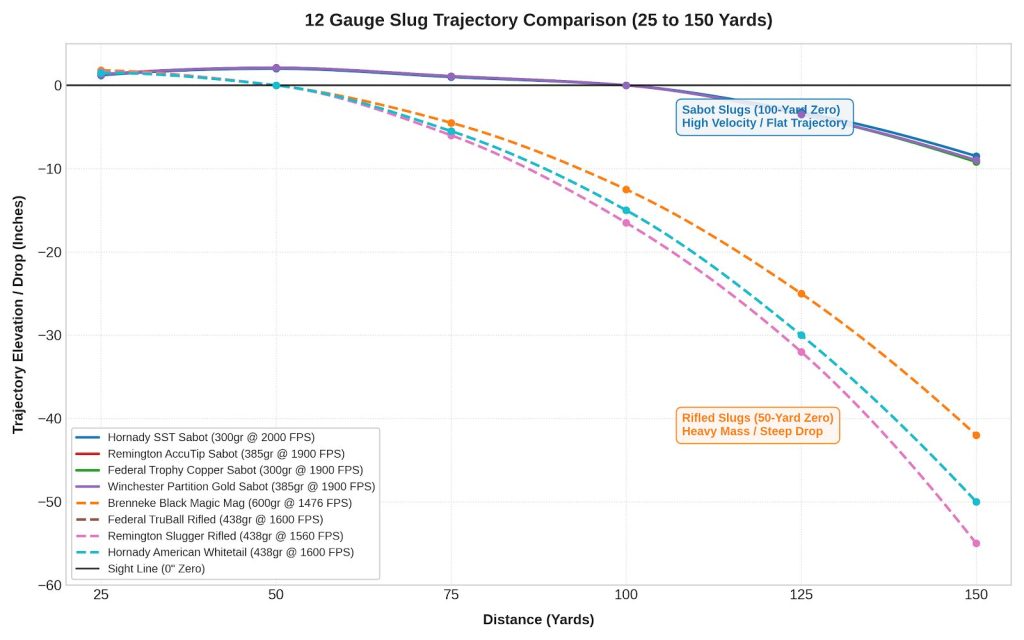
This professional trajectory chart provides shotgun hunters with precise slug drop measurements so they can accurately compensate for the rapid ballistic decline typical of heavy shotgun projectiles. Always verify your specific slug load at the range, as barrel type (rifled versus smoothbore) and choke selection will significantly influence actual downrange performance.
Understanding The 12 Gauge Slug Trajectory Chart
The data provided in our ballistic chart is essential for any hunter carrying a 12 gauge, as shotgun slugs operate on an entirely different flight profile than rifle cartridges. By analyzing these statistics, you can master your shotgun’s capabilities and understand the real-world limitations of your ammunition.
Trajectory Analysis
Bullet drop for 12 gauge slugs is extreme compared to rifle calibers because these projectiles are heavy and aerodynamically inefficient. Our chart measures this vertical drop in inches to help you calculate aiming adjustments in the field.
The table reveals two very different profiles: Sabot slugs fired from rifled barrels and traditional rifled slugs fired from smoothbore barrels. Sabot slugs, like the Hornady SST, are designed for long-range accuracy and perform well out to 125 yards with minimal drop.
In contrast, traditional rifled slugs lose speed and drop dramatically past the 50-yard mark. The Remington Slugger drops over 15 inches at 100 yards, which is why smoothbore shotgun hunters rarely attempt shots at game beyond 75 yards.
This massive difference illustrates why you must never assume your shotgun will perform like a rifle. Understanding this trajectory arc ensures you know exactly when a target is within your ethical hunting range and when you should pass on a shot.
Velocity Analysis
Muzzle velocity for 12 gauge slugs generally falls between 1,400 and 2,000 feet per second. While these numbers might seem high, the heavy weight of the projectile means they shed speed much faster than lighter rifle bullets.
High-performance sabot slugs leave the barrel at speeds near 2,000 FPS, which flattens the flight path significantly. This velocity is the primary reason why modern sabot-slug/rifled-barrel combinations can achieve rifle-like performance out to 150 yards.
Traditional rifled slugs move at lower velocities, typically 1,500 to 1,600 FPS. Because they are slower and less aerodynamic, they are effectively limited to close-range hunting where the massive impact energy of the 438-grain projectile can still do its work.
Ballistic Coefficient Analysis
The ballistic coefficient (BC) of a 12 gauge slug is generally very low because these bullets are large, heavy, and often blunt. Low BC numbers indicate a projectile that struggles to cut through air, leading to a rapid loss of velocity.
Modern sabot slugs are the exception, designed with polymer tips and sleek profiles to improve their BC. A slug like the Hornady SST features a BC much higher than traditional rifled slugs, allowing it to maintain energy and trajectory much better at 100+ yards.
Because of this poor overall aerodynamics, most slugs lose their effective kinetic energy for large game past 150 yards, even if they remain lethal. This is the primary reason why the effective range of a 12 gauge slug is strictly limited compared to high-power rifle calibers.
Best Hunting Loads Based On The Chart
Whitetail deer hunters using rifled-barrel shotguns should rely on the Hornady SST Sabot. Its superior trajectory and expansion characteristics make it the gold standard for shots out to 125 yards, providing accuracy that rivals many centerfire rifles.
For hunters using traditional smoothbore shotguns, the Federal TruBall is an excellent choice. It provides the best possible accuracy for a smoothbore system and is devastatingly effective on deer-sized game within its 60-75 yard effective range.
Large game hunters needing absolute maximum energy transfer at close range should choose the heavy Brenneke Black Magic. While it has a steeper trajectory, the sheer power of this 600-grain slug is unmatched for anchoring game in dense, tight timber.
Key Takeaways From The Chart
The recommended zero distance is the foundation of your shooting. For sabot slugs, a 100-yard zero is optimal, as it provides a manageable flight path. For traditional rifled slugs, a 50-yard zero is the standard to account for their rapid vertical drop.
Maximum point-blank range is quite short for all shotgun slugs. Sabot loads provide a point-blank range of roughly 120 yards, while rifled slugs are usually limited to 60 yards. Staying within this range ensures you don’t have to guess the bullet drop.
By properly matching your specific slug to its corresponding zero distance shown in the chart, you maximize your hunting capabilities. You will avoid the frustration of missed shots and ensure every pull of the trigger is calculated and ethical.
Common 12 Gauge Slug Types
Sabot Slugs
Sabot slugs consist of a smaller, high-performance projectile housed inside a plastic “sabot” that falls away upon exiting the barrel. These are designed strictly for use in rifled shotgun barrels.
The advantage is incredible long-range accuracy and trajectory. They act essentially like a large rifle bullet, allowing for consistent shots on game at 100–150 yards.
The disadvantage is that they require a rifled barrel to be accurate; they will perform poorly in a smoothbore shotgun. They are also generally more expensive than traditional rifled slugs.
Rifled Slugs
Also known as “Brenneke” or “Foster” style slugs, these are designed with grooves in the lead projectile to induce spin in smoothbore barrels.
The advantage is their compatibility with nearly every shotgun on the market. They are affordable and offer tremendous stopping power on game at close ranges.
The disadvantage is their rapid velocity loss and accuracy limitations. They are generally ineffective past 75 yards, making them unsuitable for wide-open fields.
Effective Hunting Range
Deer
Using a rifled-barrel shotgun with sabot slugs, you can ethically harvest deer out to 125 yards. The key is knowing your slug’s drop at 100 and 125 yards, as the bullet fall becomes noticeable at these distances.
Small Game/Hogs
For hogs or smaller deer in brush, smoothbore shotguns with rifled slugs are perfect within 60-75 yards. At this distance, you don’t need to worry about trajectory—just put the sight on the vitals and shoot.
Factors That Affect Slug Trajectory
- Barrel Type: Rifled barrels provide the spin necessary for sabots to fly straight. Smoothbore barrels require rifled slugs to achieve any semblance of accuracy.
- Velocity: Higher velocity reduces the time of flight, which minimizes the effect of gravity, leading to a flatter trajectory.
- BC: Sleeker, polymer-tipped slugs have higher BCs, retaining velocity and trajectory much better than lead-nosed slugs.
- Zero Distance: A 100-yard zero is ideal for sabot users; a 50-yard zero is better for those using traditional rifled slugs.
Frequently Asked Questions
What Is A 12 Gauge Slug Trajectory Chart
It is a reference table showing how much a slug drops at distance, allowing you to estimate your holdover for a clean shot.
What Is The Maximum Effective Range Of A 12 Gauge Slug
Sabot slugs are effective to 125–150 yards; rifled slugs are generally limited to 75 yards.
How Much Does A Slug Drop At 100 Yards
Depending on the load, sabot slugs may have zero drop at 100 yards, while traditional rifled slugs can drop 15 inches or more.
Is The 12 Gauge Slug Better Than A Rifle
The 12 gauge slug is inferior to a rifle for long-range accuracy but often superior for stopping power on large game in dense brush.
What Is The Best Zero For Shotgun Slugs
100 yards for sabot slugs and 50 yards for rifled slugs.
Does Barrel Length Affect Slug Ballistics
Yes, longer barrels help achieve the full advertised muzzle velocity of the slug, providing a slightly flatter trajectory.
What Is The Best Slug Hunting Load
The Hornady SST is the top choice for long-range sabot hunting, and Federal TruBall is great for general smoothbore use.
Can You Shoot Slugs Through A Choke
You can shoot slugs through most chokes, but improved cylinder or cylinder chokes are generally recommended for the best accuracy.
One follow-up question: Are you using a rifled barrel or a traditional smoothbore shotgun for your hunting setup?