A Bullet Ballistic Coefficient Chart is an essential numerical reference tool that measures and displays exactly how efficiently different projectiles slice through atmospheric resistance during flight. This highly specialized data matrix allows precision marksmen and long range hunters to directly compare the aerodynamic performance of various bullet designs across multiple popular calibers. By evaluating these specific aerodynamic ratings shooters can accurately calculate precise optical holdovers predict lateral wind deflection and guarantee superior terminal velocity at extended distances. Utilizing this comprehensive aerodynamic data ensures supreme accuracy and absolute maximum momentum retention when pushing modern rifle platforms to their physical limits.
Table of Contents [Click to minimize]
Bullet Ballistic Coefficient Chart
| Caliber | Manufacturer | Bullet Weight | Bullet Name | Bullet Type | G1 Ballistic Coefficient | G7 Ballistic Coefficient | Sectional Density |
| 224 Caliber | Hornady | 88 gr | ELD Match | Polymer Tipped Boat Tail | 0.545 | 0.274 | 0.251 |
| 6.5 Millimeter | Hornady | 143 gr | ELD X | Polymer Tipped Boat Tail | 0.625 | 0.315 | 0.293 |
| 6.5 Millimeter | Berger | 140 gr | Hybrid Target | Open Tip Match | 0.607 | 0.311 | 0.287 |
| 270 Caliber | Nosler | 150 gr | AccuBond Long Range | Polymer Tipped Boat Tail | 0.591 | 0.293 | 0.279 |
| 7 Millimeter | Barnes | 145 gr | LRX | Monolithic Copper | 0.486 | 0.245 | 0.257 |
| 7 Millimeter | Sierra | 183 gr | MatchKing | Hollow Point Boat Tail | 0.707 | 0.346 | 0.324 |
| 30 Caliber | Sierra | 175 gr | MatchKing | Hollow Point Boat Tail | 0.505 | 0.243 | 0.264 |
| 30 Caliber | Hornady | 212 gr | ELD X | Polymer Tipped Boat Tail | 0.673 | 0.336 | 0.319 |
| 338 Caliber | Lapua | 300 gr | Scenar | Hollow Point Boat Tail | 0.736 | 0.368 | 0.375 |
| 338 Caliber | Berger | 300 gr | Hybrid OTM | Open Tip Match | 0.818 | 0.419 | 0.375 |
Reviewing this comprehensive table illustrates exactly how differences in physical length bullet mass and modern aerodynamic design dictate the overall flight efficiency of premium projectiles.
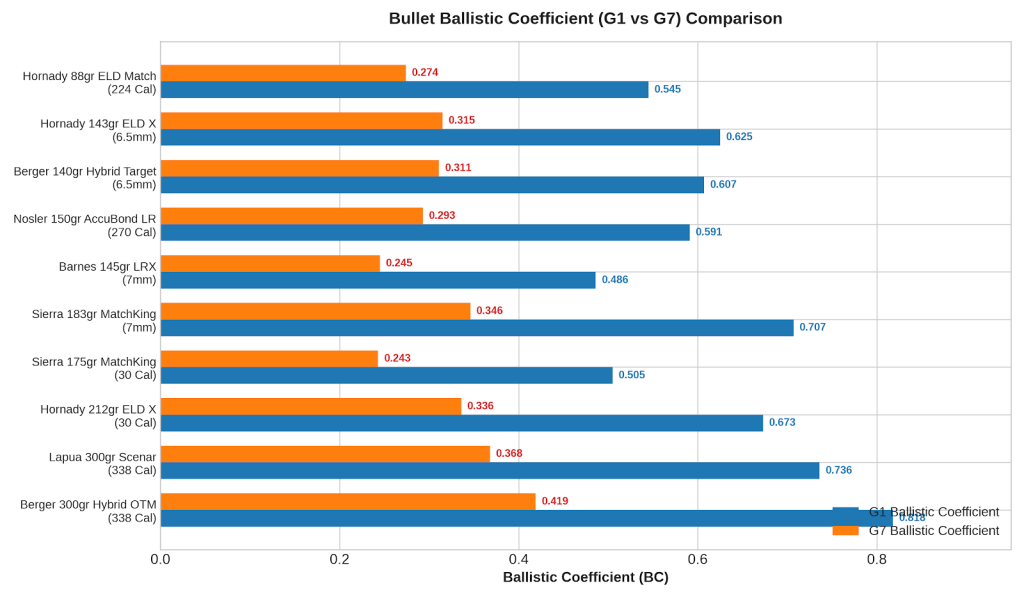
Understanding The Bullet Ballistic Coefficient Chart
Evaluating the provided data reveals that minor variations in bullet shape and massive changes in overall weight create incredible differences in downrange aerodynamic authority.
Every specific observation perfectly demonstrates why selecting a projectile with the correct aerodynamic profile remains absolutely essential for extreme long range shooting success.
G1 Versus G7 Ballistic Coefficient
The chart lists two entirely different drag models used to calculate how a bullet flies through the open atmosphere over long distances.
The G1 standard relies on an older flat base bullet shape that poorly represents modern sleek long range rifle projectiles.
The G7 standard utilizes a modern sleek boat tail profile which perfectly matches the advanced projectiles typically used by precision marksmen today.
Shooters must completely understand that comparing a G1 rating to a G7 rating is mathematically incorrect and will result in massive calculation errors.
Modern ballistic solvers heavily favor the G7 aerodynamic rating because it provides a much more consistent mathematical curve across varied velocity bands.
Velocity Retention Analysis
Evaluating the aerodynamic metrics within the table shows that bullets with massive numbers retain their initial muzzle velocity far better than lower rated options.
The Berger 338 caliber 300 grain Hybrid OTM features an absolutely massive G1 rating of 0.818 giving it a tremendous advantage over wide open spaces.
This exceptional aerodynamic rating allows the massive heavy projectile to easily slice through dense air and maintain supersonic flight well past one mile.
In stark contrast the Barnes 7 millimeter 145 grain LRX utilizes a monolithic copper design resulting in a much lower G1 rating of 0.486.
This specific data proves that for extended long range shooting aerodynamically superior projectiles preserve their forward momentum entirely better than lighter traditional designs.
Energy Retention Analysis
Muzzle energy dictates the sheer physical shock delivered to a heavy target but aerodynamic efficiency dictates how much energy actually survives the flight.
The table data highlights that the Hornady 30 caliber 212 grain ELD X features an incredibly high G1 rating of 0.673.
This impressive rating ensures that the heavy hunting bullet slices through the air cleanly carrying massive kinetic energy directly to the distant target.
Downrange energy retention is where high ballistic coefficient bullets truly separate themselves from standard lightweight hunting ammunition across vast open terrain.
Lighter bullets with poor aerodynamic shapes bleed off their kinetic energy incredibly fast arriving at the target with very little terminal stopping power.
High aerodynamic ratings guarantee that heavy bullets maintain enough physical momentum to crush thick bones and ethically harvest heavy game animals at extended distances.
Wind Drift Resistance
Lateral wind deflection is the absolute most difficult atmospheric variable that precision shooters must calculate during extreme long range engagements.
Reviewing the chart demonstrates that bullets featuring the highest aerodynamic ratings are mathematically the least affected by harsh sweeping crosswinds.
The Sierra 7 millimeter 183 grain MatchKing holds an incredibly high G1 rating of 0.707 which allows it to absolutely cheat the wind.
When a harsh crosswind strikes a bullet with a low aerodynamic rating the projectile is blown several feet entirely off the intended target path.
Practical estimations using these chart values indicate that shooters using incredibly sleek modern bullets require significantly less optical windage dialing than those utilizing older blunt designs.
Trajectory And Bullet Drop
Analyzing the mathematical relationship between aerodynamic efficiency and bullet trajectory clearly demonstrates how flat modern cartridges can shoot across open terrain.
A high aerodynamic rating ensures that the bullet loses forward velocity very slowly which keeps it flying perfectly flat over long distances.
The Hornady 6.5 millimeter 143 grain ELD X exhibits a phenomenal G1 rating of 0.625 allowing it to fly with a remarkably flat gravitational curve.
As distance increases beyond five hundred yards projectiles featuring low aerodynamic ratings begin to fall out of the sky rapidly due to massive air drag.
Shooters must completely understand that investing in highly aerodynamic bullets effectively extends the point blank ethical range of their chosen rifle platform.
Sectional Density Analysis
Sectional density directly influences how stable a hunting bullet remains during flight and how deeply it penetrates thick muscle and bone upon physical arrival.
The chart confirms that the Lapua 338 caliber 300 grain Scenar possesses the absolute highest sectional density rating of 0.375.
The incredibly light Hornady 224 caliber 88 grain option exhibits a noticeably lower sectional density value of just 0.251.
A higher sectional density means the bullet concentrates its massive physical weight over a relatively small cross sectional area forcing it incredibly deep into the vital cavity.
This specific data confirms that high sectional density directly contributes to allowing designers to craft longer and more aerodynamic shapes.
Best Bullets Based On The Chart
For Extreme Long Range Target Shooting the Berger 338 caliber 300 grain Hybrid OTM is the absolute best choice due to its massive aerodynamic dominance.
For Precision Long Range Hunting the Hornady 30 caliber 212 grain ELD X provides perfectly balanced expansion alongside a remarkably high flight rating.
If Maximum Wind Deflection Resistance is your primary goal the Sierra 7 millimeter 183 grain MatchKing takes the absolute top spot for medium calibers.
When seeking an optimal balance of low recoil and high aerodynamic efficiency the Hornady 6.5 millimeter 143 grain ELD X wins easily.
For General Purpose Target Shooting the Sierra 30 caliber 175 grain MatchKing offers incredibly reliable accuracy and highly proven historic performance metrics.
Key Takeaways From The Chart
The highest G1 rating in the entire chart belongs to the Berger 338 caliber 300 grain Hybrid OTM at an astonishing 0.818.
The highest G7 rating is also proudly held by the Berger 338 caliber 300 grain Hybrid OTM at 0.419.
The most aerodynamically efficient medium hunting bullet listed is the Hornady 30 caliber 212 grain ELD X at 0.673.
The absolute highest sectional density listed is completely tied between the Lapua and Berger 338 caliber bullets at 0.375.
The best overall extreme long range performer based on combined aerodynamic efficiency and wind cheating metrics is the Berger 338 caliber 300 grain Hybrid OTM.
Common Bullet Calibers And Their Ballistic Coefficients
The specialized internal case capacity of different modern cartridges allows them to push specifically optimized bullet shapes tailored for distinct tactical roles.
22 Caliber Options
The 22 caliber projectile group is historically known for lightweight varmint bullets that completely lack any serious aerodynamic efficiency.
However modern advancements have produced heavy variants like the 88 grain ELD Match which boasts an incredibly respectable G1 rating of 0.545.
The primary advantage of these heavy 22 caliber options is their ability to fly surprisingly flat while producing absolutely zero felt recoil for the shooter.
The main disadvantage is that these specific bullets require incredibly fast barrel twist rates to completely stabilize their massive overall length during flight.
This specific caliber weight is best applied in general target practice and precision rifle series competitions where spotting your own impacts is totally required.
6.5 Millimeter Options
The 6.5 millimeter projectile represents the absolute gold standard sweet spot for perfectly balanced aerodynamic efficiency and manageable recoil.
Typical modern bullets in this caliber easily reach G1 ratings exceeding 0.600 which previously required firing massive heavy magnum hunting cartridges.
The single biggest advantage of this caliber is its incredibly long sleek profile which effortlessly slices through dense atmospheric resistance across open canyons.
The primary disadvantage is that these specific bullets lack the extreme physical mass required to punch through heavy brush without deflecting entirely off course.
This caliber is the ultimate choice for marksmen carrying a precision bolt action rifle into the high country for versatile open plain harvesting.
7 Millimeter Options
The 7 millimeter bullet group represents a massive step up in physical weight while preserving absolutely unmatched aerodynamic flight characteristics.
Typical heavy match bullets like the 183 grain MatchKing feature mind blowing G1 ratings exceeding 0.700 which totally dominates long range wind drift.
The advantage of the 7 millimeter family is its unmatched ability to deliver magnum terminal energy while maintaining a laser flat mid range trajectory.
The main disadvantage is that utilizing these incredibly heavy aerodynamic bullets requires a long action magnum receiver to properly seat the massive projectiles.
This extreme caliber is universally recommended for pursuing large tough animals across wide open fields where deep reliable penetration is absolutely essential.
30 Caliber Options
The 30 caliber bullet represents the absolute historical global standard for pursuing large game across the entire North American continent.
Typical aerodynamic ratings vary wildly depending on the bullet design with traditional hunting soft points scoring incredibly low compared to modern polymer tipped variants.
The major benefit of the modern heavy 30 caliber bullets is that they provide massive kinetic energy transfer alongside excellent G1 ratings approaching 0.675.
The disadvantage is the noticeably steeper initial trajectory arc when compared to the hyper fast sleek 6.5 millimeter target options.
This heavyweight class is universally recommended for dedicated big game hunters pursuing massive bull elk where extreme knockdown power supersedes raw aerodynamic perfection.
338 Caliber Options
The 338 caliber projectile represents the absolute pinnacle of extreme long range target domination and heavy tactical military applications.
Typical heavy match projectiles in this massive caliber easily eclipse the 0.800 G1 rating making them the undisputed kings of long range flight.
The massive advantage is unmatched aerodynamic efficiency allowing the bullet to completely ignore crosswinds that would easily blow smaller calibers off target.
The main disadvantage is the incredibly punishing recoil which requires extreme physical strength and heavy specialized rifle platforms to control effectively.
This extreme weight is strictly reserved for ringing steel targets at distances exceeding one mile where absolute maximum velocity retention is entirely mandatory.
Factors That Affect Ballistic Coefficient
External environmental variables and internal physical bullet attributes combine to shape exactly how efficiently a projectile slices through the air.
Bullet Shape And Profile
The physical exterior design of the projectile nose whether it is a blunt round nose or a sleek sharp ogive heavily affects aerodynamic performance.
Blunt hunting bullets catch massive amounts of air creating an enormous pressure wave that dramatically slows the bullet down immediately after leaving the muzzle.
Sleek pointed bullets feature an incredibly smooth secant or tangent ogive allowing them to punch straight through the air with absolutely minimal drag.
Boat Tail Design
The rear base design of the bullet dictates how smoothly the disturbed air closes back together after the projectile physically passes through it.
A standard flat base bullet creates a massive vacuum of low pressure air behind it which physically pulls the bullet backward and slows it down.
A tapered boat tail design allows the air to seamlessly flow back together eliminating the massive rear vacuum and greatly increasing the overall aerodynamic rating.
Bullet Weight And Length
Bullet weight and overall physical length dictate the core mathematical foundation of how well a projectile retains its forward momentum over open ground.
Lighter short bullets simply lack the physical mass required to force their way through heavy dense atmospheric drag over extended long ranges.
Heavier elongated bullets contain massive amounts of physical inertia allowing them to maintain their velocity incredibly well and resulting in much higher aerodynamic scores.
Polymer Tips
The addition of a sharply pointed polymer tip absolutely transforms the aerodynamic efficiency of traditional hollow point target bullets and expanding hunting projectiles.
Open hollow point cavities catch tiny amounts of air during flight which creates microscopic turbulence and slightly reduces the overall flight rating.
A polymer tip completely seals this cavity creating an absolutely perfect aerodynamic point that resists melting under extreme aerodynamic friction heat.
Center Of Gravity
The internal weight distribution of the projectile determines exactly how stable the bullet remains while spinning rapidly through the dense atmosphere.
A perfectly balanced center of gravity ensures that the nose of the bullet points absolutely forward into the wind without wobbling off axis.
Any microscopic wobble during flight drastically increases the frontal surface area exposed to the wind completely destroying the calculated aerodynamic rating.
Velocity Dependency
The aerodynamic efficiency of a bullet is not a static constant number because atmospheric drag changes violently depending on the exact speed of the projectile.
When a bullet transitions from supersonic speed down to subsonic speed the atmospheric pressure wave collapses creating massive chaotic turbulence.
Modern G7 ratings are generally considered much more stable across varied velocity bands making them far superior for extreme long range mathematical calculations.
Atmospheric Density
High altitude mountain environments feature incredibly thin air which drastically reduces the physical drag forces acting against a flying bullet.
While atmospheric density does not change the physical bullet shape it drastically alters how the bullet utilizes its inherent aerodynamic rating in the real world.
Shooters operating in elevated mountain ranges will notice significantly flatter overall pathways and much higher retained velocities than those shooting near sea level.
Twist Rate Stability
The rifle barrel twist rate plays a highly critical role in determining if the heavy bullet spins fast enough to completely stabilize in the air.
If an incredibly long aerodynamic bullet is fired from a slow twist barrel it will wobble violently and tumble completely out of control.
An unstabilized bullet exposes its massive side profile to the oncoming wind instantly ruining its aerodynamic rating and guaranteeing a missed target.
How Ballistic Coefficient Influences Effective Range
Understanding the realistic limits of various projectiles helps precision shooters select the absolutely perfect aerodynamic profiles for their specific field goals.
Target Shooting
For standard large scale paper targets the effective range easily spans from one hundred yards out to well over one thousand yards using high efficiency ammunition.
At these extended distances heavy sleek projectiles remain comfortably supersonic keeping their flight paths entirely predictable through wildly varying atmospheric conditions.
Professional shooters highly recommend utilizing the absolute highest rated bullets available to guarantee maximum consistency when shooting across wide open mountain valleys.
Extreme Long Range Shooting
When participating in extreme long range shooting activities marksmen often push their massive magnum platforms well past fifteen hundred yards.
Achieving success at this extremely distant marker requires premium heavy match ammunition featuring G1 ratings exceeding 0.700 to ensure the bullet resists total destabilization.
Firing bullets with poor aerodynamic ratings at these distances is absolutely pointless because the wind will blow them completely off the intended target range.
Hunting Applications
Many of the premium hunting cartridges represented in a standard ballistic chart serve as primary platforms for engaging heavy animals at extended distances.
The aerodynamic properties of these rounds offer a perfect balance of manageable trajectory weapon durability and absolute high lethality in open hunting zones.
Modern hunting loads are specifically designed to ensure hunters can accurately deliver supersonic expanding hits completely ignoring complex environmental variables across vast canyons.
Tactical Applications
Military snipers universally rely on high aerodynamic ratings to ensure their projectiles hit specific targets without requiring impossible optical holdover calculations.
At extreme tactical distances the high ballistic coefficient of modern polymer tipped match ammunition allows veteran shooters to achieve incredible accuracy flawlessly.
Firing heavy calibers with massive aerodynamic efficiency guarantees that the projectile arrives with enough retained energy to completely penetrate heavy battlefield barriers.
Ballistic Coefficient Compared To Sectional Density
To understand exactly how these two vital metrics differ it helps to directly compare their mathematical definitions and practical physical applications.
| Metric Type | Primary Function | Flight Influence | Terminal Influence | Calculation Basis | Importance Level |
| Ballistic Coefficient | Aerodynamic Efficiency | Massive Drop Reduction | Minimal Expansion Effect | Shape Weight And Drag | Critical For Long Range |
| Sectional Density | Physical Mass Distribution | Minimal Flight Impact | Massive Penetration Depth | Weight And Diameter | Critical For Big Game |
The major difference shown above is that while modern specialized aerodynamic ratings completely dominate external flight path calculations sectional density dictates internal terminal performance. A bullet requires incredible aerodynamic efficiency to reach the distant target but it absolutely must possess high sectional density to punch through thick animal shoulders. When compared together standard hunting bullets require a perfect harmonious balance of both metrics to ensure they fly straight and hit with massive devastating power.
Frequently Asked Questions
What exactly does the term ballistic coefficient mean in simple terms?
It is a specific mathematical numerical value representing exactly how efficiently a bullet slices through the dense air and resists atmospheric drag during its flight.
Why is the G7 drag model considered superior to the older G1 model?
The G7 model is based entirely on a modern sleek boat tail bullet design which perfectly matches the aerodynamic profile of modern long range precision rifle projectiles.
Does a heavier bullet always have a higher aerodynamic rating than a lighter bullet?
Not necessarily because an extremely heavy bullet with a flat blunt nose will perform significantly worse than a slightly lighter bullet featuring a sleek aerodynamic polymer tip.
How does wind directly affect bullets with poor aerodynamic ratings?
Bullets with low ratings experience massive atmospheric drag causing them to slow down rapidly and allowing sweeping crosswinds to blow them entirely off their intended target path.
Do I absolutely need an incredibly high rating for shooting deer at one hundred yards?
No because at extremely close ranges the atmospheric drag has almost zero time to physically affect the bullet making traditional blunt soft point bullets perfectly acceptable for deep woods hunting.
Can I completely trust the aerodynamic data printed on an ammunition box?
Factory printed data provides an excellent baseline estimate but actual real world environmental conditions and specific rifle barrel variations require shooters to physically verify their exact drops.
Why do military snipers strictly prefer bullets with massive aerodynamic efficiency?
High efficiency ratings ensure the heavy sniper bullet hits the target with perfectly flat trajectories and minimal wind drift which absolutely guarantees highly ethical and precise surgical strikes.
Does the exact speed of my ammunition change the aerodynamic rating numbers significantly?
Yes extremely fast ammunition generates much different drag profiles across various speed transitions meaning the efficiency rating mathematically changes slightly as the bullet physically slows down.
How often do ammunition manufacturers update their published aerodynamic flight ratings?
Manufacturers completely update their specific technical ratings whenever they utilize advanced Doppler radar testing to discover far more accurate mathematical flight models for their premium projectiles.
What is the absolute most important factor when choosing a bullet for extreme long range?
Shooters must perfectly balance an exceptionally high aerodynamic rating with a heavy bullet mass to guarantee the projectile entirely ignores shifting crosswinds across massive wide open valleys.