50 Yard Zero Target: Chart & 10,25,100+ Yards Data

The 50-yard zero provides an incredibly reliable trajectory for AR-15 rifles, minimizing the need to calculate holdovers at common distances. By keeping the bullet’s flight path remarkably flat out to 200 yards, it ensures fast and accurate center-mass hits. This comprehensive guide covers ballistic charts, close-range offsets, and MRAD targeting principles.

50 Yard Zero Target

  • Setting your optic to zero at 50 yards means the bullet path perfectly intersects your crosshairs at that exact distance.
  • Shooters frequently refer to this as a 50/200 yard zero, given that the projectile typically crosses the line of sight again near 200 yards.
  • This specific setup guarantees that your round will not deviate more than roughly two inches above or below your aiming point across standard combat ranges.
  • It eliminates the need to dial turrets or memorize complex holdovers for targets inside of 200 yards.
  • Many law enforcement agencies and civilian defenders rely on this trajectory for its simplicity in high-stress situations.
See also  6.8 SPC Ballistics Chart

50 Yard Zero Chart

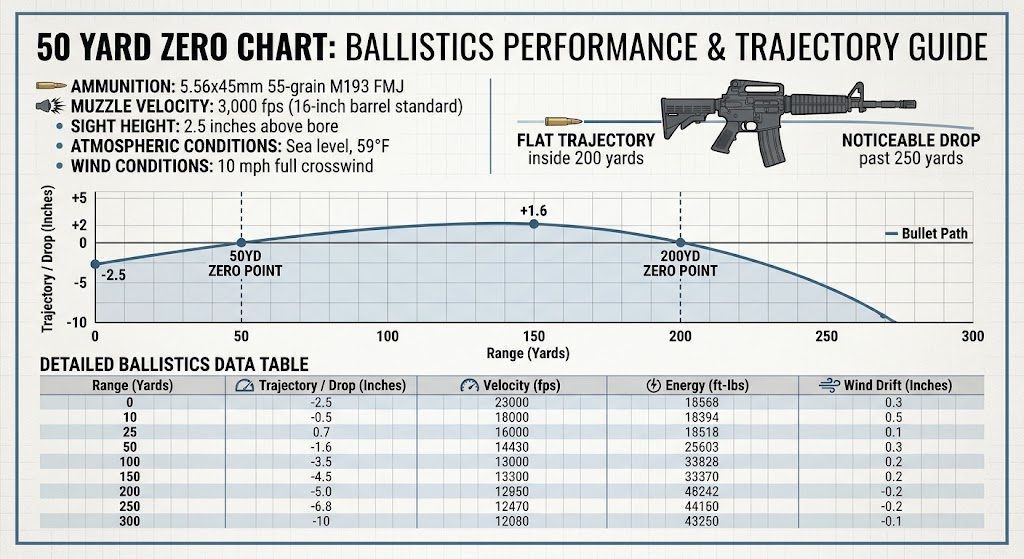
  • The data table below breaks down the exact flight path, speed, and energy retention of a 5.56mm bullet using a 50-yard zero.
  • It clearly demonstrates how the projectile stays remarkably close to the line of sight before dropping rapidly past 250 yards.
  • Ammunition: 5.56x45mm 55-grain M193 FMJ
  • Muzzle Velocity: 3,000 fps (16-inch barrel average)
  • Sight Height: 2.5 inches above the bore
  • Atmospheric Conditions: Sea level, 59°F
  • Wind Conditions: 10 mph crosswind (90-degree angle)
Range (Yards)Trajectory / Drop (Inches)Velocity (fps)Energy (ft-lbs)Wind Drift (Inches)
0-2.53,0001,0990.0
10-2.02,9621,0710.0
25-1.22,9071,0320.1
500.02,8169680.3
100+1.42,6408511.2
150+1.62,4707452.8
2000.02,3086505.0
250-3.52,1525658.0
300-9.02,00248912.0
50 Yard Zero Target: Chart & 10,25,100+ Yards Data

Printable 50 Yard Zero Target

50 Yard Zero at 25 Yards

  • If you only have access to a 25-yard range, you must use a calculated offset to achieve a true 50-yard flight path.
  • Because the barrel is positioned below the optic, the bullet is still traveling upward at the 25-yard mark.
  • To simulate a 50-yard zero at this shorter distance, your rounds must impact exactly 1.2 inches below your center point of aim.
  • Shooters can use a calibrated offset target to make this process easier, aiming at the top mark while impacts land in the designated lower zone.
  • The mechanical height of your scope mount is the most significant factor determining this specific offset measurement.
  • Target Distance: 25 Yards
  • Zero Distance Goal: 50 Yards
See also  Rifle Ballistic Chart
Ammunition / LoadSight Height (Over Bore)Muzzle Velocity (fps)Required Point of Impact (POI) Offset at 25 Yards
5.56x45mm 55-grain M1931.5 inches (Standard Iron Sights)3,000-0.7 inches (Low)
5.56x45mm 55-grain M1932.5 inches (Standard AR-15 Optic)3,000-1.2 inches (Low)
5.56x45mm 55-grain M1933.5 inches (Tall / NVG Mount)3,000-1.7 inches (Low)
5.56x45mm 77-grain OTM2.5 inches (Standard AR-15 Optic)2,750-1.2 inches (Low)

50 Yard Zero at 10 Yards

  • Zeroing at an ultra-close distance like 10 yards requires a massive hold-under, as the bullet has just left the muzzle.
  • At a 10-yard distance, the projectile remains heavily influenced by the height difference between the barrel and the optic glass.
  • A standard AR-15 will require the bullet to strike a full 2.0 inches below the crosshairs to establish the correct upward angle.
  • This extreme close-range calibration should only be used to get initial impacts on paper before moving to a longer distance.
  • Failing to confirm this offset at true 50-yard or 100-yard marks will likely result in massive accuracy errors downrange.
  • Target Distance: 10 Yards
  • Zero Distance Goal: 50 Yards
Ammunition / LoadSight Height (Over Bore)Muzzle Velocity (fps)Required Point of Impact (POI) Offset at 10 Yards
5.56x45mm 55-grain M1931.5 inches (Standard Iron Sights)3,000-1.2 inches (Low)
5.56x45mm 55-grain M1932.5 inches (Standard AR-15 Optic)3,000-2.0 inches (Low)
5.56x45mm 55-grain M1933.5 inches (Tall / NVG Mount)3,000-2.8 inches (Low)

MRAD 100 Yard Zero Target

  • Long-range precision shooters typically abandon the 50-yard zero, opting instead to zero at 100 yards using MRAD (Milliradian) optics.
  • Calibrating at 100 yards ensures the bullet only drops at further distances, meaning shooters never have to aim under a target.
  • A dedicated MRAD target features a specialized grid divided into precise 0.1 MRAD squares rather than standard inches.
  • This grid perfectly matches tactical scope turrets, allowing one grid square of error to be corrected by exactly one click on the dial.
  • If a round strikes three squares low, the shooter dials up 0.3 MRAD without needing to perform any complicated MOA math.
  • Ammunition: .308 Winchester 175-grain Sierra MatchKing
  • Muzzle Velocity: 2,600 fps
  • Sight Height: 2.0 inches over bore
  • Atmospheric Conditions: Sea level, 59°F
See also  36 Yard Zero Target: Chart and 25,50,100+ Yards Data
Range (Yards)Trajectory (Inches)Elevation Hold / Dial (MRAD)Velocity (fps)Energy (ft-lbs)
1000.00.02,4272,289
200-4.5+0.62,2611,987
300-15.5+1.42,1011,716
400-34.0+2.41,9481,475
500-61.5+3.41,8031,263

Frequently Asked Questions

1. What is the main benefit of a 50-yard zero?

  • It provides an incredibly flat trajectory, keeping bullet impacts within two inches of the aiming point out to 200 yards for rapid, accurate engagements.

2. Does a 50-yard zero cross the sights again at 200 yards?

  • Yes, for standard 5.56mm rifles, the bullet arcs upward through the sights at 50 yards and falls back down through them around the 200-yard line.

3. How do I get a 50-yard zero at a 25-yard range?

  • Aim at the center of the target and adjust your optic turrets until your impacts cluster exactly 1.2 inches below your point of aim.

4. Can I permanently zero my AR-15 at 10 yards?

  • You can use a 10-yard target with a 2.0-inch low offset to get on paper, but you must refine it at longer distances; a 10-yard zero is too prone to magnification errors.

5. Why are my shots hitting low at close range?

  • This happens because of “height over bore,” where your optic sits a few inches higher than the physical barrel, requiring distance for the bullet to rise to the sightline.

6. What makes an MRAD target better for precision shooting?

  • The printed grid is scaled to match the exact 0.1 MRAD adjustment clicks on modern tactical scopes, completely eliminating the need for inch-to-MOA conversions.

7. Is a 100-yard zero better than a 50-yard zero?

  • It depends entirely on the application; 100-yard zeros are best for precision long-range dialing, while 50-yard zeros are ideal for rapid tactical engagements inside 200 yards.

8. How far will a 50-yard zero drop at 300 yards?

  • A standard 55-grain 5.56mm round will drop roughly 9 inches at the 300-yard mark, requiring a noticeable visual holdover to strike the target.

9. Will a heavier bullet change my 50-yard zero?

  • Yes, moving to a heavier, slower round like a 77-grain bullet will alter the trajectory slightly, requiring you to re-confirm and likely adjust your zero.

10. Does optic mount height affect short-range zeroing?

  • Absolutely; taller optic mounts require steeper barrel angles, meaning you must aim even lower on 10-yard and 25-yard offset targets to achieve the same downrange zero.
Leave a Comment