The .308 Winchester is arguably one of the most iconic, versatile, and widely used rifle cartridges in the world. Whether you are hunting whitetail in the dense woods, ringing steel at 1,000 yards, or serving in a tactical capacity, the .308 is a proven performer.
But here is the hard truth of long-range precision: a great rifle and a great cartridge mean nothing if you don’t know your DOPE (Data On Previous Engagement). Gravity and wind are undefeated. To hit your target, you need a reliable reference for how your bullet behaves in flight.
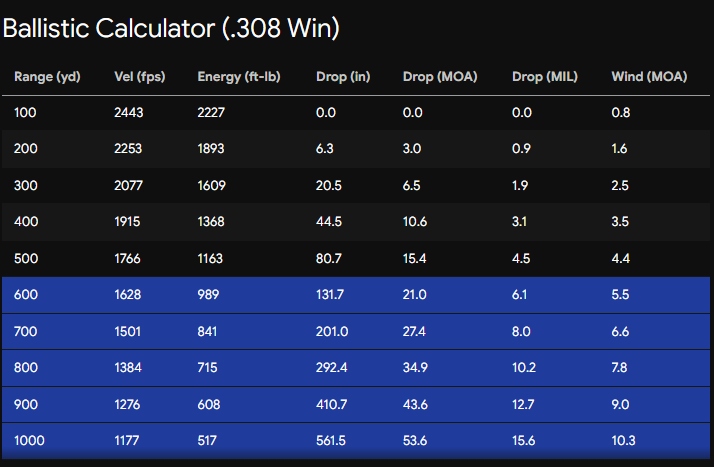
Below is your ultimate .308 ballistic cheat sheet. We have calculated the most critical data points—from drop and windage to terminal energy—based on the industry-standard long-range load: a 168-grain Boat Tail Hollow Point (BTHP) leaving the muzzle at 2,650 fps with a 100-yard zero.
The .308 Winchester Comprehensive Ballistic Cheat Sheet
Note: Wind drift is calculated based on a 10 mph full-value (90-degree) crosswind.
| Distance (Yards) | Velocity (fps) | Energy (ft-lbs) | Time of Flight (s) | Drop (Inches) | Drop (MOA) | Drop (MIL) | Wind 10mph (MOA) | Wind 10mph (MIL) |
| 100 | 2460 | 2250 | 0.12 | 0.0 | 0.0 | 0.0 | 0.7 | 0.2 |
| 200 | 2275 | 1930 | 0.24 | -4.5 | -2.2 | -0.6 | 1.5 | 0.4 |
| 300 | 2100 | 1640 | 0.38 | -15.2 | -4.8 | -1.4 | 2.5 | 0.7 |
| 400 | 1930 | 1390 | 0.53 | -33.6 | -8.0 | -2.3 | 3.5 | 1.0 |
| 500 | 1770 | 1170 | 0.69 | -60.8 | -11.6 | -3.4 | 4.7 | 1.4 |
| 600 | 1620 | 980 | 0.87 | -98.6 | -15.7 | -4.6 | 6.0 | 1.8 |
| 700 | 1485 | 820 | 1.07 | -149.5 | -20.4 | -5.9 | 7.5 | 2.2 |
| 800 | 1365 | 695 | 1.28 | -216.5 | -25.8 | -7.5 | 9.2 | 2.7 |
| 900 | 1255 | 588 | 1.51 | -302.8 | -32.1 | -9.3 | 11.0 | 3.2 |
| 1000 | 1165 | 506 | 1.76 | -412.5 | -39.4 | -11.5 | 13.0 | 3.8 |
How to Read and Apply the Cheat Sheet Data
Having the data is only half the battle; knowing how to apply it in the field is what puts rounds on target. Here is a breakdown of how to use the specific columns in this chart.
1. Elevation Drop (Inches, MOA, MIL)
Gravity is a constant, making elevation your most predictable variable.
- Drop in Inches: Best used if you are estimating holdover on an animal or a known-size target using a standard duplex reticle without dialing turrets.
- Drop in MOA / MIL: Use these numbers to dial the elevation turret on your scope or hold over using a grid reticle. For example, if your target is at 500 yards and you have a MIL-based scope, you will dial up 3.4 MILs from your 100-yard zero.
2. Wind Drift (MOA & MIL)
Unlike gravity, wind is constantly shifting. The table provides windage corrections for a 10 mph full-value crosswind (blowing directly from 3 o’clock or 9 o’clock).
- Scaling the Wind: If the wind is blowing at 5 mph, you simply cut the table’s windage value in half. If the wind is blowing at 20 mph, you double it.
- Half-Value Winds: If the wind is coming from an angle (like 1:30 or 10:30), it is a “half-value” wind. Take the full 10 mph value on the chart and multiply it by 0.5.
3. Energy (ft-lbs)
This column is critical for hunters. A general rule of thumb for ethical hunting is that you need a minimum of 1,000 ft-lbs of energy to reliably harvest a deer-sized animal. Looking at our chart, the 168gr .308 bullet drops below that threshold just after 500 yards. This tells you the maximum ethical hunting range for this specific load.
4. Time of Flight (Seconds)
Time of flight matters for two reasons: wind reading and moving targets. At 1,000 yards, the bullet is in the air for almost 1.8 seconds. A lot can happen in that time. If a target is moving, or if the wind changes suddenly during your trigger press, that time delay is what throws your shot off.
Variables That Will Change Your DOPE
While this cheat sheet is incredibly accurate for a standard 168gr match load at sea level, your specific environment and rifle will introduce slight variations. Keep an eye on these three factors:
- Bullet Weight & Profile: Lighter hunting bullets (like 150gr) will fly faster and flatter at close range but lose energy quickly. Heavier match bullets (like 175gr or 185gr) will start slower but buck the wind much better past 600 yards.
- Barrel Length: The 2,650 fps velocity used here is standard for a 20-inch to 22-inch barrel. If you are running a short 16-inch tactical barrel, you will lose about 100-150 fps, which means your bullet will drop faster than the chart states.
- Density Altitude (DA): Temperature, humidity, and elevation change how “thick” the air is. Shooting in the freezing cold at sea level creates more drag than shooting on a hot summer day in the mountains.
Print this sheet out, keep it in your dope book, and use it as your baseline to get on paper. The true mark of a precision shooter is taking this baseline data and validating it behind the trigger.