A handgun caliber ballistics chart is an essential tool that compares the velocity, energy, bullet drop, and trajectory of different pistol and revolver cartridges. Shooters compare handgun ballistics to understand terminal performance, recoil, and effective range before selecting a firearm.
This chart includes vital data for self-defense, target shooting, and hunting by showing exactly how a bullet behaves from the muzzle out to 50 and 100 yards. Whether you are choosing a compact concealed carry pistol or a heavy-hitting revolver for bear defense, analyzing the data ensures you select the right cartridge for the job.
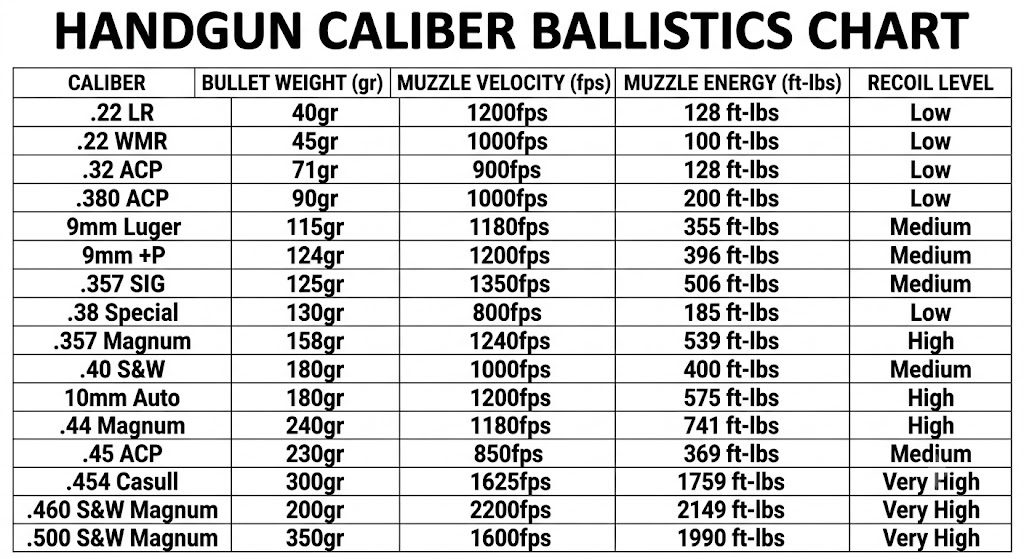
Handgun Caliber Ballistics Chart
| Caliber | Common Bullet Weight (gr) | Muzzle Velocity (fps) | Muzzle Energy (ft-lbs) | Velocity @50 yd (fps) | Energy @50 yd (ft-lbs) | Approximate Bullet Drop @100 yd | Typical Effective Range | Recoil Level | Common Use |
| .22 LR | 40 | 1,200 | 128 | 1,000 | 89 | 5.5″ | 50 yds | Low | Target / Plinking |
| .22 WMR | 45 | 1,000 | 100 | 920 | 85 | 8.0″ | 50 yds | Low | Varmint / Self Defense |
| .25 ACP | 50 | 760 | 64 | 700 | 54 | 15.0″ | 25 yds | Low | Concealed Carry |
| .32 ACP | 71 | 900 | 128 | 825 | 107 | 11.0″ | 25 yds | Low | Concealed Carry |
| .32 H&R Mag | 85 | 1,100 | 228 | 980 | 181 | 7.0″ | 50 yds | Low | Self Defense |
| .327 Fed Mag | 100 | 1,500 | 500 | 1,300 | 375 | 4.0″ | 50 yds | Medium | Self Defense |
| .380 ACP | 90 | 1,000 | 200 | 912 | 166 | 9.0″ | 25 yds | Low | Concealed Carry |
| 9mm Luger | 115 | 1,180 | 355 | 1,050 | 282 | 6.0″ | 50 yds | Medium | Self Defense / Target |
| 9mm +P | 124 | 1,200 | 396 | 1,080 | 321 | 6.0″ | 50 yds | Medium | Self Defense |
| .357 SIG | 125 | 1,350 | 506 | 1,200 | 400 | 4.5″ | 50 yds | Medium | Self Defense |
| .38 Special | 130 | 800 | 185 | 760 | 167 | 12.0″ | 50 yds | Low | Self Defense / Target |
| .38 Special +P | 125 | 945 | 248 | 880 | 215 | 9.0″ | 50 yds | Medium | Self Defense |
| .357 Magnum | 158 | 1,240 | 539 | 1,120 | 440 | 6.0″ | 100 yds | High | Self Defense / Hunting |
| .40 S&W | 180 | 1,000 | 400 | 920 | 338 | 8.5″ | 50 yds | Medium | Self Defense |
| 10mm Auto | 180 | 1,200 | 575 | 1,080 | 466 | 5.5″ | 100 yds | High | Hunting / Self Defense |
| .41 Magnum | 210 | 1,300 | 788 | 1,160 | 627 | 5.0″ | 100 yds | High | Hunting |
| .44 Special | 200 | 900 | 360 | 840 | 313 | 10.0″ | 50 yds | Medium | Self Defense |
| .44 Magnum | 240 | 1,180 | 741 | 1,070 | 610 | 6.5″ | 100 yds | High | Hunting / Self Defense |
| .45 ACP | 230 | 850 | 369 | 800 | 327 | 11.0″ | 50 yds | Medium | Self Defense |
| .45 ACP +P | 230 | 950 | 461 | 890 | 404 | 9.5″ | 50 yds | High | Self Defense |
| .45 Colt | 250 | 860 | 411 | 810 | 364 | 11.5″ | 50 yds | Medium | Self Defense / Hunting |
| .454 Casull | 300 | 1,625 | 1,759 | 1,450 | 1,400 | 4.0″ | 100 yds | Very High | Hunting |
| .460 S&W Mag | 200 | 2,200 | 2,149 | 1,900 | 1,600 | 2.0″ | 200 yds | Very High | Hunting |
| .500 S&W Mag | 350 | 1,600 | 1,990 | 1,420 | 1,560 | 5.0″ | 100 yds | Very High | Hunting |
(Note: Data represents average values from major manufacturers like Federal Premium, Winchester Ammunition, and Hornady for standard barrel lengths. Actual ballistics will vary slightly based on specific firearm barrel length and environmental conditions. Drop at 100 yards assumes a 50-yard zero.)
Handgun Caliber Ballistics Chart Image
How to Read the Handgun Caliber Ballistics Chart
Understanding handgun ballistics requires knowing how to interpret the core metrics in the table.
- Common Bullet Weight (gr): Measured in grains. A heavier bullet generally penetrates deeper but travels slower, while a lighter bullet moves faster and expands quicker.
- Muzzle Velocity (fps): The speed of the bullet as it exits the barrel, measured in feet per second. High velocity contributes to kinetic energy and flatter trajectories.
- Muzzle Energy (ft-lbs): Measured in foot-pounds, this indicates the raw kinetic power of the bullet as it leaves the muzzle. It is heavily relied upon to gauge a caliber’s stopping power.
- Velocity & Energy @50 yd: Shows how well the bullet retains speed and power over distance. Handgun bullets lose velocity rapidly compared to rifle rounds.
- Approximate Bullet Drop @100 yd: Calculates how far the bullet will fall due to gravity at 100 yards (assuming a 50-yard zero).
- Typical Effective Range: The maximum distance where the cartridge can reliably and accurately neutralize a threat or take down game.
- Recoil Level: An estimated indicator of the physical kick the shooter feels, impacting follow-up shot speed and accuracy.
Fastest Handgun Calibers
When looking at the handgun velocity chart, magnum revolver rounds traditionally dominate the speed category.
The .460 S&W Magnum is a standout, launching a 200-grain bullet at an astonishing 2,200 fps. The .454 Casull and .327 Federal Magnum also boast exceptionally high velocities. In semi-automatic platforms, the .357 SIG achieves rifle-like speed (1,350 fps) in a compact package by necking down a .40 caliber casing to fit a 9mm bullet.
Most Powerful Handgun Calibers
Muzzle energy dictates a cartridge’s terminal performance and raw destructive capability. The .500 S&W Magnum and .460 S&W Magnum produce upwards of 2,000 ft-lbs of energy, effectively matching or exceeding many centerfire rifle cartridges. For more standard tactical uses, the 10mm Auto and .357 Magnum are considered powerhouses, consistently delivering over 500 ft-lbs of energy, making them excellent choices for barrier penetration and defense against dangerous predators.
Lowest Recoil Handgun Calibers
For beginners, recoil management is crucial for developing accurate shooting habits. The .22 LR offers almost zero recoil, making it the undisputed king of target shooting and training. For centerfire personal defense, the .380 ACP and .32 ACP provide very mild recoil in micro-compact pistols. Standard 9mm Luger is widely considered the perfect middle ground, offering manageable recoil with sufficient terminal ballistics for defense.
Best Handgun Calibers for Self-Defense
A proper self-defense caliber must balance stopping power, magazine capacity, and manageable recoil.
The 9mm Luger is currently the gold standard for law enforcement and civilians, as modern hollow-point technology allows it to perform identically to larger calibers in FBI gel tests while allowing for faster follow-up shots. The .45 ACP remains a top tier choice for those who prefer heavy, slow-moving projectiles that naturally create large wound channels. The .40 S&W offers a compromise between the speed of the 9mm and the mass of the .45.
Best Handgun Calibers for Concealed Carry
Concealed carry calibers prioritize small firearm dimensions without sacrificing life-saving reliability. The 9mm Luger dominates the modern micro-compact pistol market. However, for deep concealment “pocket pistols,” the .380 ACP is incredibly popular. For revolver enthusiasts, the .38 Special (specifically in +P loadings) remains the most trusted option for snub-nose concealed carry.
Best Handgun Calibers for Hunting
Handgun hunting requires cartridges capable of ethical, deep-penetrating harvests on medium and large game. The .44 Magnum is the quintessential hunting caliber, capable of taking down deer, hogs, and black bears. For massive game like grizzly bears or elk, hunters step up to the .454 Casull, .460 S&W Magnum, or .500 S&W Magnum. In semi-automatics, the 10mm Auto has become the primary choice for backcountry chest-rig carry.
Factors That Affect Handgun Ballistics
The data in any pistol caliber chart serves as a baseline, but real-world performance fluctuates based on several variables:
- Barrel Length: Most factory ammunition is tested in 4-inch to 6-inch test barrels. Firing the same round from a 2-inch subcompact barrel results in significant velocity loss.
- Bullet Weight and Design: A Full Metal Jacket (FMJ) acts differently than a Jacketed Hollow Point (JHP). Heavier bullets drop faster but penetrate deeper.
- Powder Load: Standard pressure, +P (overpressure), and +P+ loads change the internal ballistics drastically.
- Ammunition Manufacturer: A 115-grain 9mm from Winchester may clock slightly different velocities than a similar load from Speer due to proprietary powder blends.
- Environmental Conditions: Altitude, humidity, and temperature affect air density, which in turn alters the bullet’s ballistic coefficient and downrange drop.