When it comes to varmint hunting and precision rimfire shooting, the .17 Hornady Magnum Rimfire (.17 HMR) is renowned for its blazing speed and flat trajectory. Developed by Hornady in 2002 by necking down a .22 WMR casing, this cartridge pushes extremely lightweight projectiles at exceptionally high speeds. Understanding .17 HMR velocity is crucial for maximizing its effective range, as speed is directly responsible for the cartridge’s aerodynamic performance.
Below is a detailed .17 HMR velocity chart comparing some of the most popular factory loads, followed by an in-depth explanation of what these ballistics mean for shooters.
.17 HMR Velocity Comparison Chart
The following table outlines the flight speeds for various popular .17 HMR loads from the muzzle out to 200 yards.
| Manufacturer & Load | Bullet Weight | Muzzle Velocity | 100 Yds Velocity | 200 Yds Velocity |
| Hornady V-MAX | 17 gr | 2,550 fps | 1,901 fps | 1,379 fps |
| Federal V-MAX | 17 gr | 2,530 fps | 1,884 fps | 1,366 fps |
| CCI TNT JHP | 17 gr | 2,550 fps | 1,771 fps | 1,202 fps |
| Hornady XTP | 20 gr | 2,375 fps | 1,755 fps | 1,274 fps |
| Winchester Super-X XTP | 20 gr | 2,375 fps | 1,784 fps | 1,316 fps |
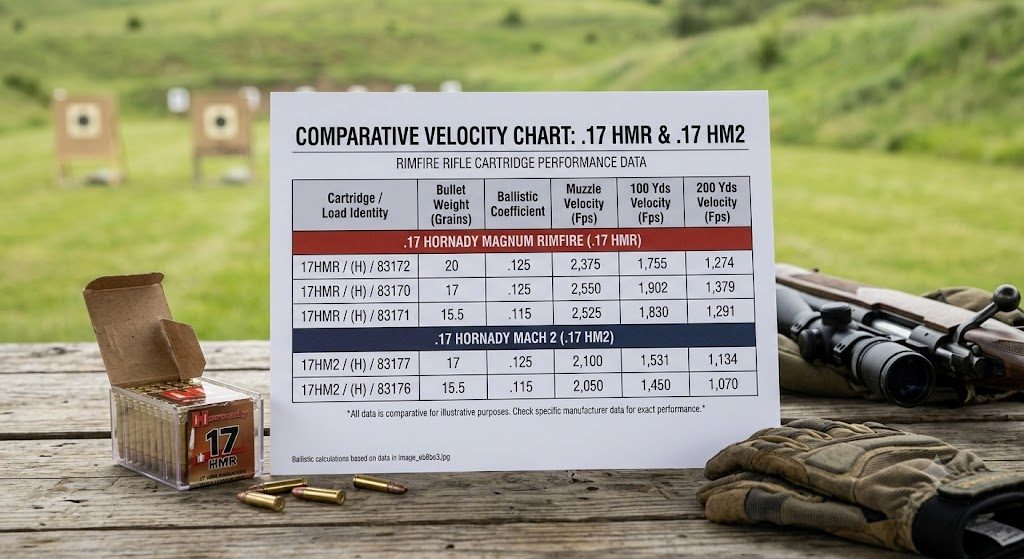
17 HMR vs 22LR Ballistics Chart
Explaining the Stats: Why Velocity Matters
The defining characteristic of the .17 HMR is its speed, which heavily influences its trajectory, energy retention, and overall effectiveness in the field. Here is a breakdown of how the velocity data impacts performance:
- Blistering Muzzle Velocity: The standard 17-grain .17 HMR bullet leaves the muzzle at a remarkable 2,550 feet per second (fps). To put this into perspective, a standard 40-grain .22 LR bullet exits the muzzle at roughly 1,200 fps. This massive difference in starting speed gives the .17 HMR a distinct advantage over traditional rimfire rounds.
- Downrange Speed Retention: Because these bullets are so light (typically between 15.5 and 20 grains), they do shed their velocity quickly as they travel downrange. However, a 17-grain V-MAX bullet still retains a highly supersonic speed of 1,379 fps at the 200-yard mark.
- Impact on Trajectory: Higher velocity directly translates to a shorter flight time, which in turn means gravity has less time to act on the bullet. This results in an incredibly flat trajectory. When sighted in at 100 yards, a standard .17 HMR bullet rises less than half an inch and will drop roughly 8.5 to 10.2 inches at 200 yards depending on the exact load. This requires significantly less holdover correction compared to the .22 LR, which drops nearly 32 inches at the same distance.
- Bullet Weight Variations: While the 17-grain options offer the highest maximum velocity, manufacturers also provide heavier 20-grain rounds, such as the Hornady XTP. These heavier bullets start slower (2,375 fps) but are designed to offer better sectional density and a higher ballistic coefficient, allowing them to resist drag and hit with slightly more kinetic energy at extended distances.