Calculate Ballistic Coefficient
You can use our tool to calculate, this one is simple tool, you can use the advance ballistic coefficient calculator also.
Ballistic Coefficient Calculator
Whether you are a long-range precision shooter, an avid hunter, or a ballistics enthusiast, you have likely encountered the term Ballistic Coefficient. Often abbreviated as BC, this metric is the cornerstone of predicting how a bullet will perform once it leaves the barrel.
In simple terms, a Ballistic Coefficient measures a projectile’s ability to overcome air resistance in flight. A higher number means the bullet is more aerodynamic, retains its velocity better, and resists wind deflection more effectively than a bullet with a lower number.
But where does this number come from? While ammunition manufacturers usually print it on the box, understanding how to calculate it yourself is crucial for mastering external ballistics. Here is the step-by-step breakdown.
The Core Formula
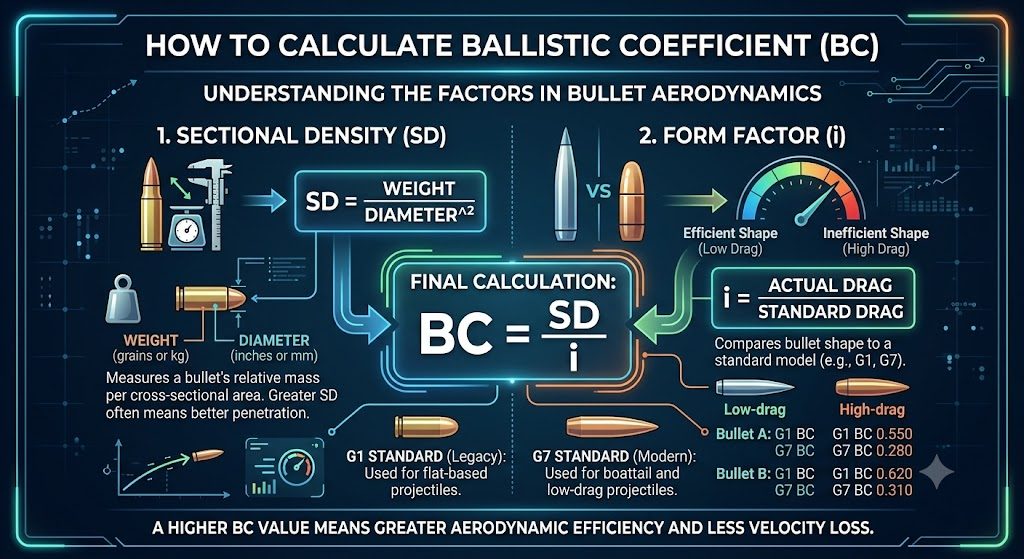
The fundamental equation for determining a bullet’s aerodynamic efficiency relies on two primary physical characteristics.
Here is the core equation:
$$BC = \frac{SD}{i}$$
To solve this, you need to know the two variables involved:
- Sectional Density is the top value, representing the bullet’s mass relative to its caliber.
- Form Factor is the bottom value, representing the aerodynamic efficiency of the bullet’s shape.
To calculate the final Ballistic Coefficient, you must first calculate these two underlying metrics.
Step 1: Calculating Sectional Density
Sectional Density indicates how effectively a bullet’s mass is distributed to push through air or penetrate a target. Heavy bullets that are very narrow have a high Sectional Density, while light, wide bullets have a low one.
The standard formula for Sectional Density requires the bullet’s weight in pounds and its diameter in inches. Because bullet weight is almost universally measured in grains, we must divide the grain weight by 7,000 (the number of grains in one pound).
This gives us the practical formula:
$$SD = \frac{Weight}{7000 \cdot Diameter^2}$$
Here is what you need to plug in:
- Weight is the mass of your bullet in grains (for example, 143 grains).
- Diameter is the actual caliber of your bullet in inches (for example, 0.264 inches).
Step 2: Determining the Form Factor
The Form Factor is the most complex variable to determine. You cannot easily calculate it with just a scale and calipers; it typically requires advanced testing like Doppler radar.
The Form Factor compares the drag of your specific bullet to the drag of a standardized, reference bullet.
$$i = \frac{Specific Drag}{Standard Drag}$$
The variables represent:
- Specific Drag is the drag coefficient of the bullet you are evaluating.
- Standard Drag is the drag coefficient of the universally accepted reference projectile.
Understanding G1 vs. G7 Standards
When calculating Form Factor, you must choose a reference standard.
- G1 Standard: This is based on an older, flat-based projectile design. It is the legacy standard still used by many manufacturers. However, its drag profile changes drastically at different velocities, making it less ideal for modern, long-range shooting.
- G7 Standard: This is based on a modern boattail projectile with a sleek, low-drag nose. If you are shooting contemporary precision rifle bullets, calculating your Ballistic Coefficient against the G7 standard will provide much more accurate drop tables across extreme distances.
Putting It All Together: An Example Calculation
Let us walk through a real-world example. Imagine you are working with a popular 6.5mm precision bullet. It weighs 143 grains and has a diameter of 0.264 inches.
First, calculate the Sectional Density:
$$SD = \frac{143}{7000 \cdot 0.264^2}$$
When you run those numbers, the resulting Sectional Density is approximately 0.293.
Next, you look up the radar data for this specific bullet and find that its Form Factor, when compared to the older G1 standard, is 0.470.
Now, plug both numbers into the core formula:
$$BC = \frac{0.293}{0.470}$$
Dividing the Sectional Density by the Form Factor gives you a final G1 Ballistic Coefficient of approximately 0.623.
Conclusion
Understanding the math behind your ammunition allows you to make highly informed decisions when building out trajectory charts and drop tables. Always ensure you know whether the Ballistic Coefficient you are working with is based on the G1 or G7 standard. Mixing up the two models in your ballistics calculator will result in wildly inaccurate predictions, causing you to miss your target downrange.