Evaluating stopping power and firearm compatibility starts with understanding a handgun caliber ballistics chart. This guide provides a complete handgun caliber size chart alongside tested performance data to help shooters select the right ammunition. Whether for daily concealed carry, law enforcement duty, or backcountry hunting, the handgun bullet caliber chart below details velocity, energy, and physical dimensions for today’s most heavily relied-upon cartridges.
Table of Contents [Click to minimize]
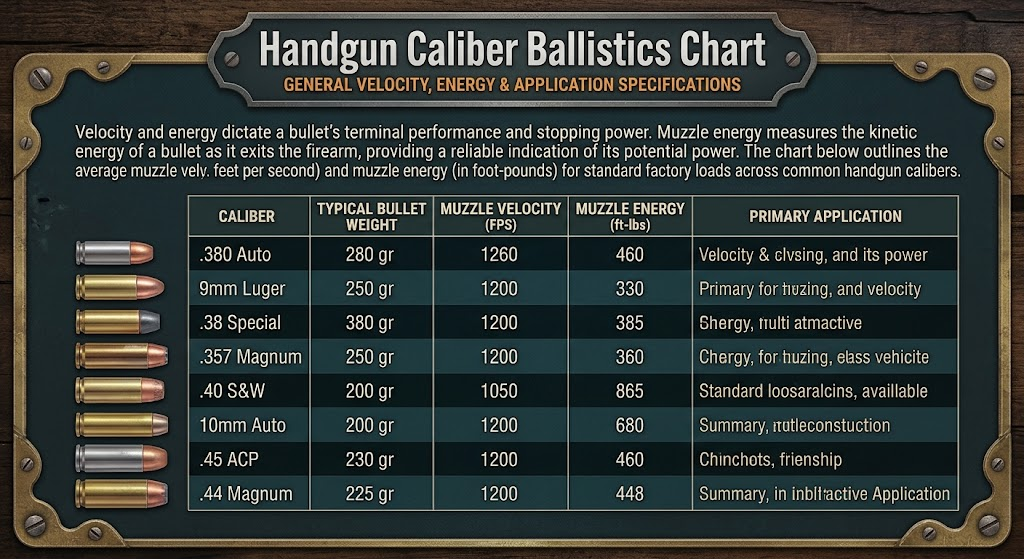
Handgun Caliber Ballistics Chart
Velocity and kinetic energy are the foundational metrics of terminal performance. Muzzle energy dictates the sheer force a bullet delivers to the target upon impact, while muzzle velocity influences both the trajectory and how reliably a hollow-point bullet will expand.
The table below outlines standard factory loads and their corresponding average muzzle velocities (FPS) and muzzle energies (ft-lbs) across the most common handguns.
| Caliber | Bullet Weight (Grains) | Average Muzzle Velocity (FPS) | Average Muzzle Energy (ft-lbs) | Primary Use Case |
| .380 ACP | 90 – 95 gr | 950 – 1,025 | 190 – 220 | Pocket Carry / Backup |
| 9mm Luger | 115 – 124 gr | 1,120 – 1,250 | 300 – 350 | Self-Defense / Duty |
| 9mm Luger +P | 124 gr | 1,200 – 1,300 | 380 – 410 | Law Enforcement |
| .38 Special | 125 – 158 gr | 800 – 950 | 200 – 250 | Snub-Nose Defense |
| .357 Magnum | 125 – 158 gr | 1,250 – 1,500 | 500 – 650 | Defense / Hunting |
| .40 S&W | 165 – 180 gr | 1,000 – 1,150 | 400 – 480 | Duty / Defense |
| 10mm Auto | 180 – 200 gr | 1,150 – 1,300 | 550 – 700+ | Bear Defense / Hunting |
| .45 ACP | 230 gr | 830 – 900 | 350 – 400 | Self-Defense / Duty |
| .44 Magnum | 240 – 300 gr | 1,200 – 1,400 | 900 – 1,200 | Big Game Hunting |
Handgun Caliber Size Chart
Cartridge dimensions dictate the size of the firearm you can carry. The physical size of the ammunition determines the required chamber thickness, frame size, magazine capacity, and grip width. For example, while the 9mm and .40 S&W can often fit into similar compact frames, the longer 10mm Auto and wider .45 ACP require larger grips and beefier slides.
This handgun caliber size chart compares the bullet diameter, case length, and maximum overall length of these essential rounds.
| Caliber | Bullet Diameter (inch / mm) | Case Length (inch / mm) | Overall Length (inch / mm) |
| .380 ACP | .355 in (9.0 mm) | .680 in (17.3 mm) | .984 in (25.0 mm) |
| 9mm Luger | .355 in (9.0 mm) | .754 in (19.15 mm) | 1.169 in (29.69 mm) |
| .38 Special | .357 in (9.1 mm) | 1.155 in (29.3 mm) | 1.550 in (39.4 mm) |
| .357 Magnum | .357 in (9.1 mm) | 1.290 in (33.0 mm) | 1.590 in (40.0 mm) |
| .40 S&W | .400 in (10.2 mm) | .850 in (21.6 mm) | 1.135 in (28.8 mm) |
| 10mm Auto | .400 in (10.2 mm) | .992 in (25.2 mm) | 1.260 in (32.0 mm) |
| .45 ACP | .452 in (11.5 mm) | .898 in (22.8 mm) | 1.275 in (32.4 mm) |
| .44 Magnum | .429 in (10.9 mm) | 1.285 in (32.6 mm) | 1.610 in (41.0 mm) |
Examining the Handgun Bullet Caliber Chart by Category
Shooters must pair their caliber choice with their intended environment. Ammunition design represents a compromise between capacity, concealability, recoil, and raw kinetic energy.
Deep Concealment and Micro-Compacts
The .380 ACP (Automatic Colt Pistol) is technically a 9x17mm cartridge. It shares the exact same .355-inch diameter bullet as the standard 9mm Luger but is loaded into a much shorter case. This shorter case limits powder capacity and pressure, significantly reducing recoil and allowing firearms to be scaled down into ultra-thin, pocket-sized platforms.
Mainstream Duty and Concealed Carry
The 9mm Luger and .45 ACP dominate the defensive market. A conventional standard-pressure 9mm load produces roughly 300 to 350 ft-lbs of muzzle energy. Despite its massive size advantage, standard .45 ACP ammunition generates only slightly more kinetic energy than the 9mm, typically hovering between 350 and 400 ft-lbs. Because the 9mm achieves similar energy with much less recoil and significantly higher magazine capacity, it has become the default standard for global military and police units.
Heavy duty and Backcountry Defense
For users venturing into bear country or hunting medium game, the 10mm Auto is the semi-automatic king. While light target loads exist that mimic the .40 S&W, full-power 10mm Auto loads can produce over 700 ft-lbs of muzzle energy. This is nearly double the power of conventional 9mm and .45 ACP rounds. In the revolver world, the .357 Magnum and .44 Magnum perform these same heavy-duty tasks, utilizing deep-penetrating heavy cast bullets.
Detailed Ballistics and Dimensions Explanations
Muzzle Velocity and Expansion
Muzzle velocity measures how fast the projectile travels in feet per second (FPS). In defensive handguns, speed is vital for hollow-point expansion. Most modern defensive bullets require a minimum threshold of around 900 to 1,000 FPS to reliably open up upon striking soft tissue. High-velocity rounds like the .357 Magnum (1,400+ FPS) force dramatic, rapid expansion.
Caliber Size and Pressure Limits (Standard vs. +P)
Physical caliber size does not always dictate internal pressure. For example, standard 9mm Luger ammunition has a SAAMI maximum pressure of 35,000 PSI. The physically larger .45 ACP operates at a much lower standard pressure of 21,000 PSI. Ammunition designated as “+P” (Overpressure) is loaded to higher internal pressures to boost velocity. A 9mm +P load is rated up to 38,500 PSI, requiring a firearm specifically rated to handle the increased stress.
Bullet Mass and Sectional Density
Sectional density measures a bullet’s weight in relation to its diameter. A heavier bullet of the same caliber will have a higher sectional density, which translates directly to deeper penetration. This is why a 147-grain 9mm bullet will generally penetrate deeper through heavy clothing or bone than a 115-grain 9mm bullet traveling at a much higher speed.
Frequently Asked Questions
What does a handgun caliber ballistics chart measure? A handgun caliber ballistics chart typically measures muzzle velocity (the speed of the bullet as it leaves the barrel), muzzle energy (the kinetic force of the bullet), and the physical weight of the bullet measured in grains.
How do you read a handgun caliber size chart? A handgun caliber size chart breaks down cartridge dimensions by bullet diameter (width of the projectile), case length (the brass casing holding the powder), and overall length (the fully assembled cartridge). These dimensions tell you how large the gun’s magazine and grip must be.
Which round is best for concealed carry on a handgun bullet caliber chart? The 9mm is overwhelmingly considered the optimal choice for concealed carry. It offers a near-perfect balance of manageable recoil, 300 to 350 ft-lbs of terminal energy, and high magazine capacity inside easily concealed frames.
Are the .380 ACP and 9mm the same diameter? Yes. Both the .380 ACP and the 9mm utilize a .355-inch diameter projectile. The difference lies in the case length; the .380 ACP has a 17.3mm case, while the 9mm has a 19.15mm case, which allows the 9mm to hold more powder and generate much higher velocity.
Is the 10mm more powerful than the .45 ACP? Yes, significantly. While standard .45 ACP generates about 350 to 400 ft-lbs of energy, full-power 10mm Auto ammunition can produce over 700 ft-lbs of muzzle energy.
What does “+P” mean in handgun ballistics? “+P” stands for Overpressure. It indicates that the ammunition is loaded to higher internal chamber pressures than the standard SAAMI specification. For instance, standard 9mm operates at 35,000 PSI, while 9mm +P is loaded to 38,500 PSI, yielding higher velocities.
Can I shoot a .38 Special in a .357 Magnum revolver? Yes. The .38 Special and .357 Magnum share the exact same .357-inch bullet diameter. The .357 Magnum case is simply 1/10th of an inch longer to hold more powder. A .357 Magnum chamber will safely accommodate and fire the shorter, lower-pressure .38 Special cartridge.
Why do law enforcement agencies use the .40 S&W? The .40 S&W was developed to offer a compromise between the high capacity of the 9mm and the heavy bullet mass of the .45 ACP. It operates at 35,000 PSI and delivers heavier projectiles than the 9mm at higher speeds than the .45 ACP.
Does a heavier bullet mean more recoil? Generally, yes. Recoil is a product of physics (every action has an equal and opposite reaction). Pushing a heavy bullet, like a 230-grain .45 ACP, requires substantial force, which translates into more rearward recoil against the shooter’s hands compared to pushing a lighter 115-grain 9mm bullet.
Which handgun caliber generates the most stopping power? In standard semi-automatic platforms, the 10mm Auto offers the highest stopping power, doubling the energy of a 9mm. In heavy revolvers, the .44 Magnum produces the most energy, easily exceeding 1,000 ft-lbs and making it the premier choice for large game hunting and defense against apex predators.