The core difference between the .308 Winchester and the .30-06 Springfield comes down to case length and powder capacity. While both cartridges fire the exact same .308-inch diameter bullet, the .30-06 features a longer case that holds roughly 20% more powder. This extra capacity allows the .30-06 to push identical bullets 100 to 150 feet per second (fps) faster and effectively handle heavier 200+ grain bullets for massive game. Conversely, the .308’s shorter case fits into lighter, more compact short-action rifles and generates about 15% less recoil, making it easier to shoot accurately.
Table of Contents [Click to open]
Detailed 308 vs 30 06 Ballistics Comparison
To truly see how these two iconic big game cartridges stack up, we have to look past the lightest bullets and compare them across standard hunting weights (150-grain and 180-grain) where their differences become clear.
| Performance Metric | .308 Winchester (150 gr) | .30-06 Springfield (150 gr) | .308 Winchester (180 gr) | .30-06 Springfield (180 gr) |
| Case Length / Action | 2.015″ / Short Action | 2.494″ / Long Action | 2.015″ / Short Action | 2.494″ / Long Action |
| Case Capacity | 56 grains H₂O | 68 grains H₂O | 56 grains H₂O | 68 grains H₂O |
| Muzzle Velocity | 2,820 ft/s | 2,910 ft/s | 2,570 ft/s | 2,700 ft/s |
| Velocity @ 300 yds | 2,215 ft/s | 2,305 ft/s | 2,050 ft/s | 2,170 ft/s |
| Muzzle Energy | 2,648 ft-lb | 2,820 ft-lb | 2,639 ft-lb | 2,913 ft-lb |
| Energy @ 300 yds | 1,634 ft-lb | 1,770 ft-lb | 1,680 ft-lb | 1,882 ft-lb |
| Drop @ 300 yds (200yd zero) | -14.2 inches | -13.0 inches | -15.5 inches | -14.1 inches |
| Drop @ 400 yds | -32.8 inches | -31.0 inches | -36.5 inches | -33.2 inches |
| Recoil Energy (8 lb rifle) | 15.8 ft-lb | 18.3 ft-lb | 18.3 ft-lb | 21.7 ft-lb |
| Ideal Game Sizing | Deer / Pronghorn | Deer / Elk | Elk / Bear | Moose / Big Bear |
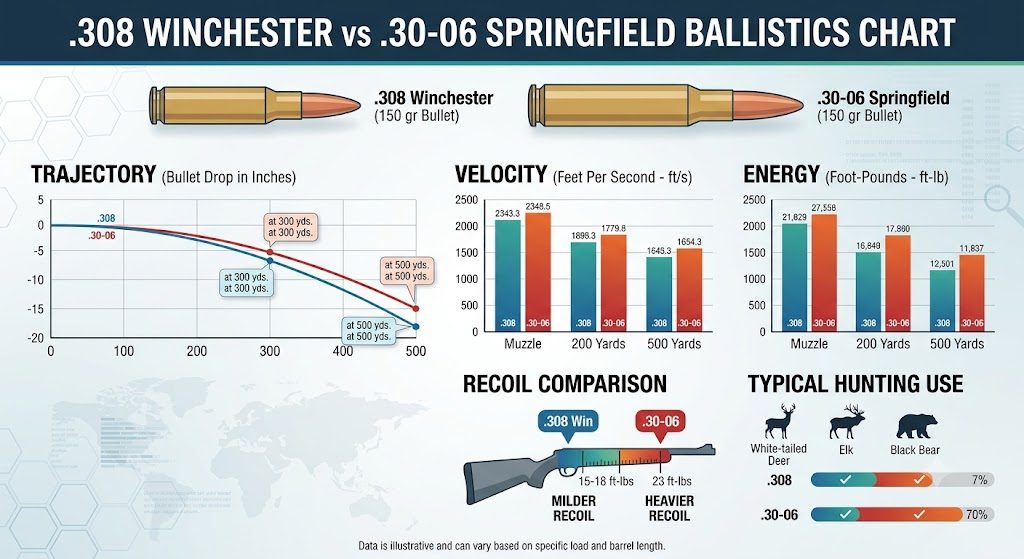
Explaining the Stats
Velocity and Energy
The .30-06 consistently outpaces the .308 by roughly 90 to 130 fps across all bullet weights. Because kinetic energy is derived from velocity and mass, the .30-06 also delivers 150 to 275 more foot-pounds (ft-lbs) of energy at the muzzle.
Inside of 250 yards, this difference is practically meaningless for deer-sized game, as both cartridges deliver massive, ethical stopping power. However, the .30-06’s true advantage emerges with heavier bullets. While the .308 struggles to push anything heavier than 180 grains at effective speeds, the .30-06 thrives with 180, 200, and even 220-grain bullets, giving hunters a distinct edge on thick-skinned, heavy-boned game like moose and large bears.
Recoil and Shootability
The .308 Winchester was designed by the military specifically to mimic the .30-06’s performance while generating less recoil. Depending on the load, the .308 kicks about 14% to 16% less than the .30-06 in a comparably weighted rifle. While 15.8 ft-lbs versus 18.3 ft-lbs of recoil might not sound vastly different on paper, the milder kick of the .308 makes it significantly easier to shoot accurately, prevents flinching for newer shooters, and allows for faster follow-up shots.
Action Size and Rifle Weight
The .308’s cartridge measures just over 2.8 inches overall, classifying it as a short-action caliber. The .30-06 measures 3.34 inches, requiring a long-action receiver. This means rifles chambered in .308 can be built with shorter bolts, making the guns inherently lighter, stiffer, and faster to cycle. If you are a backcountry hunter hiking miles through elevation, saving half a pound of rifle weight with a .308 is highly appealing.
Trajectory and Bullet Drop
Because the .30-06 pushes bullets faster, those bullets arrive at the target sooner and have less time to be pulled down by gravity.
As the chart tool above illustrates, the trajectory difference inside 300 yards is a matter of a single inch. It isn’t until you stretch out past 400 yards that the .30-06 begins to shoot noticeably flatter.
The Verdict
There is no definitive “better” cartridge, only the right one for your specific hunt.
- Go with the .30-06 Springfield if you want maximum versatility for all North American big game, plan to take shots out to 400+ yards, or intend to use heavy 180 to 220-grain bullets for elk and moose.
- Go with the .308 Winchester if you primarily hunt deer-sized game under 300 yards, want a lighter rifle for mountain hiking, prefer less recoil, or want cheaper and more plentiful practice ammunition.