The biggest difference between the 6.5 Grendel and the 6.8 SPC is their optimal engagement distance and barrel length requirements. Designed specifically for long-range precision, the 6.5 Grendel fires an aerodynamic .264-caliber bullet that retains superior velocity and kinetic energy well past 400 yards. To achieve this performance, it typically requires an 18- to 24-inch barrel.
Conversely, the military developed the 6.8 SPC (Special Purpose Cartridge) to maximize terminal ballistics from short-barreled AR-15s (14.5 to 16 inches) in close-quarters environments. It utilizes a heavier, .277-caliber projectile that hits with tremendous authority at short distances but loses energy rapidly beyond 300 yards due to a lower ballistic coefficient.
At 100 yards, the 6.8 SPC often delivers slightly more tissue damage on medium game. Beyond 300 yards, the 6.5 Grendel overtakes it, maintaining a flatter trajectory, resisting wind deflection, and delivering higher retained energy for ethical harvests.
If you prioritize long-range accuracy and hunt open plains, choose the 6.5 Grendel. If you mainly hunt inside 300 yards in thick brush with a compact carbine, the 6.8 SPC remains the superior tool.
Quick Comparison Table
| Feature | 6.5 Grendel | 6.8 SPC |
| Parent Case | .220 Russian (7.62x39mm family) | .30 Remington |
| Bullet Diameter | .264 in (6.5mm) | .277 in (6.8mm) |
| Bullet Weight (Typical) | 90 – 130 grains | 85 – 120 grains |
| Typical Muzzle Velocity | 2,400 – 2,900 fps | 2,450 – 2,900 fps |
| Typical Muzzle Energy | 1,500 – 1,800 ft-lbs | 1,500 – 1,750 ft-lbs |
| Effective Hunting Range | 400 – 500 yards | 250 – 300 yards |
| Maximum Target Range | 1,000 yards | 600 yards |
| Ballistic Coefficient (G1) | .400 – .530 | .290 – .400 |
| Recoil (AR-15 Platform) | ~9 – 11 ft-lbs | ~8 – 10 ft-lbs |
| Wind Drift (500 yds, 10mph) | ~25 inches | ~35 inches |
| Trajectory (500 yds) | ~55 inches of drop | ~65 inches of drop |
| Magazine Capacity (AR-15) | 24 – 26 rounds (Standard 30-rd size) | 25 – 28 rounds (Standard 30-rd size) |
| Typical Barrel Length | 18 – 24 inches | 14.5 – 16 inches |
| Best Use | Precision shooting, open-country hunting | Brush hunting, tactical applications |
| Best Hunting Game | Deer, antelope, coyotes, sheep | Feral hogs, deer, black bear |
| Pros | High BC, long-range energy retention | Short-barrel efficiency, terminal punch |
| Cons | Requires longer barrels for max velocity | Poor long-range energy retention |
Detailed Ballistics Comparison Chart
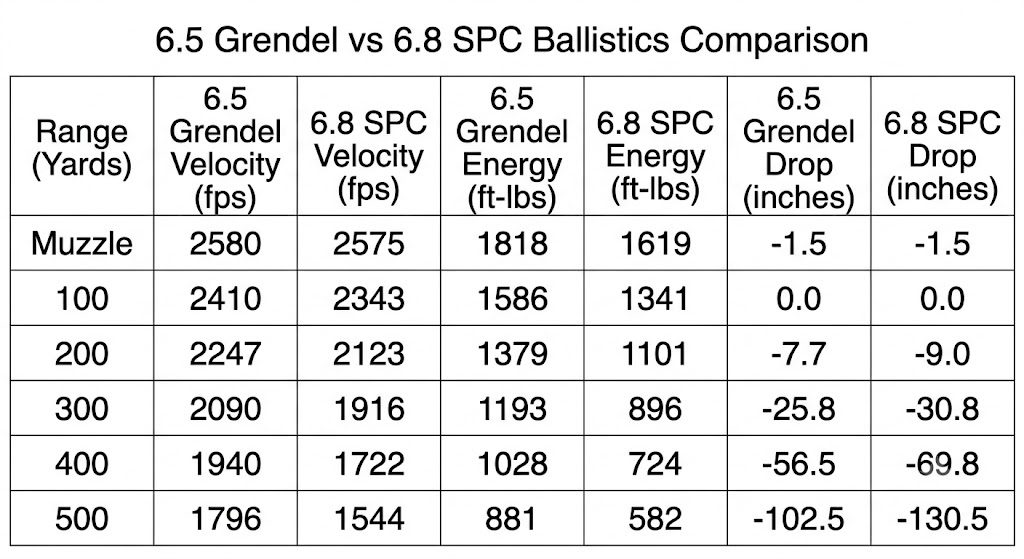
The following data compares two popular factory loads: the Hornady 6.5 Grendel 123gr SST (24-inch barrel) and the Hornady 6.8 SPC 110gr V-MAX (16-inch barrel).
Both cartridges are calculated with a 100-yard zero and a 10 mph crosswind.
| Range (Yards) | 6.5 Grendel Velocity (fps) | 6.8 SPC Velocity (fps) | 6.5 Grendel Energy (ft-lbs) | 6.8 SPC Energy (ft-lbs) | 6.5 Grendel Drop (inches) | 6.8 SPC Drop (inches) | 6.5 Grendel Wind Drift (in) | 6.8 SPC Wind Drift (in) |
| Muzzle | 2,580 | 2,575 | 1,818 | 1,619 | -1.5 | -1.5 | 0.0 | 0.0 |
| 25 | 2,538 | 2,515 | 1,759 | 1,545 | -0.6 | -0.6 | 0.1 | 0.1 |
| 50 | 2,495 | 2,456 | 1,700 | 1,473 | +0.1 | 0.0 | 0.3 | 0.4 |
| 75 | 2,453 | 2,399 | 1,643 | 1,406 | +0.4 | +0.3 | 0.6 | 0.9 |
| 100 | 2,410 | 2,343 | 1,586 | 1,341 | 0.0 | 0.0 | 1.1 | 1.6 |
| 125 | 2,368 | 2,286 | 1,531 | 1,277 | -1.1 | -1.3 | 1.8 | 2.5 |
| 150 | 2,327 | 2,231 | 1,478 | 1,216 | -2.7 | -3.1 | 2.6 | 3.8 |
| 175 | 2,287 | 2,176 | 1,428 | 1,157 | -4.9 | -5.7 | 3.6 | 5.3 |
| 200 | 2,247 | 2,123 | 1,379 | 1,101 | -7.7 | -9.0 | 4.8 | 7.1 |
| 225 | 2,207 | 2,069 | 1,331 | 1,046 | -11.1 | -13.1 | 6.2 | 9.2 |
| 250 | 2,168 | 2,017 | 1,284 | 994 | -15.3 | -18.1 | 7.8 | 11.5 |
| 275 | 2,128 | 1,966 | 1,237 | 944 | -20.2 | -24.0 | 9.6 | 14.2 |
| 300 | 2,090 | 1,916 | 1,193 | 896 | -25.8 | -30.8 | 11.6 | 17.3 |
| 350 | 2,014 | 1,817 | 1,108 | 806 | -39.5 | -47.9 | 16.3 | 24.5 |
| 400 | 1,940 | 1,722 | 1,028 | 724 | -56.5 | -69.8 | 21.9 | 33.2 |
| 450 | 1,867 | 1,631 | 952 | 650 | -77.3 | -97.0 | 28.3 | 43.5 |
| 500 | 1,796 | 1,544 | 881 | 582 | -102.5 | -130.5 | 35.7 | 55.6 |
Comparison Chart Image
1. Cartridge Overview
The firearms industry developed both of these cartridges to solve specific limitations of the standard 5.56x45mm NATO round in the AR-15 platform. However, the engineers approached the problem with entirely different goals.
Alexander Arms introduced the 6.5 Grendel in 2003. Designers Bill Alexander and Janne Pohjoispää modified the .220 Russian case to accept highly efficient 6.5mm (.264 caliber) bullets. They prioritized long-range precision and kinetic energy retention. The Grendel transforms the standard AR-15 into a legitimate 1,000-yard target rifle and a capable medium-game hunting tool past 400 yards. It achieves this by focusing on aerodynamic bullet designs rather than raw muzzle velocity.
Remington and the U.S. Army Marksmanship Unit jointly developed the 6.8 SPC (Special Purpose Cartridge) in 2002. They sought to maximize terminal performance, lethality, and reliability in short-barreled rifles used in close-quarters urban combat. Based on the classic .30 Remington case, the 6.8 SPC fires a wider .277-caliber bullet. It delivers devastating energy transfer inside 200 yards, providing a massive upgrade in stopping power over the 5.56 NATO without transitioning to the heavier AR-10 platform.
Today, both rounds maintain massive popularity among civilian shooters. The 6.5 Grendel dominates precision rifle series (PRS) gas-gun divisions and open-country hunting, while the 6.8 SPC remains a top-tier choice for feral hog eradication and dense-woods deer hunting.
2. Key Differences
The primary technical differences between these cartridges lie in their bullet diameters, case capacities, and aerodynamic efficiency. The 6.5 Grendel utilizes a .264-inch projectile, while the 6.8 SPC pushes a wider .277-inch projectile.
This minor difference in diameter creates a massive difference in bullet geometry. The 6.5 Grendel uses long, sleek bullets with exceptionally high ballistic coefficients (BC). These high-BC projectiles cut through the air with minimal drag, allowing the Grendel to maintain velocity and resist wind drift at extended distances. The tradeoff requires a shorter, wider powder column and a steeper shoulder, which feeds perfectly fine but places more stress on the AR-15 bolt extractor.
The 6.8 SPC prioritizes immediate kinetic energy transfer over aerodynamic flight. Its .277-caliber bullets are shorter and lighter for their diameter, resulting in lower ballistic coefficients. However, this design allows the 6.8 SPC to achieve complete powder burn rapidly. It generates maximum velocity out of 14.5-inch and 16-inch barrels, whereas the 6.5 Grendel needs at least 20 inches of barrel to reach its true potential.
The design philosophy dictates the application. The 6.8 SPC behaves like a modern .30-30 Winchester—a devastating short-range hammer. The 6.5 Grendel behaves like a miniature 6.5 Creedmoor—a precision scalpel capable of reaching across canyons.
3. Velocity Comparison
Measuring muzzle velocity requires matching the cartridge to its intended barrel length. The 6.8 SPC excels in short barrels, consistently pushing 110-grain bullets past 2,550 feet per second (fps) from a standard 16-inch carbine. The 6.5 Grendel requires a 24-inch barrel to push a 123-grain bullet to 2,580 fps. If fired from a 16-inch barrel, the Grendel drops closer to 2,400 fps.
Downrange velocity tells a completely different story. Because the 6.5 Grendel fires highly aerodynamic bullets, it bleeds speed much slower than the 6.8 SPC. Returning to our ballistics chart, the Grendel and SPC leave the muzzle at nearly identical speeds. By 200 yards, the Grendel travels over 120 fps faster. By 500 yards, the Grendel outpaces the SPC by more than 250 fps.
Velocity retention directly impacts bullet expansion. Most hunting projectiles require an impact velocity of at least 1,800 fps to expand reliably. The 6.8 SPC 110gr V-MAX drops below this expansion threshold around 360 yards. The 6.5 Grendel 123gr SST remains above the 1,800 fps threshold out to 500 yards.
The 6.5 Grendel wins the velocity comparison by a massive margin at long range, ensuring reliable terminal performance at distances where the 6.8 SPC essentially functions as a non-expanding solid.
4. Energy Comparison
Muzzle energy dictates the immediate stopping power a cartridge transfers to a target. Out of a 16-inch barrel, the 6.8 SPC hits incredibly hard, generating over 1,600 foot-pounds (ft-lbs) of kinetic energy with standard loads. This immediate energy transfer makes the 6.8 SPC a devastating cartridge for brush hunting and tactical engagements.
However, kinetic energy relies heavily on retained velocity. As the 6.8 SPC sheds speed due to its low-BC bullets, its kinetic energy plummets. At 300 yards, the 6.8 SPC delivers roughly 896 ft-lbs of energy. In contrast, the 6.5 Grendel delivers 1,193 ft-lbs at the exact same distance.
Ethical hunting standards generally recommend 1,000 ft-lbs of kinetic energy for medium game like whitetail deer. The 6.8 SPC falls below this ethical threshold right around 240 yards. The 6.5 Grendel carries over 1,000 ft-lbs of energy well past 400 yards.
The 6.8 SPC wins the energy comparison inside 150 yards when fired from short-barreled rifles, making it the superior brush-country cartridge. The 6.5 Grendel claims the definitive victory in downrange energy, offering nearly double the effective ethical hunting distance for big game.
5. Trajectory & Bullet Drop Comparison
Trajectory dictates how easily a shooter can place rounds on target at varying distances without making complex optic adjustments. Inside 200 yards, both cartridges shoot remarkably flat. With a 100-yard zero, the 6.5 Grendel drops 7.7 inches at 200 yards, while the 6.8 SPC drops 9.0 inches. In a practical hunting scenario inside 200 yards, the shooter simply holds the crosshairs center-mass with either rifle.
The trajectory gap widens drastically beyond 300 yards. The 6.8 SPC plunges rapidly as air resistance slows the blunt projectile. At 400 yards, the 6.8 SPC requires nearly 70 inches of holdover. The 6.5 Grendel requires only 56.5 inches of holdover.
By 500 yards, the 6.5 Grendel drops 102.5 inches, while the 6.8 SPC drops a massive 130.5 inches. That translates to an additional two and a half feet of bullet drop for the 6.8 SPC.
For shooters engaging targets past 300 yards, the flatter trajectory of the 6.5 Grendel is far more forgiving of ranging errors. Misjudging the distance to a target by 25 yards with a 6.8 SPC will result in a clean miss. The 6.5 Grendel shoots much flatter, securing the definitive win in trajectory and drop performance.
6. Wind Drift Comparison
Wind deflection separates capable short-range cartridges from true precision rounds. Wind drift ruins more long-range shots than bullet drop, primarily because gravity remains constant while wind speed and direction change constantly.
A bullet’s ability to resist wind drift depends entirely on its ballistic coefficient. The 6.5 Grendel fires projectiles with G1 BCs regularly exceeding .500. The 6.8 SPC fires projectiles with G1 BCs that rarely break .400, and often hover around .320 for hunting loads.
In a mild 10 mph crosswind at 300 yards, the 6.8 SPC drifts over 17 inches off target. The 6.5 Grendel drifts just 11.6 inches. At 500 yards, the aerodynamic superiority of the 6.5 Grendel becomes impossible to ignore. The 6.8 SPC gets blown 55.6 inches off course, while the Grendel drifts only 35.7 inches.
This 20-inch difference at 500 yards makes the 6.5 Grendel vastly superior for practical field shooting. Wind calls become significantly less critical with the Grendel, allowing hunters and competitive shooters to land first-round impacts in shifting conditions. The 6.5 Grendel easily wins the wind drift comparison.
7. Hunting Performance Comparison
Both cartridges excel at medium-game hunting within their specific operating parameters.
For feral hogs and brush-country whitetail deer inside 200 yards, the 6.8 SPC is exceptional. The .277-caliber bullet expands aggressively upon impact, dumping massive energy into the animal. Short-barreled AR-15s chambered in 6.8 SPC swing quickly in dense woods and maneuver easily in hunting blinds.
The 6.5 Grendel performs equally well on deer and hogs but extends the ethical kill zone dramatically. While the 6.8 SPC runs out of lethal energy at 250 yards, the Grendel effortlessly drops mule deer and antelope at 400 yards across open prairies. The high sectional density of the 6.5mm bullet ensures deep, vital-crushing penetration even at extended distances.
For predator hunting like coyotes, the 6.5 Grendel’s flat trajectory allows hunters to point and shoot at unknown distances with higher confidence. Neither cartridge is recommended for elk or moose, though the 6.5 Grendel can take black bear at close range with well-constructed copper monolithics.
The 6.8 SPC wins the thick-brush hunting category due to its short-barrel efficiency. The 6.5 Grendel wins the open-terrain and versatility category, offering ethical harvests at double the distance.
8. Accuracy & Long-Range Performance
The 6.5 Grendel dominates the accuracy and long-range performance category without question. The cartridge was engineered from the ground up for precision shooting. Quality factory match ammunition easily achieves sub-MOA (Minute of Angle) accuracy in well-built rifles. Competitive shooters regularly use the 6.5 Grendel to engage steel targets accurately out to 1,000 yards.
The 6.8 SPC struggles significantly in this arena. The cartridge transitions from supersonic to subsonic flight much earlier than the Grendel. When a bullet drops subsonic, it experiences a transonic shockwave that destabilizes its flight path, destroying accuracy. The 6.8 SPC typically enters this unstable transonic zone around 600 yards, establishing a hard limit on its effective target range.
Furthermore, precision ammunition options heavily favor the 6.5mm caliber. Manufacturers load exceptional match-grade projectiles like the Hornady ELD-M and Sierra MatchKing for the Grendel. The 6.8 SPC market primarily focuses on hunting and tactical ammunition, limiting factory-loaded precision options.
If ringing steel past 500 yards or shooting tiny groups on paper is the goal, the 6.5 Grendel is vastly superior to the 6.8 SPC.
9. Pros and Cons
Both cartridges offer unique advantages and distinct limitations. Evaluating these helps determine the correct tool for specific shooting applications.
6.5 Grendel Pros
• Exceptonal long-range ballistics and wind resistance
• Maintains ethical hunting energy past 400 yards
• Wide availability of high-BC, match-grade projectiles
• Capable of reaching 1,000 yards on steel targets
• Mild recoil impulse suitable for all shooters
6.5 Grendel Cons
• Requires a 20- to 24-inch barrel to achieve maximum performance
• Steep case shoulder places extra stress on AR-15 extractors
• Lower muzzle velocity than traditional varmint cartridges
6.8 SPC Pros
• Achieves maximum velocity and efficiency in 14.5 to 16-inch barrels
• Delivers devastating kinetic energy transfer inside 200 yards
• Extremely reliable feeding geometry in AR-15 magazines
• Ideal ballistics for short-range feral hog eradication
• Excellent terminal performance for home defense applications
6.8 SPC Cons
• Poor ballistic coefficients lead to rapid velocity and energy loss
• Drops completely out of ethical hunting energy past 300 yards
• Significantly more wind drift than 6.5mm alternatives
• Very limited options for match-grade precision ammunition
10. Which One Should You Choose?
Selecting between the 6.5 Grendel and the 6.8 SPC requires an honest assessment of how and where you intend to shoot.
Best for deer hunting in open country: Choose the 6.5 Grendel. The ability to ethically harvest deer at 400 yards with a flat trajectory makes it the undisputed champion of plains and agricultural hunting.
Best for hog hunting in thick brush: Choose the 6.8 SPC. It delivers massive immediate energy transfer from a highly maneuverable 16-inch barrel, dropping tough feral hogs efficiently at close range.
Best for target shooting and long range: Choose the 6.5 Grendel. High-BC match bullets, superior wind resistance, and the ability to stay supersonic out to 1,000 yards make it a legitimate precision rifle cartridge.
Best for self-defense and tactical use: Choose the 6.8 SPC. Designed specifically for short-barreled urban combat, it offers reliable feeding and exceptional close-quarters terminal ballistics.
Best all-around cartridge: Choose the 6.5 Grendel. While it requires a slightly longer barrel, the massive advantage in downrange trajectory, wind drift, and retained energy makes it a vastly more capable and versatile cartridge across a wider variety of shooting disciplines.