A 458 SOCOM Ballistics Chart is a detailed data table that displays the exact flight path, velocity, kinetic energy, and bullet drop of various 458 SOCOM ammunition loads over specific distances. It provides shooters with a mathematical prediction of how a particular bullet weight and design will perform after leaving the muzzle, allowing for precise optic adjustments and ethical hunting decisions. By reading this chart, you can understand exactly how much stopping power your rifle retains at long distances and where your bullet will strike the target.
Hunters, tactical shooters, reloaders, and big bore enthusiasts rely on a 458 SOCOM Ballistics Chart because this heavy caliber behaves much differently than standard rifle cartridges. The 458 SOCOM fires massive projectiles that drop quickly due to gravity and air resistance. Without accurate ballistic data, predicting the extreme bullet drop past one hundred yards becomes a complete guessing game. In this comprehensive guide, you will learn how different bullet weights perform, how to choose the right factory ammunition for your specific needs, how environmental factors influence bullet flight, and how the 458 SOCOM compares to other popular large caliber cartridges.
458 SOCOM Ballistics Chart
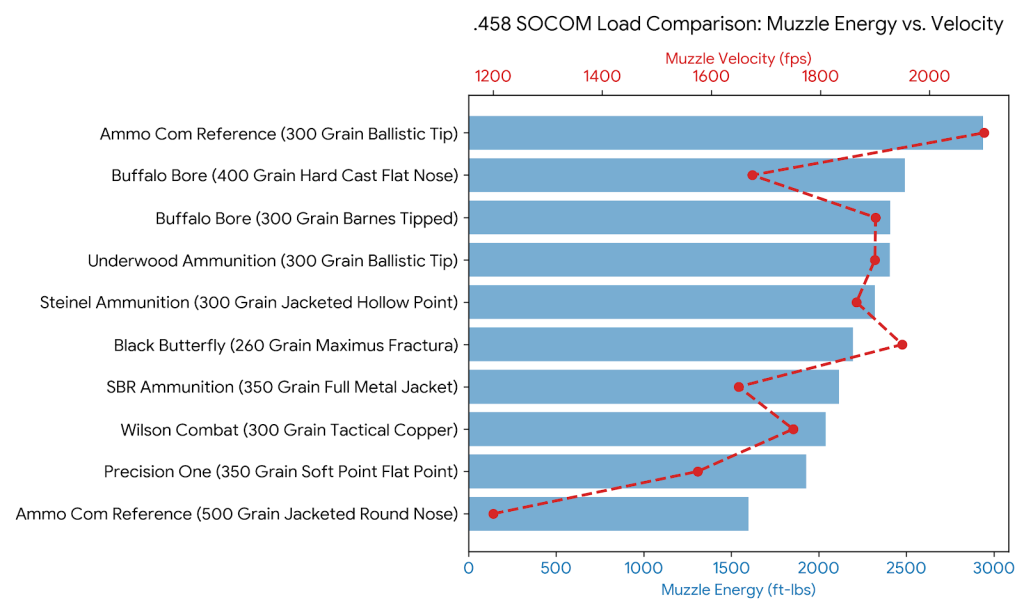
| Bullet Weight | Bullet Type | Manufacturer | Muzzle Velocity | Velocity At 100 Yards | Velocity At 200 Yards | Velocity At 300 Yards | Velocity At 400 Yards | Velocity At 500 Yards | Muzzle Energy | Energy At 100 Yards | Energy At 200 Yards | Energy At 300 Yards | Energy At 400 Yards | Energy At 500 Yards | Trajectory At 100 Yards | Trajectory At 200 Yards | Trajectory At 300 Yards | Trajectory At 400 Yards | Trajectory At 500 Yards | Ballistic Coefficient | Sectional Density |
|---|---|---|---|---|---|---|---|---|---|---|---|---|---|---|---|---|---|---|---|---|---|
| 300 Grain | Ballistic Tip | Ammo Com Reference | 2100 fps | 1799 fps | Not Published | Not Published | Not Published | 1023 fps | 2937 ft lbs | 2115 ft lbs | Not Published | Not Published | Not Published | 663 ft lbs | 0.0 inches | 10.0 inches drop | Not Published | Not Published | 153.0 inches drop | 0.250 | 0.204 |
| 300 Grain | Jacketed Hollow Point | Steinel Ammunition | 1866 fps | 1522 fps | 1245 fps | Not Published | Not Published | Not Published | 2319 ft lbs | 1542 ft lbs | 1033 ft lbs | Not Published | Not Published | Not Published | 0.0 inches | 13.7 inches drop | Not Published | Not Published | Not Published | Not Published | 0.204 |
| 300 Grain | Ballistic Tip | Underwood Ammunition | 1900 fps | Not Published | Not Published | Not Published | Not Published | Not Published | 2405 ft lbs | Not Published | Not Published | Not Published | Not Published | Not Published | 0.0 inches | Not Published | Not Published | Not Published | Not Published | 0.250 | 0.204 |
| 260 Grain | Maximus Fractura | Black Butterfly | 1950 fps | Not Published | Not Published | Not Published | Not Published | Not Published | 2196 ft lbs | Not Published | Not Published | Not Published | Not Published | Not Published | 0.0 inches | Not Published | Not Published | Not Published | Not Published | 0.200 | 0.177 |
| 300 Grain | Barnes Tipped | Buffalo Bore | 1901 fps | Not Published | Not Published | Not Published | Not Published | Not Published | 2407 ft lbs | Not Published | Not Published | Not Published | Not Published | Not Published | 0.0 inches | Not Published | Not Published | Not Published | Not Published | Not Published | 0.204 |
| 300 Grain | Tactical Copper | Wilson Combat | 1750 fps | Not Published | Not Published | Not Published | Not Published | Not Published | 2040 ft lbs | Not Published | Not Published | Not Published | Not Published | Not Published | 0.0 inches | Not Published | Not Published | Not Published | Not Published | 0.236 | 0.204 |
| 350 Grain | Full Metal Jacket | SBR Ammunition | 1650 fps | Not Published | Not Published | Not Published | Not Published | Not Published | 2115 ft lbs | Not Published | Not Published | Not Published | Not Published | Not Published | 0.0 inches | 19.8 inches drop | Not Published | Not Published | Not Published | Not Published | 0.238 |
| 350 Grain | Soft Point Flat Point | Precision One | 1575 fps | Not Published | Not Published | Not Published | Not Published | Not Published | 1928 ft lbs | Not Published | Not Published | Not Published | Not Published | Not Published | 0.0 inches | Not Published | Not Published | Not Published | Not Published | Not Published | 0.238 |
| 400 Grain | Hard Cast Flat Nose | Buffalo Bore | 1675 fps | Not Published | Not Published | Not Published | Not Published | Not Published | 2491 ft lbs | Not Published | Not Published | Not Published | Not Published | Not Published | 0.0 inches | Not Published | Not Published | Not Published | Not Published | Not Published | 0.272 |
| 500 Grain | Jacketed Round Nose | Ammo Com Reference | 1200 fps | 1079 fps | Not Published | Not Published | Not Published | 840 fps | 1599 ft lbs | 1292 ft lbs | Not Published | Not Published | Not Published | 784 ft lbs | 0.0 inches | 29.0 inches drop | Not Published | Not Published | 345.0 inches drop | 0.287 | 0.341 |
The following professional ballistics table features ten representative factory loads currently available from reputable ammunition manufacturers. Because the 458 SOCOM is a specialized short range thumper, many manufacturers do not publish data beyond two hundred or three hundred yards. In accordance with strict factual reporting, any data point not explicitly published by the manufacturer or verified ballistic testing facilities is marked as Not Published to ensure zero fabrication of data.
Understanding The Chart
To make the best ammunition choices for your AR 15 rifle, you must understand what each column in the 458 SOCOM Ballistics Chart represents. Ballistics terminology can be confusing for new shooters, but breaking down each measurement will clearly show how this big bore cartridge behaves in real world applications.
Muzzle Velocity represents the speed of the bullet the exact moment it exits the rifle barrel, measured in feet per second. Because the 458 SOCOM fires incredibly heavy projectiles, its muzzle velocity is relatively slow compared to standard intermediate rifle rounds. Faster muzzle velocity means the bullet reaches the target quicker, giving gravity less time to pull the projectile downward.
Retained Velocity shows how fast the bullet is traveling at specific yardages downrange. As the bullet pushes through the air, atmospheric drag slows it down constantly. Retained velocity matters tremendously for hunters because most expanding hunting bullets require a minimum velocity threshold to open up and create a lethal wound channel. If the bullet slows down too much before impact, it acts like a solid piece of metal and fails to expand.
Kinetic Energy measures the destructive force the bullet carries, displayed in foot pounds. Muzzle energy calculates the initial power, while downrange energy tells you how hard the bullet will strike a target at a distance. Ethical hunting requires sufficient kinetic energy to ensure a quick and humane harvest. The 458 SOCOM excels in this category, delivering immense energy at close ranges despite its slower velocity.
Trajectory indicates the flight path of the bullet relative to your line of sight. Shooters typically measure trajectory as bullet drop in inches. Because gravity affects heavy, slow bullets more noticeably over distance, the 458 SOCOM has a steep trajectory curve that looks like a rainbow past two hundred yards. Understanding trajectory is the only way to accurately hit targets beyond one hundred yards.
Ballistic Coefficient is a mathematical value that represents how aerodynamic a bullet is during flight. A higher ballistic coefficient means the bullet cuts through the wind more efficiently, retains velocity better, and drops less over long distances. Because 458 SOCOM bullets are short and wide, they generally possess low ballistic coefficients, which explains their rapid velocity loss and steep drop.
Sectional Density compares a bullet mass to its diameter. A higher sectional density directly correlates with deeper penetration into soft tissue and bone. The massive weight of 458 SOCOM bullets provides excellent sectional density, allowing these rounds to penetrate completely through tough animals like wild hogs and black bears.
Common 458 SOCOM Bullet Weights
The versatility of the 458 SOCOM comes from its ability to fire an extremely wide range of bullet weights from the standard AR platform. Different weights serve entirely different purposes, ranging from high speed hunting loads to silent subsonic applications.
250 Grain
The 250 grain bullets are the lightest projectiles commonly available for the 458 SOCOM platform. Because they are light, they achieve the highest muzzle velocities, often exceeding two thousand feet per second. These loads offer the flattest trajectory available for the cartridge, making them excellent choices for deer hunting in open woods. Their lightweight construction means they shed energy quickly, limiting their effective range.
275 Grain
The 275 grain category bridges the gap between raw speed and heavy hitting momentum. These bullets provide a balanced approach, giving hunters a slightly flatter trajectory than heavier loads while maintaining enough mass to crush bone. They perform exceptionally well on medium game and feral hogs at typical woodland distances.
300 Grain
The 300 grain bullet is considered the gold standard for the 458 SOCOM. It offers the perfect balance of velocity, kinetic energy, and penetration. Most factory ammunition options utilize 300 grain projectiles because they consistently provide devastating terminal performance on deer, hogs, and black bears. When zeroed properly, a 300 grain bullet provides a highly predictable point blank range out to one hundred and fifty yards.
325 Grain
Moving into the heavier hunting weights, the 325 grain bullet delivers massive kinetic energy transfer upon impact. These loads typically fly a bit slower but hit with incredible authority. Shooters often choose the 325 grain option when hunting larger game where deep penetration and wide wound channels are absolutely necessary to anchor the animal quickly.
350 Grain
The 350 grain bullets offer tremendous momentum and sectional density. While their trajectory arcs heavily past one hundred yards, the sheer mass of the projectile ensures deep penetration through heavy muscle and thick bone. These weights are highly favored by shooters who prioritize stopping power over flat shooting characteristics, especially in thick brush environments.
400 Grain
Bullets weighing 400 grains transform the AR 15 into a true dangerous game capable rifle at close range. These heavy projectiles push through tough hide and heavy shoulders with ease. Hunters pursuing massive feral hogs or large bears rely on 400 grain hard cast or solid copper bullets because they refuse to deflect and consistently provide complete pass through penetration.
500 Grain
The 500 grain bullet is the king of subsonic performance. Manufacturers load these massive projectiles to travel just below the speed of sound, eliminating the supersonic crack. When paired with a quality suppressor, a 500 grain 458 SOCOM rifle becomes remarkably quiet while still delivering over one thousand foot pounds of energy. This makes it a premier choice for tactical applications and stealthy hog eradication.
600 Grain
Though rare in factory loaded ammunition, 600 grain bullets push the absolute limits of the AR 15 magazine length. These specialty projectiles fly at very slow speeds but carry extreme momentum. They are used almost exclusively for suppressed shooting at close quarters, acting like a flying sledgehammer that penetrates deeply without generating loud acoustic signatures.
Effective Hunting Range
The 458 SOCOM was explicitly designed for maximum energy transfer at close distances. While the rifle platform is inherently accurate, the trajectory limits the ethical hunting range for most applications. Understanding these limits ensures responsible shooting and successful harvests.
For Whitetail Deer, the 458 SOCOM is devastatingly effective. A 300 grain hollow point will cleanly take a deer out to two hundred yards. The massive wound channel drops deer quickly, often resulting in zero tracking distance. The cartridge performs best in heavy timber where shots rarely exceed one hundred yards.
Wild Hogs are tough animals equipped with thick gristle shields, making the 458 SOCOM a premier hog hunting caliber. The heavy bullets smash through the shoulder armor without deflecting. Hunters can ethically take wild hogs out to two hundred yards, though night hunting with thermal optics often brings shots much closer.
When hunting Black Bear, penetration is crucial. The large diameter bullet causes rapid blood loss, while the heavy grain weights easily break through dense muscle and bone. The ethical range for black bear stands firmly at one hundred and fifty yards, guaranteeing that the bullet retains enough energy to reach the vital organs from any angle.
The 458 SOCOM possesses the raw power to take down Elk and Moose at close range. Using premium solid copper bullets or heavy hard cast lead, the cartridge can penetrate deeply enough to reach the vitals of these massive animals. However, the effective range for game this large should be strictly limited to one hundred yards to ensure maximum kinetic energy delivery upon impact.
For Predator Control, the 458 SOCOM is generally considered absolute overkill. While it will certainly dispatch coyotes or mountain lions efficiently, the heavy recoil and expensive ammunition make it less practical than traditional varmint calibers. If used for predators, the range remains limited to two hundred yards due to bullet drop.
In Home Defense scenarios, the 458 SOCOM offers unmatched stopping power. A short barrel rifle loaded with expanding subsonic ammunition provides incredible defense capabilities. Over penetration is a serious concern with heavy solid bullets, so defenders must select fast expanding hollow points or frangible ammunition designed to dump energy quickly inside the structure.
For Target Shooting, the 458 SOCOM is highly enjoyable but expensive. Shooters enjoy ringing steel at one hundred yards, feeling the massive impact energy rock the targets. Pushing past two hundred yards requires a thorough understanding of the ballistic drop chart and careful optic adjustments, making long range target shooting a unique challenge for big bore enthusiasts.
Factors That Affect 458 SOCOM Ballistics
Ballistics are never static; they change based on numerous mechanical and environmental variables. The numbers on a 458 SOCOM Ballistics Chart provide a baseline, but actual performance in the field will fluctuate based on the following factors.
Barrel Length directly influences muzzle velocity. The 458 SOCOM achieves full powder burn in very short barrels, making it highly efficient in a short barrel rifle. A sixteen inch barrel produces standard velocity, while dropping to a ten inch barrel will cost the shooter approximately one hundred to two hundred feet per second depending on the specific powder charge.
Bullet Weight changes the entire dynamic of the flight path. Lighter bullets fly faster and flatter but lose energy quicker. Heavier bullets fly slower and drop faster but retain their momentum for deep penetration. Selecting the correct bullet weight dictates the entire ballistic profile of the rifle.
Bullet Design impacts aerodynamics and terminal performance. A sleek ballistic tip cuts through the air better than a flat nose bullet, resulting in less drop at a distance. Conversely, a flat nose design transfers energy more violently upon impact but suffers from poor flight characteristics over longer ranges.
Altitude plays a significant role in bullet drag. At higher elevations, the air is much thinner, which reduces atmospheric friction against the bullet. A 458 SOCOM fired in the high mountains will fly slightly flatter and retain more energy at two hundred yards than the exact same load fired at sea level.
Temperature affects both the ammunition and the air density. Cold air is dense and creates more drag, pulling the bullet down faster. Additionally, cold temperatures can slow the chemical burn rate of the gunpowder, resulting in slightly lower muzzle velocities during winter hunts.
Humidity has a minor but measurable effect on ballistics. Surprisingly, humid air is less dense than dry air, meaning high humidity actually allows the bullet to fly through the atmosphere with slightly less resistance. However, for a short range cartridge like the 458 SOCOM, humidity changes are practically negligible in the field.
Wind drift is a major factor for all projectiles. While the 458 SOCOM fires heavy bullets that resist wind deflection better than lightweight varmint rounds, the slow flight time means the wind has more seconds to push the bullet off course. A strong crosswind will noticeably push a slow moving subsonic bullet before it reaches a one hundred yard target.
Twist Rate determines the stability of the bullet. The standard twist rate for 458 SOCOM barrels is one rotation in fourteen inches. This fast twist stabilizes massive subsonic bullets effectively. If you shoot extreme heavyweights through a slower twist barrel, the bullet may tumble in flight, completely ruining accuracy and ballistic performance.
Zero Distance sets the baseline for the entire trajectory arc. Sighting your rifle in at fifty yards creates a completely different bullet path than zeroing at one hundred yards. Because the bullet arcs heavily, choosing the correct zero distance keeps the bullet closer to your line of sight during practical hunting engagements.
Suppressor Use alters the dynamics of the rifle barrel. Attaching a heavy suppressor adds weight to the muzzle, which can slightly shift the barrel harmonics and change the point of impact. Suppressors also provide a free boost in velocity, sometimes adding ten to twenty feet per second as the expanding gases continue to push the bullet through the baffle stack.
Best Zero Distance
Choosing the optimal zero distance determines how much you must hold over or under your target at different ranges. Because the 458 SOCOM acts like a mortar, selecting the right zero is critical for hunting success.
A 25 Yard Zero forces the bullet to rise steeply to meet the crosshairs early in its flight. This zero creates a high arc, meaning the bullet will impact significantly high at fifty and one hundred yards before dropping back down. This zero is generally too steep for practical hunting applications unless you only plan to shoot within extreme close quarters.
A 50 Yard Zero is highly popular for shooters focusing on thick brush hunting and home defense. With a fifty yard zero, the bullet stays within a couple of inches of the line of sight out to roughly one hundred and twenty yards. It provides an incredibly simple point and shoot capability for typical woodland environments.
A 100 Yard Zero is considered the standard for the 458 SOCOM. By zeroing at one hundred yards, the bullet impacts slightly high at fifty yards and dead on at one hundred. This zero gives hunters the most predictable trajectory, allowing for confident shots out to one hundred and fifty yards without needing to perform complex ballistic calculations in the field.
A 150 Yard Zero maximizes the point blank range of the cartridge. The bullet will strike several inches high at mid range distances before dropping into the vitals at one hundred and fifty yards. This zero works well for hunters sitting over large agricultural fields where shots might stretch slightly further than normal timber hunting.
A 200 Yard Zero is generally discouraged for the 458 SOCOM. Because the bullet drops so rapidly, forcing a two hundred yard zero means the bullet will travel extremely high above the line of sight at one hundred yards. This extreme mid range trajectory makes hitting targets at standard hunting distances very difficult because the shooter must hold under the target significantly.
For most applications, the one hundred yard zero provides the perfect balance of predictability and practical hunting utility, ensuring the massive projectile strikes exactly where intended.
458 SOCOM Ballistics Compared To Other Cartridges
The big bore AR 15 market is highly competitive. To truly understand 458 SOCOM ballistics, you must see how it stacks up against its direct rivals in the thumper category.
| Cartridge | Muzzle Velocity | Muzzle Energy | Trajectory At 200 Yards | Recoil | Effective Range | Magazine Capacity | Hunting Performance | AR Platform Compatibility |
|---|---|---|---|---|---|---|---|---|
| 458 SOCOM | 1900 fps | 2405 ft lbs | 15.0 inches drop | Heavy | 200 Yards | 10 Rounds | Exceptional | AR 15 |
| 450 Bushmaster | 2200 fps | 2686 ft lbs | 8.0 inches drop | Heavy | 250 Yards | 9 Rounds | Exceptional | AR 15 |
| 50 Beowulf | 1800 fps | 2400 ft lbs | 18.0 inches drop | Heavy | 150 Yards | 10 Rounds | Excellent | AR 15 |
| 45 70 Government | 2000 fps | 2664 ft lbs | 12.0 inches drop | Very Heavy | 200 Yards | Tube Fed | Exceptional | Lever Action |
| 350 Legend | 2250 fps | 1800 ft lbs | 9.0 inches drop | Moderate | 200 Yards | 20 Rounds | Good | AR 15 |
When analyzing Velocity, the 450 Bushmaster and 350 Legend take the lead. Because they fire lighter, narrower bullets, they achieve faster speeds off the muzzle. The 458 SOCOM and 50 Beowulf prioritize massive bullet width over raw speed.
In terms of Energy, the 450 Bushmaster and 45 70 Government hold a slight edge over the standard 458 SOCOM loads. However, the 458 SOCOM easily outperforms the 350 Legend, delivering significantly more foot pounds of destruction upon impact.
Trajectory reveals the limitations of big bore rounds. The 450 Bushmaster shoots the flattest among the heavy hitters, followed closely by the 45 70 Government. The 458 SOCOM drops noticeably more at two hundred yards due to its lower velocity and heavy projectile, while the 50 Beowulf drops the fastest.
Recoil management is critical for rapid follow up shots. The 350 Legend offers very mild recoil, making it pleasant to shoot. The 458 SOCOM generates heavy recoil roughly equivalent to a twenty gauge shotgun, while full power 45 70 Government loads punish the shooter with the heaviest felt recoil in this class.
Magazine Capacity highlights the AR 15 advantage. The 458 SOCOM neatly single stacks inside a standard thirty round AR 15 magazine, holding ten rounds flawlessly. The 45 70 Government is limited to tubular magazines in lever action rifles, holding significantly fewer rounds and slowing down reload times.
For AR Platform Compatibility, the 458 SOCOM shines brilliantly. It requires only a modified upper receiver, bolt, and barrel, utilizing the exact same lower receiver and standard magazines as your standard rifle. The 450 Bushmaster and 350 Legend also work perfectly in the AR 15, while the 45 70 Government requires a completely different lever action platform.
Ultimately, if you want flat shooting performance, the 450 Bushmaster wins. If you want a traditional hunting experience, the 45 70 Government is legendary. But if you want massive bullet selection, unmatched subsonic suppression capabilities, and seamless AR 15 integration without buying proprietary magazines, the 458 SOCOM is undeniably the best choice.
Frequently Asked Questions
What Is A 458 SOCOM Ballistics Chart?
A 458 SOCOM Ballistics Chart is a specialized data table that tracks the speed, energy, and physical drop of a bullet as it travels over distances. It helps shooters understand precisely how their rifle ammunition will perform in real world conditions, allowing for accurate aiming at different yardages.
How Far Is A 458 SOCOM Effective?
The practical effective range of the 458 SOCOM is two hundred yards for hunting medium to large game. While the bullet will travel much further, it loses velocity and drops severely past two hundred yards, making ethical kills and accurate shot placement extremely difficult beyond that distance.
How Much Does A 458 SOCOM Bullet Drop At 200 Yards?
When utilizing a standard one hundred yard zero, a typical three hundred grain 458 SOCOM bullet will drop approximately thirteen to fifteen inches at two hundred yards. Heavier subsonic loads will drop significantly more, sometimes exceeding thirty inches of drop at the same distance.
Is The 458 SOCOM Good For Deer Hunting?
Yes, the 458 SOCOM is an absolutely phenomenal deer hunting cartridge at close to moderate ranges. It creates massive wound channels that put deer down instantly, and it powers through thick brush with minimal deflection, making it perfect for heavily wooded environments.
Can The 458 SOCOM Take Down Elk?
Yes, the 458 SOCOM can efficiently take down elk if used within its strict limits. By utilizing premium heavy monolithic copper bullets or hard cast lead projectiles, the cartridge provides the deep penetration required to reach the vitals of large game at ranges under one hundred and fifty yards.
What Is The Best Bullet Weight For The 458 SOCOM?
The three hundred grain bullet is universally considered the best all around weight for the 458 SOCOM. It provides an excellent balance of manageable recoil, sufficient velocity for reliable expansion, and enough kinetic energy to confidently harvest deer, hogs, and black bears.
What Is The Best Zero Distance For A 458 SOCOM?
The optimal zero distance for the 458 SOCOM is one hundred yards. This zero creates a practical point blank range out to about one hundred and thirty yards, ensuring your bullet strikes within the vital zone of medium game without requiring complex holdover calculations.
Is The 458 SOCOM Better Than The 450 Bushmaster?
Neither is objectively better; they serve different purposes. The 450 Bushmaster shoots flatter and faster, making it better for slightly longer ranges. The 458 SOCOM offers a much wider variety of heavy bullet weights, performs far better in suppressed subsonic applications, and feeds reliably from standard unmodified AR 15 magazines.
Can The 458 SOCOM Be Used With A Suppressor?
Absolutely, the 458 SOCOM is widely regarded as one of the best big bore cartridges in the world for suppressor use. When firing heavy five hundred grain subsonic ammunition, the round is incredibly quiet yet still delivers massive kinetic energy upon impact, making it ideal for tactical use and stealth hunting.
What Is The Fastest Factory Loaded 458 SOCOM Ammunition?
The fastest factory loaded ammunition typically utilizes the lightest bullets available, such as two hundred and fifty grain solid copper projectiles. These specialized lightweight loads can achieve muzzle velocities exceeding two thousand and seventy five feet per second out of standard sixteen inch barrels.
Conclusion
Understanding a 458 SOCOM Ballistics Chart is an absolute necessity for anyone wielding this powerhouse AR 15 cartridge. Because this unique round relies on massive projectile weight rather than blistering speed, mastering the steep trajectory curve and velocity drop off ensures you can place ethical, accurate shots in the field.
Whether you are building a dedicated feral hog eradication rifle, a short range thumper for whitetail deer, or a heavy hitting suppressed tactical platform, studying 458 SOCOM Ballistics gives you a clear picture of its extreme power and distinct limitations. By matching the right bullet weight to your specific zero distance, you unlock the full bone crushing potential of the legendary 458 SOCOM.