The 28 Nosler Ballistics Chart is a comprehensive reference guide that details the velocity, kinetic energy, trajectory curve, and wind drift of the 28 Nosler cartridge over various distances. By studying this chart, you can visualize exactly how your specific bullet will behave from the moment it leaves your barrel until it strikes a target hundreds or even thousands of yards downrange. This critical data allows you to accurately predict bullet drop, compensate for wind deflection, and verify that your projectile retains enough energy for an ethical kill on big game animals across open terrain.
Shooters, hunters, reloaders, and long-range precision enthusiasts use a 28 Nosler Ballistics Chart to unlock the full potential of this ultra-high-velocity cartridge. Introduced by Nosler in 2015 as part of their family of proprietary magnum rounds, the 28 Nosler is based on a shortened, necked-up 404 Jeffery case. It was specifically engineered to push heavy, highly aerodynamic .284-inch (7mm) projectiles at blistering speeds, effectively rivaling or beating standard 7mm magnums. By analyzing the numbers, a hunter can see how this high-capacity cartridge retains lethal kinetic energy and flat trajectories out to extreme distances. In this comprehensive guide, you will learn how to analyze ballistics data, choose the absolute best bullet weight for your specific needs, determine the ideal zero distance, and see how this modern magnum performs compared to other popular calibers.
28 Nosler Ballistics Chart
Below is a detailed ballistics table featuring popular factory-loaded ammunition for the 28 Nosler. The data represents a standard 26-inch test barrel and assumes a 100-yard zero under standard sea-level atmospheric conditions.
| Bullet Weight | Bullet Type | Manufacturer | Muzzle Velocity | Velocity At 100 Yards | Velocity At 200 Yards | Velocity At 300 Yards | Velocity At 400 Yards | Velocity At 500 Yards | Muzzle Energy | Energy At 100 Yards | Energy At 200 Yards | Energy At 300 Yards | Energy At 400 Yards | Energy At 500 Yards | Trajectory At 100 Yards | Trajectory At 200 Yards | Trajectory At 300 Yards | Trajectory At 400 Yards | Trajectory At 500 Yards | Ballistic Coefficient | Sectional Density |
| 150 Grain | AccuBond | Nosler | 3300 fps | 3080 fps | 2872 fps | 2673 fps | 2483 fps | 2301 fps | 3627 ft lbs | 3160 ft lbs | 2747 ft lbs | 2379 ft lbs | 2053 ft lbs | 1763 ft lbs | 0 inches | 2.1 inches drop | 8.2 inches drop | 19.0 inches drop | 35.2 inches drop | 0.496 | 0.266 |
| 155 Grain | Terminal Ascent | Federal Premium | 3200 fps | 3020 fps | 2848 fps | 2682 fps | 2521 fps | 2366 fps | 3524 ft lbs | 3139 ft lbs | 2795 ft lbs | 2475 ft lbs | 2187 ft lbs | 1925 ft lbs | 0 inches | 2.3 inches drop | 8.8 inches drop | 20.2 inches drop | 37.0 inches drop | 0.586 | 0.275 |
| 160 Grain | Partition | Nosler | 3300 fps | 3060 fps | 2832 fps | 2616 fps | 2410 fps | 2213 fps | 3868 ft lbs | 3326 ft lbs | 2851 ft lbs | 2431 ft lbs | 2063 ft lbs | 1739 ft lbs | 0 inches | 2.1 inches drop | 8.5 inches drop | 19.8 inches drop | 36.8 inches drop | 0.475 | 0.283 |
| 160 Grain | CX Outfitter | Hornady | 3250 fps | 3072 fps | 2901 fps | 2736 fps | 2577 fps | 2423 fps | 3752 ft lbs | 3352 ft lbs | 2989 ft lbs | 2658 ft lbs | 2357 ft lbs | 2085 ft lbs | 0 inches | 2.1 inches drop | 8.3 inches drop | 19.2 inches drop | 35.5 inches drop | 0.596 | 0.283 |
| 165 Grain | Ballistic Tip | Nosler | 3200 fps | 3002 fps | 2813 fps | 2631 fps | 2456 fps | 2288 fps | 3751 ft lbs | 3298 ft lbs | 2898 ft lbs | 2534 ft lbs | 2210 ft lbs | 1917 ft lbs | 0 inches | 2.3 inches drop | 8.9 inches drop | 20.5 inches drop | 37.8 inches drop | 0.525 | 0.292 |
| 168 Grain | LRX | Barnes | 3150 fps | 2962 fps | 2781 fps | 2607 fps | 2439 fps | 2277 fps | 3701 ft lbs | 3270 ft lbs | 2886 ft lbs | 2533 ft lbs | 2219 ft lbs | 1935 ft lbs | 0 inches | 2.4 inches drop | 9.2 inches drop | 21.0 inches drop | 38.5 inches drop | 0.550 | 0.298 |
| 175 Grain | AccuBond LR | Nosler | 3125 fps | 2970 fps | 2821 fps | 2677 fps | 2537 fps | 2401 fps | 3792 ft lbs | 3427 ft lbs | 3089 ft lbs | 2782 ft lbs | 2501 ft lbs | 2240 ft lbs | 0 inches | 2.4 inches drop | 9.0 inches drop | 20.2 inches drop | 36.8 inches drop | 0.648 | 0.310 |
| 175 Grain | Trophy Grade ABLR | Nosler | 3125 fps | 2970 fps | 2821 fps | 2677 fps | 2537 fps | 2401 fps | 3792 ft lbs | 3427 ft lbs | 3089 ft lbs | 2782 ft lbs | 2501 ft lbs | 2240 ft lbs | 0 inches | 2.4 inches drop | 9.0 inches drop | 20.2 inches drop | 36.8 inches drop | 0.648 | 0.310 |
| 175 Grain | ELD X | Hornady | 3100 fps | 2960 fps | 2824 fps | 2692 fps | 2563 fps | 2438 fps | 3733 ft lbs | 3402 ft lbs | 3101 ft lbs | 2814 ft lbs | 2548 ft lbs | 2300 ft lbs | 0 inches | 2.4 inches drop | 9.1 inches drop | 20.2 inches drop | 36.5 inches drop | 0.689 | 0.310 |
| 180 Grain | ELD Match | Hornady | 3050 fps | 2940 fps | 2833 fps | 2728 fps | 2626 fps | 2527 fps | 3717 ft lbs | 3454 ft lbs | 3207 ft lbs | 2973 ft lbs | 2755 ft lbs | 2552 ft lbs | 0 inches | 2.5 inches drop | 9.2 inches drop | 20.2 inches drop | 36.2 inches drop | 0.796 | 0.319 |
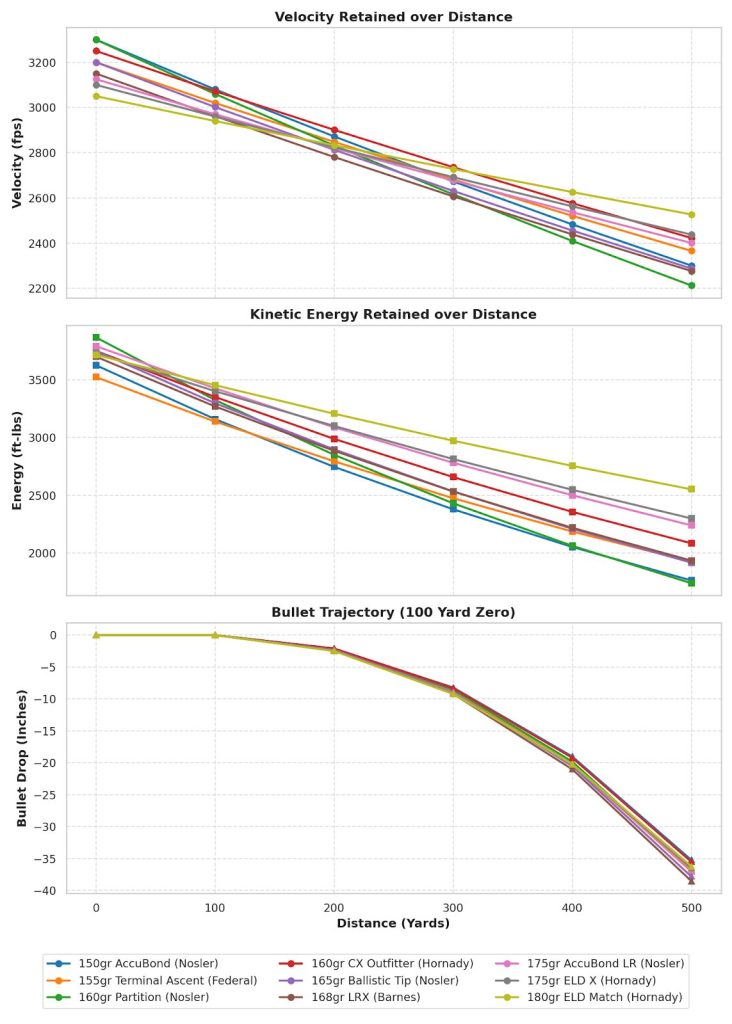
Understanding The Chart
A ballistics chart can look overwhelming at first glance due to the sheer volume of data presented. Breaking down each individual column reveals key information about how a specific load performs in the field.
Muzzle Velocity
Muzzle velocity is the speed at which the bullet exits the barrel of the firearm, measured in feet per second (fps). The 28 Nosler achieves exceptionally high muzzle velocities by packing a massive powder charge into a non-belted magnum case. Operating near SAAMI maximum pressures (around 65,000 psi), it launches heavy 7mm projectiles at speeds upwards of 3,100 to 3,300 fps, outperforming traditional 7mm cartridges.
Retained Velocity
Retained velocity refers to the speed of the bullet at specific distances downrange, such as 100 or 500 yards. Air resistance constantly slows the bullet down as it travels through the atmosphere. Retained velocity is critical for hunters because expanding hunting bullets require a minimum velocity threshold (typically 1,800 to 2,000 fps) to expand reliably upon impact. Thanks to high starting speeds and sleek bullet profiles, 28 Nosler loads retain lethal velocity past extended hunting distances.
Kinetic Energy
Kinetic energy is the amount of destructive physical force the bullet carries, measured in foot-pounds (ft-lbs). It is calculated using the weight of the bullet and its velocity at any given distance. Hunters analyze this metric on any 28 Nosler Energy Chart to verify that the load delivers sufficient power for an ethical harvest on big game. Standard guidelines recommend at least 1,000 ft-lbs of energy for deer-sized game and 1,500 ft-lbs for elk.
Trajectory
Trajectory indicates the physical path the bullet takes as it flies through the air, factoring in the constant downward pull of gravity. The 28 Nosler Trajectory Chart displays bullet drop in inches at various yardages relative to a 100-yard zero line of sight. Higher velocity magnum loads deliver remarkably flat trajectories, minimizing the needed compensation for elevation at extended ranges.
Ballistic Coefficient
The Ballistic Coefficient (BC) is a numerical value that represents how efficiently a bullet cuts through the air. A higher number indicates a more aerodynamic bullet that retains velocity and energy better over long distances. High BC bullets also resist lateral displacement from crosswinds much better than lower-rated projectiles. The .284-inch bore diameter offers some of the highest BC projectiles relative to bullet weight on the market today.
Sectional Density
Sectional density (SD) is the ratio of a bullet weight compared directly to its diameter. This metric indicates potential penetration depth into a target. Higher sectional density values generally correlate with deeper penetration. Heavy 7mm bullets weighing 160 to 180 grains offer high sectional density values (0.283 to 0.319) for penetrating thick hide and heavy bone on tough big game animals.
Common 28 Nosler Bullet Weights
The performance characteristics of the 28 Nosler shift noticeably based on bullet weight selection and construction.
150 to 155 Grain
Bullet weights in the 150 to 155-grain range offer the highest muzzle velocities for the 28 Nosler, pushing past 3,300 fps. These lightweight, ultra-fast projectiles deliver laser-flat trajectories out to 400 yards, making them ideal choices for open-country hunting of medium game like antelope, mule deer, and sheep.
160 to 168 Grain
The 160 to 168-grain category includes classic hunting projectiles, bonded designs, and solid copper monolithic options like the Barnes LRX. These weights strike a balance between high velocity, bullet integrity, and deep penetration, making them versatile choices for whitetail deer, mule deer, and black bear.
175 to 180 Grain
The 175 to 180-grain range represents the pinnacle of long-range performance for the 28 Nosler. Featuring high Ballistic Coefficients, these heavy 7mm projectiles resist wind drift and retain momentum far downrange. Loaded to velocities above 3,100 fps, they deliver devastating impact force at long distances, making them optimal for bull elk, moose, or extreme long-range target shooting.
Effective Hunting Range
The 28 Nosler Effective Range is among the most impressive of any production big game hunting cartridge.
Whitetail Deer and Antelope
For deer and antelope, the 28 Nosler is effective out to 800 yards and beyond in the hands of an experienced shooter. With proper expanding ammunition, it maintains a flat flight path, massive kinetic energy, and velocity levels that guarantee rapid ethical expansion.
Elk and Moose
Elk and moose require heavy energy delivery and deep bone-crushing penetration. Hunters generally look for a minimum of 1,500 ft-lbs of impact force. The 28 Nosler retains over 2,000 ft-lbs of energy past 600 yards with heavy 175-grain projectiles, making it a premier open-country and mountain rifle for elk and moose.
Black Bear and Grizzly Bear
Black bears and grizzlies feature dense muscle tissue and thick fat layers that require reliable projectile expansion and structural integrity. Heavy bonded or solid copper 168 to 175-grain bullets fired from the 28 Nosler easily penetrate to vital organs across deep canyons.
Wild Hogs
Feral hogs possess a dense cartilage shoulder shield that demands deep structural penetration. High-velocity 160+ grain hunting bullets out of the 28 Nosler pass through shoulder shields effortlessly at extended ranges.
Long-Range Target Shooting
For steel target shooting, high-BC match loads featuring 180-grain projectiles cut through crosswinds efficiently. The 28 Nosler remains supersonic well past 1,200 yards, making it popular for extreme long-range engagements.
Factors That Affect 28 Nosler Ballistics
Ballistics figures are influenced by physical, mechanical, and environmental variables.
Barrel Length
Barrel length directly influences final velocity. Because the 28 Nosler burns a massive powder charge relative to its bore diameter (a high overbore ratio), it requires a long 26-inch barrel to burn powder efficiently and achieve advertised velocities. Shortening the barrel to 22 or 24 inches will cause a noticeable drop in velocity (roughly 30 to 50 fps per inch).
Altitude
Higher elevations feature thinner, less dense air, reducing atmospheric drag on the bullet. Shooting the 28 Nosler at high mountain elevations results in a flatter trajectory, less wind drift, and higher retained energy downrange compared to sea-level performance.
Temperature
Cold atmospheric temperatures create denser air, increasing bullet drag. Additionally, cold ambient conditions can reduce gunpowder burn rates, lowering muzzle velocity. Selecting temperature-stable powders minimizes point-of-impact shifts in freezing conditions.
Wind
Crosswinds deflect projectiles laterally off their path. High velocity, high Ballistic Coefficient projectiles like the 175-grain or 180-grain 28 Nosler minimize time of flight and drift far less in variable crosswinds compared to standard calibers.
Twist Rate
To stabilize long, aerodynamic 175 to 180-grain 7mm projectiles, rifles chambered in 28 Nosler require fast barrel twist rates, typically 1 in 8 inches or 1 in 8.5 inches. Older or slower 1 in 9.5-inch twist rates will fail to stabilize these long projectiles.
Best Zero Distance
Selecting the optimal zero distance depends on scope setup and field application.
100 Yard Zero
A 100-yard zero is the preferred baseline for precision marksmen and long-range hunters who utilize dialable optic turrets or ballistic reticles. It establishes a clean mathematical baseline where all turret adjustments for distance are dialed upward.
200 Yard Zero
A 200-yard zero is recommended for big-game hunters using a maximum point-blank range strategy. With a high-velocity 160 to 175-grain load zeroed at 200 yards, the bullet impacts roughly 1.5 to 2 inches high at 100 yards and drops only a few inches at 250 yards, enabling a dead-center hold on a deer’s vital zone out past 275 yards without turret adjustments.
28 Nosler Ballistics Compared To Other Cartridges
Below is a comparison table showcasing how 28 Nosler loads evaluate against established hunting and magnum cartridges at 500 yards under standard sea-level conditions.
| Cartridge | Muzzle Velocity | Muzzle Energy | Trajectory At 500 Yards | Recoil | Effective Range | Receiver Size |
| 28 Nosler (175gr) | 3125 fps | 3792 ft lbs | 36.8 inches drop | Heavy | 1000+ Yards | Standard Long Action |
| 7mm Remington Magnum (175gr) | 2860 fps | 3178 ft lbs | 46.5 inches drop | Moderate-Heavy | 800 Yards | Standard Long Action |
| 7mm PRC (175gr) | 3000 fps | 3497 ft lbs | 40.5 inches drop | Heavy | 1000 Yards | Standard Long Action |
| 300 Winchester Magnum (180gr) | 2960 fps | 3480 ft lbs | 44.0 inches drop | Heavy | 1000 Yards | Standard Long Action |
| 300 PRC (212gr) | 2860 fps | 3850 ft lbs | 46.5 inches drop | Heavy | 1200 Yards | Standard Long Action |
The 28 Nosler outperforms older standard magnums like the 7mm Remington Magnum in velocity, energy retention, and trajectory flatness by burning significantly more powder in its high-capacity case. When compared to modern offerings like the 7mm PRC, the 28 Nosler produces slightly higher raw velocities with comparable bullet weights, though at the cost of shorter barrel life and higher powder consumption.
Frequently Asked Questions
What is a 28 Nosler Ballistics Chart?
It is a data reference table outlining velocity, kinetic energy, trajectory drop, and wind drift metrics for the 28 Nosler cartridge across distance. It helps shooters calculate elevation drops, wind holds, and energy retention for ethical hunting or target shooting.
How far is the 28 Nosler effective on big game?
It carries over 2,000 foot-pounds of kinetic energy past 600 yards with heavy 175-grain projectiles, making it effective for elk, deer, and large game up to and beyond that distance in the hands of an experienced shooter.
Does the 28 Nosler burn barrels fast?
Yes. Because the 28 Nosler burns a massive amount of powder relative to its 7mm bore diameter (high overbore ratio), barrel throat erosion occurs faster than standard calibers. Typical precision barrel life ranges from 600 to 1,000 rounds depending on firing schedule and heat management.
What receiver action size does the 28 Nosler require?
The 28 Nosler is designed to fit in a standard long-action receiver (3.340-inch maximum overall length), matching the action length of the .30-06 Springfield or .300 Winchester Magnum.
What twist rate is required for the 28 Nosler?
To properly stabilize modern, heavy 175 to 180-grain 7mm bullets, a fast twist rate of 1 in 8 inches (or 1 in 8.5 inches) is strongly recommended.
Conclusion
A 28 Nosler Ballistics Chart highlights the extreme performance capabilities of this modern 7mm ultra-magnum cartridge. By utilizing a high-capacity, non-belted case design that fits standard long-action receivers, the 28 Nosler launches heavy, aerodynamic projectiles at speeds over 3,100 to 3,300 fps. Understanding its trajectory curvature, retained velocity, and energy transfer characteristics enables hunters and long-range precision shooters to maximize their capabilities in open-country and mountain environments.