The main difference between the 7mm PRC and the 28 Nosler is their internal case capacity and overall powder efficiency. The 28 Nosler utilizes a massive case based on the 300 Remington Ultra Magnum to push 175 grain bullets to screaming velocities exceeding 3100 feet per second. In contrast, the newer 7mm Precision Rifle Cartridge uses a highly efficient modern case design to fire the exact same heavy bullets at roughly 3000 feet per second while burning significantly less powder. Because of its massive powder charge, the 28 Nosler delivers superior kinetic energy and a slightly flatter trajectory at extreme ranges but suffers from faster barrel wear and heavier recoil. The 7mm PRC offers hunters a more balanced and efficient long range hunting cartridge that fits perfectly into standard long action rifles without the rapid throat erosion associated with heavily overbore magnums.
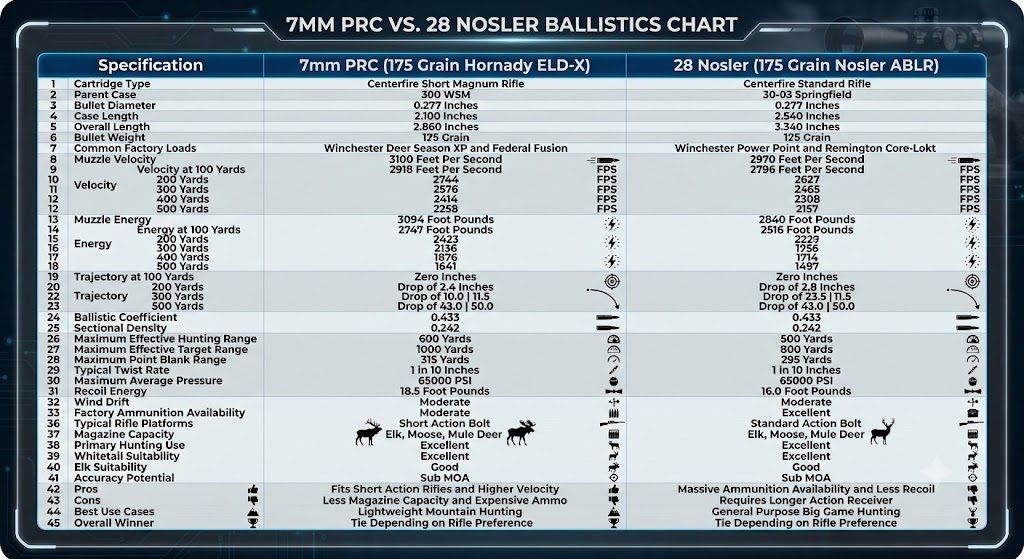
7mm PRC vs 28 Nosler Ballistics Chart
| Specification | 7mm PRC (175 Grain Hornady ELD X) | 28 Nosler (175 Grain Nosler ABLR) |
| Cartridge Type | Centerfire Magnum Rifle | Centerfire Magnum Rifle |
| Parent Case | 375 Ruger | 300 Remington Ultra Magnum |
| Bullet Diameter | 0.284 Inches | 0.284 Inches |
| Case Length | 2.280 Inches | 2.590 Inches |
| Overall Length | 3.340 Inches | 3.340 Inches |
| Bullet Weight | 175 Grain | 175 Grain |
| Common Factory Loads | Hornady Precision Hunter and Match | Nosler Trophy Grade and Match Grade |
| Muzzle Velocity | 3000 Feet Per Second | 3125 Feet Per Second |
| Muzzle Energy | 3497 Foot Pounds | 3794 Foot Pounds |
| Velocity at 100 Yards | 2860 Feet Per Second | 2975 Feet Per Second |
| Velocity at 200 Yards | 2724 Feet Per Second | 2831 Feet Per Second |
| Velocity at 300 Yards | 2593 Feet Per Second | 2692 Feet Per Second |
| Velocity at 400 Yards | 2465 Feet Per Second | 2557 Feet Per Second |
| Velocity at 500 Yards | 2341 Feet Per Second | 2426 Feet Per Second |
| Energy at 100 Yards | 3178 Foot Pounds | 3440 Foot Pounds |
| Energy at 200 Yards | 2883 Foot Pounds | 3115 Foot Pounds |
| Energy at 300 Yards | 2611 Foot Pounds | 2816 Foot Pounds |
| Energy at 400 Yards | 2360 Foot Pounds | 2541 Foot Pounds |
| Energy at 500 Yards | 2129 Foot Pounds | 2287 Foot Pounds |
| Trajectory at 100 Yards | Zero Inches | Zero Inches |
| Trajectory at 200 Yards | Drop of 2.5 Inches | Drop of 2.1 Inches |
| Trajectory at 300 Yards | Drop of 10.5 Inches | Drop of 9.0 Inches |
| Trajectory at 400 Yards | Drop of 24.5 Inches | Drop of 21.0 Inches |
| Trajectory at 500 Yards | Drop of 45.0 Inches | Drop of 38.5 Inches |
| Ballistic Coefficient | 0.689 | 0.648 |
| Sectional Density | 0.310 | 0.310 |
| Maximum Effective Hunting Range | 800 Yards | 900 Yards |
| Maximum Effective Target Range | 1500 Yards | 1500 Yards |
| Maximum Point Blank Range | 305 Yards | 320 Yards |
| Typical Twist Rate | 1 in 8 Inches | 1 in 9 Inches |
| Maximum Average Pressure | 65000 PSI | 65000 PSI |
| Recoil Energy | 26.0 Foot Pounds | 32.5 Foot Pounds |
| Wind Drift | Very Low | Very Low |
| Factory Ammunition Availability | Excellent | Moderate |
| Typical Rifle Platforms | Standard Long Action Bolt | Magnum Long Action Bolt |
| Magazine Capacity | 3 or 4 Rounds | 3 Rounds |
| Primary Hunting Use | Elk Moose and Mule Deer | Elk Moose and Mule Deer |
| Whitetail Suitability | Overkill but Effective | Overkill but Effective |
| Elk Suitability | Excellent | Excellent |
| Accuracy Potential | Sub MOA | Sub MOA |
| Pros | Efficient Powder Burn and Longer Barrel Life | Maximum Velocity and Extreme Range Energy |
| Cons | Slightly Less Velocity | Rapid Barrel Wear and Heavy Recoil |
| Best Use Cases | Long Range Big Game Hunting | Extreme Long Range Hunting |
| Overall Winner | Tie Depending on Shooter Priorities | Tie Depending on Shooter Priorities |
Muzzle Velocity Comparison
The 28 Nosler is an absolute powerhouse designed specifically to maximize velocity. When firing premium 175 grain hunting bullets the 28 Nosler achieves a staggering muzzle velocity of 3125 feet per second from a standard 26 inch barrel. The 7mm PRC fires the same weight class of bullets at a highly respectable 3000 feet per second. While the Nosler holds a 125 feet per second advantage out of the gate, the 7mm PRC achieves its velocity using a significantly smaller powder charge which makes it a remarkably efficient cartridge design.
Muzzle Energy Comparison
With greater velocity comes greater kinetic energy upon impact. The 28 Nosler generates nearly 3800 foot pounds of muzzle energy making it one of the most powerful seven millimeter cartridges ever commercialized. The 7mm PRC produces roughly 3500 foot pounds of energy at the muzzle. Both cartridges deliver more than enough knockdown power for any big game animal in North America including giant Alaskan moose and grizzly bears. Even at 500 yards both cartridges retain over 2000 foot pounds of energy ensuring devastating terminal performance at extended distances.
Trajectory Comparison
Hunters looking for the flattest shooting rifle possible will appreciate the sheer speed of the 28 Nosler. When zeroed at 100 yards the 28 Nosler drops only 38.5 inches at 500 yards. The 7mm PRC drops 45 inches at that same 500 yard marker. While the Nosler maintains a slight edge in trajectory flatness, the modern high ballistic coefficient bullets used by the 7mm PRC narrow this gap significantly as the range extends past 800 yards. Both cartridges require a quality rifle scope and precise range estimation for ethical long range hunting.
Barrel Life Comparison
The most significant tradeoff when choosing the 28 Nosler over the 7mm PRC is barrel life. The 28 Nosler is massively overbore meaning it forces a huge volume of burning powder through a relatively narrow barrel opening. This intense heat and pressure can severely erode the throat of a 28 Nosler barrel in as few as 600 to 800 rounds. The 7mm PRC uses a more modest powder column that operates far more efficiently resulting in a typical barrel life exceeding 1500 rounds before accuracy degrades noticeably.
Recoil Comparison
Burning up to 80 grains of powder per shot creates a massive amount of rearward force. A typical hunting rifle chambered in 28 Nosler generates around 32 foot pounds of felt recoil which can be punishing during extended practice sessions. The 7mm PRC generates roughly 26 foot pounds of recoil in a rifle of similar weight. Most shooters find the 7mm PRC much easier to manage without flinching which often translates to better accuracy in the field. Both rifles benefit tremendously from a high quality muzzle brake or a sound suppressor.
Rifle Action Compatibility
While both cartridges require a long action receiver they handle differently within the magazine. The 28 Nosler features a longer overall case length of 2.590 inches which can sometimes restrict hunters from seating long heavy bullets out close to the rifling lands in a standard magnum action. The 7mm PRC was specifically designed from the ground up with a shorter 2.280 inch case length. This intelligent design allows factory ammunition to perfectly seat extremely long aerodynamic bullets without exceeding the standard 3.340 inch magazine length.
Which Cartridge Is Better for Long Range Hunting
If your sole objective is delivering maximum energy at the farthest possible distances and you do not mind replacing barrels frequently, the 28 Nosler is an absolute hammer. However for the vast majority of modern hunters the 7mm PRC is the superior choice. It offers incredible long range ballistics, kicks less, burns less powder, extends your barrel life, and enjoys massive support from major ammunition manufacturers. The 7mm PRC represents the pinnacle of modern cartridge efficiency.
Frequently Asked Questions
Does the 7mm PRC kick harder than a 7mm Remington Magnum?
The recoil of the 7mm PRC is very similar to the classic 7mm Remington Magnum. Because the 7mm PRC typically fires heavier bullets ranging from 160 to 180 grains it might feel slightly more substantial depending on your exact rifle weight. Using a muzzle brake or suppressor will reduce the recoil to levels comparable to a standard 270 Winchester.
Can I shoot 28 Nosler ammunition in a 7mm PRC rifle?
You absolutely cannot interchange these two cartridges. The 28 Nosler case is significantly longer and holds a much larger volume of powder than the 7mm PRC. Attempting to chamber or fire the wrong ammunition will cause catastrophic failure to your firearm and could result in severe personal injury.
Why does the 7mm PRC use a faster twist rate?
The 7mm PRC was designed specifically to shoot modern heavy high ballistic coefficient bullets that require a faster spin to stabilize in flight. SAAMI specifications dictate a fast twist rate of one turn in eight inches for the 7mm PRC. Older seven millimeter magnums typically used slower twist rates designed for lighter bullets which limits their long range potential.
Is the 28 Nosler too much gun for whitetail deer?
Yes the 28 Nosler is generally considered extreme overkill for average whitetail deer hunting. The massive velocity and heavy bullets will cause massive meat destruction upon impact especially at close ranges inside 200 yards. It is a specialized cartridge meant for the largest tough game animals or extreme long range hunting scenarios.
Do both cartridges require a magnum bolt face?
Yes both the 7mm PRC and the 28 Nosler require a standard magnum bolt face measuring approximately 0.532 inches in diameter. Neither cartridge utilizes a traditional belted case design which allows them to feed very smoothly from standard center feed box magazines. The beltless design also helps shooters maintain better brass life when reloading.
Which cartridge has better factory ammunition availability?
The 7mm PRC currently has much better factory ammunition availability across the country. Since its introduction Hornady and other major manufacturers have flooded the market with highly accurate and affordable match and hunting loads. The 28 Nosler is more of a niche cartridge meaning ammunition is generally much more expensive and harder to find on local store shelves.
What is the maximum effective range of the 7mm PRC on elk?
The maximum effective range on an elk depends entirely on the shooter and the atmospheric conditions but the cartridge itself retains plenty of energy out to 800 yards. Most ballistics experts recommend a minimum of 1500 foot pounds of energy for clean elk harvests. The 7mm PRC easily maintains that energy threshold well past the half mile mark when using premium expanding bullets.