The .50 BMG produces massive muzzle velocities that require exceptionally long barrels to fully harness its enormous powder capacity.
When firing standard 750-grain match ammunition, muzzle velocity averages roughly 2,380 fps from a 20-inch barrel and 2,530 fps from a 24-inch barrel.
Stepping up to standard military 29-inch barrels yields approximately 2,680 fps, while 33-inch and 36-inch precision platforms achieve 2,740 fps and 2,780 fps, respectively.
Conversely, specialty heavy subsonic loads are downloaded to remain safely below the sound barrier around 1,020 fps regardless of barrel length.
It is critical to note that exact muzzle velocity varies by ammunition brand, bullet weight, bore dimensions, chamber tolerances, and ambient test conditions.
Analyzing these chronograph statistics allows shooters to choose the optimal barrel configuration for extreme-distance trajectory and energy transfer.
50 BMG Muzzle Velocity Chart
| Barrel Length | Load | Bullet Weight | Muzzle Velocity | Velocity Difference |
| 20 inches | Hornady A-Max | 750 grain | 2,380 fps | – |
| 24 inches | Hornady A-Max | 750 grain | 2,530 fps | +150 fps |
| 29 inches | Hornady A-Max | 750 grain | 2,680 fps | +150 fps |
| 33 inches | Hornady A-Max | 750 grain | 2,740 fps | +60 fps |
| 36 inches | Hornady A-Max | 750 grain | 2,780 fps | +40 fps |
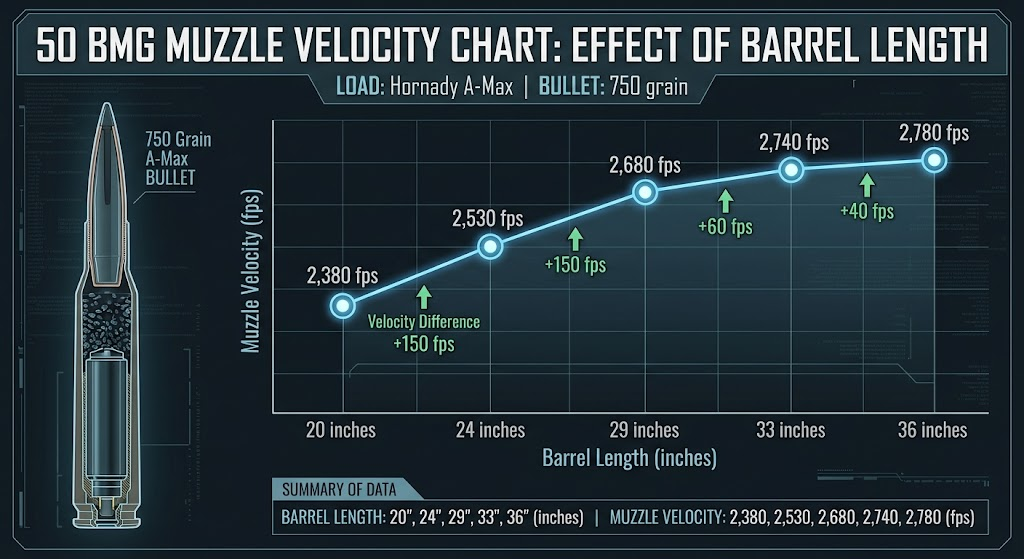
How Much Velocity Does 50 BMG Gain From Barrel Length?
Chronograph data reveals that the .50 BMG is exceptionally responsive to barrel length due to its massive case capacity and heavy propellant charge. Between 20 and 29 inches, the cartridge gains an average of 30 to 35 fps per inch of barrel added.
Beyond 29 inches, the velocity curve begins to flatten. Ballistic testing demonstrates that increasing barrel length from 29 to 33 inches yields an average gain of approximately 15 to 20 fps per inch. Moving from a 33-inch to a 36-inch custom precision barrel offers diminishing returns, adding roughly 11 to 14 fps per inch.
Does Barrel Length Affect 50 BMG Muzzle Velocity?
Yes, barrel length drastically affects .50 BMG muzzle velocity. The cartridge was originally engineered to operate from the M2 Browning Heavy Machine Gun, which utilizes a 45-inch barrel to produce over 2,820 fps with standard military projectiles.
Because modern civilian rifles and tactical anti-materiel platforms feature significantly shorter barrels, they sacrifice notable speed. Cutting from a standard 29-inch Barrett barrel down to a 20-inch compact barrel strips roughly 300 fps from your muzzle velocity. This velocity loss directly impacts flight time, wind drift, and bullet drop past 1,000 yards.
50 BMG Supersonic Velocity By Barrel Length
The .50 BMG operates primarily as a high-velocity supersonic round designed for extended-range kinetic impact.
- 661 Grain (M33 Ball): The standard military ball load is lighter and faster than match offerings. It averages approximately 2,450 fps from a 20-inch barrel, 2,750 fps from a 29-inch barrel, and can exceed 2,850 fps from a 36-inch barrel.
- 750 Grain: The Hornady A-Max and similar match-grade projectiles represent the benchmark for extreme long-range (ELR) precision. They average 2,380 fps from a 20-inch barrel and crest 2,740 fps in a 33-inch barrel.
- 800+ Grain: Ultra-heavy monolithic solid projectiles trade initial muzzle velocity for maximum ballistic coefficients, typically launching between 2,550 and 2,600 fps from a 29-inch barrel.
50 BMG Subsonic Velocity By Barrel Length
Specialized ammunition manufacturers produce heavy subsonic .50 BMG ammunition designed specifically for suppressed shooting.
To remain below the speed of sound (approximately 1,125 fps at sea level), these loads combine massive 700 to 800-grain projectiles with small charges of fast-burning propellant. Muzzle velocities average between 1,000 and 1,050 fps. Because the powder charge burns out almost immediately within the bore, barrel length provides virtually no velocity increase for subsonic loads. Additionally, these low-pressure rounds lack the energy to cycle semi-automatic gas or recoil systems.
50 BMG 20 Inch Barrel Velocity
A 20-inch barrel is an ultra-compact setup for this cartridge, commonly found on single-shot carbines like the Serbu RN-50 or custom truck guns.
- 750-Grain Match Load: Averages roughly 2,380 fps.
- Considerations: While it surrenders nearly 300 fps compared to full-size platforms, it still generates over 9,400 ft-lbs of muzzle energy. The unburnt powder creates an intense concussive muzzle blast and visible flash.
50 BMG 29 Inch Barrel Velocity
The 29-inch barrel is the standard configuration for duty rifles like the Barrett M82A1 and M107A1.
- 750-Grain Match Load: Yields approximately 2,680 fps.
- Considerations: This length captures roughly 95% of the cartridge’s practical potential, offering the ideal compromise between ballistic velocity and field portability.
50 BMG 33 Inch Barrel Velocity
A 33-inch barrel is frequently utilized on dedicated bolt-action platforms such as the Barrett M99 and Armalite AR-50.
- 750-Grain Match Load: Reaches approximately 2,740 fps.
- Considerations: Adds an extra 60 fps over a standard 29-inch barrel, reducing vertical drop when engaging targets at 1,500 to 2,000 yards.
50 BMG 36 Inch Barrel Velocity
The 36-inch barrel is standard on specialized competition and ELR rifles, such as the McMillan TAC-50.
- 750-Grain Match Load: Maxes out around 2,780 fps.
- Considerations: Extracts the absolute maximum velocity available on commercial rifle actions, keeping heavy projectiles supersonic beyond 2,500 yards.
50 BMG Velocity And Energy By Barrel Length
The following table calculates muzzle energy based on tested velocity averages for a standard 750-grain Hornady A-Max match load.
| Barrel Length | Bullet Weight | Velocity | Muzzle Energy |
| 20 inches | 750 grain | 2,380 fps | 9,433 ft-lbs |
| 24 inches | 750 grain | 2,530 fps | 10,659 ft-lbs |
| 29 inches | 750 grain | 2,680 fps | 11,961 ft-lbs |
| 33 inches | 750 grain | 2,740 fps | 12,503 ft-lbs |
| 36 inches | 750 grain | 2,780 fps | 12,871 ft-lbs |
Practical Applications
Muzzle velocity dictates the effective operational role of a .50 BMG setup:
- Military & Anti-Materiel Use: A 29-inch barrel delivers optimal terminal impact, ensuring armor-piercing and incendiary projectiles retain sufficient velocity to defeat hardened targets at 1,000+ yards.
- Extreme Long Range (ELR) Competition: ELR competitors require 33-inch or 36-inch barrels to maximize initial velocity, which minimizes flight time and reduces wind drift across distances exceeding two miles.
- Recreation & Static Range Use: Compact 20-inch and 24-inch barrels offer manageable storage and transport for recreational shooting, though with reduced long-range trajectory performance.
What Is The Best Barrel Length For 50 BMG?
The data indicates that the 29-inch barrel provides the best overall balance of muzzle velocity, kinetic energy, and field utility.
Shorter 20-inch barrels waste substantial powder combustion outside the muzzle, sacrificing nearly 300 fps of speed and thousands of foot-pounds of energy. Conversely, 36-inch barrels create an extremely heavy, front-weighted platform that only gains roughly 100 fps over a 29-inch system. The 29-inch barrel efficiently burns the propellant charge, pushing 750-grain bullets to 2,680 fps while maintaining practical portability.
Pros and Cons
Short Barrel Pros (20-24 Inches)
- Significantly easier to store, case, and transport.
- Lower overall rifle weight.
- Still produces over 9,400 ft-lbs of energy inside 800 yards.
Short Barrel Cons (20-24 Inches)
- Substantial velocity penalty (losing up to 300 fps).
- Extreme muzzle blast, concussion, and fireball.
- Rapidly increased wind drift at extended distances.
Long Barrel Pros (29-36 Inches)
- Delivers maximum muzzle velocity and downrange energy.
- Extends the supersonic flight boundary beyond 2,000 yards.
- More complete powder burn reduces unburnt propellant residue.
- Added barrel weight helps dampen heavy recoil.
Long Barrel Cons (29-36 Inches)
- Very long, front-heavy, and difficult to transport without large cases.
- Yields diminishing velocity returns beyond 33 inches.
50 BMG Muzzle Velocity: What The Data Shows
Chronograph testing clearly demonstrates that the .50 BMG relies on long barrels to achieve its intended ballistic performance. While a 36-inch barrel produces the absolute highest civilian velocity (2,780 fps with a 750-grain bullet), the velocity difference compared to a 29-inch barrel (2,680 fps) is only 100 fps.
Dropping down to a 20-inch barrel, however, introduces a severe 300 fps velocity penalty and costs the shooter over 2,500 ft-lbs of muzzle energy. For shooters prioritizing extreme-range trajectories past a mile, a 33 to 36-inch barrel provides a measurable competitive edge. For all-around practical shooting, duty use, and standard long-range engagements, the 29-inch barrel remains the most efficient and statistically proven choice.
FAQs
How fast is 50 BMG from a 20-inch barrel?
From a 20-inch barrel, a 750-grain match load averages roughly 2,380 fps, while a 661-grain M33 ball load clocks around 2,450 fps.
How fast is 50 BMG from a 29-inch barrel?
A standard 29-inch barrel pushes a 750-grain match bullet to approximately 2,680 fps, generating nearly 12,000 ft-lbs of muzzle energy.
How fast is 50 BMG from a 36-inch barrel?
A 36-inch barrel maximizes velocity, pushing 750-grain match loads to roughly 2,780 fps and 661-grain ball loads up to 2,850 fps.
Does barrel length affect 50 BMG muzzle velocity?
Yes. Due to its large propellant volume, the .50 BMG requires extended barrel length to fully combust its powder charge and accelerate heavy projectiles.
How much velocity does 50 BMG lose per inch?
Between 20 and 29 inches, the cartridge loses roughly 30 to 35 fps per inch. Beyond 29 inches, the loss rate drops to approximately 11 to 20 fps per inch.
What is the fastest 50 BMG barrel length?
The original 45-inch M2 Browning barrel generates the highest tested military velocities (over 2,910 fps with ball ammo). For civilian rifles, 36-inch barrels represent the standard maximum length.
What is the best barrel length for 50 BMG?
The 29-inch barrel is widely regarded as optimal, capturing roughly 95% of the cartridge’s velocity potential while retaining practical transportability.
Does 50 BMG gain velocity from a longer barrel?
Yes. The cartridge continues to gain velocity through 36 inches and beyond, though returns diminish noticeably past 33 inches.
How fast is subsonic 50 BMG?
Subsonic .50 BMG ammunition is loaded with heavy 700 to 800-grain bullets engineered to travel between 1,000 and 1,050 fps to eliminate the supersonic crack.
How fast is supersonic 50 BMG?
Standard supersonic .50 BMG ammunition travels between 2,380 fps and 2,910 fps, depending on bullet weight and barrel length.
What is the velocity difference between a 20 and 36 inch 50 BMG barrel?
For a 750-grain load, the velocity difference is roughly 400 fps (2,380 fps vs. 2,780 fps), representing a difference of over 3,400 ft-lbs of kinetic energy.