The .22 LR Standard Velocity cartridge utilizes a highly consistent powder charge designed to purposefully stay below the speed of sound for maximum accuracy.
When firing a traditional 40-grain solid lead bullet, muzzle velocities average roughly 880 fps from a 4-inch pistol barrel and 1,070 fps from a standard 16-inch rifle barrel.
The cartridge reaches its peak velocity of approximately 1,075 fps from an 18-inch barrel before internal bore friction begins to actively slow the projectile.
Fired from a 24-inch barrel, the speed drops back down to roughly 1,050 fps, proving that excessive barrel length negatively impacts this rimfire load.
It is critical to note that exact velocity figures vary depending on the specific ammunition lot, chamber dimensions, bore tightness, and environmental test conditions.
Analyzing these chronograph statistics allows shooters to choose the optimal barrel length for precision target shooting or suppressed hunting without sacrificing downrange performance.
22 LR Standard Velocity Chart
| Barrel Length | Load | Bullet Weight | Muzzle Velocity | Velocity Difference |
| 4 inches | CCI Standard Velocity | 40 grain | 880 fps | – |
| 10 inches | CCI Standard Velocity | 40 grain | 1,010 fps | +130 fps |
| 16 inches | CCI Standard Velocity | 40 grain | 1,070 fps | +60 fps |
| 18 inches | CCI Standard Velocity | 40 grain | 1,075 fps | +5 fps |
| 24 inches | CCI Standard Velocity | 40 grain | 1,050 fps | -25 fps |
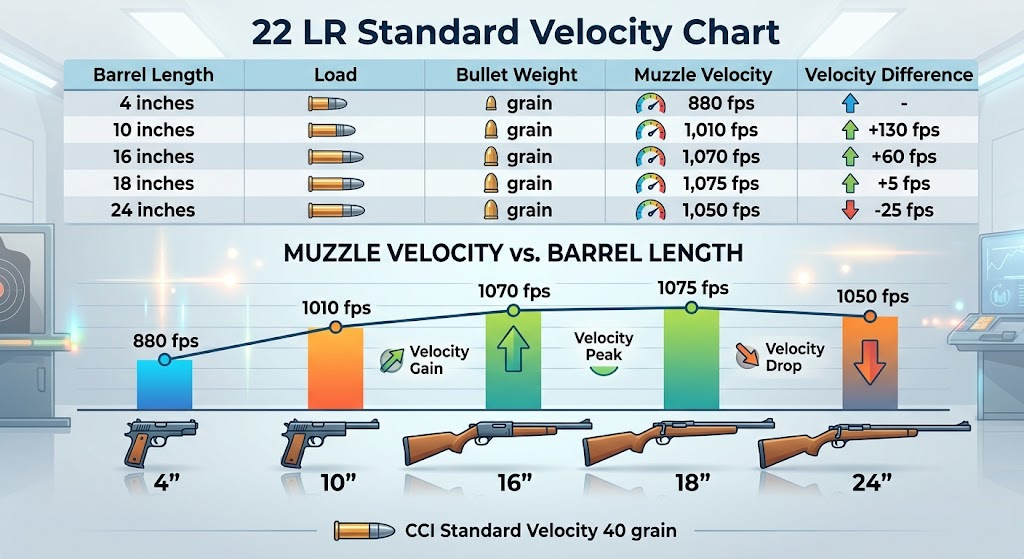
How Much Velocity Does 22 LR Standard Velocity Gain From Barrel Length?
Unlike centerfire cartridges that continuously gain speed in 24-inch or 26-inch barrels, the .22 LR Standard Velocity operates on a strict bell curve. Because the rimfire casing holds only a tiny pinch of fast-burning powder, combustion is completed very early in the barrel’s length.
Moving from a 4-inch pistol barrel to a 10-inch barrel yields massive gains, averaging roughly 20 to 25 fps per inch. Between 10 and 16 inches, the gains slow down to about 10 fps per inch. Once the bullet passes the 16 to 18-inch mark, there is no expanding gas left to accelerate it. Pushing the soft lead bullet through additional barrel length past 18 inches induces negative velocity; the friction of the rifling grabs the bullet and slows it down, causing a 24-inch barrel to shoot roughly 20 to 25 fps slower than a 16-inch barrel.
Does Barrel Length Affect 22 LR Standard Velocity?
Yes, barrel length drastically affects .22 LR Standard Velocity ammunition, penalizing both extremely short and extremely long barrels.
Cutting a barrel from a standard 16 inches down to a 4-inch pistol length strips roughly 190 fps from the muzzle velocity, drastically reducing the cartridge’s kinetic energy. Conversely, extending the barrel to 24 inches also reduces velocity due to friction. If shooters record wildly different velocities from the exact same barrel length, the discrepancy is almost always caused by ammunition lot variations, rimfire primer inconsistencies, temperature shifts, or differences in bore tightness (such as match-grade chambers).
22 LR Standard Velocity Supersonic vs Subsonic
It is vital to understand that “Standard Velocity” .22 LR is purposely engineered to be subsonic.
- Subsonic Flight (Standard Velocity): To remain below the speed of sound, a bullet must travel slower than roughly 1,125 fps at sea level. Ammunition like CCI Standard Velocity or Federal AutoMatch is loaded to peak around 1,070 fps out of a rifle barrel. Because these bullets never break the sound barrier, they do not experience transonic destabilization (the turbulence that occurs when a bullet slows back down through the sound barrier). This makes Standard Velocity drastically more accurate at 50 and 100 yards than High Velocity ammunition.
- Supersonic Flight (High Velocity): High Velocity .22 LR utilizes a slightly larger powder charge to push 40-grain bullets past 1,235 fps. While they hit harder, they produce a loud supersonic “crack” and lose accuracy as they drop back below the sound barrier downrange.
22 LR Standard Velocity 4 Inch Barrel Velocity
A 4-inch barrel is standard for popular target pistols like the Ruger Mark IV, Browning Buck Mark, or Glock 44.
- 40-Grain Load: Averages approximately 880 fps.
- Considerations: The short barrel limits kinetic energy to roughly 69 ft-lbs. However, because it keeps the velocity incredibly low, it is an exceptionally quiet host for a suppressor, producing virtually zero muzzle report.
22 LR Standard Velocity 16 Inch Barrel Velocity
The 16-inch barrel is the legal minimum for rifles in the US and the absolute most popular length for semi-autos like the Ruger 10/22.
- 40-Grain Load: Reaches approximately 1,070 fps.
- Considerations: This length extracts roughly 99% of the cartridge’s velocity potential, providing optimal kinetic energy for target shooting without adding unnecessary friction or rifle weight.
22 LR Standard Velocity 18 Inch Barrel Velocity
An 18-inch barrel is commonly found on premium bolt-action rimfire rifles like the CZ 457 or Tikka T1x.
- 40-Grain Load: Peaks at roughly 1,075 fps.
- Considerations: This is the absolute ballistic apex for the .22 LR Standard Velocity cartridge. It provides complete powder combustion and peak speed before internal bore friction can take effect.
22 LR Standard Velocity 24 Inch Barrel Velocity
A 24-inch (or longer) barrel is traditionally used on vintage target rifles, such as old Winchesters or the modern CZ Jaguar.
- 40-Grain Load: Drops to approximately 1,050 fps.
- Considerations: The extra length actively robs the bullet of kinetic energy due to internal friction. Precision shooters only use these lengths to maximize the sight radius for iron sights, improving mechanical aiming precision despite the slight speed penalty.
22 LR Standard Velocity And Energy By Barrel Length
The following table calculates muzzle energy based on tested velocity averages for a traditional 40-grain standard velocity load.
| Barrel Length | Bullet Weight | Velocity | Muzzle Energy |
| 4 inches | 40 grain | 880 fps | 69 ft-lbs |
| 10 inches | 40 grain | 1,010 fps | 91 ft-lbs |
| 16 inches | 40 grain | 1,070 fps | 102 ft-lbs |
| 18 inches | 40 grain | 1,075 fps | 103 ft-lbs |
| 24 inches | 40 grain | 1,050 fps | 98 ft-lbs |
Practical Applications
Muzzle velocity dictates the optimal use-case for this specific ammunition type:
- Precision Target Shooting (NRL22/PRS Rimfire): Standard Velocity ammunition fired from a 16 to 20-inch heavy-barreled bolt action yields the absolute best accuracy. Because the bullet starts and stays subsonic (around 1,070 fps), it flies incredibly true out to 100+ yards without turbulent transonic shifting.
- Suppressed Small Game Hunting: For pest control where stealth is paramount, an 18-inch barrel pushing standard velocity rounds is “Hollywood quiet” when suppressed. While it lacks the raw energy of High Velocity ammo, accurate shot placement makes it lethal on squirrels and rabbits.
- Handgun Plinking: A 4-inch pistol keeps standard velocity ammunition hovering around 880 fps, allowing shooters to train with virtually zero recoil and extremely low noise levels.
What Is The Best Barrel Length For 22 LR Standard Velocity?
The chronograph data definitively proves that the 16-inch to 18-inch range is the optimal barrel length for the .22 LR Standard Velocity cartridge.
Because the tiny rimfire case holds a microscopic powder charge, the expanding gases run out of pushing power shortly after the 16-inch mark. An 18-inch barrel pushes 40-grain standard bullets to 1,075 fps, wringing out the absolute maximum kinetic energy while keeping the rifle perfectly balanced. If a shooter opts for a 20-inch or 24-inch barrel, they are simply carrying around extra steel that actively slows their bullet down via friction. For any application utilizing modern optics (where iron sight radius doesn’t matter), the 16-inch to 18-inch barrel is mathematically and practically superior.
Pros and Cons
Short Barrel Pros (4-10 Inches)
- Superior agility for handguns and short-barreled rifles (SBRs).
- Extends the lifespan of standard velocity ammunition by keeping it deeply subsonic.
- Extremely lightweight to carry on the trail.
Short Barrel Cons (4-10 Inches)
- Drastic velocity loss (dropping to 850 – 900 fps).
- Fails to provide enough speed for reliable terminal expansion on small game.
- Reduced kinetic energy (under 70 ft-lbs in pistols).
Optimal Barrel Pros (16-18 Inches)
- Achieves absolute peak muzzle velocity and downrange energy.
- Fully combusts the powder charge, keeping the rifle action and suppressor cleaner.
- Perfectly balances rifle weight and handling characteristics.
Over-Length Barrel Cons (20-24+ Inches)
- Actively slows the bullet down due to bore friction.
- Adds unnecessary weight to a low-recoil rifle.
- Only beneficial for shooters requiring an extended iron sight radius.
22 LR Standard Velocity: What The Data Shows
Chronograph data exposes a unique ballistic reality for the .22 LR Standard Velocity: longer is definitively not faster. While an 18-inch barrel produces the absolute peak tested velocity (roughly 1,075 fps), the speed difference compared to a compact 16-inch carbine (1,070 fps) is practically zero.
By analyzing the data curve, shooters can see that moving past 18 inches actively damages the cartridge’s performance, with 24-inch barrels dropping speeds back down by roughly 25 fps. Conversely, dropping down to a 4-inch pistol barrel strips nearly 190 fps from the load, completely dropping muzzle energy to a meager 69 ft-lbs. Ultimately, the data proves that a 16-inch or 18-inch barrel is the undisputed king for extracting maximum accuracy and performance from standard velocity ammunition.
FAQs
How fast is 22 LR Standard Velocity from a 4-inch barrel?
From a 4-inch pistol barrel, a traditional 40-grain standard velocity load averages roughly 880 fps, remaining deeply subsonic.
How fast is 22 LR Standard Velocity from a 16-inch barrel?
A standard 16-inch rifle barrel pushes 40-grain standard velocity loads to approximately 1,070 fps.
How fast is 22 LR Standard Velocity from a 24-inch barrel?
Due to internal bore friction, a 24-inch barrel slows the bullet down compared to shorter rifles, averaging roughly 1,050 fps for standard velocity loads.
Does barrel length affect 22 LR Standard Velocity?
Yes. The cartridge gains speed rapidly up to 16 inches, hits its absolute peak around 18 inches, and then loses speed in any barrel longer than 18 inches due to friction.
How much velocity does 22 LR Standard Velocity lose per inch?
When cutting a barrel from 16 inches down to 4 inches, it loses an average of 15 to 20 fps per inch. When increasing a barrel from 18 inches to 24 inches, it loses roughly 3 to 4 fps per inch.
What is the fastest 22 LR Standard Velocity barrel length?
Chronograph testing universally shows that 16-inch to 18-inch barrels produce the absolute fastest velocities for the .22 LR cartridge.
What is the best barrel length for 22 LR Standard Velocity?
The 16-inch to 18-inch range is widely considered optimal. It extracts peak velocity, fully combusts the powder, and keeps the rifle highly maneuverable.
Does 22 LR Standard Velocity gain velocity from a longer barrel?
No. Once the barrel exceeds 18 inches, the .22 LR stops gaining velocity and actually begins to slow down as friction overtakes gas pressure.
How fast is subsonic 22 LR?
Dedicated subsonic or standard velocity .22 LR ammunition is loaded to travel around 1,050 to 1,070 fps out of a rifle to avoid the supersonic crack.
How fast is supersonic 22 LR?
High Velocity .22 LR travels between 1,235 and 1,260 fps, while Hyper-Velocity loads (like the Stinger) can exceed 1,600 fps. Standard Velocity does not reach supersonic speeds.
What is the velocity difference between a 4 and 16 inch 22 LR barrel?
For a standard 40-grain load, the velocity difference is roughly 190 fps (880 fps vs. 1,070 fps), which translates to a nearly 50% increase in kinetic energy for the rifle.