The .38 Special is a naturally subsonic, low-pressure cartridge optimized for short-barreled revolvers, relying on fast-burning powders for efficient combustion.
When firing a standard 158-grain load, muzzle velocities average approximately 720 fps from a 2-inch snub-nose barrel and roughly 810 fps from a 4-inch duty barrel.
Extending the barrel to a 6-inch target length yields roughly 860 fps, while a 16-inch lever-action carbine maximizes the standard-pressure cartridge at approximately 960 fps.
Unlike high-pressure magnum cartridges, the .38 Special’s tiny powder charge is consumed rapidly, resulting in heavily diminishing velocity returns in rifle-length platforms.
It is critical to note that exact muzzle velocity varies by ammunition pressure rating (+P vs standard), bullet weight, cylinder gap tolerances, and ambient test conditions.
Analyzing these chronograph statistics allows shooters to select the optimal barrel length for concealed carry, target shooting, or running a suppressed lever-action carbine.
38 Special Velocity Chart
| Barrel Length | Load | Bullet Weight | Muzzle Velocity | Velocity Difference |
| 2 inches | Federal American Eagle | 158 grain | 720 fps | – |
| 4 inches | Federal American Eagle | 158 grain | 810 fps | +90 fps |
| 6 inches | Federal American Eagle | 158 grain | 860 fps | +50 fps |
| 16 inches | Federal American Eagle | 158 grain | 960 fps | +100 fps |
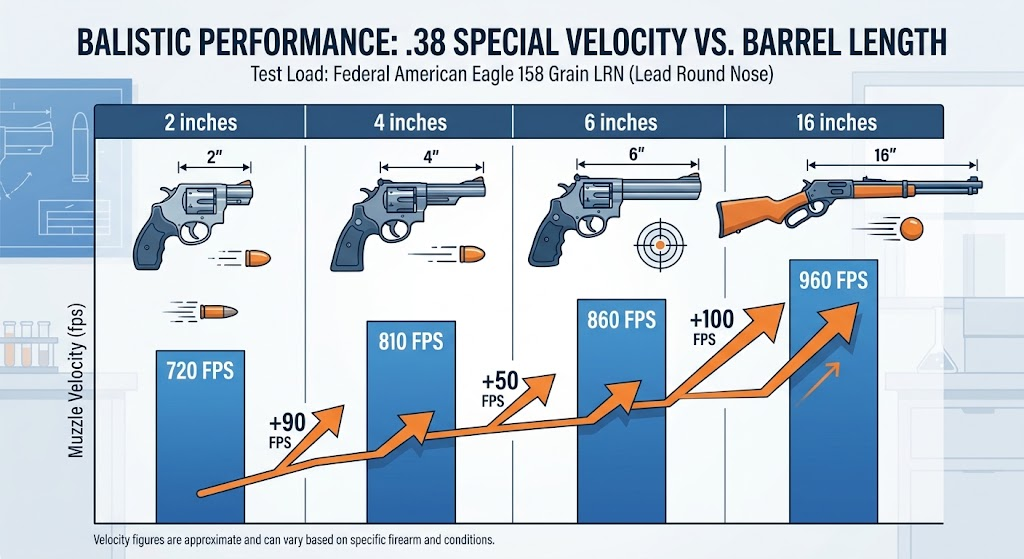
How Much Velocity Does 38 Special Gain From Barrel Length?
Chronograph data shows that the .38 Special benefits from barrel length primarily in its first few inches, after which the gains slow down significantly. Because the cartridge operates at a relatively low pressure (17,000 psi standard limit) and uses fast-burning pistol powders, the powder column combusts almost entirely within the first 4 inches of the barrel.
Between a 2-inch and 4-inch barrel, the cartridge gains an average of 40 to 45 fps per inch. Moving from a 4-inch to a 6-inch barrel, the gain drops to roughly 25 fps per inch. Stretching the barrel out to a 16-inch carbine yields an average gain of only 10 fps per inch over the 6-inch revolver.
Does Barrel Length Affect 38 Special Velocity?
Yes, barrel length affects .38 Special velocity, but the cartridge is famously forgiving in short barrels.
Because it was designed specifically for revolvers and personal defense, dropping from a 4-inch duty barrel down to a 2-inch snub-nose only strips away roughly 90 fps. This means the cartridge retains the vast majority of its intended performance even in deep-concealment firearms. If shooters record differing velocities from the exact same barrel length, the variations are usually due to the revolver’s cylinder gap (which can bleed off pressure if too loose), temperature shifts, or lot-to-lot ammunition inconsistencies.
38 Special Subsonic Velocity By Barrel Length
The .38 Special is one of the most famous and effective naturally subsonic cartridges in the world.
To remain subsonic and avoid the supersonic “crack,” a bullet must travel below approximately 1,125 fps at sea level.
- 158 Grain (Standard & +P): The historical standard weight for the cartridge. Whether fired from a 2-inch revolver (720 fps) or a 16-inch lever-action carbine (960 fps), standard pressure 158-grain loads will never break the sound barrier. Even +P overpressure variants of this weight usually peak around 1,050 fps in carbines, remaining safely subsonic and exceptionally quiet when suppressed.
- 130 Grain (FMJ target loads): Common target ammunition generally runs around 800 fps from a 4-inch barrel, maintaining a deeply subsonic profile.
38 Special Supersonic Velocity By Barrel Length
Achieving supersonic velocities with the .38 Special is difficult and requires a specific combination of lightweight bullets, +P pressures, and longer barrels.
- 110 to 125 Grain (+P): Modern defensive +P hollow points use lighter bullets to increase speed. Out of a 4-inch revolver, a 125-grain +P load averages roughly 950 to 1,000 fps (still subsonic). However, if you fire that exact same 125-grain +P load out of a 16-inch closed-breech carbine, the extra 12 inches of bore time can push the velocity to roughly 1,180 fps, allowing it to cross the supersonic threshold.
38 Special 2 Inch Barrel Velocity
The 2-inch snub-nose (found on classic carry guns like the Smith & Wesson J-Frame) is the modern primary host for the .38 Special.
- 158-Grain Load: Averages approximately 720 fps.
- Considerations: While velocity is very low, producing under 190 ft-lbs of energy, standard lead semi-wadcutter bullets will still penetrate deeply. Many modern shooters opt for +P ammunition in 2-inch barrels to push hollow points closer to 850 fps, ensuring reliable expansion.
38 Special 4 Inch Barrel Velocity
The 4-inch barrel was the undisputed standard for American law enforcement for over half a century.
- 158-Grain Load: Yields approximately 810 fps.
- Considerations: This length extracts the cartridge’s intended factory ballistics, balancing comfortable carry weight, recoil mitigation, and a long enough sight radius for excellent mechanical accuracy.
38 Special 6 Inch Barrel Velocity
A 6-inch barrel is traditionally utilized for precision target shooting and formal bullseye competitions.
- 158-Grain Load: Achieves roughly 860 fps.
- Considerations: The extra steel provides a very long sight radius and heavy front-weight that practically eliminates recoil, though the 50 fps velocity gain offers no significant terminal ballistic advantage.
38 Special 16 Inch Barrel Velocity
Lever-action carbines chambered in .357 Magnum safely and reliably fire .38 Special ammunition.
- 158-Grain Load: Reaches roughly 960 fps.
- Considerations: Unlike the .357 Magnum (which gains 600+ fps in a carbine), the .38 Special’s fast powder is fully burnt early in the bore. The 16-inch barrel only provides about a 100 fps bump over a 6-inch revolver, making it a low-recoil, quiet plinking setup rather than a hunting platform.
38 Special Velocity And Energy By Barrel Length
The following table calculates muzzle energy based on tested velocity averages for a standard 158-grain Federal American Eagle load.
| Barrel Length | Bullet Weight | Velocity | Muzzle Energy |
| 2 inches | 158 grain | 720 fps | 182 ft-lbs |
| 4 inches | 158 grain | 810 fps | 230 ft-lbs |
| 6 inches | 158 grain | 860 fps | 259 ft-lbs |
| 16 inches | 158 grain | 960 fps | 323 ft-lbs |
Practical Applications
Muzzle velocity dictates the optimal use-case for a .38 Special platform:
- Concealed Carry: The 720 to 850 fps generated by 2-inch and 4-inch revolvers is highly controllable in high-stress situations. Because the bullet is heavy and slow, over-penetration in urban environments is minimized.
- Target Shooting: The 810 to 860 fps achieved in 4-inch and 6-inch barrels creates one of the most inherently accurate, mild-recoiling centerfire profiles available, perfect for training new shooters.
- Suppressed Carbine Use: Firing standard .38 Special through a suppressed .357 Magnum lever-action rifle is often described as “Hollywood quiet.” At 960 fps, the heavy 158-grain bullet stays perfectly subsonic while the 16-inch barrel provides a closed breech to contain all expanding gases.
What Is The Best Barrel Length For 38 Special?
Because the .38 Special relies on heavy bullets rather than explosive speed, the 4-inch barrel remains the absolute best all-around length.
While a 16-inch carbine produces the highest velocity (960 fps), the cartridge lacks the powder capacity to turn that rifle into a viable medium-game hunting platform. Conversely, a 2-inch barrel drops energy below 190 ft-lbs, which can hinder modern hollow points from expanding reliably without switching to +P pressures. The 4-inch barrel perfectly optimizes the standard-pressure cartridge, effortlessly driving 158-grain bullets to their factory-intended 810 fps while keeping the firearm exceptionally balanced for belt carry or home defense.
Pros and Cons
Short Barrel Pros (2-4 Inches)
- 2-inch snub-nose revolvers are arguably the easiest centerfire handguns to conceal.
- 4-inch barrels offer the perfect ratio of packability to ballistic performance.
- Extremely low recoil makes for fast, accurate follow-up shots.
Short Barrel Cons (2-4 Inches)
- 2-inch barrels suffer significant velocity loss, often requiring +P loads for reliable expansion.
- Shorter sight radius on 2-inch models makes accurate shooting past 10 yards difficult.
Long Barrel Pros (6-16 Inches)
- 6-inch revolvers maximize sight radius and mechanical accuracy.
- 16-inch carbines guarantee the 158-grain bullet remains deeply subsonic while extending plinking range.
- Almost zero perceived recoil or muzzle blast.
Long Barrel Cons (6-16 Inches)
- Rifle barrels yield terribly diminishing velocity returns due to the small powder charge.
- Does not generate enough kinetic energy (roughly 320 ft-lbs max) for ethical deer hunting, even from a 16-inch barrel.
38 Special Velocity: What The Data Shows
Chronograph testing proves that the .38 Special is highly optimized for traditional handguns and gains very little from extended barrels. While a 16-inch carbine produces the highest practical velocity—launching a 158-grain bullet at 960 fps—the speed gained over a 4-inch duty revolver (810 fps) is only 150 fps.
By analyzing the data curve, shooters can see exactly how efficiently the cartridge burns its powder. Dropping from a 4-inch duty barrel down to a 2-inch snub-nose only sacrifices 90 fps. This proves the .38 Special was masterfully designed for its era: providing reliable, subsonic, moderate-energy performance in compact packages. For shooters seeking raw power, stepping up to a .357 Magnum is required. But for controllable defense and inherently quiet target shooting, a 2-inch or 4-inch .38 Special remains a mathematically sound choice.
FAQs
How fast is 38 Special from a 2-inch barrel?
From a 2-inch snub-nose revolver, a standard pressure 158-grain load averages roughly 720 fps. +P variants can push lightweight 125-grain bullets closer to 850 fps.
How fast is 38 Special from a 4-inch barrel?
A 4-inch revolver pushes standard 158-grain bullets to their traditional factory specification of approximately 810 fps.
How fast is 38 Special from a 16-inch barrel?
Fired from a 16-inch carbine, a standard 158-grain bullet will average roughly 960 fps, remaining safely subsonic.
Does barrel length affect 38 Special velocity?
Yes, but the gains are mild compared to magnum cartridges. Because it uses a small charge of fast-burning powder, it reaches near-peak velocity in the first few inches.
How much velocity does 38 Special lose per inch?
Between 4 inches and 2 inches, it loses an average of 40 to 45 fps per inch. Between 16 inches and 6 inches, it loses only about 10 fps per inch.
What is the fastest 38 Special barrel length?
Chronograph testing shows that 16-inch to 18-inch rifle barrels produce the absolute fastest velocities for the cartridge, though the returns are heavily diminished.
What is the best barrel length for 38 Special?
The 4-inch barrel is widely regarded as optimal for handguns, offering the best balance of velocity, sight radius, and recoil control.
Does 38 Special gain velocity from a longer barrel?
Yes, it continues to gain minor velocity up to 16-18 inches, but the gains are minimal (often less than 10 fps per inch past 6 inches).
How fast is subsonic 38 Special?
Almost all standard .38 Special ammunition is naturally subsonic. Standard 158-grain loads travel between 720 fps and 960 fps depending on barrel length.
How fast is supersonic 38 Special?
To achieve supersonic speeds (above 1,125 fps), .38 Special generally requires lightweight 110-grain or 125-grain bullets loaded to +P pressures and fired from a 16-inch carbine barrel.
What is the velocity difference between a 2 and 16 inch 38 Special barrel?
For a 158-grain load, the velocity difference is roughly 240 fps (720 fps vs. 960 fps). This highlights the cartridge’s low powder capacity, as it gains very little speed despite adding 14 inches of barrel.