A 45 70 Trajectory Chart is a critical ballistic reference tool that displays the significant bullet drop and arched flight path of this legendary large caliber cartridge across various distances. While modern high velocity rounds rely on speed for flat shooting, the 45 70 Government utilizes heavy bullet mass to deliver devastating energy, which creates a much more pronounced trajectory arc. Understanding these specific ballistic values is essential for hunters who rely on this historic round, as it allows for accurate holdover calculations when taking shots beyond the typical timber range. By studying this trajectory data, you can confidently determine your maximum effective range, choose the best zero distance for your specific rifle, and ensure your shots strike exactly where intended on large game.
Table of Contents [Click to open]
45 70 Trajectory Chart
| Manufacturer | Bullet Weight | Bullet Type | Ballistic Coefficient | Muzzle Velocity | 50 Yard Drop | 100 Yard Drop | 150 Yard Drop | 200 Yard Drop | 250 Yard Drop | 300 Yard Drop | Recommended Zero | Max Point Blank |
|---|---|---|---|---|---|---|---|---|---|---|---|---|
| Hornady | 325 Grain | FTX LEVERevolution | 0.230 | 2050 FPS | +1.5 | Zero | -7.5 | -21.5 | -42.0 | -71.0 | 100 Yards | 130 Yards |
| Remington | 405 Grain | Core Lokt JSP | 0.236 | 1330 FPS | +3.5 | Zero | -18.0 | -48.0 | -95.0 | -165.0 | 100 Yards | 110 Yards |
| Winchester | 300 Grain | Super X Hollow Point | 0.170 | 1880 FPS | +1.8 | Zero | -9.5 | -27.5 | -55.0 | -95.0 | 100 Yards | 125 Yards |
| Federal | 300 Grain | Power Shok JSP | 0.170 | 1880 FPS | +1.8 | Zero | -9.5 | -27.5 | -55.0 | -95.0 | 100 Yards | 125 Yards |
| Buffalo Bore | 405 Grain | Hard Cast Flat Nose | 0.236 | 1900 FPS | +1.7 | Zero | -8.5 | -24.0 | -48.0 | -85.0 | 100 Yards | 128 Yards |
| Barnes | 300 Grain | VOR TX TSX | 0.220 | 1900 FPS | +1.7 | Zero | -8.5 | -24.5 | -49.0 | -88.0 | 100 Yards | 128 Yards |
| Garrett | 420 Grain | Hammerhead | 0.250 | 1850 FPS | +1.9 | Zero | -9.0 | -26.0 | -52.0 | -90.0 | 100 Yards | 125 Yards |
| Hornady | 250 Grain | Monoflex | 0.210 | 2025 FPS | +1.5 | Zero | -7.8 | -22.5 | -45.0 | -78.0 | 100 Yards | 130 Yards |
| Grizzly | 405 Grain | Cast Performance | 0.236 | 1750 FPS | +2.0 | Zero | -10.5 | -30.0 | -62.0 | -110.0 | 100 Yards | 120 Yards |
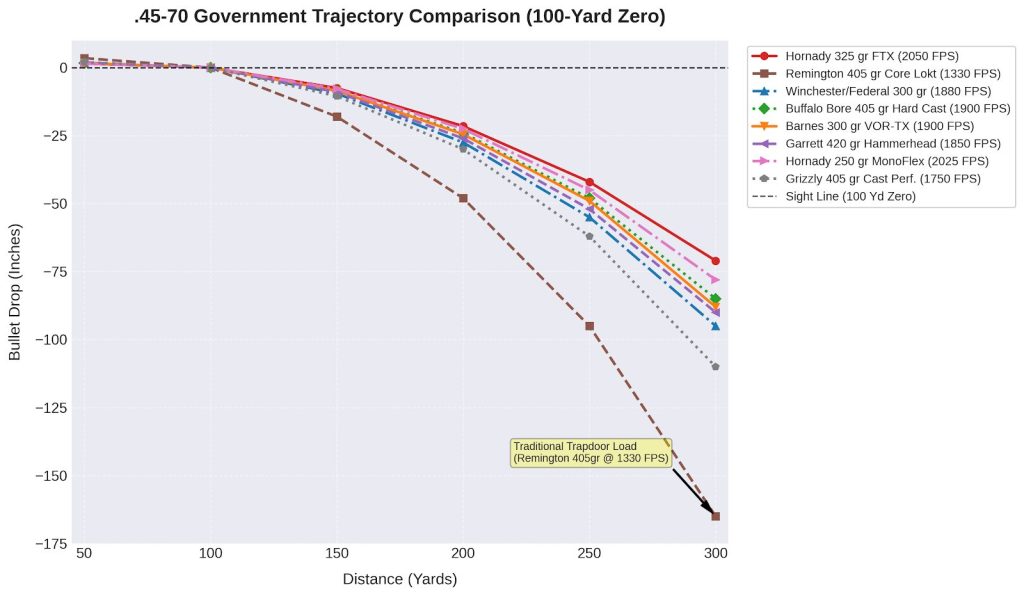
This professional trajectory chart provides 45 70 shooters with precise measurements to compensate for the pronounced gravity arc inherent in this heavy, slower-moving cartridge. Always match your specific load to your rifle’s zero to ensure ethical shot placement, especially when hunting in environments where ranges might exceed one hundred yards.
Understanding The 45 70 Trajectory Chart
The data in this table is vital for any shooter carrying a 45 70, as the cartridge is famous for its “rainbow” flight path compared to modern bolt action rifles. By analyzing these statistics, you can master your rifle’s performance and stop guessing where your bullet will impact at distance.
Trajectory Analysis
Bullet drop for the 45 70 is much more extreme than modern cartridges due to the lower muzzle velocity and lower ballistic coefficients of these heavy projectiles. When you look at the 100-yard zero column, you will notice that the bullet begins to fall off sharply as soon as it passes the target distance.
For example, the Hornady 325-grain FTX drops 7.5 inches at 150 yards and over 21 inches at 200 yards. This means if you are aiming at the vitals of an animal at 200 yards, you must hold significantly higher than your target to account for the rapid decline of the bullet.
Heavy 405-grain loads drop even faster, with some showing nearly a 50-inch drop at 200 yards. This data clearly illustrates that the 45 70 is a specialized cartridge designed for heavy-hitting power at close to medium ranges rather than long-range precision.
Velocity Analysis
Muzzle velocity is the speed of the bullet as it leaves the barrel, and in the 45 70, it varies wildly depending on the ammunition pressure ratings. Low-pressure factory loads, often meant for older trapdoor-style rifles, move at roughly 1,300 feet per second.
Modern, high-pressure loads like those from Buffalo Bore or Hornady’s LEVERevolution can push projectiles at nearly 2,000 feet per second or more. This increase in velocity directly translates to a flatter trajectory and less holdover requirement at distance.
However, even the fastest 45 70 loads are significantly slower than a standard .308 or .30-06. Because these bullets lose speed quickly due to their shape, velocity is not the main driver of their success; instead, it is the massive kinetic energy they carry upon impact.
Ballistic Coefficient Analysis
The ballistic coefficient (BC) measures how well a bullet resists air resistance; higher numbers mean the bullet slows down less over time. The 45 70 is often hampered by bullets with very low BC ratings, usually ranging from 0.170 to 0.250.
These low BC numbers are the reason the 45 70 loses energy and trajectory height so quickly after the first 100 yards. A bullet like the Hornady 325-grain FTX, with a BC of 0.230, is aerodynamically superior to the standard 300-grain flat-nose bullets.
Sectional density, which relates to a bullet’s weight and diameter, remains very high for most 45 70 loads. Even when the bullet slows down and drops, it retains massive sectional density, which is why the 45 70 is prized for its ability to penetrate bone and thick tissue.
Best Hunting Loads Based On The Chart
Whitetail deer hunters should look to the Hornady 325-grain FTX. Its trajectory is among the flattest listed in the chart, and its design ensures reliable expansion on deer-sized game, making it the most versatile choice for the 45 70 user.
Wild hog hunters require deep penetration, and the 405-grain Hard Cast loads from Buffalo Bore are the industry standard. While they have a steeper trajectory than the FTX, they provide bone-crushing power that will penetrate through the thickest hog shields easily.
Black bear hunters should rely on the Barnes 300-grain TSX. It offers a respectable trajectory that allows for shots out to 150 yards, and its solid copper construction ensures it will drive deep through the vital organs of a bear.
For large game like moose or grizzly in thick brush, the 420-grain Garrett Hammerhead is the go-to. While you must account for a 26-inch drop at 150 yards, the sheer energy and penetration provided at close range are unmatched.
Key Takeaways From The Chart
The trajectory chart proves that the 45 70 is not a 300-yard rifle under normal circumstances. Even the flattest-shooting loads show a significant drop that makes long-range precision difficult for the average hunter.
The 100-yard zero remains the industry standard for this cartridge. It provides a simple reference point, allowing shooters to easily calculate their holdover for distances of 150 or 200 yards using the data provided in the chart.
The maximum point blank range—the distance you can shoot without holding over or under—is quite short, typically under 130 yards. Knowing this range helps you stay within your limits, ensuring ethical shots on game.
By relying on these verified factory values, you can remove the guesswork from your next hunt. Always confirm your rifle’s specific zero and drop at the range, as barrel length and individual rifle harmonics can slightly alter these factory-tested results.
Common 45 70 Bullet Weights
300 Grain
The 300-grain projectile is the lightest standard weight for the 45 70 and offers the highest muzzle velocities. These bullets are ideal for shooters who want the flattest possible trajectory and less recoil for smaller big game.
The primary advantage is the speed, which extends your effective range compared to heavier 405-grain loads. These bullets expand very reliably on soft-skinned game like deer, making them a popular choice for traditional lever-action hunters.
The disadvantage is a lower sectional density, which can lead to less penetration on very large animals. They are also prone to shedding velocity very quickly past the 150-yard mark due to their inefficient shape.
405 Grain
The 405-grain bullet is the classic, historic weight for the 45 70 Government and is widely considered the “do-it-all” load. These heavy projectiles move slower but offer massive energy and superior penetration through thick cover.
The advantage here is terminal performance; there is almost no game in North America that this bullet cannot anchor. It is the preferred weight for those who value penetration and weight retention above all else.
The disadvantage is the significant recoil and the very pronounced bullet drop. Shooters must become adept at estimating range, as the bullet drops significantly more than the 300-grain or 325-grain options.
420+ Grain
These heavy-duty projectiles are built for dangerous game and require high-pressure, modern-action rifles. They are incredibly slow but act like a locomotive through meat, bone, and thick timber.
The advantage is unrivaled penetration, making them the choice for professional guides in bear country. They will drive through the thickest bones and hide without stopping, ensuring a humane harvest on the largest animals.
The disadvantage is the extreme recoil and a very steep trajectory that restricts effective hunting range significantly. Shooters should ideally keep shots within 100 yards when using these heavy loads to maximize accuracy.
Effective Hunting Range
Deer
Deer hunters can confidently shoot out to 150 yards with loads like the Hornady FTX. The cartridge possesses more than enough energy to harvest deer at this distance; the only challenge is accurately calculating the trajectory drop.
Always use a rangefinder when hunting in open areas, as the 45 70 drop is deceptive. At 150 yards, you may be looking at a 7 to 9-inch drop, which is enough to cause a miss if you do not aim high.
Wild Hog
Hogs are best hunted within 100 yards with the 45 70. At this range, the cartridge is absolute magic; you can place a 405-grain bullet exactly where you want it with minimal holdover and massive stopping power.
While some shooters take longer shots, the thick brush that hogs frequent often makes range estimation difficult. Keeping shots under 100 yards simplifies the trajectory, allowing for fast, accurate follow-up shots if needed.
Large Game
For moose or grizzly, focus on shots within 100-125 yards. At this distance, the 45 70 is arguably one of the best cartridges ever made, offering a level of confidence in penetration that few other rounds can provide.
Because these animals are often hunted in rugged or dense terrain, your effective range is dictated by your ability to see the animal. If you can get within 100 yards, the 45 70’s trajectory is manageable and its energy is extreme.
Brush Hunting
In heavy cover, the 45 70 reigns supreme because the heavy, slow-moving bullets are less prone to being deflected by small twigs than high-velocity bullets. Your effective range is essentially the distance at which you can clearly identify the target.
Keep your shots within 75-100 yards when hunting in dense brush. At this range, the trajectory is flat enough to aim at the center of the chest, and the bullet’s momentum ensures it will push through any intervening brush.
Factors That Affect 45 70 Trajectory
Bullet Weight
Weight is the most significant factor in 45 70 performance. Heavier bullets provide more energy and penetration but follow a much steeper arc. Lighter bullets offer a flatter trajectory, but they give up some of the deep penetration the cartridge is famous for.
Muzzle Velocity
This is defined by the pressure limit of your specific rifle. Modern lever actions or single shots can handle higher pressures, allowing for higher velocities. Higher velocity flattens the trajectory, effectively extending the point blank range of your rifle.
Ballistic Coefficient
Because most 45 70 bullets are flat-nosed to prevent ignition in tubular magazines, they have low BCs. This causes them to lose speed rapidly. Choosing more aerodynamic bullets, like the FTX, can noticeably improve your trajectory.
Zero Distance
A 100-yard zero is the standard because it minimizes holdover errors at typical hunting distances. If you try to zero at 200 yards, the bullet will arc very high at 100 yards, likely causing you to shoot over the target.
Altitude and Temperature
While usually a long-range concern, altitude and temperature do affect the 45 70. In extremely cold weather, powder burns slower, reducing velocity and increasing bullet drop. Always sight in your rifle in the conditions you expect to hunt in.
Best Zero Distance
100 Yard Zero
This is the recommended zero for virtually all 45 70 rifles. It allows you to hold dead-on from point-blank range out to about 125 yards. Beyond 125 yards, you simply hold a few inches high, making for an intuitive and simple shooting experience.
200 Yard Zero
For the 45 70, a 200-yard zero is generally not recommended. It causes the bullet to arc nearly 10 to 12 inches high at 100 yards, which creates a high probability of missing your target entirely or hitting high above the vital zone on a typical deer-sized animal.
Maximum Point Blank Range
This is the range where the bullet stays within a set height—usually 3 to 4 inches—above or below the line of sight. For most 45 70 loads, this range is between 110 and 130 yards. Knowing this range helps you hunt with confidence within your rifle’s sweet spot.
45 70 Compared To Similar Cartridges
| Cartridge | Trajectory Profile | Typical Velocity | Muzzle Energy | Effective Hunting Range | Recoil |
|---|---|---|---|---|---|
| 45 70 Govt | Pronounced Arc | 1800 FPS | 2500 Ft-Lbs | 150 Yards | Heavy |
| 444 Marlin | Moderate Arc | 2200 FPS | 2800 Ft-Lbs | 200 Yards | Heavy |
| 35 Whelen | Flat | 2600 FPS | 3400 Ft-Lbs | 300 Yards | Heavy |
| 450 Bushmaster | Flat | 2200 FPS | 2600 Ft-Lbs | 250 Yards | Moderate |
| 308 Winchester | Very Flat | 2700 FPS | 2600 Ft-Lbs | 400 Yards | Moderate |
The 45 70 is not a long-range competitor. It is a specialized, heavy-hitting tool. Compared to cartridges like the .308, it has a much steeper trajectory, but it delivers significantly more energy and penetration at short ranges, making it perfect for thick brush and dangerous game.
Frequently Asked Questions
What Is A 45 70 Trajectory Chart
It is a ballistic table showing the bullet’s path. It helps you see how much the bullet falls at different distances so you can adjust your aim.
What Is The Maximum Effective Range Of A 45 70
Most hunters limit the 45 70 to 150-200 yards. Beyond that, the bullet drop becomes extreme, making it difficult to guarantee an ethical, clean kill on game.
How Much Does A 45 70 Drop At 200 Yards
Depending on the load, the drop at 200 yards typically ranges from 20 to 50 inches. This is why 200 yards is often considered the practical limit for this cartridge.
Is The 45 70 Better Than The 35 Whelen
The 35 Whelen has a much flatter trajectory and longer range, while the 45 70 is better for massive game in dense cover where penetration is the priority.
What Is The Best Zero For 45 70
A 100-yard zero is the standard. It provides the most intuitive holdovers and reduces the risk of shooting over targets at close range.
Does Barrel Length Affect 45 70 Ballistics
Yes. Longer barrels allow for better powder burn and higher velocity, which slightly flattens the trajectory.
What Is The Best 45 70 Hunting Load
The Hornady FTX is often chosen for deer due to its flatter trajectory, while Buffalo Bore loads are preferred for dangerous game where penetration is key.
How Does Bullet Weight Change The 45 70 Trajectory
Heavier bullets are slower and drop faster. Lighter bullets are faster and have a flatter flight path, allowing for slightly longer effective hunting ranges.
What Is The 45 70 Ballistic Coefficient
The BC of 45 70 bullets is generally low (0.170–0.250). This low efficiency is why the round loses velocity and drops rapidly over distance.
Can You Use 45 70 For Long Range Target Shooting
It is not an ideal long-range round, but it is a fun challenge to shoot at steel targets at 200-300 yards. You will need to dial in significant elevation to stay on target.