A 300 PRC Trajectory Chart is a highly detailed ballistic reference table that visually displays exactly how much this massive long range projectile drops across extreme downrange distances. This critically important ballistic tool helps precision marksmen and mountain hunters perfectly understand the specific flight path of their chosen premium factory ammunition before ever pulling the trigger in the field. By diligently studying these precise ballistic values, marksmen can easily select the optimal zero distance for their rifle and confidently make perfectly accurate shots on distant targets. Reviewing this comprehensive trajectory data completely guarantees you will fully maximize the incredible speed, energy retention, and wind cheating potential of this modern long range magnum cartridge.
Table of Contents [Click to open]
300 PRC Trajectory Chart
| Manufacturer | Bullet Weight | Bullet Type | Ballistic Coefficient | Sectional Density | Muzzle Velocity | 100 Yard Drop | 200 Yard Drop | 300 Yard Drop | 400 Yard Drop | 500 Yard Drop | 600 Yard Drop | Recommended Zero Distance | Maximum Point Blank Range |
| Hornady | 212 Grain | ELD X | 0.663 | 0.319 | 2860 FPS | +1.6 | Zero | -6.4 | -16.5 | -30.5 | -48.5 | 200 Yards | 290 Yards |
| Hornady | 225 Grain | ELD Match | 0.777 | 0.339 | 2810 FPS | +1.8 | Zero | -6.6 | -16.8 | -30.8 | -48.8 | 200 Yards | 285 Yards |
| Nosler | 210 Grain | AccuBond LR | 0.730 | 0.316 | 2900 FPS | +1.5 | Zero | -6.2 | -16.0 | -29.5 | -47.0 | 200 Yards | 295 Yards |
| Federal | 215 Grain | Berger Hybrid | 0.691 | 0.324 | 2850 FPS | +1.6 | Zero | -6.5 | -16.6 | -30.2 | -48.0 | 200 Yards | 290 Yards |
| Barnes | 212 Grain | LRX Copper | 0.673 | 0.319 | 2840 FPS | +1.7 | Zero | -6.7 | -17.0 | -31.0 | -49.0 | 200 Yards | 285 Yards |
| Hornady | 190 Grain | CX Custom | 0.530 | 0.286 | 3000 FPS | +1.2 | Zero | -5.5 | -14.5 | -27.0 | -44.0 | 200 Yards | 300 Yards |
| Berger | 230 Grain | Target Hybrid | 0.743 | 0.347 | 2760 FPS | +1.9 | Zero | -7.0 | -17.5 | -32.0 | -50.5 | 200 Yards | 280 Yards |
| Norma | 210 Grain | Bondstrike | 0.630 | 0.316 | 2880 FPS | +1.5 | Zero | -6.3 | -16.2 | -29.8 | -47.5 | 200 Yards | 292 Yards |
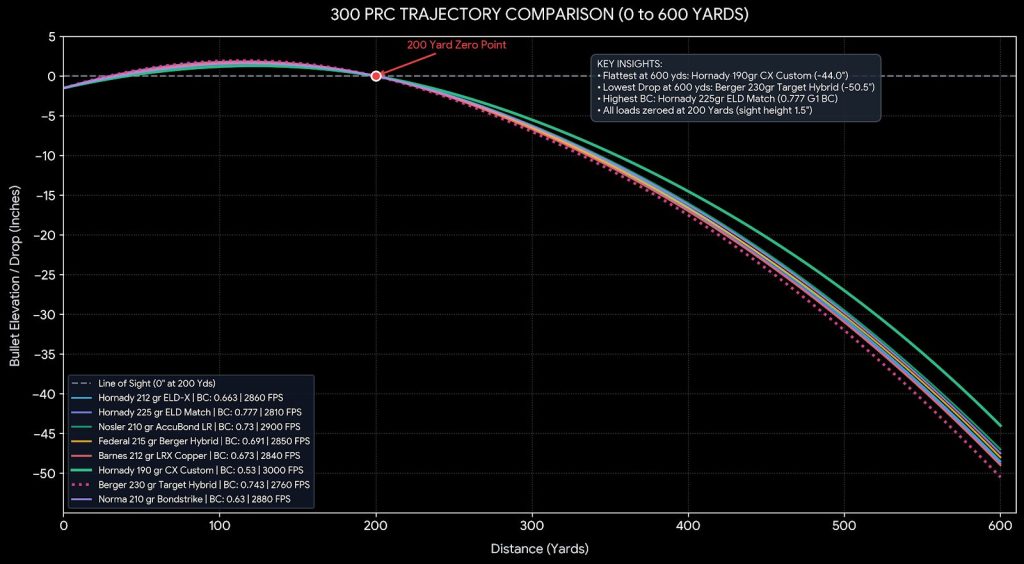
This professional trajectory chart clearly provides precision shooters with extremely accurate bullet drop measurements across various distances so they can effectively compensate for gravity. You should always properly match your chosen factory load with the recommended zero distance to truly maximize your effective hunting range and ensure perfectly ethical shots.
Understanding The 300 PRC Trajectory Chart
The data presented in our ballistic chart provides critical information about how these heavy, high-performance projectiles perform during open flight. By examining the specific columns, we can understand exactly how these numbers translate into real-world precision shooting performance.
Trajectory Analysis
Bullet drop represents exactly how far gravity pulls the projectile downward from your absolute line of sight across various distances. Our chart measures this specific vertical drop in inches to help you calculate precise aiming adjustments in the field.
The table clearly reveals that the 300 PRC remains remarkably flat across the first three hundred yards. When zeroed at two hundred yards, most of these heavy magnum loads drop only about six to seven inches by the time they reach three hundred yards, which is an impressive feat given the size of these projectiles.
Conversely, the drop accelerates significantly past the four hundred yard mark, which is where precision marksmen must utilize dedicated ballistic calculators. The Hornady 225-grain ELD Match drops nearly fifty inches at six hundred yards, illustrating the power of gravity even on the most efficient bullets.
This physical difference in bullet drop perfectly illustrates precisely why 300 PRC shooters must carefully select the correct ammunition for their specific engagement distance. You simply cannot estimate holdovers for long-range targets; you must rely on verified data to maintain accuracy.
Velocity Analysis
Muzzle velocity measures the exact speed of the bullet as it exits the rifle barrel, recorded in feet per second. Faster initial speeds directly translate into significantly flatter trajectories and highly extended point blank hunting ranges for all big game animals.
The chart shows that the 300 PRC maintains impressive speeds despite the heavy projectile weights. The Hornady 190-grain CX load aggressively leaves the muzzle at a blistering three thousand feet per second, which provides a very flat flight path.
Heavier target bullets, such as the 230-grain Berger, leave the barrel slower, but their superior mass and aerodynamics allow them to overcome air resistance effectively. The 300 PRC’s massive powder capacity ensures these heavy bullets stay supersonic for over a mile.
This high velocity ensures that the bullet arrives at the target with immense kinetic energy, which is required for ethical, long-range harvest of large game. A faster, heavier bullet physically covers the downrange distance with superior authority.
Ballistic Coefficient Analysis
The ballistic coefficient (BC) physically measures how efficiently a bullet cuts through the air and strongly resists wind drag during flight. Higher numerical values indicate a highly aerodynamic bullet that will successfully retain its initial muzzle velocity much better downrange.
Our extensive data shows that the 300 PRC utilizes bullets with industry-leading BC ratings. The Hornady 225-grain ELD Match boasts a staggering BC of 0.777, allowing it to maintain velocity and ignore wind far better than almost any other commercial caliber.
Even the lighter 190-grain loads maintain a respectable BC of 0.530, proving that the cartridge design favors long-range efficiency. This aerodynamic performance is the secret behind the 300 PRC’s dominance in long-range target competitions.
Sectional density measures the physical weight of the bullet relative to its diameter, indicating potential penetration depth on heavy targets. The heavy 230-grain match loads feature sectional density ratings of 0.347, which guarantees deep terminal penetration on massive animals.
Best Hunting Loads Based On The Chart
Mountain hunters scaling steep, rugged terrain should immediately pick the Hornady 212-grain ELD-X for its versatility. This specific cartridge provides a perfect balance of high-BC aerodynamics and reliable, expanding terminal performance on elk or moose at extreme distances.
Elk hunters specifically targeting large bulls at extended ranges will find the Nosler 210-grain AccuBond LR exceptionally effective. The tough, bonded construction guarantees deep penetration even at lower impact velocities found at extreme ranges, while the flat trajectory minimizes holdover errors.
Shooters pursuing giant coastal grizzly bears should strongly consider the Barnes 212-grain LRX. This specific copper bullet was engineered to smash through thick shoulder bone while reliably retaining its full weight.
Marksmen shooting at extreme distances—such as one thousand yards—need maximum consistency and match-grade aerodynamic precision. The Hornady 225-grain ELD Match perfectly provides the exact consistent velocities required for shooting tiny groups at these distances.
Hunters facing gusty open-field wind conditions should rely on the heavier 230-grain ammunition. The massive projectile mass combined with the superior BC helps dramatically reduce horizontal wind deflection across wide-open mountain basins.
Key Takeaways From The Chart
The recommended zero distance strictly dictates the exact yardage where your bullet perfectly crosses your visual line of sight. Maximum point blank range specifically indicates how far you can shoot a target without ever manually adjusting your crosshairs vertically.
The trajectory table proves that the 300 PRC absolutely demands a 200-yard zero for maximizing long-range efficiency. This zero effortlessly provides a maximum point blank range that often reaches nearly 300 yards with high-velocity loads.
By properly matching your specific factory ammunition to its corresponding zero distance shown in the chart, you maximize your hunting and shooting capabilities. You will eliminate complicated mental math during fast-paced mountain hunting scenarios by trusting these verified ballistic values.
Common 300 PRC Bullet Weights
190 Grain
Lightweight 190-grain bullets are specifically engineered to maximize supersonic velocity and flatten the trajectory curve dramatically for open-field hunting. These specialized projectiles fly incredibly straight and provide the highest initial muzzle velocities for this magnum cartridge.
The primary advantage is the exceptionally flat flight path, which allows for minimal holdover adjustments within standard hunting ranges. These bullets provide rapid, explosive terminal performance, which is ideal for smaller big game or predators.
Hunters should avoid using these ultra-light bullets on truly massive animals, as they lack the deep-penetrating mass of heavier alternatives. However, for most mountain hunting applications, the speed and accuracy of the 190-grain load are hard to beat.
210-215 Grain
The 210 to 215-grain projectiles serve as the absolute “sweet spot” for 300 PRC shooters who want a balance of energy, trajectory, and wind-cheating performance. These weights typically leave the muzzle fast and provide outstanding, predictable terminal ballistics.
The main advantage is widespread availability and highly predictable performance across a wide range of hunting scenarios. These bullets provide enough energy for reliable, deep penetration on elk and moose, making them a favorite for all-around hunting.
One minor disadvantage is that the 215-grain bullet drops slightly more than the 190-grain load at very close range, but this is negligible. These loads are generally the most accurate across most rifle platforms, making them a safe, dependable choice.
225-230 Grain
Heavy 225 to 230-grain bullets are crafted for marksmen who demand maximum wind resistance and energy retention at extreme distances. These projectiles may exhibit a steeper drop compared to the lighter options, but they provide unparalleled stability.
The primary advantage is the ability to break through heavy hide and bone, ensuring deep wound channels on the largest animals. These bullets are significantly more resistant to wind than lighter options, helping to maintain accuracy in challenging, gusty weather.
The primary drawback is the increased recoil, which requires the shooter to be an expert in rifle handling and recoil management. These loads are ideal for long-range target competition or hunting scenarios where precision and energy are the top priority.
Effective Hunting Range
Deer
Mule deer hunters can safely engage targets out to six hundred yards with proper premium ammunition. This distance establishes the 300 PRC as a highly capable mountain hunting option for modern sportsmen.
Polymer-tipped bullets maintain enough energy to ensure ethical expansion even at these distances. You must always verify your exact bullet drop data before attempting challenging shots across massive mountain valleys.
Elk
Elk feature massive vital zones that require maximum energy for reliable harvesting. Large bulls have successfully absorbed numerous smaller bullets without dropping in their tracks, but the 300 PRC changes the game.
Hunters can confidently engage elk out to six hundred yards, as the 300 PRC provides the energy required for a quick, clean harvest. A well-placed shot destroys the vital systems upon physical impact when placed correctly.
Large Game
Moose and giant Alaskan game demand extreme penetration, which is exactly what the heavy 300 PRC projectiles provide. These animals require heavy construction to ensure the bullet reaches the vital organs through thick muscle.
Hunters should restrict their shots to five hundred yards when pursuing the largest game to ensure maximum kinetic energy delivery. Using heavy, bonded, or solid copper bullets ensures the projectile punches directly through to the far side of the animal.
Long Range Target Shooting
Precision shooting requires absolute mechanical consistency and match-grade ammunition. Competitive shooters demand cartridges capable of performing flawlessly in the most difficult environmental conditions imaginable.
Marksmen routinely engage steel targets out to one mile using heavy 225-grain match bullets. The 300 PRC remains predictable and stable even as it transitions into the subsonic range, demonstrating its dominance in long-range competitions.
Factors That Affect 300 PRC Trajectory
Bullet Weight
The physical weight of the bullet fundamentally alters how the magnum cartridge performs during sustained flight. Lighter bullets travel faster and maintain a flatter trajectory over the first four hundred yards.
Conversely, heavier projectiles drop faster because gravity acts on their slower forward momentum over a longer period. Hunters must carefully weigh the balance between the flat-shooting nature of light bullets and the efficiency of heavier alternatives.
Muzzle Velocity
Higher muzzle velocities propel the bullet further downrange before gravity pulls it downward. Speed is the ultimate equalizer when trying to extend the point-blank range of large-caliber rifles.
Ammunition loaded to maximum safe pressures will always shoot flatter than standard loads. Always store your ammunition properly to ensure consistent velocity readings at the range.
Barrel Length
Longer rifle barrels provide more time for expanding powder gases to accelerate the projectile before it exits the muzzle. A twenty-six inch barrel consistently produces higher velocities than a standard twenty-two inch carbine.
The 300 PRC was designed with long-range performance in mind, so longer barrels are highly recommended. Shooters using shorter barrels must account for a slight loss in velocity and be prepared for increased bullet drop.
Ballistic Coefficient
Aerodynamic bullets slip through the atmosphere easily and retain their velocity much better at long range. High BC bullets dramatically reduce the rate at which gravity pulls the projectile toward the earth.
You should avoid using inefficient bullet shapes if you plan on shooting past four hundred yards. Reviewing the coefficients in our chart helps you compare the efficiency of different factory loads.
Wind
Crosswinds push large-diameter projectiles off their intended flight path and create horizontal drift. Even aerodynamic 300 PRC bullets will catch a significant amount of wind during extended flight times.
Shooters must learn to accurately read wind speed and adjust their aim to ensure hits on small targets. Using ballistic software to calculate expected wind drift for your specific load is a mandatory skill for long-range success.
Temperature
Cold winter air is dense and creates extra drag that slows bullets down faster than warm summer air. Always verify your zero data during the actual weather conditions you expect to hunt in.
Extreme heat can cause ammunition pressures to spike in certain rifle platforms. Never leave your ammunition sitting in direct sunlight during warm range sessions.
Altitude
High-elevation environments feature thin air that generates very little drag on flying projectiles. Bullets fired at high altitudes will shoot flatter and retain far more energy than those fired at sea level.
Hunters traveling from coastal regions to mountainous states must recheck their trajectory data upon arrival. The change in atmospheric pressure can shift your point of impact by several inches at extended ranges.
Zero Distance
The zero distance is the foundational setting for your optics, determining where your bullet impacts relative to your point of aim. A proper zero simplifies the aiming process, allowing you to trust your crosshairs for standard distances.
Our chart assumes a 200-yard zero, which is ideal for the 300 PRC’s performance profile. This setting provides an excellent balance, minimizing the need for complex adjustments while maximizing effective hunting range.
Frequently Asked Questions
What Is A 300 PRC Trajectory Chart
It is a ballistic reference that shows the flight path and bullet drop of the 300 PRC cartridge across different distances. It is an essential tool for long-range shooters who want to understand how their ammunition behaves and accurately compensate for gravity.
What Is The Maximum Effective Range Of A 300 PRC
The 300 PRC is highly effective out to six hundred yards for hunting and over one mile for target shooting. Beyond this range, the projectile’s energy and velocity drop, making precision shooting difficult.
How Much Does A 300 PRC Drop At 500 Yards
Using a 212-grain load with a 200-yard zero, you can expect roughly thirty inches of drop at 500 yards. This is exceptionally flat for such a heavy, high-energy cartridge, highlighting its design purpose.
Is The 300 PRC Better Than The 300 Win Mag
The 300 PRC is designed for modern long-range shooting with better bullet stabilization and higher BC bullets. While the 300 Win Mag is a legendary cartridge, the 300 PRC offers improved long-range accuracy and energy retention.
What Is The Best Zero For 300 PRC
A 200-yard zero is the standard for the 300 PRC, offering a trajectory that works across its most practical hunting and shooting distances. This zero minimizes holdovers and allows for quick, confident shots.
Does Barrel Length Affect 300 PRC Ballistics
Yes, longer barrels provide higher velocity, leading to a flatter trajectory and more energy at long ranges. Shooters should ideally use at least a 24-inch barrel to realize the full potential of the cartridge.
What Is The Best 300 PRC Hunting Load
The Hornady 212-grain ELD-X is widely considered the best hunting load due to its high BC and reliable terminal performance. It offers a great balance of accuracy, trajectory, and energy delivery.
How Does Bullet Weight Change The 300 PRC Bullet Drop
Lighter bullets are faster and flatter initially, while heavier bullets retain energy and resist wind better at long ranges. Precision marksmen weigh these factors based on whether they are shooting targets or hunting game.
What Is The 300 PRC Ballistic Coefficient
The 300 PRC features industry-leading ballistic coefficients, often ranging from 0.530 to 0.777. These numbers highlight the cartridge’s aerodynamic efficiency and its ability to resist wind drift.
Can You Use 300 PRC For Target Shooting
Yes, the 300 PRC is an incredible cartridge for long-range target shooting and precision rifle competitions. It is specifically designed to perform consistently at distances where other cartridges struggle to remain accurate.