Introduced by Roy Weatherby in 1944, the .300 Weatherby Magnum is legendary for its ultra-high velocity, flat trajectory, and hard-hitting downrange energy. By blowing out the body taper and sharpening the shoulder of the classic .300 H&H Magnum case into a signature double-radius design, Weatherby massively increased powder capacity. Officially firing a standard 180-grain hunting bullet at a scorching muzzle velocity of 3,250 feet per second (fps), it generates over 4,200 foot-pounds (ft-lbs) of muzzle energy. This makes it one of the most versatile and devastating big-game hunting cartridges in the world, maintaining lethal kinetic energy and minimal drop at distances well past 500 yards.
300 Weatherby Magnum Ballistics & Chart
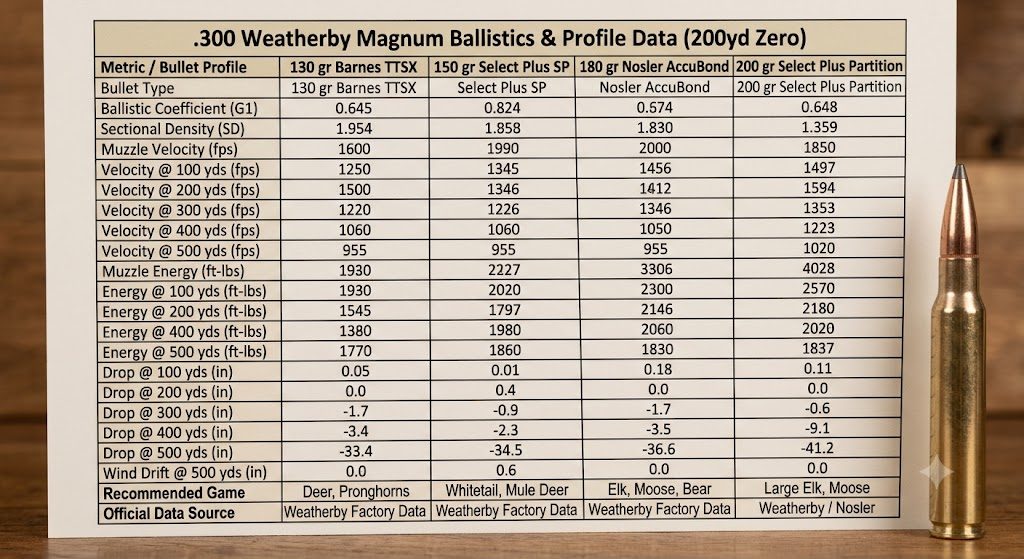
The ballistics table below displays actual performance profiles gathered from official factory listings and ballistic calculations optimized for standard conditions.
Note: All trajectory and drop figures assume a standard 200-yard zero with a scope sight height of 1.5 inches above the bore center.
| Metric / Bullet Profile | 130 gr Barnes TTSX | 150 gr Select Plus SP | 180 gr Nosler AccuBond | 200 gr Select Plus Partition |
| Bullet Type | Monolithic Copper | Soft Point (SP) | Bonded Poly-Tip | Dual-Core Partition |
| Ballistic Coefficient (G1) | 0.340 | 0.338 | 0.507 | 0.481 |
| Sectional Density (SD) | 0.196 | 0.226 | 0.271 | 0.301 |
| Muzzle Velocity (fps) | 3,500 | 3,540 | 3,250 | 3,060 |
| Velocity @ 100 yds (fps) | 3,190 | 3,210 | 3,040 | 2,860 |
| Velocity @ 200 yds (fps) | 2,900 | 2,910 | 2,840 | 2,670 |
| Velocity @ 300 yds (fps) | 2,630 | 2,620 | 2,650 | 2,490 |
| Velocity @ 400 yds (fps) | 2,370 | 2,350 | 2,470 | 2,315 |
| Velocity @ 500 yds (fps) | 2,130 | 2,100 | 2,300 | 2,150 |
| Muzzle Energy (ft-lbs) | 3,536 | 4,173 | 4,223 | 4,158 |
| Energy @ 100 yds (ft-lbs) | 2,935 | 3,430 | 3,690 | 3,630 |
| Energy @ 200 yds (ft-lbs) | 2,425 | 2,820 | 3,220 | 3,165 |
| Energy @ 300 yds (ft-lbs) | 1,995 | 2,285 | 2,805 | 2,750 |
| Energy @ 400 yds (ft-lbs) | 1,620 | 1,840 | 2,435 | 2,380 |
| Energy @ 500 yds (ft-lbs) | 1,310 | 1,468 | 2,110 | 2,050 |
| Drop @ 100 yds (in) | +1.2 | +1.1 | +1.4 | +1.6 |
| Drop @ 200 yds (in) | 0.0 | 0.0 | 0.0 | 0.0 |
| Drop @ 300 yds (in) | -5.4 | -5.5 | -6.2 | -7.1 |
| Drop @ 400 yds (in) | -16.2 | -16.6 | -18.1 | -20.5 |
| Drop @ 500 yds (in) | -33.4 | -34.5 | -36.6 | -41.2 |
| Wind Drift @ 500 yds (in) | 25.8 | 26.2 | 16.8 | 18.2 |
| Recommended Game | Deer, Pronghorns | Whitetail, Mule Deer | Elk, Moose, Bear | Large Elk, Moose |
| Official Data Source | Weatherby Factory Data | Weatherby Factory Data | Weatherby / Nosler | Weatherby Factory Data |
Column Explanation Guide
To fully evaluate how these loads perform in the field, it is crucial to understand what each column represents:
- Bullet Weight (gr): Measured in grains ($7,000 \text{ grains} = 1 \text{ pound}$). Lighter bullets shift speed upward but surrender energy quicker downstream; heavier bullets balance massive initial recoil with superior downrange velocity retention.
- Bullet Type: The physical architecture of the bullet. Options span from traditional jacketed Lead Soft Points (SP) to modern Poly-Tip bonded hunting bullets and lead-free solid copper alloys designed for controlled deformation.
- Ballistic Coefficient (BC): A mathematical rating of the bullet’s aerodynamic efficiency. A higher BC number means the projectile cuts through air drag more effectively, fighting off wind drift and retaining speed at extreme ranges.
- Sectional Density (SD): The ratio of a bullet’s weight to its diameter. Higher SD values mean the weight is concentrated heavily behind a narrow frontal area, maximizing deep penetration through thick muscle tissue and heavy bone structures.
- Velocity (fps): The physical travel speed of the bullet in feet per second. High muzzle velocities drop the flight time significantly, compressing trajectories and broadening the hunter’s effective range margin.
- Energy (ft-lbs): Kinetic force measured in foot-pounds. This value dictates the striking force delivered to the target. For clean, ethical kills, big-game guidelines typically mandate a minimum threshold of 1,000 ft-lbs for deer and 1,500 ft-lbs for elk.
- Bullet Drop (inches): Vertical bullet displacement relative to the line of sight. When zeroed at 200 yards, positive numbers show how high the bullet arches above the line of sight at mid-range, while negative numbers reveal how much it falls past the zero distance.
- Wind Drift (inches): Horizontal deflection calculated at a full 90-degree angle under a steady 10 mph crosswind. This measures a bullet’s resilience against atmospheric drag.
Best Ammo Selections by Hunting Application
Best .300 Weatherby Magnum Load for Deer
- Top Pick: 150-Grain Select Plus Soft Point (SP) or 130-Grain Barnes TTSX.
- Why it excels: Deer possess lighter bone structures and relatively thin chest walls. Pushing a lightweight 130 to 150-grain bullet past 3,500 fps translates to an intensely flat, laser-like trajectory out to 300 yards. Rapid expansion unloads devastating kinetic shock instantly inside the vitals for immediate anchoring, without the crushing recoil penalty of heavier payloads.
Best Load for Elk
- Top Pick: 180-Grain Nosler AccuBond.
- Why it excels: The 180-grain profile is widely considered the sweet spot for the .300 Weatherby. By bonding the lead core directly to a thick outer copper jacket, the AccuBond holds its structural shape cleanly upon high-velocity impact with an elk’s heavy shoulder blade. At the same time, its high ballistic coefficient retains more than 2,800 ft-lbs of striking power at 300 yards.
Best Load for Moose
- Top Pick: 200-Grain Select Plus Nosler Partition.
- Why it excels: Dropping a massive bull moose requires deep, unyielding penetration across heavy muscle mass. The dual-core construction of the Partition ensures that even if the front half expands violently upon contact, the rear lead chamber remains fully locked inside the jacket to push straight through vital organs from almost any angle.
Best Long-Range Load
- Top Pick: 200-Grain ELD-X Precision Hunter.
- Why it excels: For stretching shots out past the 400-yard mark, aerodynamic stability is everything. Boasting an ultra-high G1 ballistic coefficient of 0.626, this heavy match-grade hunting bullet resists crosswinds remarkably well. At 500 yards, it still speeds along at over 2,200 fps, carrying enough wallop to expand cleanly even at lower downrange velocities.
Factors Affecting Ballistics
- Rifle Freebore Design: Factory Weatherby rifles feature an unrifled section ahead of the chamber known as “freebore”. This acts as a relief valve, allowing the high-pressure powder charge a head start before engaging the rifling. Firing factory ammunition in custom barrels lacking this specialized throating can jump chamber pressures up dangerously.
- Barrel Length Variance: Factory ballistics are established using standard 26-inch test barrels to fully burn the massive columns of slow-burning powder. If your hunting setup utilizes a handier 24-inch or 22-inch barrel, expect to drop roughly 25 to 50 fps of velocity per inch of shortened steel.
- Atmospheric Conditions: The high velocity of the .300 Weatherby means its trajectory is highly responsive to air density. Cold, dense winter air at sea level slows bullets down faster, increasing drop. Conversely, hunting at high mountain altitudes thins out air resistance, flattening the overall flight path.
Frequently Asked Questions
How does the .300 Weatherby Magnum compare to the .300 Winchester Magnum?
The .300 Weatherby Magnum features a significantly larger case capacity, giving it a consistent 150 to 200 fps speed advantage over the standard .300 Win Mag with identical bullet weights. This translates to roughly 15% more downrange energy and a noticeably flatter trajectory, though it comes at the cost of heavier rifle recoil and higher ammunition expenses.
What is the effective hunting range of the .300 Weatherby Magnum?
For medium game like deer, its flat trajectory provides an effective range out past 600 yards. For larger game like elk, it retains the recommended baseline threshold of 1,500 ft-lbs of kinetic energy out to approximately 500–550 yards, depending heavily on your chosen bullet style and aerodynamic efficiency.
Is the recoil of the .300 Weatherby manageable?
It produces significant recoil, generating roughly 30 to 35 ft-lbs of rearward force depending on rifle weight. This is roughly double the kick of a standard .30-06 Springfield. While experienced marksmen can manage it easily, clean shot placement typically benefits from a quality recoil pad, a heavier stock configuration, or an effective muzzle brake.
For a great visual breakdown of real-world trajectory drop and how energy numbers translate into dialing your scope in the field, check out this comprehensive 300 WBY MAG Ballistics and Scope Guide. This video provides helpful field demonstrations explaining exactly how bullet drop and energy play out across varying hunting distances.