A 100-yard zero means adjusting your rifle’s optic or iron sights so the bullet impacts exactly at your point of aim at 100 yards. Many shooters favor this setup because it simplifies calculations; the bullet path never arcs significantly above the line of sight, meaning all adjustments beyond 100 yards are holdovers (aiming higher).
This guide uses the popular Federal American Eagle 5.56 NATO 55-grain M193 FMJ for its baseline measurements. While this 5.56 ballistics chart 100 yard zero provides a highly accurate reference, remember that your actual trajectory will vary depending on your specific barrel length, exact ammunition lot, sight height, and local environmental conditions.
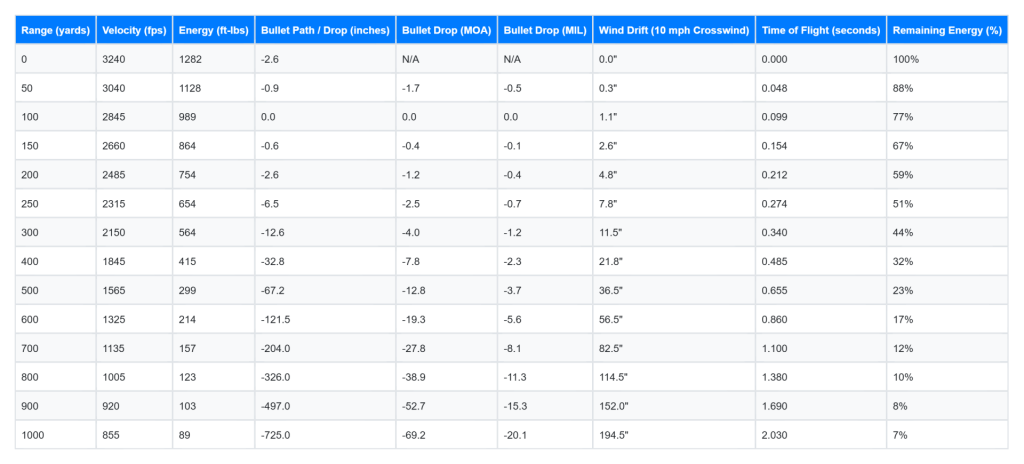
5.56 Ballistics Chart 100 Yard Zero
| Range (yards) | Velocity (fps) | Energy (ft-lbs) | Bullet Path / Drop (inches) | Bullet Drop (MOA) | Bullet Drop (MIL) | Wind Drift (10 mph Crosswind) | Time of Flight (seconds) | Remaining Energy (%) |
| 0 | 3240 | 1282 | -2.6 | N/A | N/A | 0.0″ | 0.000 | 100% |
| 50 | 3040 | 1128 | -0.9 | -1.7 | -0.5 | 0.3″ | 0.048 | 88% |
| 100 | 2845 | 989 | 0.0 | 0.0 | 0.0 | 1.1″ | 0.099 | 77% |
| 150 | 2660 | 864 | -0.6 | -0.4 | -0.1 | 2.6″ | 0.154 | 67% |
| 200 | 2485 | 754 | -2.6 | -1.2 | -0.4 | 4.8″ | 0.212 | 59% |
| 250 | 2315 | 654 | -6.5 | -2.5 | -0.7 | 7.8″ | 0.274 | 51% |
| 300 | 2150 | 564 | -12.6 | -4.0 | -1.2 | 11.5″ | 0.340 | 44% |
| 400 | 1845 | 415 | -32.8 | -7.8 | -2.3 | 21.8″ | 0.485 | 32% |
| 500 | 1565 | 299 | -67.2 | -12.8 | -3.7 | 36.5″ | 0.655 | 23% |
| 600 | 1325 | 214 | -121.5 | -19.3 | -5.6 | 56.5″ | 0.860 | 17% |
| 700 | 1135 | 157 | -204.0 | -27.8 | -8.1 | 82.5″ | 1.100 | 12% |
| 800 | 1005 | 123 | -326.0 | -38.9 | -11.3 | 114.5″ | 1.380 | 10% |
| 900 | 920 | 103 | -497.0 | -52.7 | -15.3 | 152.0″ | 1.690 | 8% |
| 1000 | 855 | 89 | -725.0 | -69.2 | -20.1 | 194.5″ | 2.030 | 7% |
- Factory Load: Federal American Eagle 5.56x45mm NATO (XM193)
- Bullet Weight: 55 grains (FMJ Boat Tail)
- Muzzle Velocity: 3,240 fps (20-inch test barrel)
- Ballistic Coefficient: 0.243 (G1)
- Zero Distance: 100 yards
- Sight Height: 2.6 inches (Standard AR-15 over-bore measurement)
- Atmospheric Conditions: Standard Sea Level (59°F, 29.92 inHg, 0% Humidity)
5.56 Ballistics Chart 100 Yard Zero Image
Understanding a 100-Yard Zero
A 100-yard zero aligns your rifle’s point of aim exactly with the bullet’s point of impact at exactly 100 yards.
Because an AR-15 optic typically sits 2.6 inches above the barrel, the bullet starts 2.6 inches low. It travels in a very slight upward angle relative to your line of sight until it meets the crosshairs at 100 yards. With this zero, the bullet never rises significantly above your line of sight.
Advantages:
- Simplifies calculations; you never have to “hold under” your target at longer distances.
- Extremely precise for 100-yard target shooting and small varmint hunting.
- Makes reading ballistic calculators and turret dialing very straightforward.
Disadvantages:
- The bullet drop at 300 yards is much steeper compared to a 50-yard or 36-yard zero.
- Requires more holdover memory for intermediate ranges.
How to Read the Ballistics Chart
Understanding the 5.56 trajectory chart requires breaking down each column:
- Range (yards): The distance from the muzzle to the target.
- Velocity (fps): How fast the bullet is traveling in feet per second.
- Energy (ft-lbs): The destructive force or kinetic energy the bullet carries upon impact.
- Bullet Path / Drop (inches): Where the bullet impacts relative to the center of your crosshairs.
- Bullet Drop (MOA / MIL): The measurement units used to dial your scope turrets to correct for bullet drop.
- Wind Drift: How far a 10 mph 90-degree crosswind pushes the bullet horizontally.
- Time of Flight: How long it takes the bullet to reach the target.
- Remaining Energy (%): The percentage of muzzle kinetic energy the bullet still retains.
Velocity Performance
The 5.56x45mm cartridge relies heavily on velocity rather than bullet weight to inflict damage. The M193 55-grain bullet leaves a 20-inch barrel at a blistering 3,240 fps.
However, because the 55-grain bullet is light and has a low ballistic coefficient (0.243), it sheds velocity rapidly. By 300 yards, it slows down to 2,150 fps. It goes transonic (dropping below the speed of sound) just past the 700-yard mark, at which point accuracy degrades significantly.
Energy Performance
Muzzle energy for the standard 55-grain M193 is approximately 1,282 ft-lbs.
For ethical hunting on medium game (like coyotes or small deer where legally permitted), experts generally recommend a minimum of 500 to 1,000 ft-lbs of retained energy. As seen in the 5.56 energy chart, the bullet drops below 500 ft-lbs just after 300 yards. By 500 yards, it retains only 23% of its original muzzle energy.
Bullet Drop with a 100-Yard Zero
With a 100-yard zero on an AR-15 (2.6-inch sight height), the 5.56 bullet path starts low, crosses zero at 100, and immediately begins falling.
At 200 yards, the drop is minimal (about 2.6 inches). By 300 yards, the bullet drops 12.6 inches. If you are shooting at 500 yards, the bullet falls more than 67 inches. At this range, you will need to adjust your scope up by roughly 12.8 MOA or 3.7 MIL to hit the target.
Wind Drift
Wind is the enemy of the lightweight 5.56 bullet. A mild 10 mph full-value crosswind will barely nudge the bullet at 100 yards (1.1 inches of drift).
However, at 300 yards, that same wind pushes the M193 bullet nearly a full foot (11.5 inches) off target. At 500 yards, you must compensate for over 36 inches of horizontal drift. Heavier bullets with better aerodynamic profiles—like the 77-grain OTM—handle wind drift far better than standard 55-grain or 62-grain loads.
Time of Flight
Time of flight dictates how much time gravity and wind have to act upon the projectile. It takes about one-third of a second (0.340s) for a 55-grain 5.56 bullet to reach 300 yards.
By the time it travels 1,000 yards, the bullet has been in the air for over 2 seconds. When shooting moving targets at distance, longer flight times require significant lead times in front of the target.
Effective Range
The practical effective range of the 5.56 depends entirely on your target and application.
| Application | Max Recommended Range | Limiting Factor |
| Defensive Use | 0 – 300 Yards | Bullet fragmentation velocity thresholds |
| Varmint Hunting | 0 – 400 Yards | Kinetic energy and bullet expansion |
| Target / Competition | 0 – 600 Yards | Transonic transition and wind drift |
| Long-Range Steel | 600 – 800 Yards | Subsonic destabilization |
100-Yard Zero vs 50-Yard Zero vs 200-Yard Zero
| Zero Distance | Advantages | Disadvantages | Best For | Max Point-Blank Range (Target Size) | Typical Bullet Path |
| 50-Yard Zero | Flattest practical trajectory to 250 yards. | Sight offset is significant up close; impacts are high at 100 yards. | Defensive carbines, duty rifles, general purpose. | ~275 yards (8-inch target) | -2.6″ at muzzle, 0″ at 50, +1.5″ at 100, 0″ at 200. |
| 100-Yard Zero | Exact holds beyond 100 yards; no high-arcing trajectory. | Requires holding high for almost all distances past 150 yards. | Precision shooting, LPVOs, benchrest, small varmints. | ~200 yards (8-inch target) | -2.6″ at muzzle, 0″ at 100, -2.6″ at 200. |
| 200-Yard Zero | Great for 3-gun and open terrain engagements. | Bullet impacts nearly 2 inches high at 100 yards. | Open terrain shooting, iron sights. | ~250 yards (8-inch target) | -2.6″ at muzzle, +1.5″ at 100, 0″ at 200. |
Best Factory Loads for a 100-Yard Zero
| Manufacturer | Bullet | Weight (gr) | BC (G1) | Muzzle Velocity | Best Use |
| Federal | XM193 FMJ | 55 | 0.243 | 3240 fps | Range training, bulk storage |
| Winchester | M855 Green Tip | 62 | 0.304 | 3060 fps | Penetration, barrier testing |
| Black Hills | OTM (Mk262) | 77 | 0.372 | 2750 fps | Long-range precision, defense |
| Hornady | V-MAX | 55 | 0.255 | 3240 fps | Varmint hunting, pest control |
| Barnes | TSX Solid Copper | 62 | 0.287 | 3000 fps | Medium game hunting, defense |
| Nosler | Ballistic Tip | 60 | 0.270 | 3150 fps | Coyote hunting |
| PMC | X-TAC FMJ-BT | 55 | 0.243 | 3270 fps | High-volume range use |
Factors That Affect the Ballistic Chart
- Barrel Length: A 10.5-inch barrel will shoot the same M193 load around 400-500 fps slower than a 20-inch barrel, drastically increasing bullet drop.
- Twist Rate: A 1:7 twist is ideal for stabilizing heavier 77-grain bullets, while 1:9 or 1:12 twists are better suited for lighter 55-grain bullets.
- Bullet Weight & Ballistic Coefficient: Heavier, high-BC bullets fly slower but resist wind drift better and retain velocity longer.
- Sight Height: A standard AR-15 sight sits 2.6 inches high. Lower sights on bolt-action rifles will change the near-zero trajectory.
- Environmental Conditions: Higher altitudes, hotter temperatures, and lower humidity all decrease air density, causing bullets to fly flatter and faster over distance.
Frequently Asked Questions
Is a 100-yard zero good for 5.56?
Yes. A 100-yard zero is excellent for precision shooters, varmint hunters, and those using Low Power Variable Optics (LPVOs) with dedicated bullet drop compensator (BDC) reticles designed specifically around a 100-yard baseline.
How much does a 5.56 drop after 100 yards?
With a standard 55-grain bullet zeroed at 100 yards, you can expect roughly 2.6 inches of drop at 200 yards, 12.6 inches at 300 yards, and 32.8 inches at 400 yards.
Is a 100-yard zero better than a 50-yard zero?
Neither is universally better. A 50-yard zero provides a slightly more “forgiving” maximum point-blank range for combat and defensive setups out to 250 yards. A 100-yard zero is better for precise target shooting where the shooter wants to avoid any positive bullet rise over the line of sight.
What is the best zero for an AR-15?
Most military and defensive instructors recommend a 50-yard or 36-yard zero for a standard AR-15 red dot or holographic sight. Precision shooters and those with magnified optics usually prefer a 100-yard zero.
How much MOA adjustment is needed at 500 yards?
For a 55-grain 5.56 zeroed at 100 yards, you will need to dial your elevation turret up by approximately 12.5 to 13.0 MOA to hit a target at 500 yards.
Should You Use a 100-Yard Zero?
Deciding to use a 100-yard zero comes down to your primary use case.
If you are a recreational target shooter, a small-game varmint hunter, or a competitor using a scope with exposed turrets and a grid reticle, the 100-yard zero is arguably the cleanest, most mathematically simple baseline to work from. It ensures that every shot past your zero distance is calculated as a positive elevation adjustment.
However, if your AR-15 is dedicated to home defense or fast-paced tactical applications where dialing turrets is impractical, a 50-yard zero might serve you better by minimizing your required holdovers inside 250 yards. Ultimately, the best zero is the one you train with and thoroughly understand.