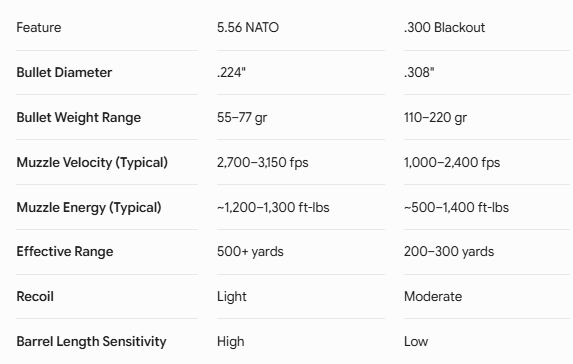
The main difference between the 5.56 NATO and the .300 AAC Blackout is their ballistic intent: the 5.56 NATO is a high-velocity, flat-shooting cartridge designed for distance and precision, whereas the .300 Blackout is a heavy-hitting, short-range specialist optimized for short-barreled rifles and suppressed performance. While both cartridges share the same base diameter and overall cartridge length, the 5.56 NATO offers superior range and a flatter trajectory, whereas the .300 Blackout delivers a larger, heavier projectile that excels in close-quarters and quiet, suppressed configurations. Choosing between them depends on whether your priority is long-range accuracy and cost-effective training or short-range terminal performance and suppressor utility, making this 5.56 vs 300 blackout ballistics chart essential for understanding their distinct roles.
Table of Contents [Click to open]
5.56 vs 300 Blackout Ballistics Chart
| Feature | 5.56 NATO | .300 Blackout |
| Bullet Diameter | .224″ | .308″ |
| Bullet Weight Range | 55–77 gr | 110–220 gr |
| Muzzle Velocity (Typical) | 2,700–3,150 fps | 1,000–2,400 fps |
| Muzzle Energy (Typical) | ~1,200–1,300 ft-lbs | ~500–1,400 ft-lbs |
| Effective Range | 500+ yards | 200–300 yards |
| Best Application | Long-range, Varmint, General | Close-quarters, Suppressed, Hunting |
| Barrel Length Sensitivity | High (needs length for velocity) | Low (full burn in short barrels) |
| Recoil | Light | Moderate |
| Ammo Cost & Availability | Lower / High | Higher / Medium |
Muzzle Velocity Comparison
The 5.56 NATO consistently achieves higher muzzle velocities, often exceeding 3,000 fps with standard 55-grain loads. In contrast, the .300 Blackout is designed with two distinct velocity profiles: supersonic loads (typically 110–125 grains) reach velocities around 2,200–2,400 fps, whereas subsonic loads stay below 1,100 fps to remain hearing-safe with a suppressor. While the 5.56 NATO remains the faster cartridge at the muzzle and beyond, the .300 Blackout trades that speed for significantly heavier projectile mass.
Muzzle Energy Comparison
Muzzle energy is surprisingly comparable between these two cartridges, though they arrive at their power differently. The 5.56 NATO generates energy through sheer speed, while the .300 Blackout utilizes a heavier .30-caliber bullet. However, the .300 Blackout produces more kinetic energy at close range in supersonic configurations, making it a “thumper” for home defense or medium-sized game, whereas the 5.56 NATO maintains a more consistent energy profile over greater distances.
Downrange Energy and Velocity
As distance increases, the ballistic paths diverge significantly. The 5.56 NATO’s lighter, high-velocity projectiles are aerodynamically efficient, maintaining lethal velocity and energy well past 300 yards. On the other hand, the .300 Blackout’s heavier, slower bullets experience a much steeper velocity and energy decline after 200 yards. While the 5.56 remains viable for longer-range engagements, the .300 Blackout is intentionally capped as a short-to-medium-range platform.
Bullet Drop and Trajectory
The 5.56 NATO is clearly the flatter-shooting cartridge. Because of its high velocity, a 5.56 round zeroed at 100 yards will require significantly less holdover at 300 or 400 yards compared to the .300 Blackout. In contrast, the .300 Blackout—particularly with subsonic or heavier supersonic loads—experiences significant bullet drop at distance, making it much more difficult to use for precision work beyond 300 yards compared with the 5.56.
Suppressor and Barrel Compatibility
The .300 Blackout is the clear winner for suppressed shooting and short-barreled configurations. It was specifically engineered to achieve a complete powder burn in barrels as short as 9 inches, whereas 5.56 NATO barrels under 10.5 inches often suffer from reliability issues and incomplete powder combustion. Furthermore, the .300 Blackout’s subsonic capability allows for true “Hollywood quiet” performance, while the 5.56 NATO remains loud due to the supersonic crack of the bullet.
Which Is Better?
The 5.56 NATO is better for the average shooter who values affordability, long-range capability, and multi-purpose performance. It is the gold standard for high-volume range training, varmint hunting, and any application where you might need to engage targets beyond 300 yards.
The .300 Blackout is better for the specialist who prioritizes close-quarters performance, suppressed utility, or short-barreled AR configurations. If your goal is a dedicated home-defense platform or a quiet suppressed setup for medium game within 200 yards, the .300 Blackout offers unmatched versatility compared to the 5.56.
FAQ
Can I shoot .300 Blackout in a 5.56 rifle?
No. Never attempt to chamber or fire .300 Blackout in a 5.56/223 barrel. It is extremely dangerous and will result in catastrophic firearm failure.
Is 5.56 or .300 Blackout better for home defense?
Both are effective, but the .300 Blackout is often preferred for its performance in short barrels and with suppressors, while the 5.56 is often cited for having less risk of over-penetration due to bullet fragmentation characteristics.
Does .300 Blackout have more recoil?
Yes, because the .300 Blackout utilizes a heavier bullet and typically generates more energy in a short-barreled package, the felt recoil is slightly more noticeable than the very light, manageable recoil of the 5.56.
Which is cheaper to train with?
The 5.56 NATO is significantly cheaper and easier to find in bulk, making it the superior choice for high-volume practice and training.