The main difference between .300 Blackout (7.62×35mm), 5.56 NATO (.223 Remington), and 7.62×39mm lies in their design origins, case dimensions, projectile weights, and intended operational roles. The 5.56 NATO is a high-velocity, lightweight intermediate cartridge optimized for flat trajectories, extended point-blank ranges, and minimal recoil out of standard rifle configurations. The 7.62×39mm is a classic military intermediate cartridge engineered for rugged reliability, intermediate-range barrier penetration, and heavy mass transfer at close to moderate distances. The .300 AAC Blackout was developed specifically to bridge these worlds, delivering heavy-projectile terminal performance and exceptional suppressed capability from short-barreled AR-15 platforms without requiring custom magazines or bolt face modifications.
This article evaluates the actual ballistic performance, velocity retention, kinetic energy, trajectory, recoil profiles, barrel length sensitivities, and practical applications of these three prominent intermediate cartridges using empirical manufacturer and independent testing data.
300 Blackout vs 556 vs 762 Comparison
| Feature | .300 Blackout | 5.56 NATO | 7.62×39mm |
| Bullet Diameter | 0.308 in (7.82 mm) | 0.224 in (5.7 mm) | 0.311 in (7.9 mm) |
| Typical Bullet Weight | 110–220 gr | 55–62 gr | 123 gr |
| Muzzle Velocity | 1,010–2,375 fps (Load Dependent) | 2,750–3,250 fps | 2,350–2,400 fps |
| Muzzle Energy | 480–1,375 ft-lbs | 1,250–1,350 ft-lbs | 1,500–1,550 ft-lbs |
| Momentum | 0.55–1.52 lb-sec | 0.49–0.58 lb-sec | 0.86–0.93 lb-sec |
| Ballistic Coefficient | 0.220–0.648 (G1) | 0.151–0.304 (G1) | 0.265–0.305 (G1) |
| Effective Range | 300–400 yd (Supersonic) / 150 yd (Subsonic) | 500–600 yd | 300–400 yd |
| Bullet Drop (at 300 yd, 100 yd Zero) | -13.5 in (110gr Supersonic) / -145 in (220gr Subsonic) | -11.5 in (M855) | -23.0 in (123gr SST) |
| Recoil | Low-Moderate (2.5–5.5 ft-lbs) | Low (3.0–3.5 ft-lbs) | Moderate (5.5–6.5 ft-lbs) |
| Penetration | 12–20 in (Gelatin, Dependent on Load) | 10–16 in (Fragmentation/Yaw dependent) | 14–22 in (Lead Core/Steel Core) |
| Expansion | Reliable down to 1,000 fps (Polymer Tip Subsonic/Supersonic) | Relies on fragmentation threshold (>2,700 fps) | Controlled to moderate expansion (SST/Soft Point) |
| Short Barrel Performance | Exceptional (Full burn achieved in 8–9 in) | Severe velocity/fragmentation loss below 14.5 in | Good (Optimized for 16 in, moderate loss at 10-12 in) |
| Suppressor Performance | Industry Benchmark (Exceptional with Subsonic loads) | Moderate (High backpressure, loud supersonic crack) | Good (Mainly supersonic, limited quality subsonic factory options) |
| Ammo Cost | High ($0.80–$1.50+ per round) | Low-Moderate ($0.45–$0.70 per round) | Low-Moderate ($0.45–$0.75 per round for brass/quality steel) |
| Ammo Availability | Widely available commercially, higher cost | Ubiquitous worldwide, multiple military surplus/commercial tiers | Common commercially and via import channels |
| Common Rifle Platform | AR-15 (Standard bolt/magazines) | AR-15, Mini-14, Bolt Actions | AK-47, SKS, AR-15 (Specialized bolts/mags), Bolt Actions |
| Best Use | Suppressed SBRs, CQB, Medium Game Hunting within 150 yd | High-volume training, target shooting, varmints, 500+ yd engagements | General utility, cost-effective intermediate hunting, rugged carbines |
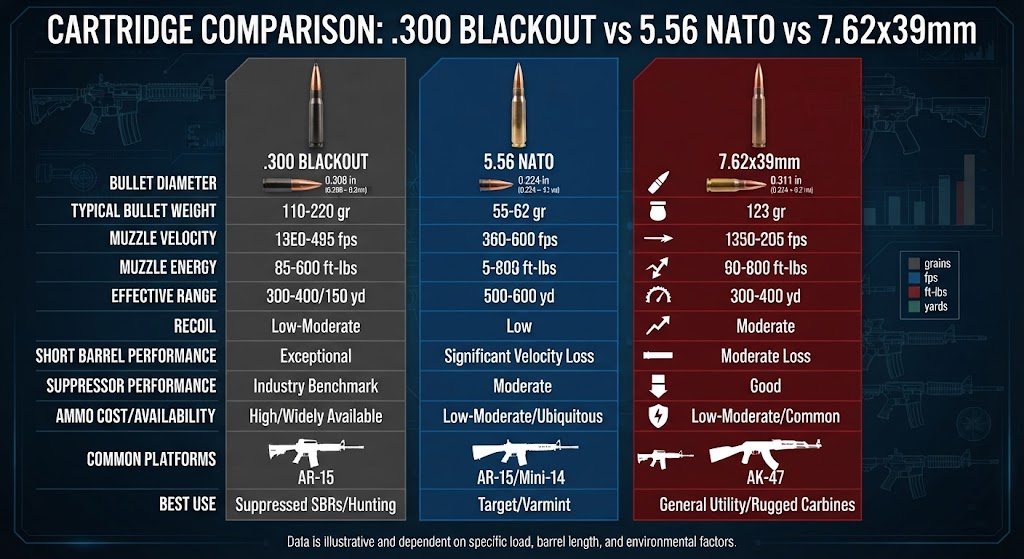
300 Blackout vs 556 vs 762 Ballistics
Evaluating intermediate cartridge ballistics requires examining how factory-loaded representative ammunition performs across varied parameters. Rather than treating a cartridge as a monolithic entity, we analyze specific factory specifications.
- 5.56 NATO (Federal American Eagle 55gr FMJ – XM193): Features a 55-grain full metal jacket boat-tail bullet with a 0.224-inch diameter, fired from a 20-inch test barrel at a muzzle velocity of 3,165 fps, generating 1,223 ft-lbs of muzzle energy with a G1 ballistic coefficient of approximately 0.243.
- 7.62×39mm (Hornady Black 123gr SST): Features a 123-grain polymer-tipped bullet with a 0.311-inch diameter, fired from a 20-inch test barrel at a muzzle velocity of 2,350 fps, generating 1,508 ft-lbs of muzzle energy with a G1 ballistic coefficient of 0.295.
- .300 AAC Blackout Supersonic (Barnes VOR-TX 110gr TAC-TX): Features a 110-grain all-copper solid expanding projectile with a 0.308-inch diameter, fired from a 16-inch test barrel at a muzzle velocity of 2,350 fps, generating 1,348 ft-lbs of muzzle energy with a G1 ballistic coefficient of 0.290.
- .300 AAC Blackout Subsonic (Hornady Custom Sub-X 190gr): Features a 190-grain polymer-tipped subsonic projectile with a 0.308-inch diameter, fired from a 16-inch test barrel at a muzzle velocity of 1,050 fps, generating 464 ft-lbs of muzzle energy with a G1 ballistic coefficient of 0.430.
300 Blackout vs 556 vs 762 Velocity
Velocity dictates the primary mechanism of injury for high-velocity small arms. The 5.56 NATO relies on high velocity to exceed its fragmentation threshold (typically above 2,700 fps). When launched from a 20-inch barrel, standard M193 55-grain ammunition achieves 3,165 fps at the muzzle, dropping to approximately 2,820 fps at 100 yards, 2,500 fps at 200 yards, and 2,205 fps at 300 yards.
In contrast, the 7.62×39mm and supersonic .300 Blackout operate in a lower velocity bracket. Hornady Black 7.62×39mm 123-grain SST exits a 20-inch barrel at 2,350 fps, maintaining roughly 2,080 fps at 100 yards, 1,840 fps at 200 yards, and 1,620 fps at 300 yards. The supersonic .300 Blackout (using a 110-grain Barnes TAC-TX from a 16-inch barrel) starts at 2,350 fps, dropping to approximately 2,050 fps at 100 yards, 1,780 fps at 200 yards, and 1,535 fps at 300 yards. Subsonic .300 Blackout rounds start below the speed of sound at roughly 1,050 fps, dropping gently to around 980 fps at 100 yards.
300 Blackout vs 556 vs 762 Muzzle Energy
Muzzle energy measures the total kinetic energy possessed by the projectile upon leaving the barrel.
- 5.56 NATO (XM193 55gr): ~1,223 ft-lbs at the muzzle; ~970 ft-lbs at 100 yards; ~760 ft-lbs at 200 yards; ~595 ft-lbs at 300 yards.
- 7.62×39mm (Hornady 123gr SST): ~1,508 ft-lbs at the muzzle; ~1,180 ft-lbs at 100 yards; ~925 ft-lbs at 200 yards; ~718 ft-lbs at 300 yards.
- .300 Blackout Supersonic (Barnes 110gr TAC-TX): ~1,348 ft-lbs at the muzzle; ~1,028 ft-lbs at 100 yards; ~775 ft-lbs at 200 yards; ~577 ft-lbs at 300 yards.
- .300 Blackout Subsonic (Hornady 190gr Sub-X): ~464 ft-lbs at the muzzle; ~415 ft-lbs at 100 yards; ~375 ft-lbs at 200 yards (rarely engaged at this distance).
While 7.62×39mm holds an outright advantage in muzzle energy over both 5.56 NATO and supersonic .300 Blackout due to its heavier projectile driven at moderate rifle speeds, energy alone does not equate to terminal effectiveness.
300 Blackout vs 556 vs 762 Momentum
Momentum measures an object’s resistance to changes in motion and provides insight into barrier penetration and mass retention through intermediate obstacles.
- 5.56 NATO (55gr M193): ~0.53 lb-sec.
- 7.62×39mm (123gr SST): ~0.89 lb-sec.
- .300 Blackout Supersonic (110gr TAC-TX): ~0.55 lb-sec.
- .300 Blackout Subsonic (190gr Sub-X): ~1.42 lb-sec.
The heavy, slow-moving subsonic .300 Blackout and the intermediate 7.62×39mm possess superior momentum compared to the lightweight 5.56 NATO, allowing them to maintain linear tracking through heavy clothing, light wood, and automobile glass with minimal deflection.
300 Blackout vs 556 vs 762 Trajectory
Trajectory is governed by muzzle velocity, ballistic coefficient (BC), and gravity. Assuming a standard 100-yard zero and a 2.5-inch optical sight height over bore:
- 5.56 NATO (55gr M193): Flat shooting profile. Rises slightly to +1.2 inches at 50 yards, dead-on at 100 yards, drops -3.5 inches at 200 yards, and drops -11.3 inches at 300 yards.
- 7.62×39mm (123gr SST): Slightly arcing trajectory. Rises +1.5 inches at 50 yards, zeroed at 100 yards, drops -6.8 inches at 200 yards, and drops -21.5 inches at 300 yards.
- .300 Blackout Supersonic (110gr TAC-TX): Comparable to 7.62×39mm. Rises +1.4 inches at 50 yards, zeroed at 100 yards, drops -6.5 inches at 200 yards, and drops -20.2 inches at 300 yards.
- .300 Blackout Subsonic (190gr Sub-X): Extreme rainbow trajectory. Zeroed at 50 yards, drops -8.5 inches at 100 yards, and drops -32.0 inches at 150 yards. Past 200 yards, subsonic drops exceed 70 to 140 inches, requiring heavy elevation holds or specialized ballistic dial adjustments.
300 Blackout vs 556 vs 762 Bullet Drop
When comparing bullet drop at extended distances from a 100-yard zero, projectile design and velocity dictate downrange holding requirements. At 300 yards, the 5.56 NATO drops roughly 11.3 inches, making torso hits achievable without dialing scope turrets. Supersonic .300 Blackout and 7.62×39mm drop between 20 and 23 inches at the same distance, requiring deliberate holdovers. Subsonic .300 Blackout experiences severe trajectory degradation past 150 yards, making 300-yard engagements with subsonic rounds impractical for precision work.
300 Blackout vs 556 vs 762 Recoil
Felt recoil is a function of bullet mass, powder charge weight, muzzle velocity, and rifle weight.
- 5.56 NATO: Generates roughly 3.0 to 3.5 ft-lbs of free recoil energy in a standard 7-pound AR-15. Recoil is exceptionally mild, allowing rapid follow-up shots and flat optics tracking during strings of fire.
- .300 Blackout Supersonic: Generates roughly 5.0 to 5.8 ft-lbs of recoil energy. While higher than 5.56 NATO, it remains easily manageable and smooth in standard AR platforms. Subsonic .300 Blackout produces minimal recoil (~2.5 ft-lbs), feeling akin to a rimfire or heavy pistol caliber carbine.
- 7.62×39mm: Generates roughly 5.8 to 6.5 ft-lbs of recoil energy in a standard semi-automatic rifle platform. It features a noticeable push, particularly in lightweight folding-stock carbines.
300 Blackout vs 556 vs 762 Penetration
Terminal penetration depends on projectile construction, impact velocity, and target density.
- 5.56 NATO relies on fragmentation upon impact (at velocities above 2,700 fps) to create devastating temporary and permanent wound cavities, penetrating 12 to 15 inches in ballistic gelatin before breaking apart.
- 7.62×39mm utilizes mass and stable yaw characteristics to penetrate 15 to 20 inches, performing reliably through barriers like plywood and car doors.
- .300 Blackout offers dual performance characteristics: supersonic expanding hunting bullets (such as the Barnes TAC-TX) penetrate 14 to 20 inches with near 100% weight retention, while purpose-built subsonic expanding bullets (like the Hornady Sub-X) achieve 13 to 17 inches of penetration even at impact velocities hovering near 1,000 fps.
300 Blackout vs 556 vs 762 Effective Range
- 5.56 NATO: Effective point-target range extends to 500–600 yards for trained shooters, limited primarily by wind drift and terminal velocity thresholds required for bullet fragmentation.
- 7.62×39mm: Effective range is realistically capped at 300–400 yards due to rapid velocity decay and steep trajectory arcs caused by lower ballistic coefficients.
- .300 Blackout Supersonic: Effective out to 300–400 yards for hunting and defensive applications, matching 7.62×39mm ballistics.
- .300 Blackout Subsonic: Strictly limited to 150 yards and in, due to extreme bullet drop and low terminal energy reserves beyond that threshold.
300 Blackout vs 556 vs 762 Barrel Length
Barrel length sensitivity represents one of the most critical operational dividers among these cartridges.
- 5.56 NATO: Highly sensitive to barrel length. Designed around a 20-inch barrel, it loses significant velocity when shortened. In a 14.5-inch or 16-inch barrel, velocity drops to roughly 2,900–3,000 fps. In a short-barreled rifle (SBR) configuration of 10.3 to 11.5 inches, velocity plummets below 2,500 fps, entirely negating the fragmentation velocity threshold needed for optimal terminal ballistics unless specialized short-barrel bonded soft-point ammunition is used.
- 7.62×39mm: Optimized for a 16-inch barrel (as found on standard AK-47 carbines). While it loses velocity in shorter barrels (such as 10.5-inch Draco pistols), its powder charge is relatively fast-burning, retaining more proportional performance in shorter lengths than 5.56 NATO.
- .300 Blackout: Engineered specifically for short-barrel performance. The entire powder charge in a .300 Blackout cartridge achieves complete combustion in a barrel as short as 8 to 9 inches. This allows shooters to run a compact SBR without suffering catastrophic velocity losses, massive muzzle blasts, or unburnt powder flash.
300 Blackout vs 556 vs 762 Suppressor Performance
- Subsonic .300 Blackout: The undisputed industry king of suppressed intermediate rifle shooting. By firing a heavy 190–220 grain bullet below the speed of sound (~1,050 fps), it eliminates the supersonic crack entirely. Paired with a quality suppressor, report levels drop to hearing-safe levels (118–130 dB), avoiding the harsh toxic gas blowback typical of over-gassed short-barrel rifles.
- Supersonic .300 Blackout & 7.62×39mm: Suppressors significantly reduce muzzle blast and flash, but the rounds still emit a sharp supersonic crack (~140+ dB) downrange.
- 5.56 NATO: Notoriously difficult to suppress effectively. Due to high port pressures and small bore diameters, suppressing a 5.56 SBR results in heavy gas blowback into the shooter’s face, accelerated weapon wear, and loud supersonic reports.
300 Blackout vs 556 vs 762 Hunting
- Deer: Supersonic .300 Blackout (with expanding copper or soft-point bullets) and 7.62×39mm (using hunting loads like Hornady SST or Federal Fusion) are effective on white-tailed deer and medium game within 150 yards. 5.56 NATO is legal for deer in many jurisdictions using barrier-blind expanding loads, but is generally discouraged for ethical medium-game hunting beyond close ranges. Subsonic .300 Blackout is viable for deer only within 75 yards with precise shot placement using expanding subsonic projectiles.
- Hogs: Both 7.62×39mm and supersonic .300 Blackout excel on feral hogs due to heavier projectile weights and deep penetration through thick gristle shields.
- Varmints & Small Game: 5.56 NATO dominates this category due to high-velocity varmint loads (such as 40gr–50gr polymer-tipped rounds) that deliver explosive fragmentation on coyotes and pests.
Note: Hunting regulations vary heavily by state and country regarding minimum caliber, case length, and energy requirements.
300 Blackout Supersonic vs Subsonic
It is vital to separate supersonic and subsonic .300 Blackout configurations. Supersonic loads (110gr–125gr) prioritize velocity, flat trajectories, and extended range (out to 300–400 yards). Subsonic loads (190gr–220gr) prioritize stealth, operating below the speed of sound for suppressed use within 100–150 yards. Mixing up these profiles leads to severe zero shifts of up to 15 to 20 inches at 100 yards.
300 Blackout Pros and Cons
.300 Blackout Pros
- Exceptional performance from short-barreled rifles (SBRs)
- Unmatched suppressed performance using subsonic ammunition
- Utilizes standard AR-15 bolts and magazines
- Excellent terminal ballistics on medium game with supersonic hunting loads
.300 Blackout Cons
- High ammunition cost compared to 5.56 and 7.62×39mm
- Steep trajectory and limited effective range for subsonic variants
- Risk of catastrophic chamber mismatch if a .300 Blackout round is inadvertently loaded into a 5.56 chamber
5.56 NATO Pros and Cons
5.56 NATO Pros
- Abundant, inexpensive, and globally available ammunition
- Extremely flat trajectory and high effective range (500+ yards)
- Minimal recoil allowing rapid multi-shot precision
- Superb selection of high-velocity varmint and defensive loads
5.56 NATO Cons
- Poor terminal performance and velocity loss in short barrels (<14.5 in)
- Difficult to suppress effectively without excessive gas blowback
- Lighter projectiles struggle with heavy intermediate barrier penetration
7.62×39mm Pros and Cons
7.62×39mm Pros
- Inexpensive surplus and commercial steel-cased ammunition options
- High muzzle energy and dependable barrier penetration
- Proven effectiveness on medium-sized game and feral hogs within 150 yards
7.62×39mm Cons
- Declining availability of cheap surplus imports
- Sub-optimal accuracy in surplus-configured AK/SKS platforms (though improved in bolt actions and modern AR builds)
- Steeper trajectory drop past 200 yards
Final Comparison
| Category | Winner | Reason |
| Velocity | 5.56 NATO | Exceeds 3,000 fps from standard barrels, outrunning both competitors. |
| Energy | 7.62×39mm | Heavier bullet mass delivers higher initial foot-pounds at the muzzle. |
| Momentum | .300 Blackout (Subsonic) | Heavy 220gr mass maximizes linear momentum. |
| Trajectory | 5.56 NATO | Flattest shooting profile and highest ballistic coefficient retention at distance. |
| Bullet Drop | 5.56 NATO | Retains the least drop out to 400+ yards. |
| Recoil | 5.56 NATO | Lowest impulse and softest felt recoil energy. |
| Short-Barrel Performance | .300 Blackout | Complete powder burn achieved in barrels under 9 inches. |
| Suppressor Performance | .300 Blackout (Subsonic) | Eliminates supersonic crack entirely for hearing-safe suppressed operations. |
| Penetration | Depends on Load | 7.62×39 and expanding .300 BLK excel via mass; 5.56 relies on fragmentation. |
| Hunting | Depends on Load | Supersonic .300 BLK and 7.62×39 for deer/hogs; 5.56 for varmints. |
| Effective Range | 5.56 NATO | Maintains lethal velocity thresholds out past 500 yards. |
| Ammo Cost | 5.56 NATO | Mass production keeps standard 5.56/.223 prices lowest. |
| Ammo Availability | 5.56 NATO | Universally stocked across all civilian and military supply chains. |
| Overall Versatility | Depends on Load | 5.56 wins for general utility/training; .300 BLK wins for specialized SBR/suppressed use. |
Which Is More Powerful: 300 Blackout, 556 or 762?
Power is multifaceted, encompassing velocity, energy, and bullet mass. In terms of raw muzzle energy, 7.62×39mm leads the pack (~1,500+ ft-lbs), followed closely by supersonic .300 Blackout (~1,350 ft-lbs), with 5.56 NATO ranking lowest in kinetic energy (~1,250 ft-lbs). However, 5.56 NATO generates its wounding potential through high-velocity tissue disruption and fragmentation, whereas 7.62×39mm and supersonic .300 Blackout rely on larger projectile diameter and mass transfer.
300 Blackout vs 556 vs 762: Which Should You Choose?
- Short Barrels:.300 Blackout is the definitive winner for barrels under 11.5 inches.
- Suppressed Shooting:.300 Blackout Subsonic provides unmatched stealth and noise reduction.
- Long-Range Shooting:5.56 NATO outperforms the others past 400 yards due to a flat trajectory.
- Hunting:Supersonic .300 Blackout or 7.62×39mm with quality soft-point/polymer-tipped loads are superior for deer and hogs within 150 yards.
- Varmint Control:5.56 NATO offers unmatched selection and velocity for small predators.
- General-Purpose Rifle Use:5.56 NATO remains the most practical and cost-effective all-around choice.
- AR-15 Platforms:5.56 NATO for general use; .300 Blackout if adding a suppressor or building an SBR.
- Budget-Conscious Shooting:5.56 NATO (.223 Rem) offers the lowest cost per round for high-volume training.
FAQs
Is 300 Blackout more powerful than 5.56?
At close range, supersonic .300 Blackout delivers greater bullet weight, frontal area, and kinetic energy than 5.56 NATO. However, 5.56 retains energy and velocity better at distances beyond 300 yards.
Is 7.62×39 more powerful than 300 Blackout?
Ballistically, standard supersonic 7.62×39mm and supersonic .300 Blackout are virtually identical in velocity and energy when fired from comparable barrel lengths.
Which has the most muzzle energy?
7.62×39mm generally produces the highest muzzle energy among standard factory loads, averaging around 1,500 ft-lbs from standard test barrels.
Which has the highest velocity?
5.56 NATO achieves the highest muzzle velocity, frequently exceeding 3,000 to 3,200 fps depending on bullet weight and barrel length.
Which has the least recoil?
5.56 NATO generates the lowest felt recoil energy (approx. 3.0–3.5 ft-lbs), making it the easiest to manage during rapid firing strings.
Which has the best trajectory?
5.56 NATO offers the flattest trajectory and least bullet drop out to extended distances due to its high velocity and favorable aerodynamics.
Which has the least bullet drop?
Within 300 yards, 5.56 NATO exhibits the least bullet drop, holding roughly 3 to 10 inches flatter than subsonic .300 Blackout or 7.62×39mm.
Which is best for short barrels?
.300 Blackout is purpose-built for short-barreled rifles, achieving complete powder combustion in barrels as short as 8 to 9 inches without velocity collapse.
Which is best with a suppressor?
Subsonic .300 Blackout is the industry standard for suppressed shooting, eliminating the sonic crack and operating at hearing-safe decibel levels.
Which is best for deer?
Supersonic .300 Blackout (with expanding copper or soft-point bullets) and 7.62×39mm (with hunting rounds like Hornady SST) are effective for white-tailed deer within 150 yards.
Which is best for hogs?
Both 7.62×39mm and supersonic .300 Blackout excel on feral hogs due to heavy projectile mass and reliable barrier penetration.
Which is best at 300 yards?
5.56 NATO is superior at 300 yards and beyond due to superior velocity retention, flatter trajectory, and manageable wind drift.
Which is cheapest to shoot?
5.56 NATO (.223 Remington) is the most economical cartridge to shoot due to massive global manufacturing scale and wide availability.
Which has the best overall ballistics?
It depends on application: 5.56 NATO excels in flat trajectory and range; .300 Blackout excels in short barrels and suppression; 7.62×39mm excels in budget utility and barrier punch.