The main difference between the 17 HMR and 17 WSM is that the 17 WSM utilizes a larger and thicker casing to generate significantly higher muzzle velocities and nearly double the kinetic energy, while the 17 HMR offers a much wider selection of highly accurate rifles and incredibly abundant ammunition for everyday varmint hunting. The 17 Winchester Super Magnum represents the absolute pinnacle of rimfire performance, capable of taking coyotes at 200 yards with a laser flat trajectory. Conversely, the 17 Hornady Magnum Rimfire has spent over two decades proving itself as the gold standard for eradicating small pests like prairie dogs and squirrels inside 150 yards. By comparing the specific ballistic profiles of these two hyper velocity rimfire cartridges, you can easily determine which of these tiny powerhouses belongs in your gun safe.
17 HMR vs 17 WSM Ballistics Chart
| Specification / Metric | 17 HMR (17 gr V-MAX) | 17 WSM (20 gr V-MAX) |
| Cartridge | .17 Hornady Magnum Rimfire | .17 Winchester Super Magnum |
| Parent Case | .22 WMR (necked down) | .27 caliber nail gun blank |
| Bullet Diameter | .172 inches | .172 inches |
| Typical Bullet Weight | 15.5 to 20 grains | 20 to 25 grains |
| Muzzle Velocity | 2,550 fps | 3,000 fps |
| Velocity at 100 Yards | 1,900 fps | 2,425 fps |
| Velocity at 200 Yards | 1,375 fps | 1,920 fps |
| Muzzle Energy | 245 ft-lbs | 400 ft-lbs |
| Energy at 100 Yards | 136 ft-lbs | 260 ft-lbs |
| Energy at 200 Yards | 72 ft-lbs | 163 ft-lbs |
| Bullet Drop (200 Yds, 100 Yd Zero) | -8.5 inches | -4.3 inches |
| Wind Drift (200 Yds, 10 mph Wind) | 16.0 inches | 8.0 inches |
| Ballistic Coefficient (G1) | 0.125 | 0.185 |
| Sectional Density | 0.055 | 0.097 |
| Effective Hunting Range | 150 yards (small pests) | 200 to 250 yards (varmints) |
| Maximum Effective Range | 200 yards | 300 yards |
| Typical Twist Rate | 1:9 | 1:9 |
| Recoil (Free Recoil Energy) | ~0.2 ft-lbs | ~0.3 ft-lbs |
| Trajectory | Flat to 150 yds | Extremely flat to 200 yds |
| Barrel Life | Practically unlimited | Practically unlimited |
| Accuracy Potential | Exceptional | Exceptional |
| Hunting Performance | Prairie dogs, squirrels | Coyotes, foxes, groundhogs |
| Target Shooting Performance | Excellent inside 150 yards | Excellent inside 250 yards |
| Long-Range Performance | Wind drift is severe past 150 | Best in class for rimfire |
| Ammunition Availability | Universal | Moderate to limited |
| Ammunition Cost | Low to moderate | Moderate to high |
| Rifle Availability | Universal in rimfire platforms | Very limited options |
| Magazine Compatibility | Standard rimfire magazines | Specialized WSM magazines |
| Suppressor Compatibility | Excellent | Excellent |
| Best Use Cases | Casual plinking, small varmints | Extended range predator control |
| Main Advantages | Rifle variety, cheap ammo | Unmatched rimfire velocity |
| Main Disadvantages | Poor wind resistance | Limited rifle and ammo selection |
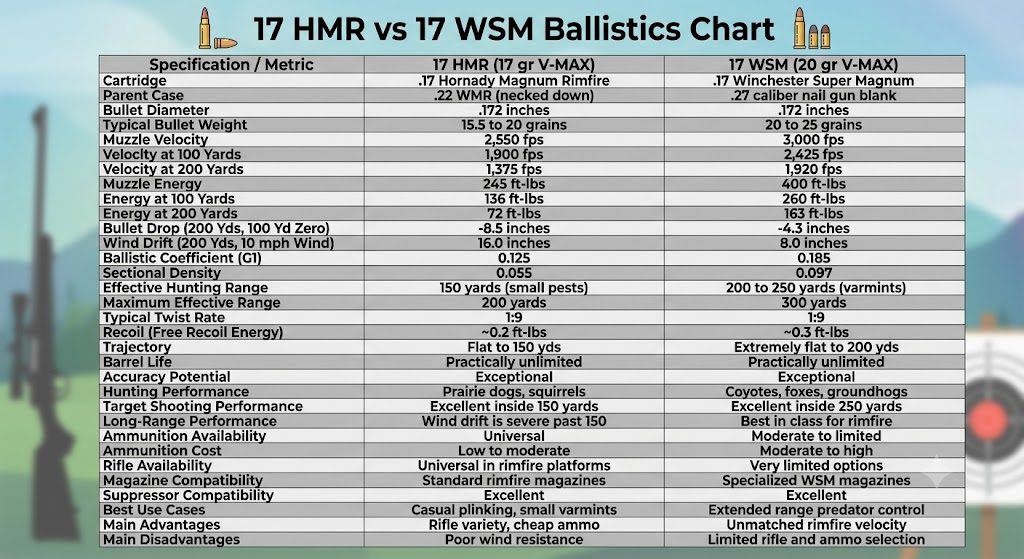
The comparison table above clearly illustrates how pushing a tiny bullet to extreme speeds drastically alters its real world performance. The 17 WSM holds a massive velocity advantage right out of the muzzle. Because it utilizes a reinforced case designed originally for industrial nail guns, it can handle much higher pressures than the 17 HMR. This allows the 17 WSM to push a heavier bullet significantly faster.
This speed and weight combination directly translates to superior kinetic energy. At every distance listed, the 17 WSM hits much harder than the 17 HMR. In fact, the 17 WSM retains more kinetic energy at 100 yards than the 17 HMR generates at the muzzle. This makes the 17 WSM a highly capable cartridge for ethical shots on tough predators like coyotes, a task where the 17 HMR frequently falls short.
The trajectory numbers reveal another clear victory for the 17 WSM. Because it gets to the target much faster, it drops only half as much as the 17 HMR at 200 yards. It also cuts wind deflection completely in half. However, the 17 HMR excels in practical utility. Its lower velocity makes it gentler on small game meat, and the overwhelming availability of ammunition and rifle platforms makes it much easier to adopt for the average shooter.
Detailed Comparison Sections
Understanding the Comparison Chart
To truly understand the gap between these two rimfire cartridges, you must look at their parent cases. The 17 HMR is simply a .22 Winchester Magnum Rimfire necked down to accept a .17 caliber bullet. The 17 WSM was built by modifying a .27 caliber industrial nail gun blank. That industrial case is much thicker, allowing it to contain nearly 33,000 PSI of chamber pressure compared to the 26,000 PSI limit of the 17 HMR.
How to Read the Ballistics Chart
When analyzing the ballistics of lightweight rimfire cartridges, wind drift and kinetic energy are the most critical factors. Tiny bullets lose their momentum very quickly and are easily blown off course by a gentle breeze. You need to verify that the cartridge you select retains enough energy at your desired hunting distance to ensure a clean harvest while resisting the wind well enough to guarantee a hit.
Velocity Comparison
The 17 WSM is the fastest rimfire cartridge in the world. Pushing a 20 grain bullet at 3,000 feet per second puts it firmly into centerfire velocity territory. The 17 HMR is no slouch, pushing a 17 grain bullet at 2,550 feet per second, but it simply cannot keep up. At 200 yards, the 17 WSM is traveling over 500 feet per second faster than the 17 HMR. This retained speed is the secret to its long range success.
Energy Comparison
Kinetic energy is required to humanely dispatch game animals. The 17 WSM produces roughly 400 foot pounds of energy at the muzzle, dwarfing the 245 foot pounds generated by the 17 HMR. As the bullets travel downrange, the heavier 20 grain bullet of the 17 WSM retains that energy much better. At 200 yards, the 17 HMR drops to a mere 72 foot pounds, which is barely enough for a prairie dog. The 17 WSM retains 163 foot pounds at 200 yards, providing plenty of power for larger pests.
Trajectory Comparison
A flat trajectory takes the guesswork out of shooting at small targets across open fields. The blistering speed of the 17 WSM makes it the undisputed king of rimfire trajectories.
Bullet Drop Comparison
If you zero both rifles at 100 yards, the trajectory gap becomes highly apparent at extended ranges. At 200 yards, the 17 HMR will drop about 8.5 inches. The 17 WSM drops only 4.3 inches. That 4 inch difference is massive when your target is a squirrel or the vital zone of a groundhog.
Wind Drift Comparison
Wind is the ultimate enemy of the .17 caliber bullet. Because these projectiles weigh next to nothing, even a slight breeze can ruin a shot. In a 10 mph crosswind at 200 yards, the 17 HMR will drift 16 inches off target. Under the exact same conditions, the faster 17 WSM will only drift 8 inches. The 17 WSM effectively doubles your margin of error in windy conditions.
Ballistic Coefficient Comparison
Ballistic Coefficient measures the aerodynamic efficiency of a bullet. While neither of these cartridges boasts high numbers compared to centerfire rifle rounds, the 17 WSM holds a distinct advantage. Because it fires slightly heavier and longer 20 to 25 grain bullets, it features a BC around 0.185. The lighter 15 to 17 grain bullets of the 17 HMR typically sit around 0.125. This higher BC is why the 17 WSM retains its velocity and fights the wind so effectively.
Accuracy Potential
Both cartridges are exceptionally accurate. The 17 HMR is legendary for its inherent precision. It is very common to find out of the box factory rifles chambered in 17 HMR that can shoot sub half inch groups at 100 yards. The 17 WSM is equally accurate on paper, but the lack of high end match grade rifles limits its potential in the hands of competitive target shooters.
Effective Range Comparison
For pest control, the 17 HMR is highly effective out to 150 yards. Beyond that distance, the wind drift becomes too severe for reliable hits on small targets. The 17 WSM extends the effective rimfire hunting range out to 200 or 250 yards. It provides the flat trajectory and retained energy necessary to connect with targets at distances normally reserved for centerfire cartridges like the .223 Remington.
Hunting Performance Comparison
If you are strictly hunting small targets like prairie dogs, squirrels, and rabbits inside 100 yards, the 17 HMR is absolutely perfect. It provides explosive terminal performance with zero recoil. However, if you want to hunt coyotes, foxes, or large raccoons, the 17 HMR lacks the necessary penetration and energy. The 17 WSM hits hard enough to anchor tough predators out to 200 yards without destroying the valuable pelt.
Target Shooting Comparison
For casual weekends at the range shooting paper targets or small steel plates, the 17 HMR is the clear winner. The ammunition is much cheaper, and you can shoot it out of dozens of different high quality rifle platforms. The 17 WSM is highly entertaining for ringing steel at 200 yards, but the cost of the ammunition makes high volume target shooting very expensive for a rimfire caliber.
Recoil Comparison
Recoil is virtually non existent for both cartridges. The 17 HMR generates roughly 0.2 foot pounds of free recoil energy, and the 17 WSM generates roughly 0.3 foot pounds. Both are so light that you can watch your own bullet impact through the rifle scope without losing your sight picture. They are both perfect training cartridges for young children and new shooters.
Barrel Life Comparison
Because both cartridges fire soft rimfire bullets and operate at much lower temperatures than centerfire rifle cartridges, barrel wear is not a concern. Unless you completely neglect cleaning your firearm, a barrel chambered in either 17 HMR or 17 WSM will easily last a lifetime of heavy shooting.
Ammunition Cost Comparison
The 17 HMR is a very affordable cartridge to shoot. Because it is produced by the millions, you can easily find budget friendly boxes for casual plinking. The 17 WSM is a premium, specialized cartridge. The thick industrial brass is more difficult to manufacture, resulting in ammunition prices that are frequently double the cost of 17 HMR.
Ammunition Availability
You will find 17 HMR ammunition in every single sporting goods store, hardware store, and gun shop in the country. It is universally stocked. The 17 WSM is much harder to find on local store shelves. Due to its limited popularity, many brick and mortar stores do not carry it, forcing shooters to buy their 17 WSM ammunition online.
Rifle Compatibility
This is the biggest downside to the 17 WSM. Because the cartridge produces much higher chamber pressures than standard rimfire rounds, gunmakers cannot simply rebarrel their existing .22 LR or 17 HMR rifle actions to accommodate it. They have to design entirely new actions. Because of this, there are very few rifles chambered in 17 WSM on the market. The 17 HMR, however, is chambered in practically every rimfire rifle platform in existence.
Pros and Cons of 17 HMR
Pros:
- Massive selection of highly accurate rifles.
- Incredibly cheap and abundant ammunition.
- Devastating performance on small pests inside 150 yards.
- Zero recoil and low muzzle blast.
Cons:
- Lacks kinetic energy for larger predators.
- Easily blown off target by light winds.
Pros and Cons of 17 WSM
Pros:
- The absolute fastest rimfire cartridge in the world.
- Exceptionally flat trajectory out to 200 yards.
- Retains enough energy for ethical coyote hunting.
- Excellent wind resistance for a rimfire bullet.
Cons:
- Very limited selection of rifles.
- Ammunition is expensive and sometimes hard to find locally.
Which Cartridge Is Better for Beginners?
The 17 HMR is the ultimate beginner cartridge. The ammunition is cheap enough to allow for high volume practice, and finding a rifle that fits the physical size of a new shooter is incredibly easy due to the massive aftermarket support. The 17 WSM is too specialized and expensive for someone just learning the fundamentals of marksmanship.
Which Cartridge Is Better for Hunting?
If your goal is eradicating ground squirrels in a small orchard, the 17 HMR is the perfect tool. If you are a dedicated predator hunter looking for a rimfire cartridge that will humanely drop a coyote at 150 yards without ruining the fur, the 17 WSM is the only correct choice between the two.
Which Cartridge Is Better for Long-Range Shooting?
For a rimfire cartridge, long range typically means anything past 150 yards. In this category, the 17 WSM dominates. Its higher velocity, heavier bullet, and superior ballistic coefficient allow it to buck the wind and maintain a flat trajectory out to distances where the 17 HMR bullet has completely run out of steam.
Which Cartridge Should You Choose?
Choose the 17 HMR if you want a reliable, highly accurate, and affordable rifle for casual target shooting and small pest control on a budget. Choose the 17 WSM if you demand absolute maximum performance from a rimfire platform and need centerfire like ballistics to hunt tough predators at extended ranges.
Verdict
The 17 HMR and the 17 WSM are both brilliant feats of rimfire engineering, but they cater to entirely different shooters. The 17 HMR is the undisputed king of convenience. It provides laser like accuracy, zero recoil, and explosive terminal performance on small pests while remaining incredibly affordable to shoot. It is the perfect everyday rimfire rifle. The 17 WSM is a highly specialized magnum. It bridges the gap between traditional rimfire cartridges and centerfire varmint rounds. It offers blistering speed and impressive knockdown power, but it sacrifices rifle variety and ammunition economy to achieve it. If you need a practical plinker, buy the 17 HMR. If you need a serious predator hunting tool that operates under rimfire specific hunting regulations, the 17 WSM stands completely alone.
FAQs
Is the 17 WSM louder than the 17 HMR?
Yes. Because the 17 WSM burns significantly more gunpowder and operates at much higher chamber pressures, it produces a noticeably louder muzzle blast and a sharper supersonic crack than the 17 HMR.
Can I shoot 17 HMR in a 17 WSM rifle?
No. It is extremely dangerous to attempt this. The 17 WSM chamber is much larger and longer than the 17 HMR cartridge. Attempting to fire a 17 HMR in a 17 WSM rifle will cause the brass case to rupture violently, which can destroy the firearm and cause severe injury.
Will a 17 HMR kill a coyote?
While a 17 HMR can theoretically kill a coyote with an absolutely perfect headshot at close range, it is widely considered unethical and underpowered for the task. The tiny bullet lacks the mass and energy required to reliably penetrate the tough hide and bone of a coyote, often resulting in severe wounding rather than a clean kill.
Why are there so few rifles chambered in 17 WSM?
The 17 WSM generates nearly 33,000 PSI of chamber pressure. Traditional rimfire rifle actions are designed to handle roughly 24,000 PSI. Firearm manufacturers must design and build completely new, stronger rifle actions with robust locking lugs to safely handle the 17 WSM, which is an expensive process that many companies avoid.
What is the effective range of the 17 HMR?
For target shooting in perfectly calm conditions, the 17 HMR is accurate out to 200 yards. For ethical hunting applications on small varmints, the effective range is practically limited to 150 yards before wind drift and energy loss become too severe.