The main difference between the .30-06 Springfield and the 6.5 Creedmoor comes down to power versus precision. The .30-06 Springfield delivers vastly more kinetic energy and pushes heavier bullets, making it the superior choice where you are hunting large, heavy game like elk or moose. The 6.5 Creedmoor is highly aerodynamic and produces less than half the recoil, making it the better option where you want pinpoint accuracy for target shooting or hunting medium game like deer using a lighter, short-action rifle.
Comprehensive Ballistics Comparison
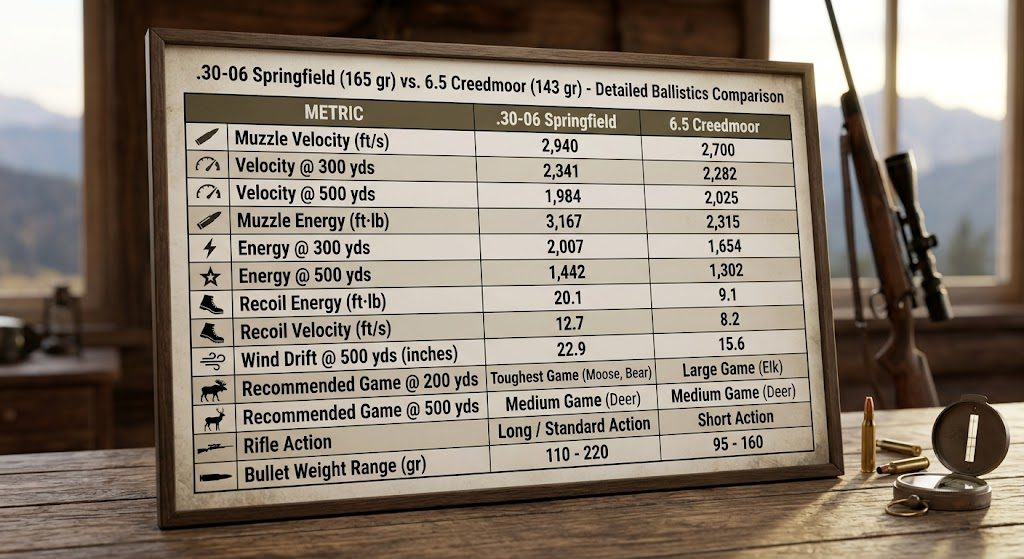
To truly understand how these cartridges behave in the real world, we have to look at the math. This table compares a highly popular 165-grain .30-06 Springfield hunting load against a 143-grain 6.5 Creedmoor load across multiple distances.
| Performance Metric | .30-06 Springfield (165 gr) | 6.5 Creedmoor (143 gr) |
| Muzzle Velocity | 2,940 ft/s | 2,700 ft/s |
| Velocity @ 100 yds | 2,731 ft/s | 2,556 ft/s |
| Velocity @ 300 yds | 2,341 ft/s | 2,282 ft/s |
| Velocity @ 500 yds | 1,984 ft/s | 2,025 ft/s |
| Muzzle Energy | 3,167 ft⋅lb | 2,315 ft⋅lb |
| Energy @ 100 yds | 2,732 ft⋅lb | 2,075 ft⋅lb |
| Energy @ 300 yds | 2,007 ft⋅lb | 1,654 ft⋅lb |
| Energy @ 500 yds | 1,442 ft⋅lb | 1,302 ft⋅lb |
| Recoil Energy | 20.1 ft⋅lb | 9.1 ft⋅lb |
| Recoil Velocity | 12.7 ft/s | 8.2 ft/s |
| Wind Drift @ 500 yds | 22.9 inches | 15.6 inches |
| Recommended Game @ 200 yds | Toughest Game (Moose, Bear) | Large Game (Elk) |
| Recommended Game @ 500 yds | Medium Game (Deer) | Medium Game (Deer) |
Detailed Breakdown of the Comparison
While both cartridges are legendary in their own right, they were built in entirely different centuries with entirely different goals. The .30-06 was designed in 1906 for military power, while the 6.5 Creedmoor was developed in 2007 specifically for long-range target precision. Here is exactly how those designs translate to performance.
1. Velocity and Aerodynamic Trajectory
At the muzzle, the .30-06 Springfield is the clear winner. It uses a massive powder charge to push a heavier bullet out of the barrel 240 feet per second faster than the Creedmoor.
However, velocity is only half the story. The 6.5 Creedmoor is famous for its exceptionally high Ballistic Coefficient (BC). This means the bullet is long, sleek, and cuts through the air with minimal drag. As both bullets travel downrange, the .30-06 loses its speed rapidly due to wind resistance. By the time the bullets reach 500 yards, the 6.5 Creedmoor has actually overtaken the .30-06, flying 41 ft/s faster.
This aerodynamic efficiency gives the 6.5 Creedmoor a distinct advantage in the wind. At 500 yards, the .30-06 is blown nearly two feet off target (22.9 inches of drift), while the Creedmoor experiences only 15.6 inches of drift. For long-range shooters, that difference is massive.
2. Kinetic Energy and Stopping Power
If you are hunting massive animals with thick hides and heavy bones, energy is your most important metric. There is no replacement for displacement, and the .30-06 Springfield dominates this category.
Right out of the muzzle, the .30-06 hits with a bone-crushing 3,167 foot-pounds of energy. That is 852 ft-lbs more than the 6.5 Creedmoor. While the gap narrows as the distance increases, the .30-06 hits significantly harder at every single practical hunting range. This makes the .30-06 a vastly superior choice for elk, moose, or big bears.
3. Recoil and Shooter Fatigue
More power equals more physical punishment. The .30-06 generates 20.1 ft-lbs of recoil energy, which is a stout kick. While most adult hunters can manage this for a few shots in the field, it can cause shooters to develop a “flinch” during long target-shooting sessions, which destroys accuracy.
The 6.5 Creedmoor was specifically engineered to be a soft-shooting cartridge. It generates a mere 9.1 ft-lbs of recoil. This means you can spot your own bullet impacts through your scope, shoot all day without a bruised shoulder, and introduce new or smaller-framed hunters to the sport without intimidating them.
4. Cartridge Size and Rifle Action Length
The physical dimensions of these cartridges dictate the type of rifle you must carry.
The .30-06 Springfield features a long case (2.494 inches) with a gradual 17.5-degree shoulder. Because of this length, it requires a “Long Action” or “Standard Action” rifle. Long actions require a longer bolt pull to cycle the next round and naturally result in a heavier, bulkier firearm.
The 6.5 Creedmoor is a modern, compact design with a sharp 30-degree shoulder. It is purposely built to fit into “Short Action” rifles. Short-action rifles are notably lighter, more compact, and feature a faster bolt throw. If you are hiking ten miles into steep mountain backcountry, a lighter short-action 6.5 Creedmoor is much easier to carry.
5. Bullet Weights and Versatility
The sheer size of the .30-06 case gives it an incredible amount of internal volume for gunpowder. This allows it to push a massive variety of bullet weights, typically ranging from 110 grains all the way up to heavy 220-grain projectiles. This makes the .30-06 one of the most versatile cartridges on earth.
The 6.5 Creedmoor is optimized for a narrower band of highly efficient bullets, typically ranging from 95 grains up to 160 grains, with 140-grain and 143-grain bullets being the undisputed sweet spot for performance.
6. Ammunition Cost and Availability
Both of these rounds are currently in the top five most popular hunting cartridges in the world. You will find boxes of both on the shelf of almost any sporting goods store.
However, because the .30-06 has been heavily produced by every manufacturer for over a century, standard hunting ammunition is generally cheaper. The 6.5 Creedmoor is often loaded as premium “match grade” ammunition, which can drive up the cost per box. For handloaders, the .30-06 has over 100 years of published load data, giving you infinite ways to customize your rounds.