The main difference between 300 Blackout and 30 30 Winchester is that 300 Blackout was designed around AR 15 platform compatibility and strong short barrel performance, while 30 30 Winchester generally launches heavier bullets with substantially greater energy from typical hunting rifles.
This detailed analysis compares velocity, muzzle energy, bullet weight, trajectory, bullet drop, recoil, penetration, expansion, and effective range.
It also evaluates hunting performance, barrel length, suppressor performance, rifle platform, ammunition cost, and availability.
Both cartridges maintain dedicated followings, but they serve drastically different primary purposes across various firearm platforms.
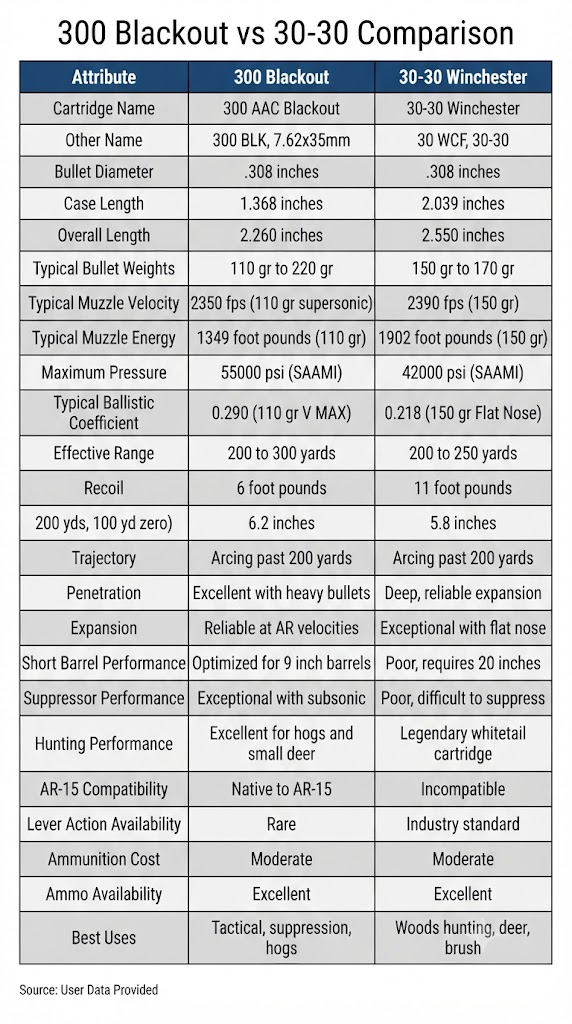
300 Blackout vs 30 30 Comparison
| Attribute | 300 Blackout | 30 30 Winchester |
| Cartridge Name | 300 AAC Blackout | 30 30 Winchester |
| Other Name | 300 BLK, 7.62x35mm | 30 WCF, 30 30 |
| Bullet Diameter | .308 inches | .308 inches |
| Case Length | 1.368 inches | 2.039 inches |
| Overall Length | 2.260 inches | 2.550 inches |
| Typical Bullet Weights | 110 gr to 220 gr | 150 gr to 170 gr |
| Typical Muzzle Velocity | 2350 fps (110 gr supersonic) | 2390 fps (150 gr) |
| Typical Muzzle Energy | 1349 foot pounds (110 gr) | 1902 foot pounds (150 gr) |
| Maximum Pressure | 55000 psi (SAAMI) | 42000 psi (SAAMI) |
| Typical Ballistic Coefficient | 0.290 (110 gr V MAX) | 0.218 (150 gr Flat Nose) |
| Effective Range | 200 to 300 yards | 200 to 250 yards |
| Recoil | 6 foot pounds | 11 foot pounds |
| Bullet Drop (200 yds, 100 yd zero) | 6.2 inches | 5.8 inches |
| Trajectory | Arcing past 200 yards | Arcing past 200 yards |
| Penetration | Excellent with heavy bullets | Deep, reliable expansion |
| Expansion | Reliable at AR velocities | Exceptional with flat nose |
| Short Barrel Performance | Optimized for 9 inch barrels | Poor, requires 20 inches |
| Suppressor Performance | Exceptional with subsonic | Poor, difficult to suppress |
| Hunting Performance | Excellent for hogs and small deer | Legendary whitetail cartridge |
| AR 15 Compatibility | Native to AR 15 | Incompatible |
| Lever Action Availability | Rare | Industry standard |
| Ammunition Cost | Moderate | Moderate |
| Ammo Availability | Excellent | Excellent |
| Best Uses | Tactical, suppression, hogs | Woods hunting, deer, brush |
Explanation of Ballistics and Performance
The data presented in the comparison table outlines a clear distinction in design philosophy between these two thirty caliber options. When analyzing the information, it becomes evident that neither cartridge is universally superior. Instead, their physical dimensions, pressure limits, and typical bullet weights dictate highly specialized roles. The 300 AAC Blackout utilizes a shortened 5.56 NATO case, allowing it to function flawlessly in modern semi automatic platforms with minimal modifications. In contrast, the classic 30 30 Winchester features a rimmed, high capacity case engineered over a century ago for lever action rifles.
300 Blackout vs 30 30 Ballistics
When evaluating ballistics, the most critical factor is the difference in bullet weight and case capacity. The 30 30 Winchester holds significantly more powder, which allows it to push heavier 150 grain and 170 grain bullets to impressive velocities. A standard Federal Premium 150 grain Power Shok load generates a muzzle velocity of 2390 feet per second from a 20 inch barrel. This translates to an initial momentum that hits game animals with devastating force.
The 300 Blackout operates with a much smaller powder charge but compensates with higher maximum chamber pressures. Using a Hornady 110 grain V MAX supersonic load, the 300 Blackout achieves 2350 feet per second from a 16 inch barrel. The 300 Blackout relies on lighter bullets to achieve that speed, but its pointed projectiles possess a higher ballistic coefficient, allowing them to cut through the air more efficiently than the traditional flat nose bullets required for tubular magazines.
300 Blackout vs 30 30 Velocity
Velocity is highly dependent on ammunition selection and barrel length. We must separate the modern round into two distinct categories: supersonic and subsonic. Subsonic ammunition intentionally restricts muzzle velocity to approximately 1010 feet per second to remain below the speed of sound.
For a direct comparison using supersonic loads:
Federal Power Shok 150 grain 30 30 yields a muzzle velocity of 2390 fps. At 100 yards, it retains 2018 fps. At 200 yards, it slows to 1683 fps.
Hornady 110 grain V MAX 300 Blackout yields a muzzle velocity of 2350 fps. At 100 yards, it retains 2020 fps. At 200 yards, it slows to 1720 fps.
Because the pointed bullet is more aerodynamic, it actually retains its velocity slightly better over distance, catching up to the heavier lever action bullet around the 100 yard mark despite starting slightly slower.
300 Blackout vs 30 30 Muzzle Energy
The larger powder capacity of the classic woods rifle provides a massive advantage in kinetic energy.
The 150 grain 30 30 generates 1902 foot pounds of muzzle energy.
The 110 grain 300 Blackout generates 1349 foot pounds of muzzle energy.
This means the lever action round produces roughly 41 percent more energy at the muzzle. Downrange energy retention is also critical.
At 100 yards, the 150 grain 30 30 delivers 1356 foot pounds of energy.
At 100 yards, the 110 grain 300 Blackout delivers 997 foot pounds of energy.
At 200 yards, the 30 30 still carries 943 foot pounds, while the modern cartridge drops to 723 foot pounds.
The heavier bullet of the classic lever action simply hits with more authority at all practical hunting distances.
300 Blackout vs 30 30 Trajectory and Bullet Drop
Assuming a 100 yard zero for both rifles:
At 150 yards, the 30 30 drops 1.7 inches, while the 300 Blackout drops 1.8 inches.
At 200 yards, the 30 30 drops 5.8 inches, while the 300 Blackout drops 6.2 inches.
At 250 yards, the 30 30 drops 12.8 inches, while the 300 Blackout drops 13.5 inches.
At 300 yards, the 30 30 drops 23.5 inches, while the 300 Blackout drops 24.5 inches.
The data confirms that bullet drop is exceptionally similar between these two rounds when firing supersonic ammunition. The shooter will not notice a meaningful difference in holdover.
300 Blackout vs 30 30 Recoil
Felt recoil heavily favors the modern AR 15 cartridge. A typical lever action rifle weighs approximately 7 pounds. Firing a standard 150 grain hunting load, the rifle generates about 11 foot pounds of free recoil energy.
An AR 15 chambered in the modern round also weighs about 7 pounds but generates only about 6 foot pounds of recoil energy. The gas operating system of the AR 15 further absorbs this energy, spreading the recoil impulse out over a longer duration, allowing for rapid follow up shots.
Barrel Length and Suppressor Performance
The classic lever action cartridge was designed for long barrels. To achieve the advertised 2390 feet per second, a 20 inch barrel is standard. If you cut the barrel down to 16 inches, you lose significant velocity, and muzzle blast increases dramatically.
The modern thirty caliber was specifically engineered to achieve full powder burn in just 9 inches of barrel length. A 9 inch barrel will push a 110 grain bullet past 2100 feet per second. This makes it the undisputed king of short barrel rifles. Furthermore, the modern round was built for suppressed use. When loaded with heavy 220 grain subsonic bullets, the rifle produces minimal noise. The classic lever action cartridge is notoriously difficult to suppress due to the tubular magazine layout and the lack of factory subsonic ammunition.
Hunting Performance: Deer and Hogs
For generations, the classic lever action has been the undisputed monarch of the deer woods. The 150 grain and 170 grain bullets carry enough energy to ethically harvest large bucks from any reasonable angle, punching through thick shoulder bones easily. The modern round is capable of taking deer, but the lighter 110 grain bullets lack the heavy momentum of the older round, making quartering shots riskier.
However, for hog hunting, the modern AR 15 cartridge dominates. The ability to use a semi automatic platform with 30 round magazines allows a hunter to engage multiple moving targets rapidly. The modern cartridge is perfectly suited to short barrel, suppressed AR 15s equipped with heavy night vision gear.
Home Defense and Rifle Platforms
In a home defense scenario, the modern cartridge provides overwhelming advantages. A short barrel AR 15 is incredibly compact, holds 30 rounds, requires no manual cycling, and can be easily suppressed with subsonic expanding ammunition to protect the defender’s hearing. A standard lever action rifle is unwieldy in tight hallways and holds fewer rounds.
Platform availability heavily dictates the buying decision. The AR 15 offers unparalleled modularity, allowing owners to change stocks, optics, and handguards easily. The traditional thirty caliber is primarily found in lever action rifles, which point naturally but are difficult to modernize with lights or modern optics.
Ammunition Cost and Effective Range
Full metal jacket practice ammunition for the modern AR 15 round is widely produced, often costing around 60 to 75 cents per round. The classic lever action round does not have a large tactical training market. Standard soft point hunting ammunition usually costs between 1.25 and 1.50 dollars per round, making it noticeably more expensive for casual target shooters.
Regarding effective range, most hunting bullets require an impact velocity of at least 1800 feet per second to expand reliably. The classic 150 grain bullet drops below 1800 feet per second at approximately 175 yards. The modern 110 grain bullet drops below 1800 feet per second at exactly 150 yards. Both cartridges should practically be limited to a maximum effective hunting range of 200 yards.
Pros and Cons
300 Blackout Pros:
Native compatibility with standard AR 15 magazines and bolt carrier groups.
Exceptional performance from extremely short 9 inch barrels.
Industry leading subsonic suppressor compatibility.
Low recoil makes it accessible for all shooters.
300 Blackout Cons:
Significantly lower muzzle energy than traditional hunting rounds.
Subsonic ammunition lacks the terminal expansion needed for ethical medium game hunting.
30 30 Winchester Pros:
Massive kinetic energy advantage for ethical hunting.
Heavy bullet weight ensures deep penetration on large deer.
Housed in lightweight, fast handling lever action rifles.
30 30 Winchester Cons:
Tubular magazines require ballistically inferior flat nose bullets.
Very difficult to suppress due to supersonic speeds and magazine tube interference.
Final Decision Table
| Category | Winner | Why |
| Muzzle Velocity | Advantage 30 30 | Pushes heavier bullets slightly faster. |
| Muzzle Energy | Advantage 30 30 | Holds 41 percent more kinetic energy due to larger powder capacity. |
| Downrange Energy | Advantage 30 30 | Heavier bullet mass retains momentum better at 200 yards. |
| Trajectory | Depends on Load | Supersonic loads for both feature almost identical drop inside 200 yards. |
| Recoil | Advantage 300 Blackout | Generates nearly half the free recoil energy of the traditional round. |
| Short Barrel Performance | Advantage 300 Blackout | Achieves full powder burn in 9 inches. |
| Suppressor Compatibility | Advantage 300 Blackout | Designed for subsonic use and easy muzzle threading. |
| Deer Hunting | Advantage 30 30 | Superior energy and heavier bullets ensure quick, ethical kills. |
| Hog Hunting | Advantage 300 Blackout | AR 15 platform allows rapid follow up shots on moving sounds. |
| Overall Versatility | Advantage 300 Blackout | Can hunt, defend a home, shoot suppressed, and run in an AR 15. |
Which Should You Choose?
If you are a dedicated deer hunter hunting in thick woods where shots rarely exceed 150 yards, the 30 30 Winchester is the definitive choice. Its superior muzzle energy, heavier bullet weight, and deep penetration capabilities ensure ethical harvests. Conversely, if you value versatility, tactical applications, and modern modularity, the 300 AAC Blackout is the clear winner. AR 15 owners can adopt the caliber simply by swapping an upper receiver, and short barrel rifle users have no better option on the market for suppressed shooting.
FAQ
Is 300 Blackout more powerful than 30 30?
No. The traditional lever action cartridge holds more powder and pushes heavier bullets, resulting in roughly 40 percent more muzzle energy.
Which has more stopping power?
For hunting medium game, the traditional lever action provides superior terminal stopping power due to heavier bullet mass and greater kinetic energy transfer.
Which has a flatter trajectory?
When comparing standard supersonic loads, their trajectories are virtually identical inside 200 yards.
Is 300 Blackout good for deer hunting?
Yes, provided the hunter uses quality expanding supersonic ammunition and limits shots to 150 yards.
Is 30 30 good for hog hunting?
Yes, it possesses excellent terminal power, though the lever action platform limits the speed of follow up shots.
Which is better for short barrels?
The modern AR round is vastly superior, achieving full powder burn in a 9 inch barrel.
Which is cheaper to shoot?
The AR 15 cartridge is noticeably cheaper for casual target practice, with full metal jacket practice ammunition readily available.