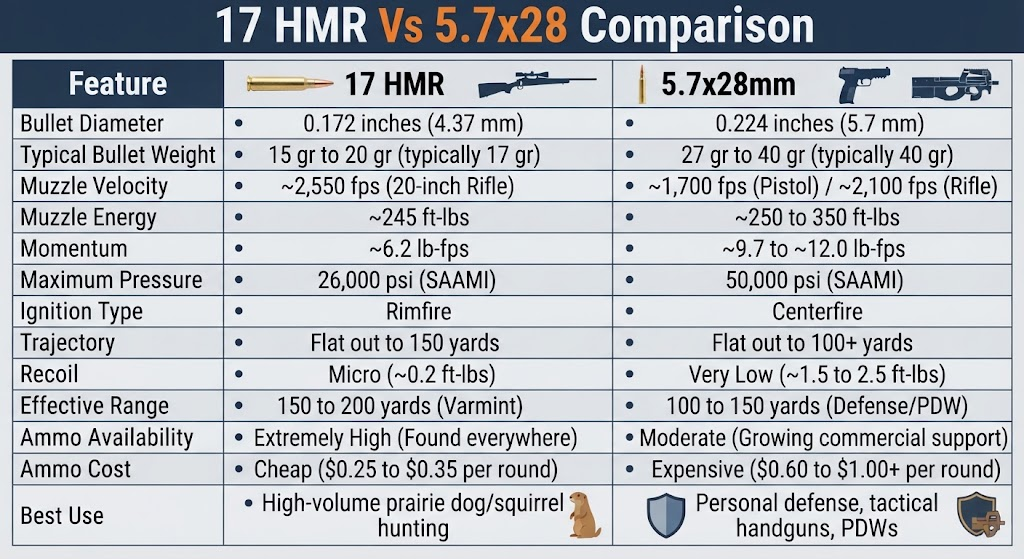
The main difference in the 17 Hmr Vs 5.7×28 comparison is that the 17 HMR is a rimfire cartridge engineered for highly accurate, high-volume varmint hunting, whereas the 5.7x28mm is a centerfire tactical cartridge designed for personal defense weapons and handguns. While the 17 HMR provides ultra-fast, fragmenting performance for small pests at extended ranges, the 5.7x28mm offers deeper penetration, reloadable brass, and combat-proven reliability in modern semi-automatic defensive platforms.
17 Hmr Vs 5.7×28 Comparison
| Feature | 17 HMR | 5.7x28mm |
| Bullet Diameter | 0.172 inches (4.37 mm) | 0.224 inches (5.7 mm) |
| Typical Bullet Weight | 15 gr to 20 gr (typically 17 gr) | 27 gr to 40 gr (typically 40 gr) |
| Muzzle Velocity | ~2,550 fps (20-inch Rifle) | ~1,700 fps (Pistol) / ~2,100 fps (Rifle) |
| Muzzle Energy | ~245 ft-lbs | ~250 to 350 ft-lbs |
| Momentum | ~6.2 lb-fps | ~9.7 to ~12.0 lb-fps |
| Maximum Pressure | 26,000 psi (SAAMI) | 50,000 psi (SAAMI) |
| Ignition Type | Rimfire | Centerfire |
| Trajectory | Flat out to 150 yards | Flat out to 100+ yards |
| Recoil | Micro (~0.2 ft-lbs) | Very Low (~1.5 to 2.5 ft-lbs) |
| Effective Range | 150 to 200 yards (Varmint) | 100 to 150 yards (Defense/PDW) |
| Ammo Availability | Extremely High (Found everywhere) | Moderate (Growing commercial support) |
| Ammo Cost | Cheap ($0.25 to $0.35 per round) | Expensive ($0.60 to $1.00+ per round) |
| Best Use | High-volume prairie dog/squirrel hunting | Personal defense, tactical handguns, PDWs |
The table above illustrates two completely different design philosophies. The 17 HMR (Hornady Magnum Rimfire) was created in 2002 by necking down a .22 WMR case to accept a tiny 0.172-inch projectile, maximizing velocity and flat-shooting accuracy for hunting small game.
The 5.7x28mm was designed by FN Herstal in the late 1980s as a military and law enforcement centerfire cartridge to replace the 9mm in the PDW (Personal Defense Weapon) role. Chambered in the P90 submachine gun and the Five-seveN pistol, it was engineered to defeat soft body armor (using restricted military loads) while providing massive magazine capacity, high velocity, and exceptionally low recoil for tactical operators.
17 Hmr Vs 5.7×28 Ballistics
To objectively evaluate the ballistic capabilities, we must examine standard factory ammunition fired from common barrel lengths.
- Load A (17 HMR High Velocity): Hornady 17-grain V-MAX. Tested from a 20-inch rifle barrel. Muzzle velocity is 2,550 feet per second. Muzzle energy is 245 foot-pounds.
- Load B (17 HMR Heavy Game): Hornady 20-grain XTP. Tested from a 20-inch rifle barrel. Muzzle velocity is 2,375 feet per second. Muzzle energy is 250 foot-pounds.
- Load C (5.7x28mm Handgun Load): FN SS197SR 40-grain V-MAX. Tested from a 4.8-inch pistol barrel. Muzzle velocity is roughly 1,700 feet per second. Muzzle energy is 256 foot-pounds.
- Load D (5.7x28mm Carbine Load): FN SS197SR 40-grain V-MAX. Tested from a 16-inch rifle barrel. Muzzle velocity is roughly 2,100 feet per second. Muzzle energy is 391 foot-pounds.
17 Hmr Vs 5.7×28 Velocity
Velocity is the defining characteristic for both of these micro-calibers, allowing them to shoot flat and deliver hydrostatic shock.
When comparing rifles, the 17 HMR is faster, pushing its ultra-light 17-grain bullet out of a long barrel at 2,550 feet per second. The 5.7x28mm pushes a significantly heavier 40-grain bullet out of a carbine at roughly 2,100 feet per second.
When the 5.7x28mm is fired from its native handgun platforms, velocity drops to roughly 1,700 fps. While slower than the 17 HMR rifle, 1,700 fps from a handgun is blistering speed—significantly faster than standard 9mm or .45 ACP loads.
17 Hmr Vs 5.7×28 Muzzle Energy
Muzzle energy represents the raw kinetic work capacity of a projectile.
The 17 HMR generates roughly 245 to 250 foot-pounds of energy at the muzzle. This is lethal for prairie dogs, rabbits, and squirrels, but it lacks the necessary power to reliably stop larger predators or human-sized threats.
The 5.7x28mm generates roughly 250 foot-pounds of energy from a pistol and approaches 400 foot-pounds of energy from a carbine. Because it utilizes a heavier, wider centerfire bullet, it retains its kinetic energy significantly better upon impact, making it far more capable in tactical applications.
17 Hmr Vs 5.7×28 Momentum
Momentum calculates mass in motion, which dictates a bullet’s ability to drive through heavy clothing and tissue without deflecting or splashing superficially on the surface.
Because the 5.7x28mm fires a bullet that is more than twice as heavy as the 17 HMR (40 grains vs 17 grains), it completely dominates this category. A 40-grain 5.7x28mm bullet traveling at 2,100 fps yields approximately 12.0 pound-feet per second of momentum. A 17-grain 17 HMR traveling at 2,550 fps yields only 6.2 pound-feet per second. The 5.7x28mm carries nearly double the driving mass.
17 Hmr Vs 5.7×28 Trajectory
Understanding external ballistics highlights the strict range limitations of lightweight projectiles.
Both cartridges shoot exceptionally flat inside 100 yards due to their high velocities. The 17 HMR only drops roughly 8.5 inches at 200 yards, making it an absolute laser beam for picking off tiny targets across a field.
The 5.7x28mm also shoots incredibly flat compared to traditional pistol calibers (like 9mm), making it incredibly easy to hit targets at 100 yards with a handgun or PDW without needing complex holdovers.
17 Hmr Vs 5.7×28 Recoil
Recoil is virtually non-existent for both cartridges.
The 17 HMR generates roughly 0.2 foot-pounds of free recoil energy in a rifle, which is essentially zero. The 5.7x28mm generates roughly 1.5 to 2.5 foot-pounds in a handgun or PDW. The incredibly soft recoil of the 5.7x28mm is one of its primary tactical advantages, allowing shooters to deliver remarkably fast, accurate, and tightly grouped follow-up shots under stress.
17 Hmr Vs 5.7×28 Penetration & Expansion
The 17 HMR utilizes highly frangible bullets (like the polymer-tipped V-MAX). Upon impacting a small animal, the bullet fragments violently and explosively, creating a massive but shallow wound channel perfectly suited for instant pest eradication.
The 5.7x28mm utilizes a heavier centerfire bullet designed for deeper penetration. Commercial defensive loads (like the 40-grain V-MAX or dedicated hollow points) will penetrate adequately into soft tissue and tumble or expand, creating a permanent wound cavity capable of stopping a threat, while remaining light enough to minimize the risk of over-penetration through drywall.
17 Hmr Vs 5.7×28 Self Defense
The 5.7x28mm is the definitive winner for self-defense. It was explicitly designed for tactical military and police use. Centerfire primers provide unquestionable ignition reliability, the lightweight ammunition allows handguns to hold 20+ rounds in flush-fit magazines, and the ballistics are proven in combat.
The 17 HMR should never be used for self-defense unless it is an absolute emergency. Rimfire primers are inherently less reliable than centerfire primers, and the tiny, fragmenting bullets lack the mass and penetration required to reliably incapacitate a human-sized threat.
Which Has More Stopping Power: 17 Hmr Vs 5.7×28?
The 5.7x28mm possesses vastly superior stopping power. It hits with a heavier, wider bullet, generates more kinetic energy from comparable barrel lengths, and carries double the linear momentum for reliable tissue penetration.
Which Is More Powerful: 17 Hmr Vs 5.7×28?
Based on raw kinetic energy, momentum, and internal pressure, the 5.7x28mm is significantly more powerful.
17 HMR Pros And Cons
Pros
- Extremely cheap to shoot, allowing for high-volume pest eradication
- Ammunition is universally available in almost every sporting goods store
- Provides hyper-accurate, laser-flat trajectories out to 150 yards for varmint hunting
- No reloading required; simple, reliable rimfire convenience
Cons
- Rimfire ignition is inherently less reliable than centerfire for defensive roles
- Tiny bullets lack the kinetic mass for medium game or self-defense
- Extremely susceptible to wind drift past 100 yards
5.7x28mm Pros And Cons
Pros
- High-velocity centerfire performance with practically zero recoil in handguns
- Exceptional magazine capacity (often 20 to 30 rounds in standard platforms)
- Flat trajectory makes 100-yard shots with a handgun or PDW surprisingly easy
- Highly effective for tactical applications and personal defense
Cons
- Ammunition is expensive and less ubiquitous than standard 9mm or .22 LR
- Lacks the raw kinetic energy and heavy mass of traditional defensive calibers like .45 ACP
- Firearms chambered in 5.7x28mm (FN Five-seveN, P90, Ruger-5.7) are typically expensive
Final Comparison
| Category | Winner | Reason |
| Velocity | 17 HMR | Smaller bullet in a rifle barrel achieves 2,550 fps |
| Muzzle Energy | 5.7x28mm | Heavier bullet yields superior energy, especially out of a carbine |
| Momentum | 5.7x28mm | Bullet mass is more than double that of the 17 HMR, driving deeper |
| Penetration | 5.7x28mm | Centerfire projectile design ensures adequate defensive penetration |
| Trajectory | Tie | Both shoot exceptionally flat for their respective ranges |
| Recoil Control | Tie | Both generate essentially zero felt recoil |
| Firearm Reliability | 5.7x28mm | Centerfire ignition is vastly superior to rimfire for guaranteed firing |
| Self Defense | 5.7x28mm | Purpose-built tactical round with massive magazine capacities |
| Varmint Hunting | 17 HMR | Fragmentation, rifle accuracy, and cheap ammo make it the ultimate pest round |
| Ammo Cost | 17 HMR | Standard rimfire mass-production makes it incredibly cheap |
| Ammo Availability | 17 HMR | Found on nearly every sporting goods shelf in America |
| Overall Performance | Depends on Role | 17 HMR for budget-friendly hunting; 5.7x28mm for tactical defense |
17 Hmr Vs 5.7×28: Which Should You Choose?
Selecting the winner in the 17 Hmr Vs 5.7×28 matchup is simple because they serve entirely different purposes.
Choose the 17 HMR if your primary goal is small game hunting, pest control, or budget-friendly target shooting at 100 to 150 yards. It is one of the most accurate and explosive rimfire cartridges ever created. You can buy hundreds of rounds for a fraction of the cost of centerfire ammunition, allowing you to eradicate prairie dogs all day long without breaking the bank.
Choose the 5.7x28mm if you are looking for a highly advanced personal defense caliber. It offers a unique combination of high capacity, blistering velocity, and virtually zero recoil in lightweight handguns and carbines. It is a premium, tactical centerfire cartridge built to save lives in close-quarters environments.
FAQs
Is 5.7x28mm more powerful than 17 HMR?
Yes, the 5.7x28mm is a high-pressure (50,000 psi) centerfire cartridge that fires a bullet more than twice as heavy as the 17 HMR. It delivers greater kinetic energy and significantly more momentum for deep penetration.
Can a 5.7x28mm penetrate body armor?
Strictly controlled military and law enforcement loads (like the FN SS190 with a steel penetrator core) are capable of defeating Level IIIA soft body armor. However, standard commercial sporting and defensive ammunition available to civilians is not classified as armor-piercing.
Can you use 17 HMR for self-defense?
It is highly discouraged. The 17 HMR uses inherently less reliable rimfire primers, and the tiny 17-grain bullet is designed to explode on contact with small rodents. It lacks the necessary mass to reach vital organs reliably in a human-sized threat.
Which is cheaper to shoot?
The 17 HMR is significantly cheaper. As a mass-produced rimfire cartridge, a 50-round box is incredibly affordable. The 5.7x28mm is a boutique centerfire tactical cartridge and often costs three to four times as much per round.
Which is better for coyote hunting?
The 5.7x28mm out of a rifle barrel is marginally better for coyotes due to its heavier bullet and better penetration, but both cartridges are generally considered underpowered for ethical, consistent coyote kills past 50 to 75 yards compared to dedicated centerfire rounds like the .223 Remington or 17 Hornet.