The main difference between the cartridges is that the 6mm Arc Vs .308 comparison pits a modern, low-recoil AR-15 precision cartridge against a legendary, heavy-hitting AR-10 and short-action staple. While the .308 Winchester delivers significantly more kinetic energy and barrier-penetrating mass for large game, the 6mm ARC offers superior aerodynamics, drastically less wind drift, and extreme long-range accuracy from a much lighter weapon system.
6mm Arc Vs .308 Comparison
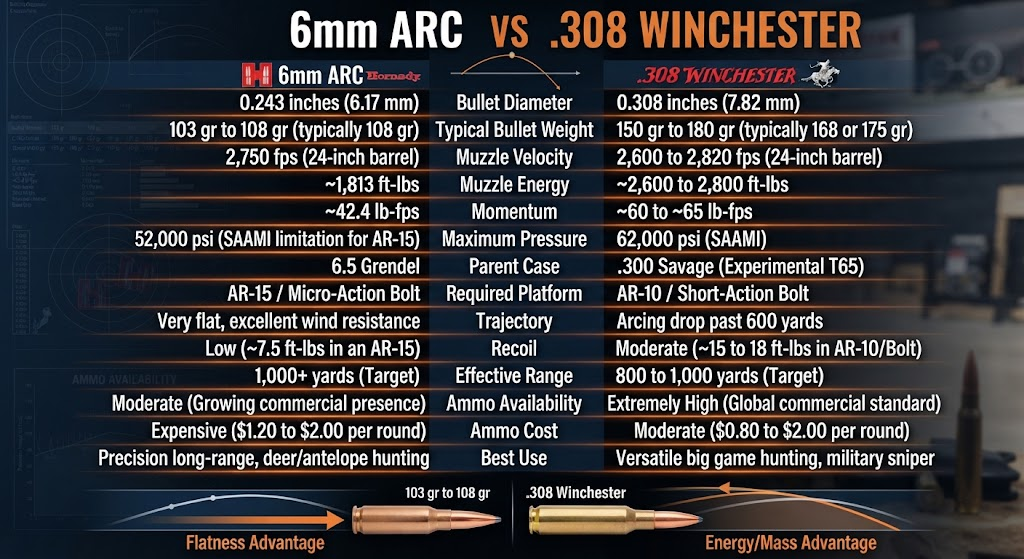
| Feature | 6mm ARC | .308 Winchester |
| Bullet Diameter | 0.243 inches (6.17 mm) | 0.308 inches (7.82 mm) |
| Typical Bullet Weight | 103 gr to 108 gr (typically 108 gr) | 150 gr to 180 gr (typically 168 or 175 gr) |
| Muzzle Velocity | 2,750 fps (24-inch barrel) | 2,600 to 2,820 fps (24-inch barrel) |
| Muzzle Energy | ~1,813 ft-lbs | ~2,600 to 2,800 ft-lbs |
| Momentum | ~42.4 lb-fps | ~60 to ~65 lb-fps |
| Maximum Pressure | 52,000 psi (SAAMI limitation for AR-15) | 62,000 psi (SAAMI) |
| Parent Case | 6.5 Grendel | .300 Savage (Experimental T65) |
| Required Platform | AR-15 / Micro-Action Bolt | AR-10 / Short-Action Bolt |
| Trajectory | Very flat, excellent wind resistance | Arcing drop past 600 yards |
| Recoil | Low (~7.5 ft-lbs in an AR-15) | Moderate (~15 to 18 ft-lbs in AR-10/Bolt) |
| Effective Range | 1,000+ yards (Target) | 800 to 1,000 yards (Target) |
| Ammo Availability | Moderate (Growing commercial presence) | Extremely High (Global commercial standard) |
| Ammo Cost | Expensive ($1.20 to $2.00 per round) | Moderate ($0.80 to $2.00 per round) |
| Best Use | Precision long-range, deer/antelope hunting | Versatile big game hunting, military sniper |
The table above illustrates the massive physical difference in weapon platforms. The 6mm ARC was explicitly designed by Hornady to squeeze maximum long-range performance into the lightweight AR-15 platform, restricting its overall length and operating pressure (52,000 psi) to keep the AR-15 bolt safe. The .308 Winchester is a full-sized short-action cartridge requiring the larger, heavier AR-10 receiver or a standard short-action bolt rifle, operating at a much higher 62,000 psi to drive its heavy projectiles.
6mm Arc Vs .308 Ballistics
To objectively evaluate the ballistic capabilities, we must examine real-world factory match ammunition representing the pinnacle of precision for both cartridges fired from 24-inch barrels.
- Load A (6mm ARC Heavy Match): Hornady 108-grain ELD Match. Muzzle velocity is 2,750 feet per second. Muzzle energy is 1,813 foot-pounds. Ballistic Coefficient (G1) is 0.536.
- Load B (6mm ARC Precision Hunter): Hornady 103-grain ELD-X. Muzzle velocity is 2,800 feet per second. Muzzle energy is 1,793 foot-pounds. Ballistic Coefficient (G1) is 0.512.
- Load C (.308 Winchester Heavy Match): Federal Premium Gold Medal 175-grain Sierra MatchKing. Muzzle velocity is 2,600 feet per second. Muzzle energy is 2,627 foot-pounds. Ballistic Coefficient (G1) is 0.505.
- Load D (.308 Winchester Standard Match): Federal Premium Gold Medal 168-grain Sierra MatchKing. Muzzle velocity is 2,650 feet per second. Muzzle energy is 2,619 foot-pounds. Ballistic Coefficient (G1) is 0.462.
6mm Arc Vs .308 Velocity
At the muzzle, the 6mm ARC holds a slight velocity advantage, pushing its streamlined 108-grain bullets at 2,750 fps compared to the .308 Winchester pushing heavy 175-grain bullets at 2,600 fps.
However, because the 6mm ARC utilizes long, needle-like projectiles with higher Ballistic Coefficients than standard .308 bullets, it cuts through the atmosphere with less drag. This means the 6mm ARC retains its velocity much better over extreme distances, staying supersonic further downrange than the older, blunter .308 Winchester.
6mm Arc Vs .308 Muzzle Energy
Muzzle energy represents raw kinetic work capacity, and the .308 Winchester is the undisputed heavyweight in this comparison.
The 6mm ARC produces roughly 1,800 foot-pounds of energy at the muzzle, which is highly lethal for deer and antelope out to 400 or 500 yards.
The .308 Winchester produces roughly 2,600 to 2,800 foot-pounds of energy at the muzzle. That massive 800 to 1,000 foot-pound advantage makes the .308 Winchester a vastly superior choice for large, heavy-boned game like elk, moose, or black bear at typical hunting ranges.
6mm Arc Vs .308 Momentum
Momentum calculates mass in motion, which dictates a bullet’s ability to crush through dense bone and structural barriers without deflecting.
Because momentum relies heavily on bullet weight, the .308 Winchester easily dominates. A 175-grain .308 bullet traveling at 2,600 fps yields approximately 65.0 pound-feet per second of linear momentum. A 108-grain 6mm ARC bullet traveling at 2,750 fps yields approximately 42.4 pound-feet per second. The .308 simply carries far more physical mass into the target.
6mm Arc Vs .308 Trajectory
Understanding external ballistics highlights why precision shooters are migrating to 6mm cartridges. The calculations below assume a standard rifle optic height of 1.5 inches above the bore and a 200-yard zero.
| Distance | 6mm ARC (108 gr at 2,750 fps) Drop | .308 Win (175 gr at 2,600 fps) Drop |
| Muzzle | -1.5 inches | -1.5 inches |
| 200 Yards | 0.0 inches (Zero) | 0.0 inches (Zero) |
| 400 Yards | -22.5 inches | -28.5 inches |
| 600 Yards | -70.9 inches | -89.4 inches |
| 800 Yards | -154.5 inches | -194.2 inches |
| 1000 Yards | -283.5 inches | -362.5 inches |
The trajectory data demonstrates the massive aerodynamic superiority of the 6mm ARC. At 1,000 yards, the older .308 Winchester drops almost 80 inches (nearly 7 feet) more than the 6mm ARC.
More importantly, the 6mm ARC ignores the wind much better. Assuming a 10 mph crosswind at 1,000 yards, the 108-grain 6mm ARC drifts roughly 73 inches, while the 175-grain .308 Winchester drifts nearly 95 inches. In long-range shooting, cheating the wind is the key to consistent hits, and the 6mm ARC does it effortlessly.
6mm Arc Vs .308 Recoil
Recoil management is critical for spotting your own bullet impacts through a riflescope.
The 6mm ARC is famously pleasant to shoot. Fired from an 8-pound AR-15, it generates roughly 7.5 foot-pounds of free recoil energy. The shooter can easily watch their bullet strike the target.
The .308 Winchester generates roughly 15 to 18 foot-pounds of free recoil energy in an identical weight rifle. While entirely manageable for most adults, it kicks twice as hard as the 6mm ARC, causing significant muzzle jump that can force a shooter to lose their sight picture during rapid follow-up shots.
6mm Arc Vs .308 Penetration & Expansion
On medium game like deer, both cartridges offer excellent expansion and complete pass-throughs when using quality hunting ammunition.
However, on heavy game (elk, bear), the .308 Winchester provides vastly superior terminal performance. Its heavy 150- to 180-grain expanding bullets retain more mass after striking thick shoulder bones, ensuring deep penetration into vital organs that the lighter 103-grain 6mm ARC bullet might struggle to reach from poor angles.
Which Has More Stopping Power: 6mm Arc Vs .308?
For precision target shooting at 1,000 yards, stopping power is irrelevant. But for hunting, the .308 Winchester possesses significantly more stopping power due to its massive kinetic energy advantage and heavier projectiles capable of crushing thick bone.
Which Is More Powerful: 6mm Arc Vs .308?
Based on raw kinetic energy and momentum, the .308 Winchester is vastly more powerful, delivering roughly 1,000 more foot-pounds of energy at the muzzle.
6mm ARC Pros And Cons
Pros
- Exceptional long-range ballistics keep heavy 6mm bullets supersonic past 1,000 yards
- Drastically less wind drift and bullet drop compared to the .308 Winchester
- Fits perfectly into lightweight AR-15 platforms with just a bolt, barrel, and magazine swap
- Extremely low recoil allows for rapid, accurate follow-up shots and personal trace spotting
Cons
- Requires a specialized 6.5 Grendel bolt face in AR-15s, which leaves thinner bolt lugs
- Lacks the raw kinetic energy required for ethical shots on large, heavy-boned game like elk
- Ammunition is expensive and limited primarily to precision or medium-game loads
.308 Winchester Pros And Cons
Pros
- The undisputed global standard for short-action precision and big-game hunting
- Massive kinetic energy makes it highly effective on elk, moose, and bear
- Ubiquitous ammunition availability in every sporting goods store worldwide at affordable prices
- Incredible barrel life and robust military-grade reliability
Cons
- Requires a heavier, bulkier AR-10 platform or standard short-action bolt rifle
- Steep trajectory drop and heavy wind drift at extreme long ranges compared to modern 6mm rounds
- Produces double the recoil of the 6mm ARC
Final Comparison
| Category | Winner | Reason |
| Velocity | 6mm ARC | Lighter bullets achieve slightly faster muzzle speeds and retain them better |
| Muzzle Energy | .308 Winchester | Massive powder capacity yields roughly 1,000 more ft-lbs of kinetic energy |
| Momentum | .308 Winchester | 175-grain bullets carry immense linear driving mass and momentum |
| Penetration | .308 Winchester | Heavy weight pushes bullets deep through the dense bone of large game |
| Expansion | Tie | Both expand reliably based entirely on specific bullet construction |
| Trajectory | 6mm ARC | Superior aerodynamics drastically reduce drop and wind drift past 600 yards |
| Recoil Control | 6mm ARC | Generates half the recoil of the .308, allowing for faster follow-up shots |
| Effective Range | 6mm ARC | Superior retained speed and wind resistance extend target hits past 1,000 yards |
| Platform Weight | 6mm ARC | Fits directly into lightweight, highly maneuverable AR-15 receivers |
| Ammo Cost | .308 Winchester | Extreme global popularity provides massive, cheap bulk options |
| Ammo Availability | .308 Winchester | Found in massive quantities in literally every sporting goods store worldwide |
| Overall Performance | Depends on Target | 6mm ARC for 1,000-yard AR-15 precision; .308 for large game and universal utility |
6mm Arc Vs .308: Which Should You Choose?
Selecting between the 6mm ARC and the .308 Winchester depends entirely on whether you prioritize lightweight extreme-range precision or heavy-hitting hunting utility.
Choose the 6mm ARC if you want to turn a standard, lightweight AR-15 into a highly capable 1,000-yard precision target rifle or an ethical deer and antelope hunting platform. It offers the incredibly low recoil of a varmint rifle but hits targets at distances normally reserved for heavy magnum calibers. Its ability to ignore wind drift makes it an elite tool for marksmen.
Choose the .308 Winchester if you want the ultimate all-around, versatile powerhouse. It delivers the massive kinetic energy required to ethically hunt elk, moose, and bear. It offers the unmatched convenience of finding cheap, high-performance ammunition in every gun shop on the planet, and is the absolute gold standard for short-action reliability.
FAQs
Is 6mm ARC more powerful than .308 Winchester?
No, the .308 Winchester is significantly more powerful. It generates roughly 2,600 to 2,800 foot-pounds of muzzle energy, completely dwarfing the 1,800 foot-pounds generated by the 6mm ARC.
Which has a flatter trajectory?
The 6mm ARC shoots a substantially flatter trajectory past 600 yards. Its modern, highly aerodynamic bullets retain velocity much better than the older .308, resulting in significantly less bullet drop and wind drift at 1,000 yards.
Can an AR-15 shoot .308 Winchester?
No. The .308 Winchester is too long and generates too much pressure to fit into a standard AR-15. It requires the larger, heavier AR-10 platform. The 6mm ARC was specifically designed to fit inside the smaller AR-15.
Which has more recoil?
The .308 Winchester generates double the recoil of the 6mm ARC. A .308 kicks with roughly 15 to 18 foot-pounds of force, while the 6mm ARC produces a very mild 7.5 foot-pounds.
Which is better for deer hunting?
Both are highly effective on deer. The 6mm ARC offers less recoil and a flatter trajectory for open-country shots, while the .308 Winchester offers massive blood trails and authoritative knockdown power in thick brush.
Which is better for elk hunting?
The .308 Winchester is vastly superior for elk. The 6mm ARC lacks the necessary kinetic energy, momentum, and heavy bullet mass required to ethically and reliably penetrate the thick shoulders of large game like elk.
Which should you choose?
Choose the 6mm ARC for 1,000-yard precision target shooting from a lightweight AR-15. Choose the .308 Winchester for universal ammunition availability and heavy-hitting big game hunting.