The main difference between the .223 and the .22 ARC (Advanced Rifle Cartridge) is that the .223 Remington is a universal, standard-pressure intermediate cartridge optimized for 55-grain to 77-grain bullets in everyday AR-15 platforms, while the .22 ARC is a highly specialized, fat-cased modern cartridge designed to replicate the blistering velocity of the .22-250 bolt-action rifle out of a standard AR-15 by pushing ultra-heavy, high-ballistic-coefficient .224 caliber bullets at extreme speeds.
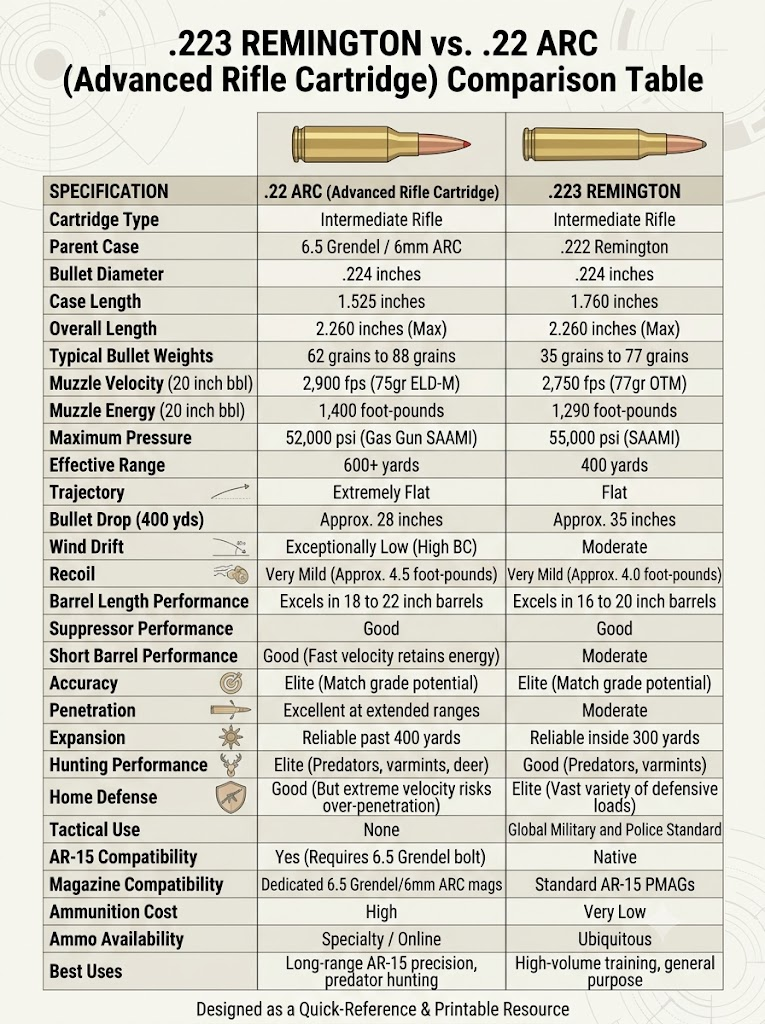
.223 vs .22 arc Comparison Table
| Specification | .22 ARC (Advanced Rifle Cartridge) | .223 Remington |
| Cartridge Type | Intermediate Rifle | Intermediate Rifle |
| Parent Case | 6.5 Grendel / 6mm ARC | .222 Remington |
| Bullet Diameter | .224 inches | .224 inches |
| Case Length | 1.525 inches | 1.760 inches |
| Overall Length | 2.260 inches (Max) | 2.260 inches (Max) |
| Typical Bullet Weights | 62 grains to 88 grains | 35 grains to 77 grains |
| Muzzle Velocity (20 inch bbl) | 2,900 fps (75gr ELD-M) | 2,750 fps (77gr OTM) |
| Muzzle Energy (20 inch bbl) | 1,400 foot-pounds | 1,290 foot-pounds |
| Maximum Pressure | 52,000 psi (Gas Gun SAAMI) | 55,000 psi (SAAMI) |
| Effective Range | 600+ yards | 400 yards |
| Trajectory | Extremely Flat | Flat |
| Bullet Drop (400 yds) | Approx. 28 inches | Approx. 35 inches |
| Wind Drift | Exceptionally Low (High BC) | Moderate |
| Recoil | Very Mild (Approx. 4.5 foot-pounds) | Very Mild (Approx. 4.0 foot-pounds) |
| Barrel Length Performance | Excels in 18 to 22 inch barrels | Excels in 16 to 20 inch barrels |
| Suppressor Performance | Good | Good |
| Short Barrel Performance | Good (Fast velocity retains energy) | Moderate |
| Accuracy | Elite (Match grade potential) | Elite (Match grade potential) |
| Penetration | Excellent at extended ranges | Moderate |
| Expansion | Reliable past 400 yards | Reliable inside 300 yards |
| Hunting Performance | Elite (Predators, varmints, deer) | Good (Predators, varmints) |
| Home Defense | Good (But extreme velocity risks over-penetration) | Elite (Vast variety of defensive loads) |
| Tactical Use | None | Global Military and Police Standard |
| AR-15 Compatibility | Yes (Requires 6.5 Grendel bolt) | Native |
| Magazine Compatibility | Dedicated 6.5 Grendel/6mm ARC mags | Standard AR-15 PMAGs |
| Ammunition Cost | High | Very Low |
| Ammo Availability | Specialty / Online | Ubiquitous |
| Best Uses | Long-range AR-15 precision, predator hunting | High-volume training, general purpose |
Understanding the Numbers
The .223 Remington has been the undeniable king of the AR-15 platform since its commercial introduction in the 1960s. Designed to fit the geometric confines of the AR-15 magazine well (2.260 inches overall length), it is a highly efficient cartridge that thrives with bullets ranging from 55 to 77 grains.
The .22 ARC, introduced by Hornady in 2023, was engineered to completely rewrite the rules of what an AR-15 can do. To achieve bolt-action .22-250 performance in a semi-automatic gas gun, Hornady took the fat 6.5 Grendel case (specifically the 6mm ARC variant) and necked it down to hold a .224 caliber bullet. This fat case holds roughly 17% more powder than the .223 Remington.Because the brass case itself is much shorter (1.525 inches compared to 1.760 inches), it leaves massive amounts of room inside the AR-15 magazine well to seat incredibly long, ultra-heavy, high-ballistic-coefficient bullets (up to 88 grains) entirely outside of the powder column.
Velocity Comparison
Velocity is the engine that drives flat trajectories and explosive terminal performance.
The .22 ARC is an absolute speed demon. When pushing a light 62-grain ELD-VT bullet, the .22 ARC easily achieves 3,300 feet per second out of a 20-inch barrel.A .223 Remington struggles to reach 3,100 fps with the same weight class.
When stepping up to heavy match bullets, the gap remains wide. A 75-grain .22 ARC load leaves the muzzle at 2,900 fps. A comparable 77-grain .223 Remington tops out around 2,750 fps. The massive powder capacity of the .22 ARC allows it to drive identical bullet weights 150 to 300 fps faster than the .223 Remington, replicating true bolt-action magnum velocities from a standard gas gun.
Muzzle Energy Comparison
Muzzle energy measures the absolute kinetic force transferred to a target upon impact.
Because kinetic energy relies heavily on velocity squared, the .22 ARC completely dominates the .223 Remington. The .22 ARC routinely generates around 1,500 foot-pounds of energy at the muzzle with hunting loads.The .223 Remington typically hovers around 1,250 to 1,300 foot-pounds.
More importantly, the .22 ARC retains that energy drastically better. At 300 yards, the .22 ARC still hits with nearly 1,000 foot-pounds of force, while the .223 Remington bleeds down to roughly 750 foot-pounds.
Trajectory Comparison
A flat trajectory minimizes the margin of error when estimating range for a hunter or competitive shooter in the field.
Because the .22 ARC launches at a much higher initial velocity and utilizes bullets with exceptionally high Ballistic Coefficients (BC), it shoots significantly flatter than the .223 Remington. The ARC reaches the target faster, giving gravity less time to pull the projectile downward. While the .223 Remington holds a relatively flat arc out to 300 yards, it begins to drop steeply after that.
Bullet Drop Comparison
Assuming a standard 100-yard zero for both rifles, the mathematical bullet drop at extended distances illustrates the aerodynamic superiority of the .22 ARC.
- .22 ARC (75gr ELD-M):Drops approximately 28 inches at 400 yards.
- .223 Remington (77gr OTM): Drops approximately 35 inches at 400 yards.
- .22 ARC (62gr ELD-VT):Drops approximately 42 inches at 500 yards.
- .223 Remington (55gr FMJ): Drops well over 60 inches at 500 yards.
This massive difference in vertical drop provides the .22 ARC shooter with a much larger margin of error when engaging targets past 300 yards.
Wind Drift Comparison
Wind deflection is the absolute greatest enemy of the precision shooter. Wind drift is mitigated strictly by a bullet’s velocity and its aerodynamic profile.
The .22 ARC was purpose-built to defeat the wind. By utilizing a shorter case, it can chamber incredibly long 88-grain Hornady ELD Match bullets that feature phenomenal ballistic coefficients. The standard .223 Remington simply cannot fit these ultra-long 88-grain bullets into an AR-15 magazine. Because the .22 ARC pushes higher-BC bullets faster, it spends less time exposed to crosswinds and drifts significantly less than the .223 Remington at 400 and 500 yards.
Recoil Comparison
Recoil dictates a shooter’s ability to spot their own impacts through a rifle scope and fire rapid follow-up shots.
Both cartridges are absolute joys to shoot and produce negligible recoil. The .223 Remington generates roughly 4.0 foot-pounds of free recoil in an AR-15. The .22 ARC, burning a slightly larger powder charge to push a heavier bullet, generates roughly 4.5 foot-pounds.
Practically speaking, the difference is unnoticeable to the human shoulder. Both fall into the “whisper-light” category, making them perfect for youth shooters, pest control, and rapid-fire competitions.
Stopping Power Comparison
Stopping power on game animals requires massive energy transfer and deep tissue disruption.
The .223 Remington is highly effective on small varmints and coyotes inside 300 yards. However, it often lacks the kinetic energy and heavy bullet mass required for ethical stops on medium game like whitetail deer at extended ranges.
The .22 ARC delivers vastly superior stopping power. The hydrostatic shock generated by an 80-grain or 88-grain bullet impacting at high velocities creates massive internal trauma that anchors coyotes, feral hogs, and deer with much more authority than the traditional .223.
Penetration Comparison
Penetration is critical for ensuring the bullet reaches the vital organs of heavily muscled animals on quartering angles.
Sectional Density (SD) measures a bullet’s weight relative to its diameter. Because the .22 ARC is capable of firing much heavier 80-grain and 88-grain bullets, those bullets possess a higher sectional density than the standard 55-grain or 62-grain bullets typically fired from a .223 Remington. This allows the heavier .22 ARC bullets to penetrate deeper through shoulder bones and thick muscle, making it a much more ethical choice for hunting medium game.
Expansion Comparison
To accurately test bullet expansion, the ballistics industry relies on calibrated ordinance gel.
Traditional hunting bullets require an impact velocity of at least 1,800 fps to reliably force the copper jacket open. Because the .22 ARC starts 200 fps faster and utilizes high-BC bullets that retain their speed efficiently, it stays above that critical 1,800 fps expansion threshold for roughly 150 to 200 yards further downrange than the .223 Remington.
Accuracy Comparison
Both cartridges are capable of elite, sub-MOA mechanical accuracy.
The .223 Remington has a reputation for phenomenal precision, especially when utilizing heavy 77-grain MatchKing or OTM bullets.
However, the .22 ARC chamber and cartridge were designed concurrently by Hornady using modern, tight-tolerance methodologies.It is exceptionally accurate at longer ranges simply because it defies environmental variables (wind and gravity) much better than the older .223 design.
Effective Range Comparison
The effective range of a rifle is severely limited by bullet drop, wind deflection, and retained energy.
For the .223 Remington, 400 yards is generally considered the absolute maximum effective range for reliable, predictable performance on targets. For hunting, that range is strictly limited to 200 or 250 yards.
The .22 ARC stretches the AR-15 platform into a true 600 to 800-yard target rifle. For hunters, the .22 ARC provides the necessary velocity and energy to ethically harvest coyotes and antelope out to 400 yards and beyond.
Suppressor Performance Comparison
Both cartridges are strictly supersonic when used for hunting or target shooting. Pushing massive volumes of gas through a titanium or steel suppressor will tame the concussive blast and reduce the visual muzzle flash, but neither cartridge can be made completely silent. The supersonic crack of the .224 bullet breaking the sound barrier will always remain loud.
Short Barrel Performance Comparison
Modern tactical and hunting applications frequently require maneuverable short-barreled rifles (SBRs).
The .223 Remington relies heavily on barrel length to generate velocity. When chopped down to 10.5 or 12.5 inches, it loses massive amounts of speed, neutering its terminal performance and effective range.
The .22 ARC, while it thrives in 18 to 22-inch barrels, maintains an immense speed advantage even when chopped down.Because it has 17% more powder capacity, a short-barreled .22 ARC will still push bullets significantly faster than a short-barreled .223 Remington, making it a surprisingly capable compact hunting platform.
Home Defense Comparison
Inside the home, a defender must balance stopping power against over-penetration and auditory safety.
The .223 Remington (specifically loaded with 55-grain ballistic tips or hollow points) is considered an elite home defense cartridge because the lightweight bullets fragment violently upon hitting drywall, drastically reducing the risk of over-penetration.
The .22 ARC is highly lethal but is not ideal for suburban home defense. Pushing heavy 80-grain or 88-grain bullets at 2,800+ fps significantly increases the risk that the projectile will blow clean through an intruder and penetrate multiple interior walls, endangering family members in adjacent rooms.
Hunting Comparison
These cartridges were built for entirely different hunting environments.
The .223 Remington is a fantastic, highly affordable cartridge for high-volume prairie dog shooting or calling coyotes inside 200 yards.
The .22 ARC is a true “do-it-all” modern hunting cartridge for the AR-15. It completely replicates the legendary .22-250 bolt-action hunting experience in a semi-automatic gas gun.It is elite for open-country predator hunting and highly capable of taking deer and feral hogs at medium ranges.
Tactical and Duty Use Comparison
The .223 Remington (5.56 NATO) is the undisputed global standard for modern militaries and law enforcement agencies. Its logistical dominance is unparalleled.
The .22 ARC has zero tactical or duty footprint. It was engineered purely for the commercial civilian sporting market to satisfy the demands of precision shooters and hunters.
AR-15 Compatibility
Both cartridges fit perfectly into the standard AR-15 platform, utilizing a standard mil-spec upper and lower receiver.
However, you cannot use a standard .223/5.56 bolt to fire the .22 ARC. Because the .22 ARC uses the fatter 6.5 Grendel parent case, you must purchase a dedicated 6.5 Grendel/6mm ARC bolt head and swap the barrel.
Magazine Compatibility
The .223 Remington feeds flawlessly from standard aluminum USGI magazines and polymer Magpul PMAGs holding 30 rounds.
Because the .22 ARC features a fat, bloated case, standard 5.56 magazines will not feed them reliably. You must use dedicated 6.5 Grendel or 6mm ARC magazines, which typically hold a maximum of 25 rounds in the same physical space as a 30-round .223 magazine.
Ammo Cost Comparison
To become proficient with a precision rifle, you must practice frequently.
The .223 Remington is arguably the cheapest centerfire rifle ammunition on the planet. You can buy bulk 55-grain FMJ practice ammunition for a fraction of the cost of premium hunting rounds.
The .22 ARC is a premium, specialized precision cartridge. There is no “cheap” practice ammo. Every box of factory ammunition is loaded with premium Hornady ELD or CX bullets, meaning it costs significantly more per round to shoot.
Ammo Availability Comparison
Walk into any sporting goods store, rural hardware store, or gas station in North America, and you will find .223 Remington on the shelf.
The .22 ARC is a very new cartridge (introduced in late 2023). While heavily supported by Hornady, it is still a specialty item. You will likely need to order .22 ARC ammunition online or visit a dedicated, large-scale firearms retailer to find it consistently.
Reloading Comparison
Both cartridges are absolute favorites in the precision reloading community.
The .223 Remington is highly economical to reload, with infinite load data, cheap brass, and abundant powder choices.
The .22 ARC is a handloader’s dream for extreme long-range precision. The ability to seat massive, aerodynamic 88-grain .224 bullets perfectly into the short case allows handloaders to tune the .22 ARC to achieve microscopic standard deviations in velocity for competitive PRS (Precision Rifle Series) gas-gun matches.
Pros and Cons
.22 ARC
Pros
- Delivers bolt-action .22-250 velocity and power from an AR-15.
- Exceptionally high Ballistic Coefficient bullets defeat wind drift.
- Extremely flat trajectory for precision shooting out to 600+ yards.
- Generates significantly more kinetic energy than a .223.
- Elite hunting capabilities for predators and medium game.
Cons
- Requires a specialized 6.5 Grendel bolt face and dedicated magazines.
- Ammunition is expensive and difficult to find in rural stores.
- Heavier recoil (though still very mild) compared to a standard .223.
.223 Remington
Pros
- The absolute gold standard for the AR-15 platform.
- Ammunition is universally available and incredibly cheap.
- Massive ecosystem of rifles, parts, and magazines available globally.
- Elite for close-quarters home defense and high-volume training.
- Extremely mild recoil impulse.
Cons
- Trajectory drops significantly past 300 yards.
- Cannot fit heavy, ultra-high-BC bullets inside standard magazines.
- Lacks the kinetic energy for ethical harvests on larger game at a distance.
Final Verdict
Choosing between the .223 Remington and the .22 ARC comes down entirely to what distances you plan to shoot and how much you are willing to spend on ammunition.
- For the Tactical Shooter and Plinker: Choose the .223 Remington. The incredibly low cost of bulk factory ammunition allows you to train, compete in 3-Gun matches, and defend your home efficiently without breaking the bank.
- For Extreme Long-Range AR-15 Target Shooting: Choose the .22 ARC. The aerodynamic efficiency and massive velocity will allow you to ring steel at 600 to 800 yards with far more consistency and less wind drift than the .223 Remington could ever dream of.
- For Predator and Coyote Hunters: Choose the .22 ARC. It completely replicates the devastating speed and flat trajectory of the legendary .22-250 bolt-action rifle, but allows for fast, semi-automatic follow-up shots on running coyotes.
- For the Budget-Conscious Hunter: Choose the .223 Remington. If your shots are strictly inside 200 yards in the thick timber, the .223 provides all the accuracy and lethality you need for small game and varmints at a fraction of the cost.
FAQ
Is the .22 ARC more powerful than the .223 Remington?
Yes, significantly. Because the .22 ARC possesses a fatter case with roughly 17% more powder capacity, it pushes identical bullet weights much faster.Furthermore, it can fire heavier bullets (up to 88 grains) that the .223 cannot efficiently load, resulting in vastly more kinetic energy at the muzzle and downrange.
Can I shoot .22 ARC out of a 5.56/.223 AR-15?
You can use the same upper and lower receiver, but you absolutely must change the barrel to a .22 ARC barrel, swap the bolt head to a 6.5 Grendel/6mm ARC bolt, and utilize dedicated magazines.
Why is the .22 ARC so popular?
The .22 ARC solved a massive problem for AR-15 enthusiasts. Previously, to get .22-250 magnum-level velocity, you had to buy a heavy bolt-action rifle. The .22 ARC crams that extreme velocity and aerodynamic superiority into a lightweight, semi-automatic gas gun.
What is the effective range of the .223 Remington?
When loaded with modern match or hunting ammunition, the .223 Remington is highly ethical and effective inside 300 yards. Beyond 400 yards, the bullet sheds velocity rapidly, and wind drift becomes very difficult to predict accurately.
Can the .22 ARC kill a deer?
Yes. When loaded with premium hunting bullets (like the 80-grain ELD-X), the .22 ARC delivers enough kinetic energy and deep penetration to ethically harvest whitetail deer and antelope at moderate ranges.
Does the .22 ARC have a lot of recoil?
No. While it technically produces slightly more recoil than a standard .223 Remington due to the larger powder charge, it still generates under 5 foot-pounds of free recoil. It feels like a very light, gentle push, making it highly suitable for young shooters and precision marksmen.