The main difference between the 45 colt and the 44 special is their original design era and bullet diameter. The 45 colt is a 19th century black powder military cartridge that utilizes a wider .452 inch diameter bullet to deliver massive heavy cast lead payloads, while the 44 special is an early 20th century smokeless powder cartridge utilizing a .429 inch diameter bullet that famously served as the highly accurate, low recoil stepping stone to the legendary 44 Magnum.
45 colt vs 44 special Comparison Table
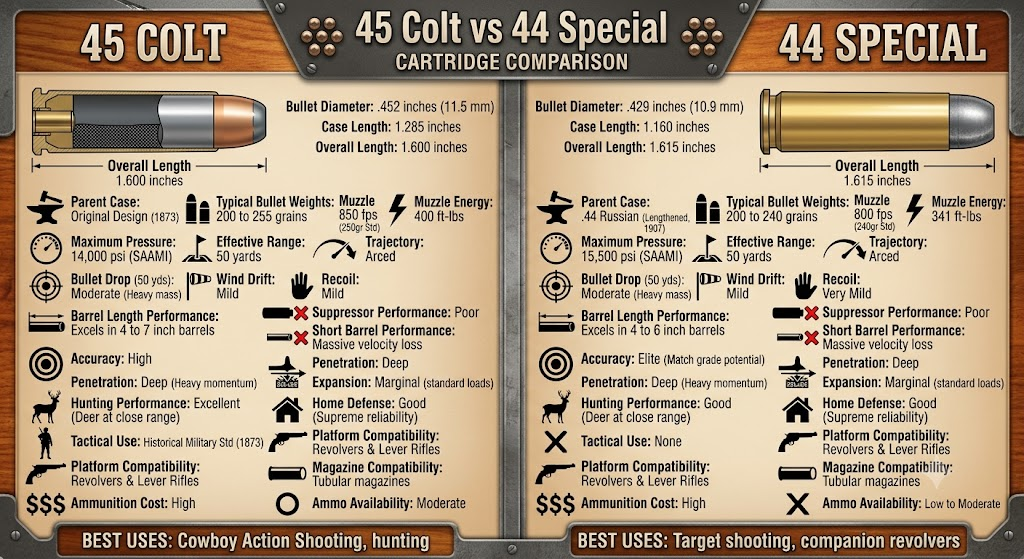
To accurately compare these two classic big bore revolver cartridges, we must examine their physical dimensions, pressure limits, and baseline ballistic performance. The data below represents standard factory loads safe for use in all firearms chambered for these calibers. For the 45 colt, we reference a traditional 250 grain lead round nose load. For the 44 special, we reference a standard 240 grain lead semi wadcutter.
| Specification | 45 colt | 44 special |
| Cartridge Type | Centerfire Revolver | Centerfire Revolver |
| Parent Case | Original Design (1873) | .44 Russian (Lengthened, 1907) |
| Bullet Diameter | .452 inches (11.5 mm) | .429 inches (10.9 mm) |
| Case Length | 1.285 inches | 1.160 inches |
| Overall Length | 1.600 inches | 1.615 inches |
| Typical Bullet Weights | 200 grains to 255 grains | 200 grains to 240 grains |
| Muzzle Velocity (Handgun bbl) | 850 fps (250gr Standard) | 800 fps (240gr Standard) |
| Muzzle Energy (Handgun bbl) | 400 foot pounds | 341 foot pounds |
| Maximum Pressure | 14,000 psi (SAAMI) | 15,500 psi (SAAMI) |
| Effective Range | 50 yards | 50 yards |
| Trajectory | Arced | Arced |
| Bullet Drop (50 yds) | Approximately 3.5 inches | Approximately 4.0 inches |
| Wind Drift | Moderate (Heavy mass) | Moderate (Heavy mass) |
| Recoil | Mild | Very Mild |
| Barrel Length Performance | Excels in 4 to 7 inch barrels | Excels in 4 to 6 inch barrels |
| Suppressor Performance | Poor (Revolver cylinder gap) | Poor (Revolver cylinder gap) |
| Short Barrel Performance | Massive velocity loss | Massive velocity loss |
| Accuracy | High | Elite (Match grade potential) |
| Penetration | Deep (Heavy momentum) | Deep (Heavy momentum) |
| Expansion | Marginal in standard loads | Marginal in standard loads |
| Hunting Performance | Excellent (Deer at close range) | Good (Deer at close range) |
| Home Defense | Good (Supreme mechanical reliability) | Good (Supreme mechanical reliability) |
| Tactical Use | Historical Military Standard (1873) | None |
| Platform Compatibility | Revolvers and Lever Action Rifles | Revolvers and Lever Action Rifles |
| Magazine Compatibility | Tubular magazines | Tubular magazines |
| Ammunition Cost | High | High |
| Ammo Availability | Moderate | Low to Moderate |
| Best Uses | Cowboy Action Shooting, hunting | Target shooting, companion revolvers |
Understanding the Engineering
The technical differences between these cartridges reflect a pivotal transition in firearms propellant history.
The 45 colt was adopted by the United States Cavalry in 1873. Because it was designed during the black powder era, the brass case is very long and cavernous to accommodate up to 40 grains of black powder. To ensure that modern smokeless ammunition does not blow up antique revolvers, the 45 colt is strictly limited to a very low maximum pressure of 14,000 psi.
The 44 special was introduced by Smith and Wesson in 1907. It is essentially a lengthened version of the older .44 Russian cartridge, redesigned specifically to utilize modern smokeless powders. Because it was built for stronger early 20th century revolvers, it operates at a slightly higher maximum pressure of 15,500 psi. However, the case capacity is still massive for the required powder charges. Handloaders quickly realized they could push the 44 special well beyond its factory limits, which directly led Elmer Keith to develop the .44 Magnum in the 1950s by lengthening the case even further.
Velocity Comparison
Velocity dictates trajectory flatness and terminal performance.
When examining standard factory loads, both cartridges are intentionally loaded to very conservative velocities. The 45 colt pushes a massive 250 grain bullet at roughly 850 feet per second. The 44 special typically pushes a 240 grain bullet at roughly 800 feet per second. Both are inherently subsonic big bore cartridges that rely entirely on heavy mass rather than blistering speed to achieve their results.
Muzzle Energy Comparison
Muzzle energy measures the absolute kinetic force transferred to the target upon impact.
Because the 45 colt fires a slightly heavier bullet at a slightly faster velocity in standard factory trim, it holds a definitive mathematical edge. A 250 grain 45 colt generates roughly 400 foot pounds of kinetic energy. The standard 240 grain 44 special generates approximately 341 foot pounds of energy. Both deliver excellent, deep penetrating kinetic force, but neither will produce the explosive hydrostatic shock associated with high velocity magnum cartridges.
Trajectory Comparison
Because both cartridges fire incredibly heavy, slow moving bullets, neither of them possesses a flat trajectory. They both lob their projectiles in a steep arc. They are designed exclusively for close quarters defensive engagements and short range target shooting. If you attempt to shoot a target at 100 yards with either cartridge, you will need to aim significantly higher than your intended point of impact to compensate for the rapid drop.
Bullet Drop Comparison
Assuming a standard 25 yard zero for both handguns, the bullet drop at 50 yards is nearly identical. The 45 colt will drop approximately 3.5 inches at 50 yards. The slightly slower 44 special will drop roughly 4.0 inches. Inside typical self defense distances of 10 to 15 yards, bullet drop is completely irrelevant for both calibers.
Wind Drift Comparison
Wind deflection is mitigated by a bullet’s velocity and its aerodynamic profile.
Both cartridges fire heavy, blunt nosed lead bullets that resist wind drift fairly well at short ranges simply due to their massive weight. While they travel slowly, the sheer mass acts like an anchor in the air. At 50 yards, wind drift is a minor concern for both cartridges.
Recoil Comparison
Recoil dictates a shooter’s ability to fire accurate follow up shots and enjoy extended range sessions.
Because standard pressure loads operate at very low pressures, firing either cartridge from a heavy steel revolver is an exceptionally pleasant experience. The 44 special generates slightly less recoil due to its lower powder charges and slightly lighter bullets. It is famous for its mild, gentle push. The 45 colt produces a slightly firmer rolling push, but neither cartridge produces the sharp, stinging snap of a modern high pressure magnum.
Stopping Power Comparison
Stopping power requires a combination of adequate penetration and wide tissue disruption.
Both cartridges are legendary man stoppers. Because standard pressure loads travel below 900 feet per second, traditional hollow points often fail to expand reliably in either caliber. However, expansion is largely unnecessary. The 45 colt starts out at .452 inches wide, and the 44 special starts out at .429 inches wide. They crush massive, permanent wound channels through sheer diameter and momentum, causing rapid blood loss regardless of bullet expansion.
Penetration Comparison
Penetration is critical for ensuring the bullet reaches vital organs, especially on heavy quartering angles.
Both cartridges excel in this category. They utilize heavy cast lead bullets that maintain their momentum incredibly well as they punch through tissue and bone. The 44 special has a slightly better sectional density due to its narrower bullet diameter relative to its weight, allowing it to penetrate marginally deeper on average, though the difference is practically imperceptible in the field.
Accuracy Comparison
Both cartridges are capable of elite mechanical accuracy, but the 44 special holds a distinct historical advantage.
The 44 special was engineered during a golden era of target shooting. The dimensions of the cartridge combined with the inherent quality of early 20th century Smith and Wesson revolvers gave the 44 special a reputation for pinpoint, ragged hole accuracy at 25 yards. The 45 colt is also highly accurate, but it was originally a military combat cartridge where loose chamber tolerances were sometimes preferred to ensure the weapon functioned when fouled with black powder residue.
Effective Range Comparison
The effective range of both cartridges is strictly limited by their short sight radius and rapidly decreasing bullet energy. The practical effective range of both the 45 colt and the 44 special is generally limited to 50 yards for the average shooter.
Suppressor Performance Comparison
Suppressors are highly effective on native subsonic cartridges, but the firearm platform matters entirely.
While both cartridges are naturally subsonic, suppressing a traditional revolver is completely ineffective due to the cylinder gap. High pressure gases and noise escape from the small space between the cylinder and the barrel before ever reaching the silencer attached to the muzzle.
Short Barrel Performance Comparison
When you cut a barrel down to 2 or 3 inches for a concealed carry configuration, internal ballistics change drastically.
Both cartridges suffer terribly in short snub nose revolvers. The powder does not have enough time to burn completely before the massive bullets exit the muzzle, resulting in extreme velocity loss and a blinding fireball. Firing a 250 grain bullet at 650 feet per second from a snub nose revolver significantly reduces terminal performance.
Home Defense Comparison
Inside the home, a heavy revolver provides supreme mechanical simplicity. There are no slides to rack and no magazines to seat.
Both the 45 colt and the 44 special are highly capable home defense cartridges. Their low operating pressures mean the indoor concussive blast is much less deafening than a modern 9mm or .357 Magnum. However, their heavy bullets will easily over penetrate through interior drywall, requiring the homeowner to be absolutely certain of their backstop.
Hunting Comparison
These cartridges are excellent short range hunting tools.
If you own a strong, modern revolver like a Ruger Blackhawk, you can purchase specialized high pressure ammunition for the 45 colt. These heavy loads push 300 grain hard cast bullets at 1,200 feet per second, transforming the antique cartridge into a massive bear defense and big game hunting tool that rivals the .44 Magnum.
The 44 special is a capable deer cartridge at close ranges with modern hollow points, but it is typically overshadowed in the hunting woods by its modern offspring, the highly powerful .44 Magnum.
Platform Compatibility
Both cartridges are exclusively designed for revolvers and lever action rifles. The wide rimmed cases stack perfectly in tubular magazines and extract flawlessly from revolver cylinders. Neither cartridge is compatible with standard semi automatic pistols.
It is highly important to note that any revolver or lever action rifle chambered in .44 Magnum can safely chamber and fire 44 special ammunition. This makes the 44 special an incredibly popular, low recoil practice cartridge for .44 Magnum owners.
Ammo Cost and Availability Comparison
To become proficient with a heavy handgun, you must practice frequently.
Neither cartridge is cheap to shoot. They both require massive amounts of raw brass and heavy lead projectiles to manufacture. Standard practice ammunition for both calibers is typically priced at a premium.
Walk into a standard sporting goods store, and you will likely find a few boxes of 45 colt tailored toward Cowboy Action Shooting enthusiasts. The 44 special is much harder to find locally. It is a specialty cartridge that often requires online ordering.
Reloading Comparison
This is where both cartridges truly shine. They are absolute favorites in the reloading community.
Both are straight walled cartridges that size easily in carbide dies. The massive case capacity allows handloaders to experiment with an infinite variety of cast lead bullets and powder charges. Handloading the 44 special is a rite of passage for traditional revolver enthusiasts, allowing them to recreate Elmer Keith’s famous heavy hunting loads.
Pros and Cons
45 colt
Pros
- Generates slightly more kinetic energy in standard factory loads.
- Incredibly mild recoil in heavy, full size revolvers.
- Can fire specialized high pressure hunting loads safely in strong revolvers.
- Deeply steeped in American Wild West history.
- Excellent stopping power through massive bullet diameter.
Cons
- Terrible velocity loss when fired from short snub nose barrels.
- Low velocity in standard loads results in poor hollow point expansion.
- Ammunition is significantly more expensive than modern semi auto calibers.
44 special
Pros
- World class inherent mechanical accuracy.
- Whisper light recoil makes it exceptionally pleasant to shoot.
- Can be safely fired in any firearm chambered for .44 Magnum.
- Supreme mechanical reliability in modern double action revolvers.
- Highly economical to reload using cast lead bullets.
Cons
- Factory ammunition is incredibly difficult to find locally.
- Lacks the case capacity to match hot 45 colt hunting loads.
- Standard pressure loads offer marginal hollow point expansion.
Final Verdict
Choosing between the 45 colt and the 44 special comes down to balancing historical nostalgia against modern versatility.
- For the .44 Magnum Owner: Choose the 44 special. Being able to practice with whisper quiet, low recoil ammunition in your heavy .44 Magnum hunting revolver is an absolute joy that every shooter should experience.
- For Big Game Hunting: Choose the 45 colt. When loaded with specialized high pressure ammunition in a modern Ruger revolver, the 45 colt delivers bone crushing kinetic energy that the 44 special simply cannot safely replicate.
- For Target Shooting Accuracy: Choose the 44 special. Its historical pedigree as a pinpoint target cartridge remains true today. It is inherently one of the most accurate big bore revolver cartridges ever designed.
- For Cowboy Action Competition: Choose the 45 colt. It is the undisputed king of the single action revolver, providing the exact authentic experience of the American frontier.
FAQ
Is the 45 colt more powerful than the 44 special?
When firing standard pressure factory ammunition, the 45 colt generates slightly more kinetic energy due to its heavier bullet mass. Furthermore, the 45 colt can be loaded to much higher pressures in strong modern revolvers, allowing it to drastically exceed the maximum power limitations of the 44 special.
Can I shoot 44 special in a .44 Magnum revolver?
Yes. The .44 Magnum cartridge case is simply a lengthened version of the 44 special. Therefore, every .44 Magnum revolver or lever action rifle can safely chamber and fire the shorter, lower pressure 44 special cartridge.
Can I shoot 45 colt in a .454 Casull revolver?
Yes. Similar to the 44 Magnum lineage, the .454 Casull is a lengthened, ultra high pressure version of the 45 colt. Any firearm chambered in .454 Casull or .460 S&W Magnum can safely fire standard 45 colt ammunition for cheap, low recoil practice.
Why is the 44 special so hard to find?
The 44 special became commercially overshadowed by the .44 Magnum in the 1950s. Most shooters seeking a .44 caliber revolver simply buy a .44 Magnum. As a result, ammunition manufacturers only produce the 44 special in small, seasonal batches tailored toward dedicated handloaders and collectors.