The main difference between the .455 webley and the .45 acp is their historical design era and their intended firearm platform. The .455 webley is a low pressure, rimmed cartridge designed for top break British service revolvers, relying on a massive bullet at very slow speeds, while the .45 acp is a modern, higher pressure rimless cartridge designed for the semi automatic 1911 pistol to provide greater velocity, energy, and reliable magazine feeding.
.455 webley vs .45 acp Comparison Table
To accurately compare these two historic military cartridges, we must examine their physical dimensions, pressure limits, and baseline ballistic performance. The data below represents standard factory loads. For the .455 webley, we reference the traditional 262 grain lead round nose Mark II military load. For the .45 acp, we reference standard 230 grain full metal jacket military ball ammunition.
| Specification | .455 webley | .45 acp |
| Cartridge Type | Centerfire Revolver | Semi Automatic Handgun |
| Parent Case | .476 Enfield | None (Original Design, 1904) |
| Bullet Diameter | .454 inches (11.5 mm) | .452 inches (11.5 mm) |
| Case Length | 0.760 inches | 0.898 inches |
| Overall Length | 1.250 inches | 1.275 inches |
| Typical Bullet Weights | 262 grains to 265 grains | 185 grains to 230 grains |
| Muzzle Velocity | 600 fps (262gr Standard) | 830 fps (230gr Standard) |
| Muzzle Energy | 210 foot pounds | 352 foot pounds |
| Maximum Pressure | 13,000 psi (SAAMI Standard) | 21,000 psi (SAAMI Standard) |
| Effective Range | 25 to 50 yards | 50 yards |
| Trajectory | Heavily Arced | Arced |
| Bullet Drop (50 yds) | Approximately 5.0 inches | Approximately 3.0 inches |
| Wind Drift | Moderate (Heavy mass) | Moderate |
| Recoil | Very Mild | Mild to Moderate |
| Barrel Length Performance | Excels in 4 to 6 inch barrels | Excels in 4 to 5 inch barrels |
| Suppressor Performance | Poor (Revolver cylinder gap) | Elite (Naturally subsonic) |
| Short Barrel Performance | Massive velocity loss | Moderate velocity loss |
| Accuracy | Good | High |
| Penetration | Moderate (Slow moving lead) | Deep (Full metal jacket) |
| Expansion | Non existent in standard loads | Devastating with modern hollow points |
| Hunting Performance | Not Recommended | Marginal (Small game only) |
| Home Defense | Poor (Antique firearms) | Elite (Modern high capacity platforms) |
| Tactical Use | British Military Standard (1891 to 1932) | US Military Standard (1911 to 1985) |
| Platform Compatibility | Top Break Revolvers | Semi Automatic Pistols and Carbines |
| Magazine Compatibility | None (Cylinder only) | Double stack and single stack box magazines |
| Ammunition Cost | Very High | Very Low |
| Ammo Availability | Rare / Specialty | Ubiquitous |
| Best Uses | Historical collecting, reenactments | Concealed carry, home defense, duty use |
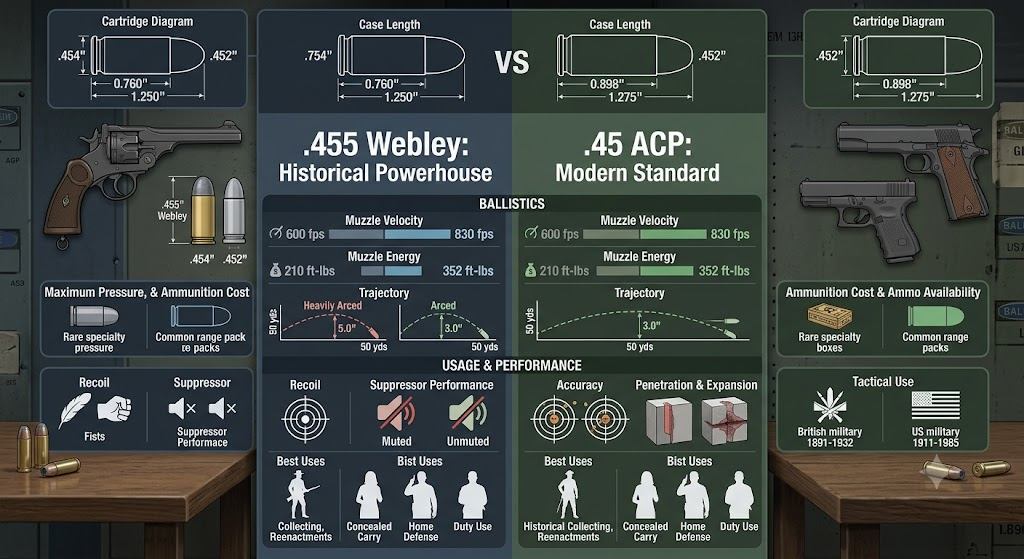
Understanding the Engineering
The technical differences between these cartridges reflect the transition from 19th century revolver tactics to 20th century semi automatic warfare.
The .455 webley was introduced in 1891 for the British military. It was designed to be fired from the massive Webley top break revolvers. The British military doctrine at the time prioritized firing a very heavy, soft lead bullet at incredibly slow velocities to maximize energy transfer and avoid over penetration in close quarters combat. Because it was originally developed during the black powder era and transitioned to cordite, it operates at a very low maximum pressure of 13,000 psi to ensure antique top break hinges do not snap under stress.
The .45 acp (Automatic Colt Pistol) was developed by John Moses Browning in 1904. The United States Cavalry wanted a sidearm that replicated the stopping power of older .45 caliber revolvers but in a modern, fast reloading semi automatic platform. Browning designed a rimless cartridge that stacks perfectly in magazines. It operates at 21,000 psi, which provides vastly superior velocity and kinetic energy while remaining safe in early 1911 slide mechanisms.
Velocity Comparison
Velocity dictates how reliably a modern hollow point bullet forces its cavity open upon entering soft tissue.
The .45 acp possesses a massive velocity advantage. A standard 230 grain .45 acp bullet travels at approximately 830 feet per second.
The .455 webley is one of the slowest military cartridges ever fielded. It must push a massive 262 grain bullet while operating at a very low pressure, meaning it leaves the barrel at a sluggish 600 feet per second. You can occasionally see the bullet traveling downrange in perfect lighting conditions.
Muzzle Energy Comparison
Muzzle energy measures the absolute kinetic force transferred to the target upon impact.
Because kinetic energy heavily favors velocity, the .45 acp completely outclasses the British revolver cartridge. The .45 acp generates roughly 352 foot pounds of energy. The .455 webley generates only 210 foot pounds of energy. While the massive bullet diameter of the Webley makes it lethal, it produces kinetic energy levels that are lower than a modern 9mm or .38 Special.
Trajectory Comparison
A flat trajectory makes hitting targets at unknown distances much easier.
Because the .45 acp drives lighter bullets much faster out of the muzzle, it shoots noticeably flatter. The .455 webley lobs its massive projectile in a very steep arc, dropping rapidly past 25 yards. In a practical military or self defense scenario inside 10 yards, this trajectory difference is negligible, but it becomes glaring at 50 yards.
Bullet Drop Comparison
Assuming a standard 25 yard zero for both handguns, the bullet drop at 50 yards illustrates the trajectory difference perfectly. The .45 acp will drop approximately 3.0 inches at 50 yards. The incredibly slow moving .455 webley will drop roughly 5.0 inches or more, depending on the specific loading.
Wind Drift Comparison
Wind deflection is mitigated by a bullet’s velocity and its aerodynamic profile.
Handgun bullets generally possess terrible aerodynamics. The .455 webley bullet acts like an anchor in the air due to its massive weight, but it travels so slowly that crosswinds have ample time to push it off target. The .45 acp reaches the target faster, giving it a slight practical advantage in windy conditions at 50 yards.
Recoil Comparison
Recoil directly dictates a shooter’s ability to fire rapid and accurate follow up shots.
The .455 webley produces exceptionally mild recoil. Firing a low pressure cartridge out of a massive steel Webley revolver results in a very gentle, slow rolling push. It is incredibly easy to shoot one handed, which was a requirement for British cavalrymen holding reins.
The .45 acp generates a moderately heavy push. When fired from a modern polymer pistol or a classic steel 1911, the reciprocating slide absorbs some energy, but the 21,000 psi operating pressure ensures a firm recoil impulse that requires solid grip fundamentals to manage quickly.
Stopping Power Comparison
Stopping power requires a combination of adequate penetration, rapid energy transfer, and wide bullet expansion.
The .45 acp is a legendary man stopper. Premium modern .45 acp hollow points expand violently upon impact to nearly an inch in diameter, dumping all their energy instantly to disrupt the central nervous system.
The .455 webley relies entirely on the fact that it starts out massive. Because it travels at 600 feet per second, hollow points will absolutely never expand. However, the heavy 262 grain bullet creates a wide, permanent wound channel through sheer diameter and momentum, effectively stopping threats without relying on modern bullet technology.
Penetration Comparison
Penetration is critical for ensuring the bullet reaches vital organs.
The .45 acp utilizes full metal jacket ball ammunition or bonded hollow points that penetrate deeply into tissue, easily meeting the FBI standard of 12 to 18 inches. The .455 webley utilizes unjacketed, soft cast lead bullets. While the momentum carries the heavy bullet deep into soft tissue, the soft lead can deform on heavy bone, limiting its penetration on heavily clothed or armored targets compared to the .45 acp.
Expansion Comparison
To test expansion, the ballistics industry relies on calibrated ordinance gel.
A premium .45 acp hollow point hits tissue at high speed and violently mushrooms. A .455 webley will not expand at all. The velocity is far below the minimum 800 feet per second threshold required to force open copper jackets or lead cavities.
Accuracy Comparison
Both cartridges are capable of good mechanical accuracy.
The .45 acp is a highly accurate match cartridge in custom tuned 1911 pistols. The .455 webley is mechanically accurate, but it is handicapped by the heavy double action trigger pulls and rudimentary iron sights found on antique service revolvers.
Effective Range Comparison
The effective range of a defensive handgun is strictly limited by its short sight radius and rapidly decreasing bullet energy. The practical effective range of the .45 acp is 50 yards. The .455 webley is best utilized inside of 25 yards due to its extremely steep trajectory and slow velocity.
Suppressor Performance Comparison
Suppressors are highly effective on native subsonic cartridges, but the firearm platform matters entirely.
The .45 acp is the gold standard for suppressed centerfire pistols. Because it is naturally subsonic with 230 grain bullets, adding a silencer completely eliminates the supersonic crack and massively reduces the muzzle blast.
Suppressing a .455 webley is completely ineffective. High pressure gases and noise escape from the cylinder gap of the revolver before ever reaching the muzzle.
Short Barrel Performance Comparison
Both cartridges suffer velocity loss in short barrels, but the .455 webley is affected more drastically. Firing a .455 webley from a rare snub nose variant drops the velocity to roughly 500 feet per second, resulting in a severe lack of terminal performance. The .45 acp retains enough velocity in 3 or 4 inch concealed carry barrels to remain highly lethal.
Home Defense Comparison
Inside the home, you must balance stopping power against ammunition capacity and weapon simplicity.
A .45 acp pistol is an elite choice for home defense. A modern double stack pistol holds 10 to 15 rounds, accommodates a weapon mounted light effortlessly, and provides devastating terminal ballistics.
The .455 webley is an antique. It holds 6 rounds, cannot mount modern accessories, and uses very weak ammunition. It is not recommended for home defense in the modern era.
Hunting Comparison
Neither cartridge is designed for hunting medium or large game. They both lack the kinetic energy, velocity, and deep penetration required to ethically harvest deer or feral hogs. They should be strictly relegated to target shooting or small game at close ranges.
Platform Compatibility
The .45 acp is exclusively designed for semi automatic pistols and pistol caliber carbines. The rimless case stacks perfectly in box magazines.
The .455 webley features a wide rimmed base. It is absolutely incompatible with standard semi automatic pistols. Firing the .455 webley requires a revolver. Due to antique designs, many original Webley revolvers had their cylinders shaved down in the 20th century to accept .45 acp on moon clips, which can be highly dangerous due to the pressure differences.
Ammo Cost Comparison
To become proficient with a firearm, you must practice frequently.
The .45 acp is incredibly cheap to shoot. Commercial practice ammunition is mass produced by the billions globally, making it highly affordable.
The .455 webley is significantly more expensive. It is an obsolete specialty cartridge. When a manufacturer produces a small seasonal batch, a box of 50 rounds typically costs three to four times the price of a comparable box of .45 acp.
Ammo Availability Comparison
Walk into any sporting goods store in the world, and you will find .45 acp ammunition sitting on the shelf. The .455 webley is incredibly difficult to find locally. It almost always requires ordering from specialized online ammunition retailers.
Reloading Comparison
Both cartridges are very popular in the reloading community.
The .45 acp is easy and cheap to reload using widely available components.
The .455 webley is kept alive almost entirely by handloaders. Shooters cast their own lead bullets and load light powder charges to safely shoot their antique revolvers without paying exorbitant factory ammunition prices.
Pros and Cons
.455 webley
Pros
- Incredibly mild recoil.
- Massive bullet diameter crushes wide wound channels.
- Supreme historical value for military collectors.
- Fun and easy to reload with cast lead bullets.
Cons
- Terrible velocity limits kinetic energy and trajectory.
- Ammunition is incredibly expensive and rare.
- Revolver platform is obsolete for modern tactical use.
- Zero hollow point expansion.
.45 acp
Pros
- Unmatched combination of magazine capacity and stopping power.
- Elite terminal ballistics with modern hollow point ammunition.
- Ammunition is universally available and highly affordable.
- Excellent suppressor host.
- Chambered in thousands of modern firearm designs.
Cons
- Recoil can be intimidating for absolute beginners.
- Lacks the kinetic energy for big game hunting.
- Heavy bullet weight makes carrying spare magazines noticeably heavy.
Final Verdict
Choosing between the .455 webley and the .45 acp comes down to whether you are a historical collector or someone seeking a practical modern firearm.
- For Concealed Carry and Home Defense: Choose the .45 acp. It offers modern ammunition capacity, superior hollow point expansion, and vastly faster reload times in highly reliable modern firearms.
- For High Volume Training: Choose the .45 acp. The incredibly low cost of factory ammunition will save you massive amounts of money over the lifespan of the firearm.
- For Historical Collecting: Choose the .455 webley. The Webley top break revolver is an iconic piece of British military history, and firing the original low pressure cartridge is a fantastic nostalgic experience.
- For Suppressor Use: Choose the .45 acp. The naturally subsonic 230 grain bullets run flawlessly through modern pistol suppressors, whereas the Webley revolver cannot be suppressed at all.
FAQ
Is the .455 webley more powerful than the .45 acp?
No. The .45 acp is significantly more powerful. Because it operates at a much higher pressure limit (21,000 psi versus 13,000 psi), the .45 acp drives bullets at much higher velocities, resulting in nearly double the kinetic energy of the .455 webley.
Can I shoot .45 acp in a .455 webley revolver?
You should never fire standard .45 acp ammunition in an unmodified .455 webley revolver. Many antique Webleys had their cylinders shaved to accept .45 acp in moon clips, but the high pressure of standard .45 acp can crack the cylinder or blow up the top break hinge of the antique revolver. Handloaders must create custom, low pressure .45 acp loads specifically for shaved Webleys.
Why is the .455 webley so slow?
The .455 webley was designed during a transitional period in propellant history. The British military wanted a heavy bullet that would not over penetrate enemies in close combat. They kept the pressure incredibly low so the cartridge would not snap the mechanical hinge on their top break revolvers, resulting in a massive bullet moving at very slow speeds.
Are the bullet diameters exactly the same?
No. The .45 acp uses a .451 to .452 inch diameter bullet. The .455 webley uses a slightly wider .454 to .455 inch diameter bullet.