The main difference between the .30-06 Springfield and the .223 Remington is their physical size and the resulting ballistic performance. The .30-06 Springfield is a large, full-power rifle cartridge firing heavier .308-inch bullets designed for large game and extended ranges. The .223 Remington is an intermediate cartridge firing lighter .224-inch bullets, producing less recoil and primarily serving varmint hunting, target shooting, and defensive roles where high capacity and low recoil are advantageous.
30 06 vs .223: Main Difference
| Specification | .30-06 Springfield | .223 Remington |
| Cartridge name | .30-06 Springfield | .223 Remington |
| Other names | .30 Gov’t ’06, 7.62x63mm | 5.56x45mm (similar, not identical) |
| Bullet diameter | 0.308 inches (7.82 mm) | 0.224 inches (5.70 mm) |
| Case length | 2.494 inches (63.3 mm) | 1.760 inches (44.7 mm) |
| Overall cartridge length | 3.340 inches (84.8 mm) | 2.260 inches (57.4 mm) |
| Typical bullet weights | 150 to 220 grains | 40 to 77 grains |
| Typical muzzle velocity | 2,700 to 2,900 fps | 2,750 to 3,300 fps |
| Typical muzzle energy | 2,800 to 3,000 ft-lbs | 1,200 to 1,300 ft-lbs |
| Maximum pressure | 60,000 psi (SAAMI) | 55,000 psi (SAAMI) |
| Typical effective range | 600 to 800+ yards | 300 to 500 yards |
| Recoil | Moderate to heavy (approx. 20 ft-lbs) | Very light (approx. 4 ft-lbs) |
| Common firearm types | Bolt-action rifles, semi-automatic hunting rifles | AR-15 platforms, bolt-action varmint rifles |
| Common uses | Medium to large game hunting, target shooting | Varmint hunting, target shooting, self-defense |
| Hunting suitability | Deer, elk, moose, bear, wild boar | Coyote, prairie dog, fox, small deer (where legal) |
| Military history | U.S. military service from 1906 to late 1970s | Commercial parent of the 5.56x45mm NATO |
| Availability | Widely available globally | Extremely common, high volume production |
Winner: Tie – The .30-06 Springfield is strictly superior for large game and energy transfer, while the .223 Remington wins for high-volume shooting and low recoil.
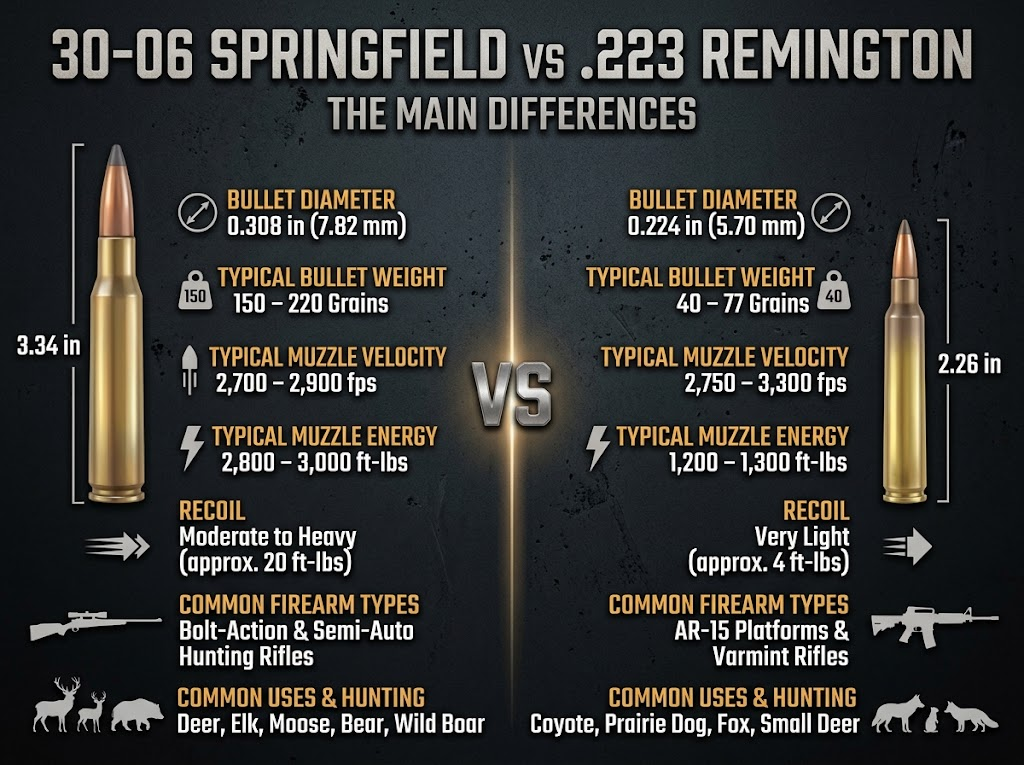
What Is .30-06 Springfield?
The .30-06 Springfield was adopted by the United States Army in 1906 and served as the primary military rifle cartridge through two World Wars and the Korean War. It uses a 2.494-inch bottleneck case firing a 0.308-inch diameter bullet. Ammunition for the .30-06 typically features bullet weights ranging from 150 to 220 grains, though lighter and heavier options exist.
Loaded to a SAAMI maximum pressure of 60,000 psi, the cartridge pushes a 150-grain bullet to approximately 2,900 feet per second (fps), generating over 2,800 foot-pounds (ft-lbs) of muzzle energy. The recoil is noticeable, averaging around 20 ft-lbs in a standard hunting rifle. Today, it remains one of the most popular big game hunting cartridges in the world, capable of taking nearly any terrestrial game in North America.
What Is .223 Remington?
The .223 Remington is a rimless, bottlenecked intermediate cartridge introduced commercially in 1962 as the civilian counterpart to the military 5.56x45mm cartridge development. It fires a 0.224-inch diameter bullet from a 1.760-inch case. The .223 Remington typically uses bullet weights between 40 and 77 grains, producing velocities ranging from 2,750 fps with heavy match bullets up to 3,300 fps with light varmint loads.
Generating around 1,200 to 1,300 ft-lbs of muzzle energy, the .223 Remington produces very mild recoil, making it exceptionally easy to shoot accurately. It is crucial to distinguish .223 Remington from 5.56 NATO. While they look identical externally, 5.56 NATO ammunition is loaded to higher pressures and uses a slightly different chamber specification. Rifles chambered in 5.56 NATO can safely fire .223 Remington ammunition, but firing 5.56 NATO in a rifle explicitly chambered for .223 Remington can cause unsafe pressure spikes and is generally not recommended by SAAMI.
.30-06 vs .223 Ballistics
| Cartridge | Bullet Weight | Muzzle Velocity | Muzzle Energy | Test Barrel Length | Notes |
| .30-06 Springfield | 150 gr | 2,910 fps | 2,820 ft-lbs | 24 inches | Federal Premium Nosler Ballistic Tip |
| .30-06 Springfield | 180 gr | 2,700 fps | 2,913 ft-lbs | 24 inches | Remington Core-Lokt |
| .30-06 Springfield | 220 gr | 2,410 fps | 2,837 ft-lbs | 24 inches | Hornady InterLock Round Nose |
| .223 Remington | 40 gr | 3,300 fps | 967 ft-lbs | 24 inches | Fiocchi V-Max |
| .223 Remington | 55 gr | 3,240 fps | 1,282 ft-lbs | 24 inches | Hornady V-Max |
| .223 Remington | 75 gr | 2,790 fps | 1,296 ft-lbs | 24 inches | Hornady BTHP Match |
Bullet weight and muzzle velocity dictate both the muzzle energy and the trajectory of a cartridge. The .30-06 Springfield uses much heavier bullets than the .223 Remington, allowing it to retain energy and resist wind deflection at extended distances, which is vital for hunting large animals. The .223 Remington achieves high initial velocities with light bullets, resulting in a very flat trajectory over moderate ranges, but it sheds velocity and energy faster than the heavier .30-06 projectiles.
.30-06 vs .223 Size and Dimensions
The physical dimensions illustrate the main difference between 30-06 and .223 Remington.
- Bullet diameter: .30-06 is 0.308 inches; .223 is 0.224 inches.
- Case length: .30-06 is 2.494 inches; .223 is 1.760 inches.
- Overall cartridge length: .30-06 is 3.340 inches; .223 is 2.260 inches.
- Case diameter: .30-06 is 0.471 inches; .223 is 0.376 inches.
- Base diameter: .30-06 is 0.470 inches; .223 is 0.377 inches.
- Rim diameter: .30-06 is 0.473 inches; .223 is 0.378 inches.
- Typical cartridge weight: .30-06 is approximately 400 grains (depending on load); .223 is approximately 180 grains.
The .30-06 Springfield requires a standard long-action rifle to cycle its 3.340-inch overall length, whereas the .223 Remington fits neatly into short-action rifles and the AR-15 platform. The larger case capacity of the .30-06 holds substantially more gunpowder, directly translating into its higher energy output.
.30-06 vs .223 Bullet Weight
| Cartridge | Common Bullet Weights | Lightest Common Weight | Heaviest Common Weight | Typical Applications |
| .30-06 Springfield | 150 gr, 165 gr, 180 gr | 110 gr | 220 gr | Deer, elk, moose, bear, target shooting |
| .223 Remington | 55 gr, 62 gr, 69 gr, 75 gr | 40 gr | 77 gr | Varmints, target shooting, defense |
The .30-06 Springfield uses substantially heavier bullets because its 0.308-inch bore diameter allows for long, dense projectiles that carry significant momentum. This mass is necessary for penetrating the thick hide and bone of large game. The .223 Remington is restricted to lighter bullets due to its smaller 0.224-inch diameter and the limited powder capacity of its case.
.30-06 vs .223 Velocity
When looking at 30 06 vs .223, both cartridges are capable of high speeds. The .223 Remington is generally faster at the muzzle, driving a 55-grain bullet at approximately 3,240 fps from a 24-inch barrel. The .30-06 Springfield drives a heavier 150-grain bullet at roughly 2,900 fps from a similar barrel.
Velocity is significantly affected by barrel length, bullet weight, the specific ammunition load, and the firearm design. A short 16-inch barrel on an AR-15 chambered in .223 will yield much lower velocities than a 24-inch bolt-action rifle firing the identical cartridge. Similarly, the .30-06 velocity will decrease if fired from an 18-inch carbine barrel instead of a standard 22-inch or 24-inch hunting barrel.
.30-06 vs .223 Muzzle Energy
The .30-06 Springfield produces substantially more muzzle energy than the .223 Remington due to the massive difference in bullet weight and powder capacity. Energy is a product of mass and velocity squared. A typical 150-grain .30-06 load generates over 2,800 ft-lbs of kinetic energy at the muzzle. A typical 55-grain .223 Remington load generates around 1,280 ft-lbs.
While individual loads vary, a .30-06 will consistently output more than twice the kinetic energy of a .223 Remington, making it vastly superior for applications where terminal energy and deep penetration are required.
.30-06 vs .223 Recoil
Recoil is influenced by a combination of factors:
- Bullet weight
- Muzzle velocity
- Powder charge
- Firearm weight
- Stock design
- Muzzle devices where applicable
The .30-06 Springfield generates approximately 20 ft-lbs of free recoil energy when fired from an 8-pound rifle. This is considered a moderate to heavy recoil level that can cause fatigue during extended range sessions.
The .223 Remington generates approximately 4 ft-lbs of recoil energy from a 7-pound rifle. This is a very mild recoil impulse, making the .223 an excellent choice for high-volume shooting, fast follow-up shots, and training new shooters.
.30-06 vs .223 Effective Range
Effective range depends heavily on the firearm, the selected ammunition, target size, the shooter’s skill, and the intended application.
For the .30-06 Springfield, the effective hunting range for deer-sized game is commonly cited as 400 to 500 yards, assuming the shooter can accurately place the shot. For target shooting, the .30-06 remains supersonic and predictable well past 800 yards.
For the .223 Remington, the effective range for varmint hunting is generally up to 300 to 400 yards. For target shooting, match-grade heavy bullets (like 75-grain or 77-grain) fired from fast-twist barrels can reach out to 600 yards. However, its lightweight bullet gets blown off course by wind much easier than the heavier .30-caliber projectiles at extended distances.
.30-06 vs .223 for Hunting
When analyzing .30-06 vs .223 for hunting, they serve entirely different roles. The .223 Remington is a premier varmint and small game cartridge, excelling at hunting coyotes, prairie dogs, and foxes where flat trajectories and explosive light bullets are desired.
The .30-06 Springfield is a dedicated medium to large game cartridge. It is universally accepted for deer, elk, moose, black bear, and wild boar. The heavy bullet selection allows hunters to tailor the .30-06 to the specific game being hunted. In many jurisdictions, .223 Remington is not legally permitted for hunting large game due to its low bullet weight and kinetic energy.
.30-06 vs .223 for Deer Hunting
For deer hunting, the .30-06 Springfield is one of the most proven cartridges in existence. It provides overwhelming energy to ensure an ethical harvest at close range in heavy brush or across open fields at 400 yards.
The .223 Remington can be used for deer hunting, but it requires careful bullet selection, typically necessitating heavy bonded or solid copper bullets designed for controlled expansion rather than explosive varmint fragmentation. Crucially, hunters must verify local regulations, as many states strictly prohibit the use of .22-caliber centerfire cartridges for deer hunting. Where it is legal, the .223 is restricted to close ranges to ensure adequate terminal performance.
.30-06 vs .223 for Long Range
For long-range shooting, the .30-06 Springfield holds an advantage in velocity retention, muzzle energy, and wind resistance. Heavy .30-caliber bullets with high ballistic coefficients cut through the wind efficiently and maintain supersonic flight at longer distances than most .223 Remington loads. However, the heavy recoil of the .30-06 makes spotting your own impacts difficult.
The .223 Remington is popular for mid-range target shooting and precision rifle series (PRS) training because it produces almost zero recoil and ammo is inexpensive. With high ballistic coefficient 77-grain bullets, the .223 performs admirably out to 600 yards. Past that distance, the light bullet is highly sensitive to wind deflection and rapidly loses velocity.
.30-06 vs .223 Rifle Size and Weight
Rifles chambered in .30-06 Springfield are almost exclusively long-action bolt rifles, single-shots, or heavy semi-automatics like the M1 Garand or Browning BAR. Because of the cartridge length and the heavy recoil, .30-06 rifles generally feature 22-inch or 24-inch barrels and weigh between 7.5 and 9 pounds to help mitigate recoil. Magazine capacity typically ranges from 3 to 5 rounds.
Rifles chambered in .223 Remington include short-action bolt rifles and the highly popular AR-15 platform. Because the cartridge is short and produces little recoil, these rifles can be built very light and compact, often weighing between 6 and 7 pounds with 16-inch to 20-inch barrels. Modern sporting rifles in .223 also feature much higher magazine capacities.
.30-06 vs .223 Cost Per Round
Ammunition pricing fluctuates, but the .223 Remington is consistently cheaper due to less material usage and massive commercial and military economies of scale. Based on current online retailer pricing structures for basic practice ammunition:
| Cartridge | Bullet Weight | Ammo Type | Quantity | Price | Cost Per Round |
| .223 Remington | 55 gr | FMJ Practice (Brass) | 500 rounds | $250.00 | $0.50 |
| .223 Remington | 62 gr | BTHP Match | 200 rounds | $140.00 | $0.70 |
| .30-06 Springfield | 150 gr | FMJ Practice (Brass) | 200 rounds | $230.00 | $1.15 |
| .30-06 Springfield | 180 gr | Soft Point Hunting | 20 rounds | $30.00 | $1.50 |
Shooting .223 Remington is highly economical, making it ideal for high-volume practice, whereas the .30-06 Springfield is priced as a dedicated hunting and medium-volume target round.
.30-06 vs .223 Availability
Both cartridges are ubiquitous in the United States and globally.
The .223 Remington benefits from being tied to the military 5.56 NATO supply chain, meaning millions of rounds are manufactured annually. It is usually available in bulk cases at discount prices.
The .30-06 Springfield is a staple on the shelf of every sporting goods store, hardware store, and rural outfitter. While you might not buy it in 1,000-round cases, you will almost never struggle to find 20-round boxes of quality hunting ammunition anywhere hunting supplies are sold.
.30-06 vs .223 Pros and Cons
.30-06 Pros and Cons
Pros:
- Produces exceptional muzzle energy capable of taking any North American big game.
- Wide range of available bullet weights from 110 to 220 grains.
- Excellent performance at extended hunting ranges.
- Ammunition is universally available anywhere hunting is legal.
Cons:
- Recoil is substantial and can induce flinching in new shooters.
- Requires a long-action rifle, which adds weight and length.
- Ammunition is more than twice as expensive as .223 Remington.
.223 Pros and Cons
Pros:
- Extremely light recoil makes it easy to shoot accurately.
- Ammunition is highly affordable and available in bulk quantities.
- Fits into lightweight, short-action rifles and modern semi-automatic platforms.
- Excellent flat trajectory for varmint hunting.
Cons:
- Lacks the muzzle energy required for large game hunting.
- Light bullets are easily pushed off target by wind at long ranges.
- Illegal for deer hunting in several jurisdictions.
.30-06 vs .223 FAQs
What is the main difference between .30-06 and .223?
The main difference is size and power. The .30-06 is a large hunting cartridge firing heavy bullets with high recoil, while the .223 is a small intermediate cartridge firing light bullets with minimal recoil.
Is .30-06 bigger than .223?
Yes, the .30-06 Springfield case is much longer and wider, and it fires a larger 0.308-inch diameter bullet compared to the 0.224-inch bullet of the .223 Remington.
Is .30-06 more powerful than .223?
Yes, the .30-06 generates over twice the kinetic energy of the .223 Remington.
Which has more muzzle energy, .30-06 or .223?
The .30-06 Springfield produces 2,800 to 3,000 ft-lbs of muzzle energy, while the .223 Remington produces 1,200 to 1,300 ft-lbs.
Which has more recoil, .30-06 or .223?
The .30-06 has significantly more recoil, generating around 20 ft-lbs compared to the 4 ft-lbs produced by the .223 Remington.
Is .223 good for hunting?
The .223 is excellent for varmint and predator hunting, such as coyote or prairie dog, but it is generally underpowered for large game.
Is .30-06 good for hunting?
The .30-06 is considered one of the most versatile and effective big game hunting cartridges in the world, suitable for deer, elk, and bear.
Can .223 and .30-06 use the same ammunition?
No, they are completely different sizes and cannot be chambered in the same rifles.
What is the bullet diameter of .30-06?
The bullet diameter of the .30-06 Springfield is 0.308 inches.
What is the bullet diameter of .223?
The bullet diameter of the .223 Remington is 0.224 inches.
What is the velocity of .30-06?
A typical 150-grain .30-06 bullet travels at approximately 2,900 feet per second at the muzzle.
What is the velocity of .223?
A typical 55-grain .223 bullet travels at approximately 3,240 feet per second at the muzzle.
What is the effective range of .30-06?
For hunting, the effective range is typically 400 to 500 yards, while target shooters can effectively use it past 800 yards.
What is the effective range of .223?
For varmint hunting, the effective range is roughly 300 to 400 yards, while heavy match bullets can reach 600 yards for target shooting.
Is .223 the same as 5.56 NATO?
No. They share identical exterior dimensions, but 5.56 NATO is loaded to higher pressures and has slightly different chamber throat specifications. Rifles chambered in 5.56 NATO can fire .223 Remington, but not necessarily the reverse.