The main difference between the .223 Remington and the .22-250 Remington is that the .22-250 delivers dramatically higher velocities and a much flatter trajectory for long-range varmint hunting, while the .223 Remington provides significantly better barrel life, cheaper ammunition, and unmatched versatility for everyday shooting applications. Originally derived from the .250-3000 Savage case, the .22-250 is a specialized speed demon designed specifically to vaporize prairie dogs and coyotes at extreme distances across windy plains. By pushing identical bullet weights nearly 500 feet per second faster than its competitor, it completely changes the math on bullet drop. Conversely, the .223 Remington is the ultimate utility cartridge. Chambered in countless rifle platforms, it remains the standard for everything from tactical training and home defense to casual range plinking. Comparing these two popular centerfire cartridges reveals exactly which tool is best suited for your specific shooting needs.
223 vs 22-250 Ballistics Chart
| Specification / Metric | .223 Remington (55 gr V-Max) | .22-250 Remington (55 gr V-Max) |
| Cartridge | .223 Remington | .22-250 Remington |
| Parent Case | .222 Remington | .250-3000 Savage |
| Bullet Diameter | .224 inches | .224 inches |
| Typical Bullet Weight | 55 to 77 grains | 40 to 55 grains |
| Muzzle Velocity | 3,240 fps | 3,680 fps |
| Velocity at 100 Yards | 2,865 fps | 3,280 fps |
| Velocity at 200 Yards | 2,518 fps | 2,900 fps |
| Velocity at 300 Yards | 2,198 fps | 2,550 fps |
| Velocity at 500 Yards | 1,634 fps | 1,930 fps |
| Muzzle Energy | 1,282 ft-lbs | 1,654 ft-lbs |
| Energy at 100 Yards | 1,002 ft-lbs | 1,315 ft-lbs |
| Energy at 200 Yards | 774 ft-lbs | 1,025 ft-lbs |
| Energy at 300 Yards | 589 ft-lbs | 795 ft-lbs |
| Energy at 500 Yards | 326 ft-lbs | 455 ft-lbs |
| Bullet Drop (500 Yds, 200 Yd Zero) | -43.5 inches | -31.0 inches |
| Wind Drift (500 Yds, 10 mph Wind) | 35.0 inches | 28.0 inches |
| Ballistic Coefficient (G1) | 0.250 to 0.350 | 0.250 to 0.275 (typical factory loads) |
| Sectional Density | 0.157 to 0.219 | 0.114 to 0.157 |
| Effective Hunting Range | 300 yards (medium game) | 500+ yards (varmints) |
| Maximum Effective Range | 600 yards | 700 yards |
| Typical Twist Rate | 1:7 to 1:12 | 1:12 to 1:14 |
| Recoil (Free Recoil Energy) | ~4.5 ft-lbs | ~6.5 ft-lbs |
| Trajectory | Arcs moderately past 300 yds | Exceptionally flat to 400 yds |
| Barrel Life | 8,000 to 10,000+ rounds | 1,500 to 2,500 rounds |
| Accuracy Potential | Excellent | Superb for varmints |
| Hunting Performance | Varmints to small deer | The ultimate predator cartridge |
| Target Shooting | Excellent general purpose | Great for long-range steel |
| Long-Range Performance | Supersonic past 600 yards | Supersonic past 700 yards |
| Ammunition Availability | Exceptionally high | Moderate to High |
| Ammunition Cost | Low to moderate | High |
| Rifle Availability | Universal | Common in bolt actions |
| Magazine Compatibility | Standard AR-15 magazines | Standard short action magazines |
| Suppressor Compatibility | Excellent | Excellent |
| Best Use Cases | Plinking, defense, hunting | Long-range varmint hunting |
| Main Advantages | Ammo cost, barrel life | Extreme velocity, flat trajectory |
| Main Disadvantages | Lower energy at distance | Accelerates barrel wear |
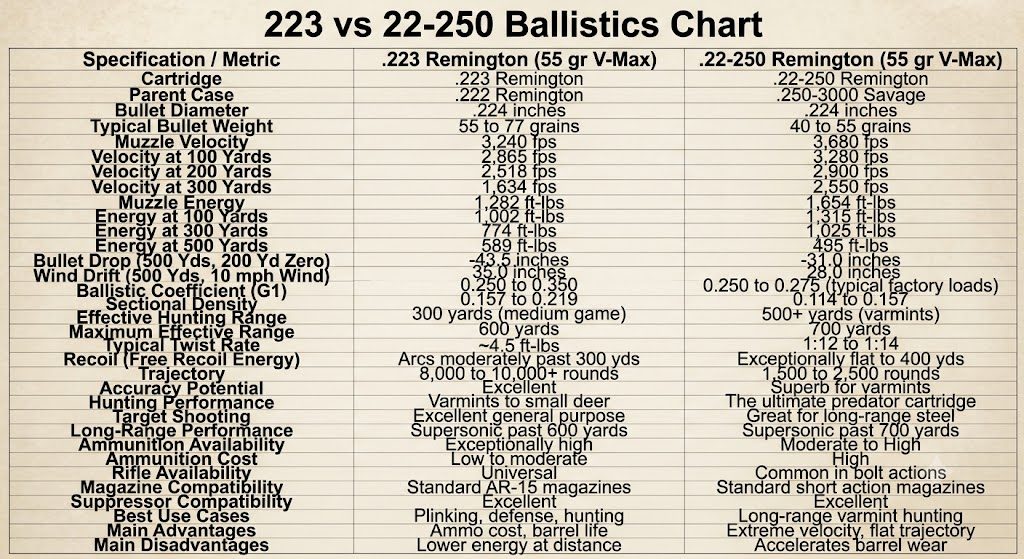
The comparison table above clearly illustrates what happens when you pack significantly more gunpowder behind the exact same .22 caliber bullet. The .22-250 Remington utilizes a much larger case than the .223 Remington, allowing it to generate incredible chamber pressures and massive velocities. At the muzzle, the .22-250 pushes a 55-grain bullet nearly 450 feet per second faster than the .223 Remington.
Because of this intense starting speed, the .22-250 retains significantly more energy downrange. At 300 yards, the .22-250 delivers more kinetic energy than the .223 Remington does at 200 yards. This translates directly to better terminal ballistics on tough predators like coyotes. Furthermore, the extreme velocity gives the .22-250 a laser-like trajectory. It cuts through the wind more effectively and drops considerably less at 500 yards than the .223 Remington.
However, these impressive ballistics come with practical trade-offs. The intense heat and pressure generated by the .22-250 will erode a rifle barrel much faster than a standard .223 Remington. Additionally, factory .22-250 ammunition is almost exclusively loaded with premium varmint bullets, making it much more expensive to shoot. The .223 Remington remains the king of economy and volume shooting, while the .22-250 stands as a specialized tool for reaching out to extreme distances.
Detailed Comparison Sections
Understanding the Comparison Chart
To truly understand this match-up, you have to look at case capacity. The .223 Remington was designed to be efficient, using a small powder charge to achieve respectable velocities. The .22-250 Remington was designed to maximize speed at all costs. It uses a necked-down .250-3000 Savage case, which holds significantly more powder than the .223 case, resulting in vastly different performance profiles.
How to Read the Ballistics Chart
When analyzing the ballistics chart, velocity and trajectory are the most critical factors. Velocity dictates how fast the bullet travels and how violently it expands upon impact. Trajectory encompasses bullet drop and wind deflection. A flatter trajectory means the shooter does not have to be as precise when estimating the distance to a target in the field.
Velocity Comparison
The velocity difference between these two cartridges is staggering. Firing identical 55-grain bullets, the .22-250 leaves the muzzle at roughly 3,680 fps. The .223 Remington tops out around 3,240 fps. The .22-250 is actually traveling faster at 100 yards than the .223 Remington is at the muzzle. This raw speed means the .22-250 reaches the target much faster, giving moving animals less time to react.
Energy Comparison
More velocity equals more kinetic energy. At the muzzle, the .22-250 generates a whopping 1,654 foot-pounds of energy, easily dwarfing the 1,282 foot-pounds produced by the .223 Remington. This massive power gap continues all the way downrange. At 500 yards, the .22-250 retains 455 ft-lbs of energy, while the .223 Remington is left with only 326 ft-lbs. This makes the .22-250 a much more reliable anchor on medium-sized predators at extended ranges.
Trajectory Comparison
Speed directly impacts trajectory. Because the .22-250 gets to the target faster, gravity simply has less time to pull the bullet toward the ground.
Bullet Drop Comparison
If you zero both rifles at 200 yards, the .22-250 requires far less elevation adjustment at distance. At 500 yards, a standard 55-grain .223 Remington will drop about 43.5 inches. The exact same bullet fired from a .22-250 will drop only 31 inches. That 12.5-inch difference is massive when trying to hit the small vitals of a coyote or groundhog.
Wind Drift Comparison
Wind is highly disruptive to lightweight .22 caliber bullets. The sheer speed of the .22-250 helps it outrun the wind. In a 10 mph crosswind at 500 yards, the .22-250 will drift roughly 28 inches. Under the same conditions, the slower .223 Remington will drift about 35 inches off target.
Ballistic Coefficient Comparison
Ballistic Coefficient (BC) measures how efficiently a bullet flies through the air. Modern .223 Remington rifles often feature fast twist rates (like 1:7 or 1:8) that can stabilize long, heavy bullets with high BCs. Traditional .22-250 rifles usually have slow twist rates (like 1:12 or 1:14), restricting them to shorter, lighter bullets with lower BCs. While the .22-250 relies on raw muzzle velocity, the .223 Remington relies on aerodynamic efficiency for its long-range performance.
Accuracy Comparison
Both cartridges are exceptionally accurate. The .223 Remington is heavily utilized in high-power rifle competitions and produces incredibly tight groups. The .22-250 is a legendary varmint round, known for its ability to repeatedly hit very small targets at long distances. You can expect sub-MOA precision from quality rifles chambered in either cartridge.
Effective Range Comparison
The .223 Remington is highly effective on varmints out to 400 yards and can be used on medium game inside 200 to 300 yards with proper bullet selection. The .22-250 pushes the boundaries of .22 caliber performance. It is absolutely devastating on varmints and predators at 500 yards and beyond.
Hunting Performance Comparison
If you are hunting inside 200 yards, both cartridges will quickly dispatch coyotes, foxes, and groundhogs. However, for wide-open spaces where shots frequently exceed 300 yards, the .22-250 is the undisputed king. Its explosive terminal performance and forgiving trajectory make it the ultimate predator hunting cartridge.
Target Shooting Comparison
For casual range trips, training courses, and ringing steel plates at 100 yards, the .223 Remington is the obvious choice. The ammunition is cheap, and the rifles are easy to find. The .22-250 is a poor choice for high-volume range plinking because it heats up barrels very quickly and the ammunition is quite expensive.
Long-Range Performance Comparison
Within 600 yards, the sheer velocity of the .22-250 makes it much easier to hit targets because the bullet drops so little. However, at extreme distances like 800 or 1,000 yards, a .223 Remington firing heavy 77-grain match bullets will actually outperform a standard .22-250 because the heavier bullet retains its momentum better over very long flight times.
Recoil Comparison
Both cartridges are very pleasant to shoot. A standard .223 Remington generates about 4.5 foot-pounds of free recoil energy. The .22-250 produces slightly more, coming in around 6.5 foot-pounds due to the heavier powder charge. Both recoil impulses are mild enough that most shooters can watch their own impacts through a rifle scope.
Barrel Life Comparison
This is the biggest downside to the .22-250. Pushing large amounts of gunpowder through a small .22 caliber bore creates a cutting torch effect in the throat of the rifle barrel. A .22-250 will often lose its peak accuracy between 1,500 and 2,500 rounds. A .223 Remington operates at much cooler temperatures and can easily surpass 8,000 to 10,000 rounds of barrel life.
Ammunition Cost Comparison
The .223 Remington is one of the cheapest centerfire rifle cartridges on the market. Bulk training ammunition can be purchased for pennies on the dollar compared to premium hunting loads. The .22-250 is almost exclusively sold with high-end polymer-tipped varmint bullets, making every pull of the trigger a premium investment.
Ammunition Availability
You can find boxes of .223 Remington in literally any sporting goods store, hardware store, or shooting range. While the .22-250 is a very popular hunting cartridge, it is not always stocked in bulk. You can reliably find .22-250 ammunition during hunting season, but options may be limited during the off-season.
Rifle Compatibility
The .223 Remington is the native cartridge for the AR-15 platform and is chambered in nearly every bolt-action rifle in production. The .22-250 is primarily a bolt-action cartridge. While custom AR-10s can be built to shoot the .22-250, it requires a short-action receiver and is not nearly as common or convenient as a standard AR-15.
Pros and Cons of .22-250
Pros:
- Extreme muzzle velocities.
- Incredibly flat trajectory out to 400 yards.
- Hits with massive kinetic energy.
- Devastating terminal performance on predators.
Cons:
- Accelerates barrel wear rapidly.
- Ammunition is expensive.
- Typically limited to bolt-action rifles.
Pros and Cons of .223 Remington
Pros:
- Ammunition is incredibly cheap and easy to find.
- Exceptional barrel life.
- Universal platform compatibility.
- Perfect for high-volume training.
Cons:
- Lower velocities and energy than magnum .22s.
- More bullet drop at extended distances.
Which Cartridge Is Better for Beginners?
The .223 Remington is the perfect centerfire rifle for beginners. It offers negligible recoil, cheap ammunition for frequent practice, and a wide variety of rifle platforms. The .22-250 is too expensive and hard on barrels for a beginner looking to learn the fundamentals through high-volume practice.
Which Cartridge Is Better for Hunting?
If you are a dedicated predator hunter shooting coyotes across wide-open canyons, the .22-250 is the superior choice. Its flat trajectory and high energy transfer ensure ethical, immediate kills at long distances. If you are hunting in dense woods where shots rarely exceed 150 yards, the .223 Remington is more than sufficient.
Which Cartridge Is Better for Long-Range Shooting?
For practical hunting and varmint eradication out to 600 yards, the .22-250 makes long-range shooting easier due to its flat trajectory. However, if your goal is shooting paper or steel at 800 yards or beyond, a fast-twist .223 Remington loaded with heavy match bullets is actually the better option for bucking the wind over extended flight times.
Which Cartridge Should You Choose?
Choose the .22-250 if you are a serious predator hunter who needs maximum velocity, explosive terminal performance, and a flat trajectory over open terrain. Choose the .223 Remington if you want a reliable, cost-effective, and highly versatile rifle that can serve multiple roles from range plinking to home defense.
Verdict
The .223 Remington and the .22-250 Remington are both legendary cartridges that excel in completely different environments. The .223 Remington is an unmatched general-purpose tool. Its affordability, barrel life, and widespread availability make it an essential cartridge for any gun owner. It does everything reasonably well without breaking the bank. The .22-250, however, is a high-performance specialist. It sacrifices barrel life and ammunition economy to deliver breathtaking velocity and laser-flat ballistics. If your primary goal is vaporizing small targets at half a mile, the .22-250 stands alone. For practically everything else, the .223 Remington is the smarter, more practical choice.
FAQs
Is a .22-250 bigger than a .223?
The bullets fired from both cartridges are exactly the same diameter (.224 inches). However, the brass casing of the .22-250 is significantly wider and longer than the .223 Remington, allowing it to hold much more gunpowder.
Can you shoot a .223 out of a .22-250?
Absolutely not. The chamber of a .22-250 is much larger than a .223 Remington. Attempting to fire a .223 cartridge in a .22-250 rifle will result in a ruptured case and could cause catastrophic failure, leading to severe injury.
Is the .22-250 good for deer hunting?
In states where it is legal to hunt deer with .22 caliber centerfire rifles, the .22-250 can be used successfully. However, you must use heavily constructed hunting bullets designed for controlled expansion, and shot placement must be absolutely perfect to ensure an ethical harvest.
Why does the .22-250 burn barrels faster?
The .22-250 funnels a massive amount of burning gunpowder through a very small hole. This creates intense heat and pressure that acts like a cutting torch on the metal in the throat of the barrel, wearing away the rifling much faster than smaller cartridges.
Which is louder, .223 or .22-250?
The .22-250 is noticeably louder. The larger powder charge creates a much larger blast and a sharper crack when the bullet breaks the sound barrier compared to the smaller .223 Remington.