The main difference between the .270 Winchester, .308 Winchester, and .30-06 Springfield is that the .270 Winchester fires a lighter bullet at extreme velocities for a laser flat trajectory, the .308 Winchester provides excellent short action efficiency with mild recoil, and the .30-06 Springfield relies on a massive case capacity to deliver unmatched kinetic energy on large game. These three legendary cartridges have dominated the hunting industry for decades. The .270 Winchester is the ultimate open country deer cartridge, eliminating the need for complex holdovers at distance. The .308 Winchester is the king of versatility, offering abundant cheap ammunition and functioning perfectly in compact short action rifles. The .30-06 Springfield is the heavy hitting powerhouse, capable of taking down any big game animal in North America. Choosing the right caliber depends heavily on your target game and the distances you plan to shoot.
270 vs 308 vs 30-06 Ballistics Chart
| Specification / Metric | .270 Winchester (130 gr SST) | .308 Winchester (150 gr SST) | .30-06 Springfield (165 gr SST) |
| Cartridge | .270 Winchester | .308 Winchester | .30-06 Springfield |
| Parent Case | .30-06 Springfield | .300 Savage | Original Design |
| Bullet Diameter | .277 inches | .308 inches | .308 inches |
| Typical Bullet Weight | 130 to 150 grains | 150 to 180 grains | 150 to 220 grains |
| Muzzle Velocity | 3,060 fps | 2,820 fps | 2,800 fps |
| Velocity at 100 Yards | 2,840 fps | 2,590 fps | 2,600 fps |
| Velocity at 200 Yards | 2,630 fps | 2,370 fps | 2,410 fps |
| Velocity at 300 Yards | 2,430 fps | 2,165 fps | 2,225 fps |
| Velocity at 500 Yards | 2,060 fps | 1,780 fps | 1,885 fps |
| Muzzle Energy | 2,702 ft-lbs | 2,648 ft-lbs | 2,872 ft-lbs |
| Energy at 100 Yards | 2,328 ft-lbs | 2,234 ft-lbs | 2,476 ft-lbs |
| Energy at 200 Yards | 1,996 ft-lbs | 1,870 ft-lbs | 2,128 ft-lbs |
| Energy at 300 Yards | 1,704 ft-lbs | 1,560 ft-lbs | 1,814 ft-lbs |
| Energy at 500 Yards | 1,225 ft-lbs | 1,055 ft-lbs | 1,300 ft-lbs |
| Bullet Drop (500 Yds, 200 Yd Zero) | -36.5 inches | -45.5 inches | -44.0 inches |
| Wind Drift (500 Yds, 10 mph Wind) | 18.5 inches | 24.5 inches | 21.0 inches |
| Ballistic Coefficient (G1) | 0.460 | 0.415 | 0.475 |
| Sectional Density | 0.242 | 0.226 | 0.248 |
| Effective Hunting Range | 500 yards (deer/antelope) | 400 yards (medium game) | 500+ yards (large game) |
| Maximum Effective Range | 800 yards | 800 yards | 1,000 yards |
| Typical Twist Rate | 1:10 | 1:10 to 1:12 | 1:10 |
| Recoil (Free Recoil Energy) | ~16.5 ft-lbs | ~16.5 ft-lbs | ~20.5 ft-lbs |
| Trajectory | Exceptionally flat | Moderate arc past 300 yds | Moderate arc past 300 yds |
| Barrel Life | 3,000 to 4,000 rounds | 8,000 to 10,000 rounds | 5,000 to 7,000 rounds |
| Accuracy Potential | Excellent for hunting | Superb for precision target | Excellent for big game |
| Hunting Performance | Mule deer, antelope, sheep | Whitetail deer, feral hogs | Elk, moose, large bear |
| Target Shooting Performance | Good for long range hunting | The gold standard for precision | Good for heavy steel impacts |
| Long-Range Performance | Supersonic past 1,000 yards | Supersonic past 800 yards | Supersonic past 1,000 yards |
| Ammunition Availability | Very High | Universal | Universal |
| Ammunition Cost | Moderate | Low to moderate | Moderate |
| Rifle Availability | Common in long actions | Universal in short actions | Universal in long actions |
| Magazine Compatibility | Standard long action | Standard short action / AR-10 | Standard long action |
| Suppressor Compatibility | Excellent | Excellent | Excellent |
| Best Use Cases | Open plains hunting | Tactical training, deer hunting | Heavy timber big game hunting |
| Main Advantages | Flat trajectory, high velocity | Ammo cost, short action | Massive energy, versatile weights |
| Main Disadvantages | Lacks mass for massive game | Steep drop past 400 yards | Noticeably heavier recoil |
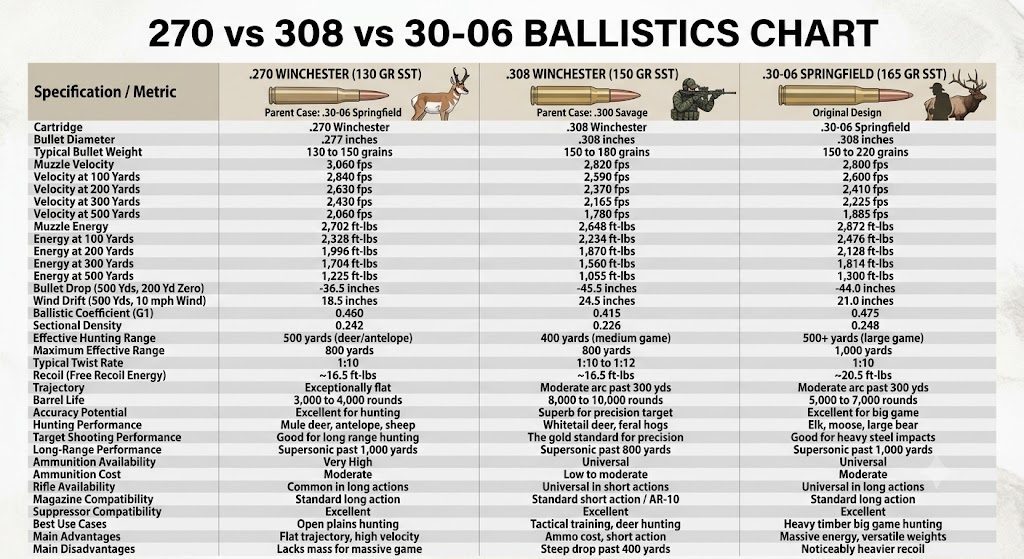
The comparison table reveals how these three iconic cartridges utilize different case capacities and bullet weights to achieve their results. The .270 Winchester takes the velocity crown. By placing a lighter bullet into a necked down .30-06 case, the .270 achieves speeds over 3,000 feet per second. This blistering speed gives the .270 Winchester the flattest trajectory and the least amount of wind drift at 500 yards.
However, velocity alone does not guarantee knockdown power on giant game animals. The .30-06 Springfield relies on the perfect balance of powder capacity and heavy .30 caliber bullets to generate superior kinetic energy. It hits with massive force at the muzzle and retains over 1,300 foot-pounds of energy at 500 yards, making it the undeniable choice for hunters pursuing moose or elk at extended distances.
The .308 Winchester takes a highly efficient approach. It was designed to replicate the original military ballistics of the .30-06 but within a much shorter brass case. Because it uses less powder, it generates slightly less velocity and energy than the .30-06. The real world tradeoff is that the .308 Winchester offers excellent barrel life, very mild recoil, and fits into compact, lightweight short action rifles. The .308 Winchester is universally considered the most economical and versatile target shooting cartridge of the three, while the .30-06 and .270 remain specialized hunting juggernauts.
Detailed Comparison Sections
Understanding the Comparison Chart
To truly understand the dynamic between these cartridges, you must look at their shared lineage. The .30-06 Springfield is the grandparent cartridge. The .270 Winchester was created by taking that .30-06 case and shrinking the neck to hold a smaller .277 caliber bullet. The .308 Winchester was created decades later by shortening the overall length of the .30 caliber casing to cycle more reliably in automatic military weapons. Their physical differences dictate their ballistic realities.
How to Read the Ballistics Chart
When reading this three way comparison, focus heavily on bullet drop and retained energy. Bullet drop dictates how difficult it will be to successfully place a shot at long distances over open terrain. Retained energy dictates whether the bullet will have enough force to ethically harvest an animal once it reaches that distance.
Velocity Comparison
The .270 Winchester is the undisputed speed champion here. A standard 130 grain hunting bullet leaves the .270 barrel at roughly 3,060 fps. When you step up to the .30 caliber rounds, the speed drops. A 150 grain .308 Winchester leaves around 2,820 fps, and a 165 grain .30-06 Springfield leaves around 2,800 fps. Because the .270 starts faster and utilizes highly aerodynamic bullets, it stays supersonic much longer than the heavier .308 Winchester.
Energy Comparison
If you are hunting massive animals, kinetic energy is your primary concern. The .30-06 Springfield leads the pack by generating nearly 2,900 foot-pounds of energy at the muzzle. The .270 Winchester and .308 Winchester sit very close to each other, producing around 2,700 and 2,650 foot-pounds respectively. Downrange, the heavier bullet of the .30-06 holds its momentum. At 500 yards, the .30-06 retains 1,300 ft-lbs, the .270 retains 1,225 ft-lbs, and the .308 drops to 1,055 ft-lbs.
Trajectory Comparison
Trajectory encompasses both gravity and atmospheric resistance. The cartridge that arrives at the target the fastest will always drop the least.
Bullet Drop Comparison
With all three rifles zeroed at 200 yards, the drop differences become glaring at extreme ranges. At 500 yards, the hyper fast .270 Winchester drops only 36.5 inches. The .30-06 Springfield drops about 44 inches. The .308 Winchester, being the slowest of the group, drops roughly 45.5 inches. If you hunt in open canyons where range estimation is difficult, the flat path of the .270 Winchester provides a massive advantage.
Wind Drift Comparison
Wind pushes lightweight, slow bullets off course quickly. The .270 Winchester slices through the wind best, drifting only 18.5 inches in a 10 mph crosswind at 500 yards. The .30-06 Springfield drifts 21 inches due to its heavy, aerodynamic bullet. The .308 Winchester struggles the most in the wind, drifting nearly 24.5 inches under the exact same conditions.
Ballistic Coefficient Comparison
Ballistic Coefficient (BC) measures how efficiently a bullet glides through the air. The long, sleek 130 grain bullets of the .270 Winchester boast excellent BC ratings around 0.460. The 165 grain .30-06 Springfield bullets feature highly efficient BC ratings near 0.475. The standard 150 grain .308 Winchester bullet is relatively short for its diameter, resulting in a lower BC of around 0.415. This is precisely why the .308 bleeds velocity faster than the other two.
Accuracy Potential
All three cartridges are mechanically accurate enough to win competitions. The .308 Winchester has the strongest reputation for precision target shooting simply because it is highly efficient and match grade target ammunition is mass produced globally. In a hunting scenario, all three cartridges will easily shoot one inch groups at 100 yards in a quality bolt action rifle.
Effective Range Comparison
For target shooting on steel plates, the .270 and .30-06 can easily stretch to 1,000 yards. The standard .308 Winchester begins to struggle heavily with wind and drop past 800 yards. For practical hunting, the .270 Winchester and .30-06 Springfield are highly effective out to 500 yards. The .308 Winchester is best utilized inside 400 yards to ensure proper bullet expansion on medium game.
Hunting Performance Comparison
If you are strictly hunting whitetail deer, wild hogs, or black bears in the woods, the .308 Winchester is perfect. If you are hunting mule deer, sheep, or antelope across wide open plains, the flat trajectory of the .270 Winchester is vastly superior. If you are targeting moose, giant elk, or hunting in grizzly bear territory, the deep penetration and heavy bullet options of the .30-06 Springfield make it the only logical choice of the three.
Target Shooting Comparison
The .308 Winchester is the absolute best choice for high volume target shooting. The ammunition is incredibly cheap, the recoil is mild enough to shoot all day without a bruised shoulder, and the short action receiver allows for faster bolt cycling. The .270 and .30-06 heat up barrels very quickly and cost significantly more to shoot per round.
Long-Range Performance Comparison
The .30-06 Springfield is an unsung hero of long range shooting. When loaded with modern, heavy match bullets weighing 190 grains or more, it completely outclasses the .308 Winchester at 1,000 yards. The .270 Winchester also performs beautifully at long range but is rarely used for competitive target shooting due to a lack of heavy match grade bullets on the commercial market.
Recoil Comparison
Felt recoil determines how easily a shooter can spot their own impacts and take fast follow up shots. The .308 Winchester and .270 Winchester both generate roughly 16.5 foot-pounds of free recoil energy. The .270 feels slightly sharper and snappier, while the .308 feels like a mild push. The .30-06 Springfield is noticeably heavier, generating over 20 foot-pounds of recoil energy, which can cause flinching in smaller framed or inexperienced shooters.
Barrel Life Comparison
Burning massive amounts of gunpowder degrades rifle barrels. The .308 Winchester is incredibly efficient and gentle on barrels, often lasting 8,000 to 10,000 rounds before accuracy fades. The larger powder charge of the .30-06 Springfield will wear a barrel out around 5,000 to 7,000 rounds. The hyper velocity .270 Winchester acts like a cutting torch in the throat of the barrel, typically limiting peak precision life to roughly 3,000 to 4,000 rounds.
Ammunition Cost Comparison
The .308 Winchester is the undisputed champion of economy. Because it is a global military and law enforcement standard, factories produce practice ammunition by the millions, keeping costs extremely low. The .270 Winchester and .30-06 Springfield are strictly civilian hunting cartridges. Practice ammunition is available, but it costs noticeably more than bulk .308 Winchester.
Ammunition Availability
You will never have an issue finding ammunition for any of these three cartridges. They are the top selling centerfire rifle calibers in North America. Every hardware store, sporting goods retailer, and local gun shop will have multiple shelves dedicated to the .270, .308, and .30-06.
Rifle Compatibility
The .308 Winchester holds a distinct advantage in firearm selection. Because it is a short action cartridge, it can be chambered in highly compact, lightweight bolt action rifles and fits perfectly into the semi automatic AR-10 platform. The .270 Winchester and .30-06 Springfield require standard long action receivers, meaning the rifles are generally heavier and require a longer bolt throw to cycle a new round.
Pros and Cons of .270 Winchester
Pros:
- Laser flat trajectory out to 500 yards.
- Excellent wind bucking capabilities.
- Very manageable recoil for a magnum speed cartridge.
- The ultimate open country deer cartridge.
Cons:
- Does not offer the massive bullet weights needed for the largest game.
- Shorter barrel life due to high velocities.
Pros and Cons of .308 Winchester
Pros:
- Incredibly cheap and abundant practice ammunition.
- Fits into lightweight short action rifles.
- Exceptional barrel life.
- Mild recoil suitable for all adult shooters.
Cons:
- Steep bullet drop past 400 yards.
- Lacks the kinetic energy of the larger long action calibers.
Pros and Cons of .30-06 Springfield
Pros:
- Massive stopping power for all North American big game.
- Capable of firing incredibly heavy 220 grain bullets.
- Retains excellent energy at long distances.
- Universal availability of hunting ammunition.
Cons:
- Noticeably heavier recoil impulse.
- Requires a heavier long action rifle.
Which Cartridge Is Better for Beginners?
The .308 Winchester is the best centerfire rifle cartridge for beginners. The recoil is very forgiving, allowing new shooters to learn solid fundamentals without fear of the rifle kicking them. Additionally, the availability of cheap practice ammunition means a beginner can afford to shoot frequently and build their confidence.
Which Cartridge Is Better for Hunting?
This depends entirely on the game you pursue. If you are hunting antelope or deer in open canyons, the .270 Winchester takes the crown due to its flat trajectory. If you are hunting thick timber for elk or moose, the heavy hitting .30-06 Springfield is vastly superior. If you just want an everyday deer rifle for the woods behind your house, the .308 Winchester is a perfect and economical choice.
Which Cartridge Is Better for Long-Range Shooting?
For competitive target shooting, the .308 Winchester is the most popular due to the availability of match rifles and cheap ammunition. However, if you are looking for pure long range ballistic performance in the wind, the .30-06 Springfield is the best of the three when loaded with heavy, high ballistic coefficient match bullets.
Which Cartridge Should You Choose?
Choose the .270 Winchester if you hunt deer or sheep across wide open spaces and hate calculating complex holdovers. Choose the .308 Winchester if you want a versatile, affordable, and mild shooting rifle for target practice and medium game hunting. Choose the .30-06 Springfield if you want one rifle capable of ethically harvesting every single big game animal on the North American continent.
Verdict
The .270 Winchester, .308 Winchester, and .30-06 Springfield are the three pillars of modern centerfire rifle shooting. They represent completely different engineering philosophies. The .270 Winchester is a specialized scalpel, offering blistering speed and a flat trajectory for precision hunting in open country. The .308 Winchester is the ultimate general purpose tool, balancing economy, barrel life, and mild recoil into a compact short action package. The .30-06 Springfield is the undeniable sledgehammer of the group. It ignores the trends of modern short magnum cartridges by relying on massive powder capacity to drop the largest animals on earth with absolute authority. Assess your budget, your target game, and your recoil tolerance to easily determine which of these legends belongs in your hands.
FAQs
Is the .270 more powerful than the .308?
Yes, standard .270 Winchester factory hunting loads generate slightly more muzzle velocity and kinetic energy than standard .308 Winchester loads. The .270 also retains that energy much better at extended distances due to its highly aerodynamic bullets.
Can you use a .308 for elk hunting?
Yes, the .308 Winchester is highly capable of killing an elk. However, it requires precise shot placement and high quality, deep penetrating bullets. Hunters using a .308 should generally limit their shots on elk to 300 yards or less to ensure the bullet retains enough energy for a humane harvest.
Why is the .30-06 so popular?
The .30-06 Springfield is popular because of its incredible versatility and proven history. After serving the US Military through two World Wars, it flooded the civilian market. Its massive case capacity allows hunters to load light 110 grain bullets for coyotes or massive 220 grain bullets for grizzly bears, making it the ultimate do it all cartridge.
Does the .30-06 kick harder than the .270?
Yes. The .30-06 Springfield kicks noticeably harder than the .270 Winchester. Because the .30-06 pushes a heavier bullet using more gunpowder, it creates a much stronger rearward force against the shooter’s shoulder.
Can I shoot .308 in a .30-06 rifle?
Absolutely not. The .308 Winchester is a much shorter cartridge. If you place a .308 cartridge into a .30-06 chamber, the firing pin will push the entire cartridge forward into the barrel, potentially causing a catastrophic and dangerous malfunction.
Which cartridge has the longest barrel life?
The .308 Winchester has the longest barrel life of the three. Because it uses the smallest powder charge to push a moderate sized bullet, it generates the least amount of throat eroding heat. A quality .308 barrel can easily last for 10,000 rounds of accurate target shooting.