The main difference between .300 Blackout and 5.56 is that .300 Blackout fires heavier bullets optimized for short barrels and suppressed shooting, while 5.56 delivers higher velocity, flatter trajectories, and better long-range performance.
Choosing between these two legendary AR-15 chamberings requires looking past the hype and focusing on the raw data. In this comprehensive guide, we compare velocity, muzzle energy, recoil, trajectory, bullet drop, penetration, effective range, suppressor performance, barrel length performance, hunting capability, ammunition cost, and ideal use cases. By the end of this article, you will learn all of these differences in detail and confidently know which cartridge belongs in your rifle.
5.56 vs 300 Blackout Comparison Table
To understand how these cartridges perform, we first need to look at their physical dimensions and baseline performance metrics. The data below represents standard factory loads, including both supersonic and subsonic variants for the .300 Blackout.
| Specification | .300 Blackout (300 BLK) | 5.56x45mm |
| Cartridge Type | Intermediate Rifle | Intermediate Rifle |
| Parent Case | .223 Remington / 5.56 NATO | .222 Remington Special |
| Bullet Diameter | .308 in (7.62mm) | .224 in (5.7mm) |
| Case Length | 1.368 in | 1.760 in |
| Overall Length | 2.260 in | 2.260 in |
| Typical Bullet Weights | 110 gr – 220 gr | 55 gr – 77 gr |
| Muzzle Velocity | 1,050 fps (Sub) – 2,375 fps (Super) | 2,700 fps – 3,260 fps |
| Muzzle Energy | 465 ft-lbs (Sub) – 1,378 ft-lbs (Super) | 1,282 ft-lbs – 1,331 ft-lbs |
| Maximum Pressure | 55,000 psi (SAAMI) | 62,366 psi (NATO) |
| Effective Range | 400 yds (Super) / 200 yds (Sub) | 500 – 600 yds |
| Trajectory | Rainbow (Sub) / Moderate (Super) | Flat |
| Bullet Drop (300 yds) | -13.7″ (110gr) / -104.6″ (190gr) | -11.3″ (55gr) / -11.6″ (62gr) |
| Wind Drift | High (due to lower velocity) | Moderate |
| Recoil | Mild (approx. 6-7 ft-lbs) | Very Mild (approx. 4-5 ft-lbs) |
| Barrel Length Performance | Excellent in 9-inch barrels | Requires 16-20 inches for max velocity |
| Suppressor Performance | Industry-leading (Subsonic) | Moderate (Remains supersonic) |
| Short Barrel Performance | Outstanding (Full burn by 9″) | Poor (Loses heavy velocity, concussive) |
| Long Range Performance | Poor | Good |
| Accuracy | 1-2 MOA | 1-2 MOA |
| Penetration | Excellent (Heavy projectiles) | High (Speed-based penetration) |
| Expansion | Very Good (Speed or design dependent) | Excellent (Fragmentation based) |
| Hunting Performance | Excellent (Deer, Hogs out to 200 yds) | Good (Varmints, small game) |
| Home Defense | Elite (Subsonic minimizes over-penetration) | Excellent (High velocity fragments on drywall) |
| Tactical Use | CQB / Suppressed Operations | Standard Infantry / General Purpose |
| AR-15 Compatibility | Yes (Requires only a barrel swap) | Yes (Native platform) |
| Magazine Compatibility | Yes (Standard AR-15 PMAGs work) | Yes |
| Ammunition Cost | Moderate to High | Low to Moderate |
| Ammo Availability | Good | Excellent (NATO Standard) |
| Best Uses | Suppressed SBRs, CQB, Hog Hunting | Plinking, Target, General Purpose, Varmints |
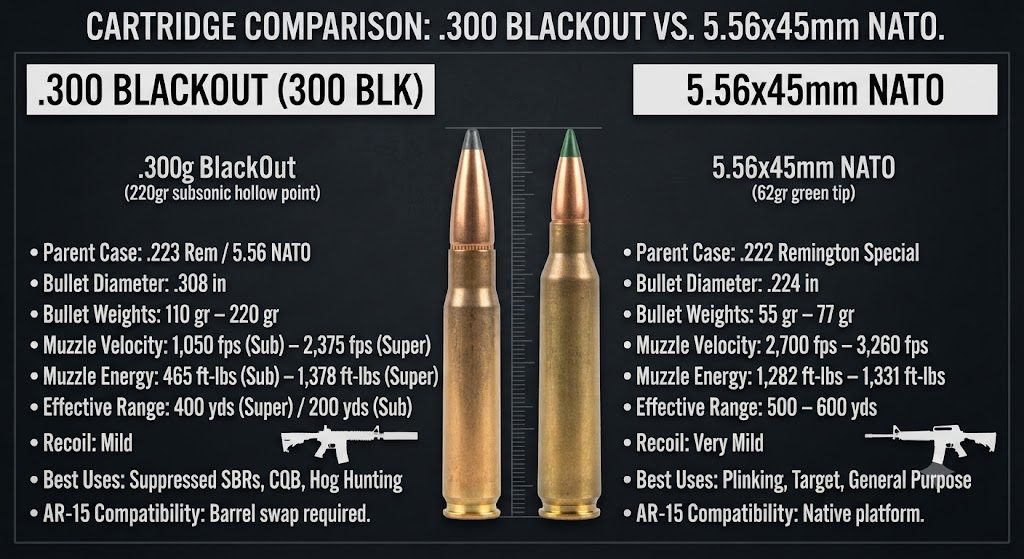
Understanding the Numbers
Looking at the table, the genius of the .300 Blackout design becomes clear. It utilizes the exact same parent case as the 5.56 NATO but cuts it down to 1.368 inches to accommodate a massive .30 caliber (7.62mm) bullet while keeping the overall length identical at 2.260 inches. This means .300 Blackout fits perfectly into standard AR-15 magazines and uses the exact same bolt carrier group as the 5.56 NATO.
However, their ballistics are completely different. The 5.56 NATO relies on blinding speed—pushing a 55-grain bullet at over 3,200 feet per second (fps). This generates massive hydrostatic shock and fragmentation. The .300 Blackout, conversely, uses mass to do its work. Pushing a 110-grain bullet at 2,375 fps yields 1,378 foot-pounds (ft-lbs) of energy, slightly edging out the 5.56 NATO’s 1,282 ft-lbs. More dramatically, heavy 190-grain subsonic .300 BLK loads intentionally hover at 1,050 fps to avoid breaking the sound barrier, yielding a modest 465 ft-lbs of energy but running incredibly quietly when suppressed.
Velocity Comparison
Velocity is the driving force behind bullet stabilization, expansion, and range. In this category, the two cartridges are designed for completely different goals.
Muzzle Velocity Data (16-inch barrel):
- 5.56 NATO (Frontier 55gr M193): 3,240 fps
- 5.56 NATO (M855 62gr): 3,110 fps
- .300 Blackout (Hornady BLACK 110gr V-MAX): 2,375 fps
- .300 Blackout (Hornady 190gr Sub-X): 1,050 fps
Analysis:
The 5.56 NATO is a speed demon. By utilizing a lightweight projectile (typically 55 to 62 grains), it leaves the muzzle screaming at over 3,100 fps. This extreme speed is what allows the relatively tiny .224 caliber bullet to inflict catastrophic damage upon impact; when 5.56 hits soft tissue at velocities over 2,500 fps, it tends to yaw and violently fragment.
The .300 Blackout supersonic loads are significantly slower, launching a 110-grain bullet at 2,375 fps. Subsonic loads are intentionally throttled down to 1,050 fps to ensure they stay below the speed of sound (approximately 1,125 fps at sea level), eliminating the supersonic “crack”.
Winner: 5.56 NATO
If raw speed is the metric, 5.56 NATO is the undeniable winner. Its high velocity drives its flat trajectory and fragmentation capabilities.
Muzzle Energy Comparison
Muzzle energy (measured in foot-pounds) dictates how much kinetic force the bullet carries.
Muzzle Energy Data (16-inch barrel):
- .300 Blackout (110gr V-MAX): 1,378 ft-lbs
- 5.56 NATO (62gr M855): 1,331 ft-lbs
- 5.56 NATO (55gr M193): 1,282 ft-lbs
- .300 Blackout (190gr Sub-X): 465 ft-lbs
Analysis:
Despite firing vastly different projectiles at different speeds, the supersonic .300 Blackout (110gr) and standard 5.56 NATO loads produce remarkably similar kinetic energy at the muzzle. The .300 Blackout’s 110-grain V-MAX load actually edges out the 5.56 M855 by roughly 47 ft-lbs (1,378 vs 1,331). The 5.56 makes its energy through velocity, while the .300 BLK makes it through bullet mass.
However, the .300 Blackout Subsonic load (190gr) produces only 465 ft-lbs of energy. Because kinetic energy relies heavily on the velocity squared, dropping the speed to 1,050 fps cripples the energy output, making subsonic .300 BLK ballistically similar to a high-pressure .45 ACP pistol round.
Winner: .300 Blackout (Supersonic)
Supersonic .300 Blackout slightly outperforms 5.56 NATO in raw muzzle energy, throwing a heavier projectile with more initial kinetic force.
Trajectory Comparison
Trajectory refers to the arc the bullet travels from the muzzle to the target. A flatter trajectory makes hitting targets at unknown distances easier because the shooter has to make fewer holdover adjustments.
Velocity Retention at 300 Yards:
- 5.56 NATO (55gr M193): Drops from 3,240 fps to 2,128 fps
- .300 Blackout (110gr V-MAX): Drops from 2,375 fps to 1,597 fps
Analysis:
The 5.56 NATO shoots incredibly flat because its high velocity minimizes the time gravity can act on the bullet. The lightweight 55-grain bullet cuts through the air, retaining over 2,100 fps at 300 yards.
The .300 Blackout (110gr) acts like a traditional .30-30 Winchester; it arches significantly more. The subsonic 190-grain .300 BLK trajectory resembles a rainbow; because it starts at 1,050 fps, gravity begins dragging it down immediately, making it very difficult to place shots precisely past 150 yards without exact rangefinding.
Winner: 5.56 NATO
The 5.56 NATO has a vastly superior trajectory, allowing point-and-shoot capability out to 250+ yards without complex math.
Bullet Drop Comparison
Let’s look at the actual drop data (in inches) assuming a standard 100-yard zero.
| Distance | 5.56 NATO (55gr M193) | .300 BLK (110gr V-MAX) | .300 BLK (190gr Sub-X) |
| 100 Yards | 0″ | 0″ | 0″ |
| 200 Yards | -2.8″ | -3.2″ (Approximated from 1.5″ high 100yd zero) | -33.4″ |
| 300 Yards | -11.3″ | -13.7″ | -104.6″ |
| 400 Yards | -27.4″ | Rapid Drop | Extremely High Drop |
| 500 Yards | -54.0″ | Not Recommended | Not Recommended |
(Note: Data normalized from Hornady and standard ballistic tables. Subsonic 190gr zero adjusted for context, dropping over 100 inches at 300 yards.)
Analysis:
At 200 yards, the 5.56 NATO (55gr) drops roughly 2.8 inches, and the supersonic .300 BLK (110gr) is not far behind at around 3.2 inches. However, at 300 yards, the separation begins. The 5.56 NATO drops 11.3 inches, while the supersonic .300 BLK drops 13.7 inches.
The 190-grain Subsonic .300 BLK, however, is a completely different story. At 300 yards, it plummets a staggering 104.6 inches. You are aiming nearly 9 feet over your target to make a hit.
Winner: 5.56 NATO
5.56 NATO is practically untouched here, dropping less than half of what subsonic 300 Blackout does at typical engagement ranges.
Wind Drift Comparison
Wind drift is dictated by a bullet’s ballistic coefficient (how aerodynamic it is) and its time in flight.
Analysis:
Because the 5.56 NATO reaches the target faster, wind has less time to push the bullet off course. The supersonic .300 Blackout uses a relatively short, stubby .30 caliber bullet (110gr-125gr), which generally has a lower ballistic coefficient than heavy-for-caliber 5.56 match bullets (like the 77gr OTM). Subsonic .300 Blackout bullets are heavy and aerodynamic, but they travel so slowly that a 10 mph crosswind will push them completely off a standard man-sized target at 200 yards.
Winner: 5.56 NATO
Due to higher velocity and shorter flight times, the 5.56 NATO resists wind drift far better across all ranges.
Recoil Comparison
Recoil in an AR-15 platform is famously soft, largely due to the buffer tube system and direct impingement (or piston) gas operation absorbing the rearward force.
Analysis:
The 5.56 NATO produces around 4 to 5 foot-pounds of felt recoil depending on the rifle’s weight. It is practically non-existent, making it highly suitable for beginners, rapid follow-up shots, and long training days.
The .300 Blackout, pushing a heavier projectile, generates slightly more recoil—typically around 6 to 7 foot-pounds in supersonic loads. Subsonic loads, despite the heavy bullet, generate very little recoil because of the reduced powder charge and low velocity.
Winner: 5.56 NATO
While both have incredibly mild recoil, 5.56 NATO objectively kicks less, making it slightly easier to keep the reticle on target during rapid fire.
Stopping Power Comparison
“Stopping power” is an unscientific term for terminal ballistics—how efficiently a bullet dumps its energy into the target to incapacitate it.
Energy Retention at 200 Yards:
- 5.56 NATO (55gr M193): 744 ft-lbs
- .300 Blackout (110gr V-MAX): 821 ft-lbs
- .300 Blackout (190gr Sub-X): 384 ft-lbs
Analysis:
At close ranges (inside 100 yards), 5.56 NATO creates massive temporary wound cavities due to its speed. When M193 (55gr) hits soft tissue at over 2,500 fps, it tumbles and fragments, destroying surrounding tissue.
However, the .300 Blackout (supersonic) simply punches a larger hole and pushes more mass through the target. At 200 yards, the 110gr V-MAX retains 821 ft-lbs of energy compared to the 55gr M193’s 744 ft-lbs. The .30 caliber bullet expands aggressively to nearly half an inch in diameter, crushing bone and causing massive blood loss.
Winner: .300 Blackout (Supersonic)
For close-to-medium range stopping power, the supersonic .300 BLK delivers a larger frontal surface area, deeper tissue damage on large game, and retains slightly more kinetic energy at 200 yards.
Penetration Comparison
Penetration matters when dealing with barriers (auto glass, heavy clothing, drywall, bone).
Analysis:
The 5.56 M855 (62gr “Green Tip”) utilizes a mild steel penetrator in its nose. It is specifically designed to penetrate light barriers and standard steel helmets at a distance. However, the 55gr M193 tends to fragment aggressively upon hitting hard barriers due to its high velocity.
The .300 Blackout, firing 110gr to 220gr bullets, has the distinct advantage of mass. Heavier bullets maintain momentum when striking barriers like auto glass or heavy bone. Subsonic loads, while slow, have tremendous sectional density; a 220gr subsonic bullet will sail through drywall and heavy clothing with minimal deflection, which is a key reason it meets FBI protocol terminal ballistic requirements.
Winner: Tie
5.56 NATO (M855) wins for penetrating light steel and armor, while .300 Blackout wins for penetrating heavy organic barriers (thick bone on wild hogs) and auto glass without fragmenting prematurely.
Expansion Comparison
To test expansion, the industry uses calibrated 10% ordinance gel.
Analysis:
Standard 5.56 NATO FMJ does not “expand”—it fragments. However, when loaded with soft point or bonded bullets (like the 62gr Federal Fusion), 5.56 expands beautifully to around .45 caliber.
The .300 Blackout shines in this department. A .30 caliber bullet starts at .308 inches. When a bullet like the Barnes 110gr TAC-TX hits gel, its monolithic copper design opens into four massive petals, expanding to over .60 inches while retaining nearly 100% of its weight.
Even at subsonic speeds, specialized bullets like the Hornady 190gr Sub-X are engineered with deep skives and a polymer tip to force expansion at velocities as low as 900 fps, expanding to 0.54 inches in gel tests.
Winner: .300 Blackout
The .300 BLK starts larger and expands wider. Specialized subsonic expanding rounds (like the Sub-X) are engineering marvels that provide reliable expansion even at 1,000 fps.
Accuracy Comparison
Both cartridges are capable of excellent accuracy when matched with quality barrels and match-grade ammunition.
Analysis:
With standard bulk range ammo, both cartridges will print 1.5 to 2.5 MOA (Minute of Angle) groups at 100 yards.
With match-grade ammo (such as 5.56 loaded with 77gr Sierra MatchKing bullets, or .300 BLK loaded with 110gr V-MAX or 125gr MatchBurners), both rifles easily achieve sub-MOA precision (less than 1 inch at 100 yards).
Winner: Tie
Neither cartridge is inherently more accurate than the other inside 200 yards. At extended ranges (400+ yards), 5.56 NATO is functionally more accurate simply because it requires fewer wind and elevation corrections.
Effective Range Comparison
Effective range is the distance at which a bullet still carries enough velocity and energy to reliably incapacitate a target or expand properly.
Analysis:
The 5.56 NATO was designed to be effective out to 500-600 yards on man-sized targets. With a 16-inch barrel, the 5.56 NATO stays supersonic out to roughly 650 yards.
The .300 Blackout’s effective range is much shorter. Supersonic loads run out of steam rapidly, dropping below the 1,000 ft-lbs threshold recommended for deer hunting around 150 yards, and completely running out of reliable expansion velocity around 300-400 yards. Subsonic loads, due to their extreme drop, have a practical maximum effective range of 100 to 150 yards for hunting, and 200 yards for target shooting.
Winner: 5.56 NATO
If you need to shoot past 250 yards, the 5.56 NATO is vastly superior.
Suppressor Performance Comparison
Suppressors reduce the muzzle blast of a firearm, but they cannot stop the sonic boom created when a bullet breaks the sound barrier (approx. 1,125 fps).
Analysis:
5.56 NATO cannot be effectively loaded to subsonic speeds because a 55-grain bullet traveling at 1,000 fps would have the kinetic energy of a .22 LR. Therefore, every 5.56 NATO round fired is supersonic. A suppressor will eliminate the muzzle blast, but the loud “crack” of the bullet breaking the sound barrier remains, requiring ear protection in closed spaces.
The .300 Blackout was explicitly designed around suppressor use. By firing a massive 190gr, 208gr, or 220gr bullet at 1,050 fps, the bullet never breaks the sound barrier. When paired with a quality suppressor, a .300 Blackout AR-15 sounds like a pneumatic nail gun. It is genuinely hearing-safe, making it the favorite of Special Operations units.
Winner: .300 Blackout
The .300 BLK is the undisputed king of suppressed centerfire rifle cartridges.
Short Barrel Performance Comparison
The AR-15 was originally designed with a 20-inch barrel to maximize the velocity of the 5.56 cartridge.
Analysis:
When you chop a 5.56 barrel down to 10.5 inches or shorter, a massive amount of unburnt powder violently explodes outside the muzzle. This results in a massive fireball, concussive blast, and a severe drop in velocity (often dipping below 2,500 fps), which neuters the 5.56’s fragmentation ability.
The .300 Blackout utilizes fast-burning pistol powders. A .300 Blackout cartridge achieves full powder burn in a 9-inch barrel. This means you get maximum ballistic efficiency, no unburnt powder fireball, and a compact, highly maneuverable weapon system without sacrificing lethality.
Winner: .300 Blackout
The .300 Blackout was built for short-barreled rifles (SBRs) and AR pistols. It completely dominates the 5.56 in sub-10-inch configurations.
16-inch vs 10.5-inch Barrel Performance
5.56 NATO in a 16″ vs 10.5″ Barrel:
- A 16-inch barrel pushes 55gr 5.56 at roughly 3,200 fps.
- A 10.5-inch barrel drops that velocity to roughly 2,700 fps. This 500 fps loss drastically reduces the fragmentation threshold range to inside 50 yards.
.300 Blackout in a 16″ vs 10.5″ Barrel:
- A 16-inch barrel pushes 110gr .300 BLK at 2,375 fps.
- A 10.5-inch barrel pushes the exact same load at roughly 2,200 fps. The loss is minimal (only 175 fps).
Winner: .300 Blackout
If you are building a 16-inch rifle, 5.56 NATO makes sense to maximize its velocity. If you are building a 10.5-inch rifle, the .300 BLK is mathematically and ballistically superior.
Home Defense Comparison
Inside the home, engagements are typically 3 to 10 yards. Over-penetration and sound concussion are the two biggest concerns.
Analysis:
Firing a 5.56 NATO indoors without ear protection will cause permanent hearing damage and immense disorientation due to the 160+ decibel blast. However, 5.56 lightweight defensive loads (like Hornady TAP) are excellent because they fragment rapidly upon hitting drywall, reducing the risk of killing someone in the next room.
The .300 Blackout, specifically a suppressed short-barreled rifle firing expanding subsonic ammunition (like the 190gr Sub-X), is arguably the greatest home defense setup ever created. The bullet hits with the mass of a .45 ACP, expands reliably, and the suppressed report will not deafen the shooter or their family.
Winner: .300 Blackout
A suppressed .300 BLK SBR is unmatched for home defense maneuverability, terminal performance, and auditory safety.
Hunting Comparison
Both cartridges have distinct roles in the hunting woods.
Analysis:
- Varmints (Coyotes, Prairie Dogs): 5.56 NATO wins easily. Its flat trajectory and explosive 55gr V-MAX loads make it devastating on small, thin-skinned predators out to 300+ yards.
- Deer: .300 Blackout wins. Supersonic 110gr to 125gr solid copper or bonded bullets create wide wound channels and pass through vitals effortlessly out to 150-200 yards. 5.56 NATO is legal in some states for deer, but its margin for error is razor-thin.
- Hogs: .300 Blackout wins. Feral hogs have thick cartilage shields. The heavy .30 caliber projectiles crush through this armor much more reliably than a light .224 projectile.
Winner: .300 Blackout
For medium game (deer and hogs), the .30 caliber mass of the Blackout is superior. For pest control at long ranges, pick the 5.56.
Tactical / Duty Use Comparison
In military and law enforcement applications, the mission dictates the gear.
Analysis:
The military uses 5.56 NATO as the standard infantry rifle cartridge because it is lightweight (soldiers can carry hundreds of rounds), effective at combat ranges (0-500 yards), and logistically simple.
The .300 Blackout was developed explicitly for JSOC (Joint Special Operations Command). Elite units wanted the suppressed, subsonic capabilities of an MP5 submachine gun (firing 9mm), but with the ability to instantly switch magazines to a supersonic load capable of engaging targets at 300 yards. The .300 BLK SBR replaced the submachine gun in many CQB (Close Quarters Battle) roles.
Winner: Tie
5.56 for general infantry and patrol cops; .300 BLK for SWAT, hostage rescue, and Special Operations.
AR-15 Compatibility
The .300 AAC Blackout (Advanced Armament Corp.) was designed with a single mandate: it must work flawlessly in the M4/AR-15 platform without requiring proprietary parts.
Analysis:
To convert a 5.56 NATO AR-15 to .300 Blackout, you only need to change the barrel.
- Same Lower Receiver: Yes.
- Same Upper Receiver: Yes.
- Same Bolt Carrier Group (BCG): Yes.
- Same Buffer Weight: Yes (mostly, though tuning for subsonics may require buffer changes).
Winner: Tie
Both are native to the AR-15 platform. The ease of swapping calibers is a massive win for the consumer.
Magazine Compatibility
One of the logistical hurdles of alternative AR-15 calibers (like 6.5 Grendel or 7.62x39mm) is the need for specialized magazines.
Analysis:
Because the .300 Blackout case is just a trimmed 5.56 case, the case head and body taper remain identical. Standard 30-round 5.56 PMAGs or USGI aluminum magazines hold 30 rounds of .300 Blackout perfectly.
Caution: Because they share magazines, it is dangerously easy to accidentally chamber a .300 Blackout round in a 5.56 rifle. If fired, the .30 caliber bullet will squeeze into the .22 caliber bore, resulting in a catastrophic explosion that will destroy the rifle and likely injure the shooter. Always mark your magazines clearly.
Winner: Tie
Flawless cross-compatibility.
Ammo Cost Comparison
To become proficient with a rifle, you must shoot it. The cost of ammunition dictates how often you can train.
Analysis:
- 5.56 NATO: As the standard military cartridge of the Western world, 5.56 is mass-produced on an unimaginable scale. Practice FMJ ammo (like PMC 55gr or Winchester M193) can often be found for $0.40 to $0.50 per round.
- .300 Blackout: Despite growing popularity, it remains a specialty cartridge. Cheap FMJ plinking ammo usually starts around $0.65 to $0.80 per round. Subsonic loads and premium hunting loads (like Hornady Sub-X or Barnes TAC-TX) often cost $1.50 to $2.00+ per round.
Winner: 5.56 NATO
5.56 NATO is significantly cheaper to buy in bulk, making it the better option for high-volume training.
Ammo Availability Comparison
Analysis:
Walk into any hardware store, bait shop, or big-box sporting goods store in America, and you will find 5.56 NATO or .223 Remington on the shelf. The logistical footprint of 5.56 is unbeatable.
.300 Blackout is widely available online and in dedicated gun stores, but in rural areas or during ammo panics, it is one of the first calibers to vanish from shelves.
Winner: 5.56 NATO
You will never struggle to find 5.56 ammo.
Reloading Comparison
For handloaders, both cartridges offer deep ecosystems.
Analysis:
- 5.56 NATO: Components are cheap and plentiful. However, trimming, swaging primer pockets (for military brass), and loading tiny .224 bullets requires care.
- .300 Blackout: A handloader’s dream. You can physically make your own .300 BLK brass by taking cheap, abundant 5.56 brass, chopping the neck off, and resizing it in a .300 BLK die. You can load it with anything from 110gr V-MAX bullets to massive 220gr Sierra MatchKings. It uses very little powder (often 10-20 grains of pistol powder like H110 or Lil’Gun), making it highly economical to reload.
Winner: .300 Blackout
The ability to form cases from free 5.56 brass and use low-charge-weight pistol powders makes .300 BLK uniquely rewarding for reloaders.
Pros and Cons
.300 Blackout
Pros
- Achieves full powder burn and max efficiency in ultra-short 9-inch barrels.
- Subsonic loads are entirely hearing-safe when paired with a suppressor.
- Heavy .30 caliber bullets provide excellent barrier penetration and expansion.
- Perfect for hunting deer and feral hogs inside 200 yards.
- Uses standard 5.56 AR-15 magazines and bolt carrier groups.
Cons
- Ammunition is significantly more expensive than 5.56.
- Supersonic loads have a rapid bullet drop past 250 yards.
- Subsonic loads drop over 100 inches at 300 yards, limiting effective range.
- Catastrophic risk if accidentally chambered in a 5.56 rifle.
5.56 NATO
Pros
- High velocity creates devastating fragmentation and terminal performance on soft targets.
- Incredibly flat trajectory allows for point-and-shoot accuracy out to 300 yards.
- Ammunition is inexpensive and available everywhere in the world.
- Very low recoil makes it perfect for new shooters and rapid follow-up shots.
- Highly effective out to 500+ yards.
Cons
- Poor performance in barrels shorter than 10.5 inches (severe velocity loss, massive concussion).
- Cannot be effectively suppressed to true subsonic, hearing-safe levels.
- The lightweight bullet is prone to wind drift at long ranges.
- Considered by some hunters to be too light for ethical kills on medium-sized game like deer.
Final Verdict
Choosing between .300 Blackout and 5.56 NATO depends entirely on the length of your barrel and what you intend to shoot.
- For Beginners: 5.56 NATO. The low ammo cost allows for the high-volume training necessary to build fundamentals.
- For Home Defense: .300 Blackout. A suppressed short-barreled .300 BLK firing expanding subsonics (like the Hornady 190gr Sub-X) prevents hearing damage and stops threats immediately.
- For General AR-15 Owners (16-inch barrel): 5.56 NATO. The 16-inch barrel maximizes the velocity that the 5.56 needs to be effective.
- For Suppressed Rifles: .300 Blackout. The cartridge was born to be suppressed.
- For Short-Barreled Rifles (SBRs): .300 Blackout. It achieves full powder burn in 9 inches; 5.56 suffers massive velocity loss in short barrels.
- For Long-Range Shooting: 5.56 NATO. Its flat trajectory and retained velocity excel out to 500+ yards.
- For Hunting Deer & Hogs: .300 Blackout. The heavier .30 caliber projectile ensures deep penetration and ethical kills out to 200 yards.
- For Coyote/Varmint Hunting: 5.56 NATO. The blinding speed and flat trajectory make hitting small moving targets at long range much easier.
- For Tactical/Duty Use: 5.56 NATO for patrol/infantry out to 500 yds; .300 Blackout for entry teams and CQB operations.
- For Budget-Conscious Shooters: 5.56 NATO. Surplus M193 and bulk 55gr ammo is cheap and abundant.
FAQ
Is .300 Blackout more powerful than 5.56?
In terms of kinetic energy at the muzzle, supersonic .300 Blackout (approx. 1,378 ft-lbs) is slightly more powerful than 5.56 NATO (approx. 1,282 ft-lbs). However, .300 BLK delivers its power via mass, while 5.56 delivers it via velocity.
Does .300 Blackout have more recoil?
Yes, slightly. Firing a heavier 110gr to 220gr bullet generates more rearward force than a lightweight 55gr bullet, but both are considered very low-recoil cartridges suitable for all shooters.
Which is better for home defense?
.300 Blackout is superior for home defense, particularly when using a short barrel, a suppressor, and subsonic expanding ammunition like the Hornady Sub-X. This combination protects the defender’s hearing and limits wall penetration.
Which is quieter with a suppressor?
.300 Blackout is vastly quieter. Heavy subsonic loads (190gr-220gr) travel below the speed of sound (1,050 fps), completely eliminating the supersonic “crack” that the 5.56 NATO produces.
Is 5.56 better at long range?
Yes. 5.56 NATO has a much flatter trajectory. At 300 yards, a 55gr 5.56 bullet drops about 11.3 inches, whereas a subsonic .300 Blackout bullet drops over 100 inches. 5.56 is effective out to 500+ yards.
Can I use the same AR-15 magazine?
Yes. .300 Blackout was designed to feed perfectly from standard 5.56 NATO / .223 Remington AR-15 magazines without modification.
Which cartridge is cheaper?
5.56 NATO is significantly cheaper. Bulk practice ammunition for 5.56 is mass-produced globally, making it highly affordable compared to the specialty .300 Blackout rounds.
Is .300 Blackout good for deer?
Yes, supersonic .300 Blackout loads (like the 110gr Barnes TAC-TX or 125gr SST) are excellent for deer hunting at ranges inside 150 to 200 yards, providing deep penetration and wide expansion.
Is 5.56 enough for hog hunting?
While 5.56 can kill hogs with precise ear/head shots, the .300 Blackout is widely preferred. The heavy cartilage shields on wild feral hogs are better defeated by the heavier mass of a .30 caliber bullet.
Which has better stopping power?
At close ranges, both are devastating, but they work differently. 5.56 relies on hyper-velocity fragmentation to destroy tissue. .300 Blackout relies on large-diameter expansion and deep penetration to cause massive bleeding. For large, tough targets, .300 Blackout has the edge.