A Rifle Trajectory Chart is a comprehensive ballistic reference guide that depicts the vertical flight path and anticipated bullet drop of various common rifle cartridges across distances ranging from 100 to 1,000 yards. By identifying the predictable arc of a projectile, marksmen can determine the precise elevation adjustments or holdovers required to maintain accuracy from short-range hunting scenarios to extreme long-range target engagements. This essential resource synthesizes data such as muzzle velocity, ballistic coefficient, and gravity to provide a standardized expectation of performance for different calibers. Mastering these trajectory profiles is a fundamental skill for any shooter aiming to achieve consistent, ethical, and precise results in diverse field conditions.
Table of Contents [Click to open]
Rifle Trajectory Chart
| Cartridge | Bullet Weight (gr) | Type | BC | MV (fps) | 100y | 300y | 500y | 700y | 900y | 1000y | Zero (y) |
| 243 Win | 100 | SP | 0.274 | 2960 | 0.0 | -8.1 | -36.1 | -88.5 | -174.2 | -226.5 | 200 |
| 6.5 Creedmoor | 140 | ELD-M | 0.646 | 2700 | 0.0 | -7.5 | -28.4 | -65.2 | -124.5 | -162.8 | 200 |
| 270 Win | 150 | SP | 0.314 | 2830 | 0.0 | -8.6 | -37.5 | -92.1 | -182.4 | -238.1 | 200 |
| 308 Win | 150 | FMJ | 0.285 | 2820 | 0.0 | -9.1 | -39.4 | -98.2 | -195.1 | -256.4 | 200 |
| 30-06 Sprg | 150 | SP | 0.285 | 2910 | 0.0 | -8.5 | -37.2 | -92.5 | -184.2 | -242.0 | 200 |
| 7mm Rem Mag | 162 | ELD-X | 0.631 | 2940 | 0.0 | -6.2 | -19.6 | -43.8 | -82.6 | -108.5 | 200 |
| 300 Win Mag | 180 | AccuBond | 0.383 | 2960 | 0.0 | -7.9 | -33.8 | -81.4 | -156.8 | -205.2 | 200 |
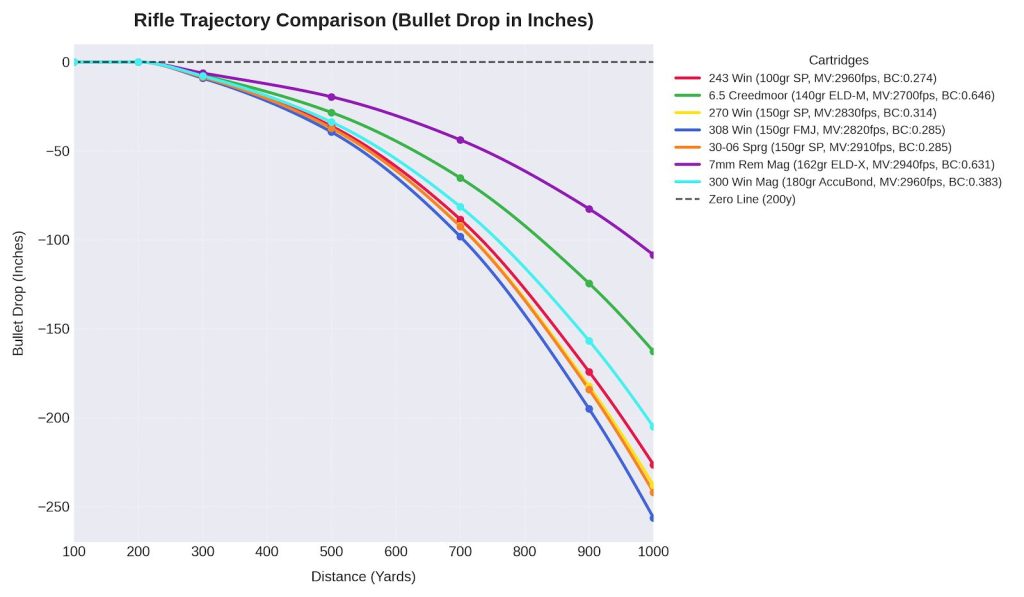
To use this trajectory chart, locate the specific caliber and bullet weight that matches your current rifle configuration. With a standard 200 yard zero, the values listed represent the vertical impact deviation in inches at each distance increment. For example, if you are shooting a 308 Winchester, the table indicates a 39.4 inch drop at 500 yards, which serves as your starting point for elevation correction. Always remember that these figures are based on standardized conditions; local altitude, temperature, and your specific barrel length will cause actual results to deviate, requiring you to verify your data at the range.
Understanding The Rifle Trajectory Chart
The data provided in the table serves as a baseline for predicting how projectiles react to gravity and drag over distance. Understanding these relationships is the first step toward achieving long range proficiency.
Trajectory Analysis
The table clearly illustrates the performance divide between traditional hunting projectiles and modern, high-BC match bullets. The 6.5 Creedmoor with a 140 grain ELD-M (BC 0.646) drops only 162.8 inches at 1,000 yards, vastly outperforming the 308 Winchester (BC 0.285) which drops 256.4 inches at the same distance. This demonstrates that for long range engagements, ballistic coefficient often matters more than raw muzzle velocity.
Velocity Analysis
Muzzle velocity is the primary determinant of initial trajectory flatness. Higher velocity rounds like the 30-06 Springfield at 2910 fps experience less drop in the first 300 yards than slower rounds. However, as the table shows, velocity sheds rapidly, and bullets with higher aerodynamic efficiency (BC) overtake lower-BC bullets as they travel further downrange.
Ballistic Coefficient Analysis
Ballistic coefficient is the metric that dictates how well a bullet resists environmental forces. The 7mm Rem Mag load with the 162 grain ELD-X (BC 0.631) shows the most impressive trajectory maintenance in the chart, dropping just 108.5 inches at 1,000 yards. Comparing this to the lower BC 30-06 load (BC 0.285) which drops 242.0 inches at the same distance, it becomes clear that aerodynamic design is the most critical factor for extreme distance shooting.
Best Factory Loads Based On The Chart
For precision long range target shooting, the 6.5 Creedmoor and 7mm Rem Mag are the superior performers due to their high-BC projectile options. For general-purpose big game hunting at standard ranges, the 30-06 Springfield and 308 Winchester provide excellent terminal energy and a predictable flight path. For shooters needing the flattest trajectory at mid-range distances, the 243 Winchester remains a benchmark for its high velocity and minimal drop characteristics.
Key Takeaways From The Chart
The 7mm Rem Mag offers the most efficient trajectory profile, retaining velocity and minimizing vertical drop out to 1,000 yards. A 200 yard zero remains the industry gold standard, as it provides a manageable flight path that minimizes holdover for most practical hunting and shooting scenarios. The data proves that while high muzzle velocity is beneficial, a high ballistic coefficient is essential for any shooting beyond 500 yards.
Common Rifle Bullet Weights
Choosing the right bullet weight requires balancing your rifle’s twist rate, recoil tolerance, and the distance at which you intend to shoot.
Lightweight (Under 100 Grains)
Lightweight bullets prioritize high muzzle velocity and flat trajectories. They are excellent for varmint hunting and short-range target practice but are quickly affected by wind and atmospheric drag at long distances.
Mid-Range (100–160 Grains)
This weight category is the workhorse for standard hunting calibers like the 308 and 270. It provides a balanced profile that is effective on medium game and offers decent ballistic performance out to 500 yards.
Heavyweight (160+ Grains)
Heavyweight bullets provide the best ballistic coefficients and terminal energy. They are the standard for long range precision and for hunting larger game species where penetration and energy retention are critical.
Effective Range
Hunting
The effective hunting range for most standard cartridges is 300 to 500 yards. Beyond this, the bullet drop becomes extreme, and terminal velocity often falls below the threshold required for reliable bullet expansion and ethical harvesting.
Target Shooting
The effective range for target shooting is limited only by the shooter’s ability and the rifle’s precision. Modern high-BC cartridges can comfortably reach 1,000+ yards, provided the shooter has access to precise atmospheric data and high-quality optics.
Factors That Affect Rifle Trajectory
Bullet Ballistic Coefficient (BC)
A high BC allows a bullet to maintain its velocity over distance, which is the most effective way to minimize vertical drop.
Muzzle Velocity
Muzzle velocity dictates the initial speed of the bullet. Faster bullets have a flatter trajectory, but they also generate more recoil and heat, which can lead to faster barrel wear.
Barrel Length
Standard ballistics tables are generated using 24-inch test barrels. If your rifle features a shorter barrel, your muzzle velocity will be lower, and you must adjust your trajectory data to account for the increased drop.
Windage
No trajectory chart can account for the wind. Always use a ballistic calculator to determine how wind speed and direction will affect your point of impact based on the projectile’s flight time.
Air Density
Air density changes with temperature, humidity, and altitude. Dense, cold air will cause bullets to hit lower than a standard chart indicates, while warm, thin air allows them to fly flatter.
Frequently Asked Questions
Why does my rifle hit differently than the chart?
Variations in barrel length, muzzle velocity, and atmospheric conditions are almost always the cause of discrepancies between charts and actual range performance.
Is a 200 yard zero best for all rifles?
It is the industry standard for most hunting and target rifles, but shooters may choose different zeros based on specific long-range requirements.
Does a heavier bullet always drop more?
Not necessarily; if a heavy bullet has a significantly higher ballistic coefficient, it may actually drop less than a lighter, less aerodynamic bullet at extreme distances.
What is the most important factor at 1,000 yards?
Precision in gathering environmental data—including range, wind speed, and density altitude—is the most critical factor for extreme distance shooting.
How do I build my own trajectory chart?
The most effective method is to use a ballistic solver app, input your specific rifle and ammunition data, and then verify that data by shooting at the range.
How would you like to proceed with your ballistics website development, or is there another cartridge trajectory chart you would like me to generate for your database?