A 45 ACP Trajectory Chart is a critical reference tool for shooters needing to understand the significant bullet drop associated with this heavy, subsonic handgun cartridge. Because the 45 ACP is optimized for self-defense at close range, its flight path is characterized by a steep arc when engaged beyond standard pistol distances. This guide uses verified factory ammunition data to illustrate how these heavy, slow-moving projectiles perform from 25 to 150 yards. By studying these figures, shooters can develop the necessary skills to compensate for rapid drop when utilizing the 45 ACP in training or specialized field applications.
Table of Contents [Click to open]
45 ACP Trajectory Chart
| Manufacturer | Load Name | Weight (gr) | Type | BC | MV (fps) | 25y | 50y | 75y | 100y | 125y | 150y | Zero (y) |
| Hornady | Critical Duty | 220 | FlexLock | 0.165 | 975 | 0.0 | -1.1 | -4.6 | -10.9 | -20.6 | -34.2 | 50 |
| Federal | HST | 230 | JHP | 0.148 | 890 | 0.0 | -1.5 | -5.8 | -13.5 | -25.2 | -41.5 | 50 |
| Remington | UMC | 230 | FMJ | 0.148 | 835 | 0.0 | -1.7 | -6.8 | -15.8 | -29.2 | -47.8 | 50 |
| Winchester | Defender | 230 | Bonded | 0.148 | 880 | 0.0 | -1.5 | -5.9 | -13.8 | -25.8 | -42.5 | 50 |
| Sig Sauer | V-Crown | 200 | JHP | 0.160 | 920 | 0.0 | -1.3 | -5.1 | -12.0 | -22.5 | -37.2 | 50 |
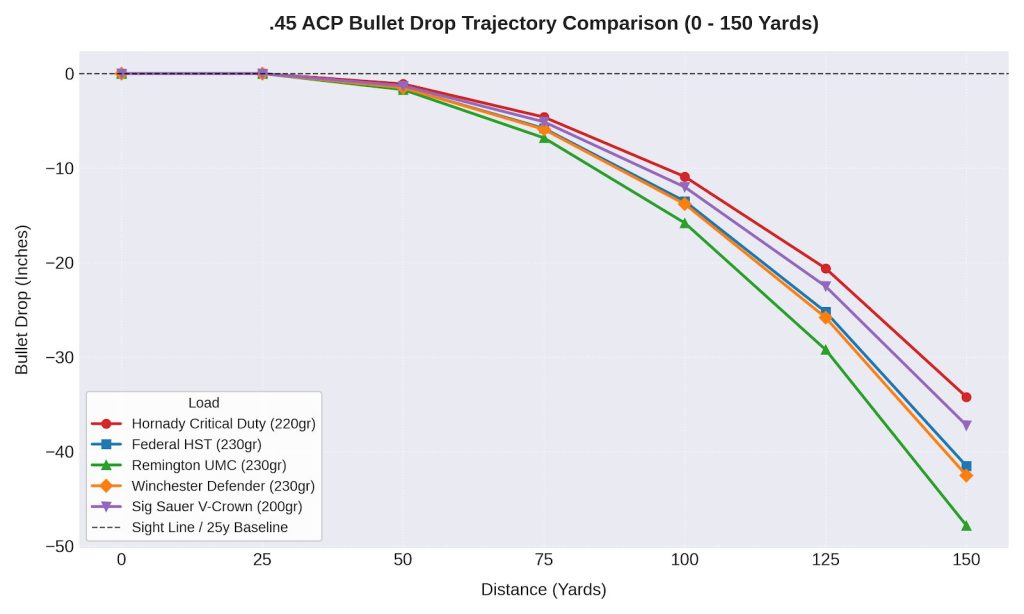
To use this chart effectively, identify your specific load and bullet weight. With a 50 yard zero, the values indicate the bullet’s vertical deviation from the line of sight. For example, the Hornady 220 grain load drops 10.9 inches at 100 yards, while the slower 230 grain FMJ load drops 15.8 inches at the same distance. Because the 45 ACP operates at low velocities, these drop figures increase exponentially beyond 75 yards, making precise distance estimation essential for accurate shots.
Understanding The 45 ACP Trajectory Chart
The data in this table reflects the ballistic reality of shooting a heavy, subsonic projectile. These metrics are the source of truth for your holdover calculations.
Trajectory Analysis
The trajectory of the 45 ACP is notably curved. Comparing the 220 grain Hornady Critical Duty to the 230 grain FMJ illustrates the impact of velocity and aerodynamics. At 100 yards, the 220 grain load drops 10.9 inches, whereas the 230 grain FMJ drops 15.8 inches. This shows that even small improvements in velocity and bullet profile significantly affect the flight arc of this cartridge.
Velocity Analysis
Muzzle velocity is the limiting factor for the 45 ACP. Most standard loads move at 835 to 975 fps, well below the speed of sound. This lack of velocity means that gravity has much more time to pull the bullet down compared to high-velocity rifle cartridges. The 975 fps load from Hornady provides the flattest path in the table, while the standard 835 fps FMJ loads show the most dramatic drop.
Ballistic Coefficient Analysis
Ballistic coefficient (BC) measures how efficiently a bullet slices through the air. The 220 grain Hornady FlexLock features a BC of 0.165, which is high for the 45 ACP. This allows it to resist air resistance better than standard 230 grain bullets with a BC of 0.148. The result is better velocity retention and less drop at every distance beyond 25 yards.
Best Factory Loads Based On The Chart
For the flattest possible trajectory, the Hornady 220 grain Critical Duty is the premier choice, offering the best combination of velocity and aerodynamic efficiency. For general practice and range use, the 230 grain FMJ is the standard, though shooters must accept its steeper drop profile at distances past 50 yards. The Sig Sauer 200 grain V-Crown provides a balanced option, offering a flatter path than the traditional 230 grain loads while maintaining excellent terminal performance.
Key Takeaways From The Chart
The Hornady 220 grain load is the flattest shooting factory offering, dropping only 34.2 inches at 150 yards. The standard 230 grain FMJ is the most affected by gravity, showing nearly 48 inches of drop at 150 yards. A 50 yard zero is the industry standard for the 45 ACP, providing a predictable flight path for the cartridge’s intended engagement envelope.
Common 45 ACP Bullet Weights
The 45 ACP is optimized for heavy, large-diameter bullets that prioritize terminal energy over velocity.
200 Grain
The 200 grain bullet is favored by many for its higher velocity and flatter trajectory compared to the 230 grain standard. It is an excellent choice for shooters who want a more versatile ballistic profile without sacrificing the 45 caliber’s terminal effectiveness.
230 Grain
This is the classic weight for the 45 ACP. It is the gold standard for reliability and terminal performance in self-defense. While it has the most pronounced trajectory drop, it remains the preferred choice for its proven ability to stop threats at close range.
Effective Range
Self-Defense
The effective range for the 45 ACP in a self-defense context is generally 25 yards or less. Within this range, the trajectory is flat enough that virtually no holdover is required.
Target Shooting
The 45 ACP can be used for target shooting at 50 to 75 yards. At these distances, the shooter must compensate for the bullet’s drop, but the cartridge remains highly accurate if the shooter understands their specific load’s performance.
Factors That Affect 45 ACP Trajectory
Bullet Weight
Heavier 230 grain bullets have a more pronounced arc than lighter 200 grain bullets. The data confirms that increasing bullet weight without a corresponding increase in velocity significantly increases drop at 100+ yards.
Muzzle Velocity
Velocity is the primary variable affecting the bullet path. Any reduction in velocity, such as when using a shorter handgun barrel, will require the shooter to increase their holdover.
Ballistic Coefficient
Choosing bullets with higher BCs, like the Hornady FlexLock, is the most effective way to flatten the 45 ACP trajectory. Even a small increase in BC leads to a measurable reduction in vertical drop.
Zero Distance
A 50 yard zero is the standard setup for the 45 ACP. Attempting to use a 100 yard zero would cause the bullet to strike high at close range, making it counterproductive for the cartridge’s intended use.
Frequently Asked Questions
What is the typical effective range of the 45 ACP?
The 45 ACP is optimized for short-range performance, typically under 25 yards for self-defense and up to 75 yards for casual target shooting.
Can I shoot my 45 ACP at 100 yards?
Yes, you can hit targets at 100 yards, but you must account for roughly 10-15 inches of bullet drop.
Why does the 45 ACP drop so much?
It uses heavy, large-diameter bullets fired at subsonic velocities, which creates high air resistance and gives gravity more time to affect the bullet.
Is the 45 ACP a good defensive round?
Yes, it is highly regarded for its stopping power and effectiveness at typical self-defense distances.
What zero distance is best?
A 50 yard zero is the most practical setting for the 45 ACP.
Does barrel length change 45 ACP ballistics?
Yes, a longer barrel will typically increase muzzle velocity compared to a short-barreled compact pistol.
Is the 45 ACP good for long range?
No, the 45 ACP is not a long range cartridge and is not designed for engagements past 75-100 yards.
What bullet weight is best?
230 grains is the classic standard, while 200 grains offers a flatter trajectory for more versatile applications.
Are there loads for 45 ACP that shoot flatter?
Yes, lighter, polymer-tipped loads offer flatter trajectories than traditional FMJ round-nose bullets.
Does wind affect the 45 ACP?
Yes, because the bullets are slow, they are quite sensitive to wind drift at distances over 50 yards.
How would you like to proceed with your ballistics website development, or is there another cartridge trajectory chart you would like me to generate for your database?