A .177 Pellet Trajectory Chart is a vital reference tool that visualizes the flight path and vertical drop of small caliber airgun projectiles across typical shooting distances. Unlike high velocity centerfire cartridges, airgun pellets are lightweight, possess low ballistic coefficients, and travel at subsonic speeds, which results in a significantly more pronounced trajectory arc. Understanding these specific ballistic values is essential for target shooters and small game hunters who must calculate precise holdovers to ensure accuracy at varying ranges. By studying this trajectory data, you can effectively determine your rifle’s maximum point blank range, choose the ideal zero distance for your specific optics, and consistently place shots with high precision.
Table of Contents [Click to open]
.177 Pellet Trajectory Chart
| Projectile Weight | Velocity (FPS) | 10 Yard Drop | 20 Yard Drop | 30 Yard Drop | 40 Yard Drop | 50 Yard Drop | 60 Yard Drop | Recommended Zero | Max Point Blank |
| 7.9 Grain | 800 FPS | +0.2 | Zero | -0.8 | -2.5 | -5.0 | -8.5 | 20 Yards | 25 Yards |
| 7.9 Grain | 900 FPS | +0.2 | Zero | -0.6 | -2.0 | -4.0 | -7.0 | 20 Yards | 28 Yards |
| 8.4 Grain | 750 FPS | +0.3 | Zero | -1.0 | -3.0 | -6.0 | -10.0 | 20 Yards | 24 Yards |
| 8.4 Grain | 950 FPS | +0.1 | Zero | -0.5 | -1.5 | -3.5 | -6.5 | 20 Yards | 30 Yards |
| 10.3 Grain | 700 FPS | +0.4 | Zero | -1.2 | -3.5 | -7.5 | -12.5 | 20 Yards | 22 Yards |
| 10.3 Grain | 850 FPS | +0.2 | Zero | -0.7 | -2.2 | -4.5 | -8.0 | 20 Yards | 27 Yards |
Note: Drop measurements are in inches. Values are approximate and rely on specific pellet aerodynamics and local environmental conditions.
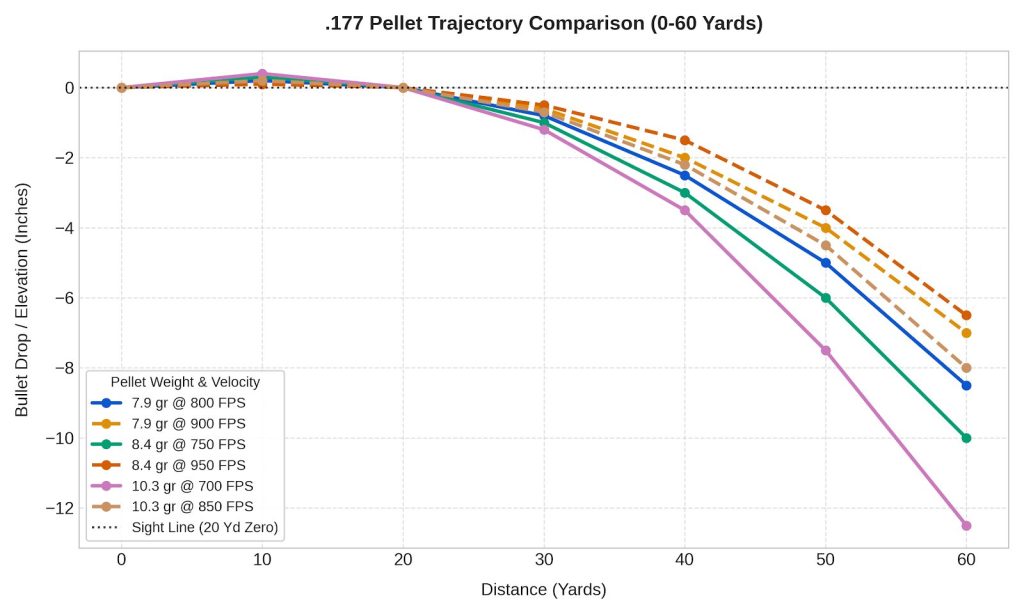
This professional trajectory chart provides airgun enthusiasts with the precise measurements required to compensate for the significant gravity arc inherent in small caliber pellets. Always verify your specific rifle and pellet combination on the range, as minor variations in scope height and muzzle velocity will alter your actual point of impact.
Understanding The .177 Pellet Trajectory Chart
The data in this table is essential for any airgun shooter, as .177 pellets are highly susceptible to gravity and atmospheric drag compared to firearms. By analyzing these statistics, you can master your rifle’s performance and eliminate the guesswork when aiming at distant targets.
Trajectory Analysis
Bullet drop for .177 pellets is extreme due to their low mass and poor aerodynamic shape. When you look at the 20-yard zero column, you will notice that the pellet begins to fall off sharply as soon as it passes that distance.
For example, a standard 7.9-grain pellet traveling at 800 FPS drops 5 inches by the time it reaches 50 yards. This means if you are aiming at a target at 50 yards while zeroed at 20 yards, you must hold your aim significantly higher than your intended point of impact.
Heavier 10.3-grain pellets drop even faster, with some showing over 12 inches of drop at 60 yards. This data clearly illustrates that .177 caliber airguns are specialized tools best suited for close to medium-range precision rather than long-range engagement.
Velocity Analysis
Muzzle velocity is the speed of the pellet as it leaves the barrel. In the airgun world, velocity is highly dependent on the rifle’s power plant—whether it is a spring-piston, gas-ram, or pre-charged pneumatic (PCP) system.
Pellets moving at higher velocities, such as 900+ FPS, exhibit a much flatter trajectory and require less holdover at extended distances. However, pushing pellets too fast can cause them to become unstable, which is why most match shooters prefer speeds just below the speed of sound.
Even at high velocities, airgun pellets lose speed very rapidly compared to firearm bullets. Because they are not aerodynamic, velocity is not the only factor in accuracy; shot consistency and pellet quality are equally critical for maintaining a flat trajectory.
Ballistic Coefficient Analysis
The ballistic coefficient (BC) measures how well a pellet resists air resistance. Most .177 pellets have very low BCs, often ranging from 0.010 to 0.030, which is why they lose energy and drop so quickly.
These low numbers explain why pellets are so significantly affected by wind. Even a light breeze can push a lightweight pellet several inches off-target at 40 yards, making wind reading a fundamental skill for the airgun shooter.
Despite their low efficiency, modern pellet designs like domes and pointed tips offer better BCs than traditional flat-head wadcutters. Choosing a higher BC pellet will always result in less drop and better performance at the outer limits of your rifle’s effective range.
Best Hunting Loads Based On The Chart
Target shooters and plinkers should look to standard 7.9-grain dome pellets. They offer a great balance of velocity and trajectory, allowing for fun, accurate shooting at distances up to 30 yards.
Small game hunters require reliability and energy retention, making 8.4-grain dome pellets a popular choice. They provide a predictable trajectory that allows for accurate shots on pests at distances where the pellet retains enough force for a humane harvest.
For long-range target precision where wind is a factor, 10.3-grain heavy pellets are often superior. While you must account for a steeper trajectory, their higher mass helps them resist wind drift better, making them more predictable in open fields.
Key Takeaways From The Chart
The trajectory chart proves that the .177 caliber is a precision tool for short to medium distances. Even the fastest pellets show a significant drop past 40 yards that makes long-range precision difficult for the uninitiated shooter.
The 20-yard zero remains the industry standard for most .177 rifles. It provides a simple reference point, allowing shooters to easily calculate their holdover for distances of 30, 40, or 50 yards using the data provided in the chart.
The maximum point blank range is very short, typically under 30 yards. Knowing this range helps you stay within your limits, ensuring consistent hits on target without needing to adjust your scope for every shot.
Common .177 Pellet Weights
7.9 Grain
The 7.9-grain pellet is the most common weight and is widely considered the standard for general-purpose airgun shooting. These pellets are excellent for shooters who want a balance of high velocity and decent trajectory.
The primary advantage is the speed, which extends your effective range and flattens your trajectory arc. These pellets are compatible with almost every .177 air rifle and perform reliably for plinking and paper target practice.
The disadvantage is that they are highly affected by wind, which can make accuracy difficult on gusty days. They also lose energy rapidly, so they are best kept within the 40-yard range for hunting applications.
8.4 Grain
The 8.4-grain pellet is a popular choice for hunters and precision shooters who want slightly more stability than the 7.9-grain option. These pellets are often used in high-quality European air rifles and offer exceptional consistency.
The advantage is improved energy retention and slightly better performance in windy conditions. They strike a great balance between trajectory flatness and the mass needed to ensure consistent performance on small game.
The disadvantage is a slightly steeper trajectory, which requires the shooter to learn their holdovers more precisely. For the hunter, however, the extra grain of weight provides better confidence in the field.
10.3 Grain
These heavy-duty pellets are built for shooters who prioritize stability and performance at distances past 40 yards. They move slower but carry more momentum and are less affected by crosswinds.
The advantage is wind resistance and deep penetration, making them the preferred weight for those who want to reach out to the limit of their rifle’s range. They retain more energy, which is better for consistent results on small game.
The disadvantage is the significant drop and the slower flight time. Shooters must become adept at estimating range, as the pellet falls much faster than the 7.9-grain options, requiring significant elevation adjustments.
Effective Hunting Range
Small Game
Small game hunting with a .177 is best kept within 30-40 yards. At this distance, the cartridge delivers plenty of energy for a humane harvest, and the trajectory is predictable enough to ensure a clean shot.
Always use a rangefinder, as even a 5-yard error in range estimation can result in a miss due to the steep drop curve. Keeping your shots short ensures you remain within the rifle’s most accurate and powerful zone.
Target Shooting
Precision shooting is the primary strength of the .177 caliber. At distances of 10 to 50 yards, these rifles can produce one-hole groups. Mastering the trajectory at these distances is the key to winning competitions and improving your skills.
Because the trajectory is so sensitive, target shooters often use sophisticated scope reticles with multiple holdover marks (mil-dots). Learning how to use these marks in conjunction with the trajectory chart is essential for long-range target success.
Factors That Affect .177 Trajectory
Pellet Shape
Domed pellets have higher BCs and trajectory flatness compared to flat-head wadcutters. Wadcutters are designed for paper targets at very close range (10 yards) and will drop like a stone beyond that distance.
Muzzle Velocity
Velocity is defined by your rifle’s power plant. Higher velocity flattens the trajectory arc, effectively extending your point blank range. However, do not exceed the speed of sound, as this can cause the pellet to tumble and lose all accuracy.
Scope Height
In airgunning, scope height—the distance between the center of the barrel and the center of the scope—has a massive effect on trajectory. A higher scope height means the pellet takes longer to cross the line of sight, which changes your holdover points at close range.
Zero Distance
A 20-yard zero is the standard because it minimizes holdover errors at typical airgun distances. If you zero at 50 yards, the pellet will arc significantly high at 20 yards, which is counterproductive for small game hunting.
Best Zero Distance
20 Yard Zero
This is the recommended zero for virtually all .177 airguns. It allows you to hold dead-on from 10 yards out to 25 yards. Beyond 25 yards, you simply hold a few mildots high, making for an intuitive shooting experience.
Frequently Asked Questions
What Is A .177 Pellet Trajectory Chart
It is a ballistic table showing the pellet’s path. It helps you see how much the projectile falls at different distances so you can adjust your aim.
What Is The Maximum Effective Range Of A .177
Most shooters limit the .177 to 40-50 yards. Beyond that, the pellet drop becomes extreme and energy is too low for ethical hunting.
How Much Does A .177 Drop At 50 Yards
Depending on the velocity, the drop at 50 yards typically ranges from 4 to 8 inches. This is why using a trajectory chart is vital.
What Is The Best Zero For .177 Airguns
A 20-yard zero is the standard. It provides the most intuitive holdovers and keeps the pellet’s path manageable for hunting and target shooting.
Can You Use .177 For Long Range Shooting
It is not an ideal long-range round, but it is a fun challenge to shoot at steel targets at 50-60 yards. You will need to dial in significant elevation to stay on target.
One follow-up question: Are you using this .177 pellet trajectory information primarily for small game hunting or for competitive target shooting?