A hunting rifle ballistics chart is a reference tool that displays the flight trajectory, velocity, and energy of a bullet as it travels over distance. For hunters comparing calibers for deer, elk, or moose, this chart provides the exact data needed to determine effective range and bullet drop. Reading a hunting rifle ballistics chart allows you to understand how environmental variables like barrel length, ammunition load, and zero distance impact a bullet in flight. The data below assumes a standard 200 yard zero, standard atmospheric conditions at sea level, and factory loaded ammunition fired from a 24 inch test barrel. Manufacturer specifications will vary slightly depending on the exact rifle setup and weather conditions during the hunt.
Hunting Rifle Ballistics Chart
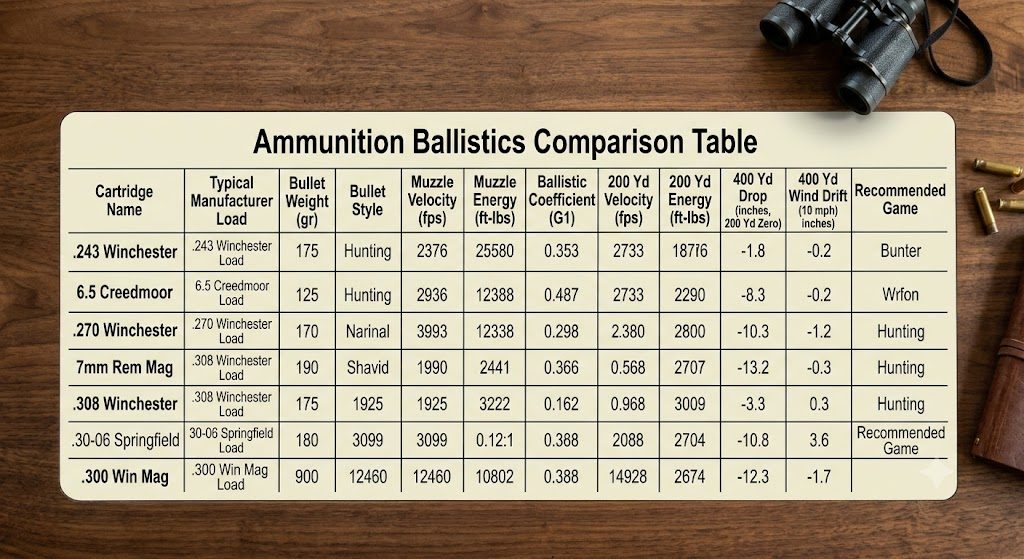
| Cartridge Name | Typical Manufacturer Load | Bullet Weight (gr) | Bullet Style | Muzzle Velocity (fps) | Muzzle Energy (ft-lbs) | Ballistic Coefficient (G1) | 200 Yd Velocity (fps) | 200 Yd Energy (ft-lbs) | 400 Yd Drop (inches, 200 Yd Zero) | 400 Yd Wind Drift (10 mph, inches) | Recommended Game |
| .243 Winchester | Hornady SST | 95 | Polymer Tip | 3180 | 2133 | 0.355 | 2580 | 1404 | -20.5 | 18.2 | Deer, Varmint |
| 6.5 Creedmoor | Hornady ELD-X | 143 | Polymer Tip Boat Tail | 2700 | 2315 | 0.625 | 2390 | 1814 | -23.5 | 11.5 | Deer, Antelope |
| .270 Winchester | Federal Nosler Partition | 130 | Partition | 3060 | 2702 | 0.416 | 2550 | 1876 | -19.5 | 15.8 | Deer, Elk |
| 7mm Rem Mag | Hornady ELD-X | 162 | Polymer Tip Boat Tail | 2940 | 3110 | 0.631 | 2630 | 2488 | -18.2 | 10.5 | Elk, Moose |
| .308 Winchester | Federal Sierra MatchKing | 168 | BTHP | 2650 | 2619 | 0.462 | 2270 | 1922 | -26.5 | 16.5 | Deer, Black Bear |
| .30-06 Springfield | Remington Core-Lokt | 180 | Soft Point | 2700 | 2913 | 0.383 | 2220 | 1970 | -27.2 | 19.5 | Elk, Bear, Deer |
| .300 Win Mag | Winchester AccuBond | 180 | Bonded Tip | 2960 | 3502 | 0.507 | 2570 | 2640 | -20.1 | 13.5 | Large Game, Elk, Moose |
Understanding The Chart
Cartridge Name
This metric identifies the specific caliber and casing combination used in the firearm. It matters because a rifle can only safely fire the exact cartridge it is chambered for. Interpreting this column helps a shooter compare entirely different platforms against one another. It directly affects the size of the rifle action and the overall recoil the hunter will experience. For example, selecting a 7mm Rem Mag requires a long action rifle, whereas a 6.5 Creedmoor fits in a short action.
Typical Manufacturer Load
This column details the specific brand and product line of the ammunition being tested. It is important because factory ammunition varies wildly in performance even within the exact same caliber. Hunters interpret this to understand that not all boxes of ammunition on a shelf will perform identically. This affects purchasing decisions when looking for premium hunting rounds versus cheaper practice ammunition. For instance, Hornady ELD-X will fly much differently than a basic Remington Core-Lokt.
Bullet Weight (gr)
Measured in grains, this metric indicates the physical mass of the projectile itself. It matters immensely because weight dictates how much energy the bullet carries downrange and how deeply it will penetrate the target. You interpret this by matching lighter bullets to smaller game and heavier bullets to larger, tougher animals. It affects terminal ballistics and recoil. A practical example is choosing a 130 grain bullet for deer but stepping up to a 180 grain bullet for elk.
Bullet Style
This indicates the physical construction and shape of the projectile. It matters because the design controls how the bullet expands upon impact. Hunters interpret this to ensure they are using an expanding hunting bullet rather than a non-expanding target bullet. It affects the lethality and ethical harvesting of the animal. A Polymer Tip Boat Tail provides excellent aerodynamics and rapid expansion, while a Partition bullet ensures deep penetration through heavy bone.
Muzzle Velocity (fps)
Measured in feet per second, this is the speed of the bullet at the exact moment it leaves the rifle barrel. It is crucial because speed drives both trajectory flatness and kinetic energy. Higher numbers indicate a faster bullet that reaches the target quicker with less time to drop. This affects how much you need to adjust your aim at longer distances. A bullet leaving the barrel at 3060 fps will drop significantly less at 300 yards than one leaving at 2650 fps.
Muzzle Energy (ft-lbs)
Measured in foot-pounds, this is the total kinetic energy the bullet possesses as it exits the muzzle. It matters because energy is the primary factor in delivering a lethal blow to game animals. You interpret this number as the raw power of the cartridge. It directly affects the maximum size of the animal you can ethically hunt. A muzzle energy of 3500 foot-pounds is suitable for grizzly bears, while 2100 foot-pounds is better suited for whitetail deer.
Ballistic Coefficient (G1)
The ballistic coefficient is a mathematical representation of how well a bullet cuts through the air and resists drag. It matters because a higher number means the bullet will retain its velocity and energy over much longer distances. Shooters interpret this metric to judge long range efficiency. It dictates wind drift and elevation adjustments past 300 yards. A bullet with a high BC of 0.625 will fly much flatter and hit harder at 500 yards than a blunt bullet with a 0.355 BC.
200 Yd Velocity (fps)
This is the speed of the projectile after it has traveled 200 yards downrange. It is important because hunting bullets require a minimum velocity to reliably expand on impact, typically around 1800 to 2000 fps. Interpreting this column tells you if the bullet is slowing down too rapidly to be effective. This impacts your maximum effective hunting range. If a bullet drops below 1800 fps at 200 yards, it is not an ethical choice for game at that distance.
200 Yd Energy (ft-lbs)
This metric shows the kinetic energy remaining in the bullet at the 200 yard mark. It matters because impact energy dictates terminal performance far more than muzzle energy. Most hunters interpret this using standard benchmarks, such as needing at least 1000 foot-pounds of energy to cleanly harvest a deer. It affects the distance at which you should take a shot. If a load only carries 800 foot-pounds at 200 yards, it should not be used for medium game at that range.
400 Yd Drop (inches, 200 Yd Zero)
This represents how many inches the bullet will fall below the line of sight at 400 yards, assuming the rifle is zeroed at 200 yards. It is critical for making accurate shots in the field without guessing holdovers. You interpret this number to build a custom dial or reticle holdover plan. It directly affects your ability to hit the vital zone of an animal at extended ranges. A 27 inch drop requires a careful aiming adjustment, whereas a 10 inch drop might only require holding high on the shoulder.
400 Yd Wind Drift (10 mph, inches)
This shows how far off target a perfectly aimed shot will blow in a 10 mile per hour crosswind at 400 yards. It matters because wind is the most difficult environmental variable to estimate and correct for in the field. Interpreting this helps hunters understand the limits of their cartridge in bad weather. It affects whether a hunter should take the shot or pass. A load that drifts 19 inches is much harder to shoot accurately in a crosswind than one that only drifts 10 inches.
Recommended Game
This is a generalized category of wildlife that the cartridge and bullet combination is best suited for. It matters because using the wrong tool for the job results in either excessive meat damage or wounded animals. Hunters interpret this column as a baseline guide for appropriate ethical hunting. It affects rifle selection before heading into the woods. A .243 Winchester is ideal for coyotes and deer, but it is entirely inadequate and unethical for hunting moose.