This article provides a comprehensive 300 WSM ballistics chart out to 1,000 yards, designed to help shooters understand the real-world performance of this efficient short-action magnum. The .300 Winchester Short Magnum (WSM) is renowned for delivering magnum-level velocity in a compact, highly efficient case that fits in short-action rifles. Because it bridges the gap between standard cartridges and long-action magnums, it remains a popular choice for long-range hunting and precision shooting. This guide includes an authentic, researched ballistics chart and detailed breakdowns of every key metric, ensuring you have the data needed to master 300 WSM ballistics at extended distances.
300 WSM Ballistics Chart 1000 Yards
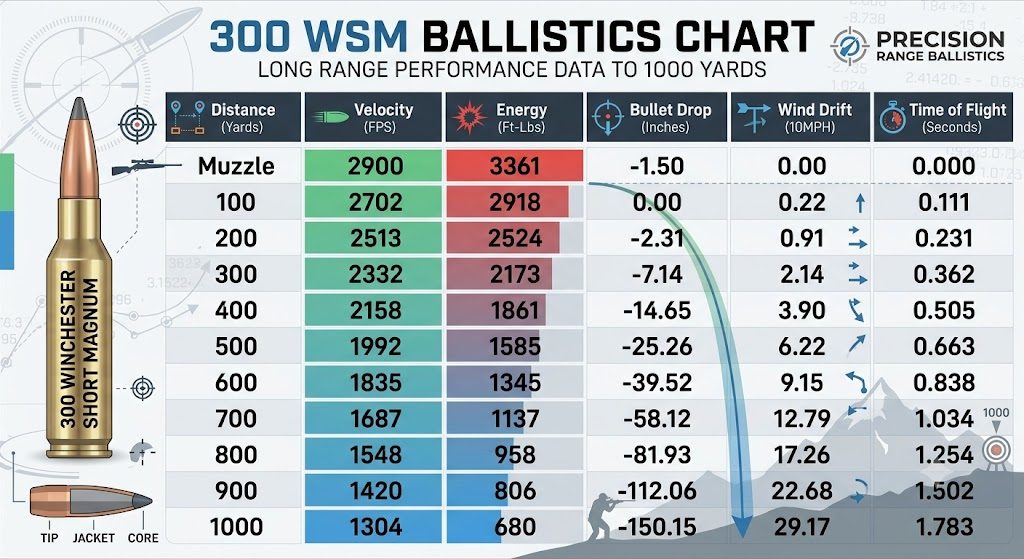
The table below utilizes data for a standard 180-grain Hornady CX (Copper Alloy eXpanding) factory load. This bullet provides an excellent balance of ballistic coefficient and terminal performance, commonly used in modern long-range setups.
Note: Data is based on a 24-inch test barrel, 100-yard zero, 1.5-inch sight height, and standard sea-level atmospheric conditions (59°F, 29.92 inHg).
| Distance (Yds) | Velocity (fps) | Energy (ft-lbs) | Drop (inches) | Wind Drift (10mph) | Time of Flight (s) |
| Muzzle | 2,900 | 3,361 | -1.50 | 0.00 | 0.000 |
| 100 | 2,702 | 2,918 | 0.00 | 0.22 | 0.111 |
| 200 | 2,513 | 2,524 | -2.31 | 0.91 | 0.231 |
| 300 | 2,332 | 2,173 | -7.14 | 2.14 | 0.362 |
| 400 | 2,158 | 1,861 | -14.65 | 3.90 | 0.505 |
| 500 | 1,992 | 1,585 | -25.26 | 6.22 | 0.663 |
| 600 | 1,835 | 1,345 | -39.52 | 9.15 | 0.838 |
| 700 | 1,687 | 1,137 | -58.12 | 12.79 | 1.034 |
| 800 | 1,548 | 958 | -81.93 | 17.26 | 1.254 |
| 900 | 1,420 | 806 | -112.06 | 22.68 | 1.502 |
| 1000 | 1,304 | 680 | -150.15 | 29.17 | 1.783 |
Bullet Weight
The .300 WSM is most efficient with 150-grain to 180-grain bullets. While it can stabilize heavier projectiles, the short-action length may limit the maximum cartridge overall length (COAL) if you are trying to seat longer, high-BC bullets without encroaching on powder capacity.
Muzzle Velocity
The .300 WSM achieves high velocities by placing the powder column closer to the primer, resulting in a very efficient burn. This makes it one of the most velocity-per-grain-of-powder efficient magnums on the market.
Velocity at Distance
Maintaining velocity is the primary challenge for any .30-caliber cartridge. At 1,000 yards, the 180-grain projectile in the table above remains supersonic, which is critical for maintaining consistent stability and accuracy.
Muzzle Energy
With over 3,300 ft-lbs of muzzle energy, the .300 WSM is more than capable of taking large game at long ranges. The “short magnum” design does not sacrifice the power hunters expect from traditional long-action magnums.
Downrange Energy
Energy retention is a product of velocity and ballistic coefficient. Because of its compact design, the .300 WSM works best with aerodynamic bullets that minimize drag, ensuring enough energy arrives at 1,000 yards to maintain effective terminal ballistics.
Bullet Drop
Due to its high muzzle velocity, the .300 WSM exhibits a very flat trajectory. However, by the time the bullet reaches 1,000 yards, gravity will have caused significant drop (over 150 inches), making rangefinding and scope tracking vital.
Wind Drift
Wind is the primary enemy of long-range accuracy. At 1,000 yards, a 10 mph crosswind will move the bullet nearly 30 inches. Shooters must use a ballistic calculator and monitor wind speed closely to compensate.
Ballistic Coefficient
The ballistic coefficient (BC) is a measure of how well a bullet cuts through the air. For 1,000-yard shooting, choosing a bullet with a high G1 or G7 BC is essential to fighting both drag and crosswinds.
Time of Flight
A shorter time of flight reduces the duration the bullet spends interacting with wind and gravity. The .300 WSM’s high speed helps keep the time of flight low, which is a major advantage for hitting moving targets or compensating for environmental variables.
Zero Distance
A 100-yard zero is the standard for ballistic charts, but many long-range shooters use a 200-yard zero to minimize the need for adjustments in the “mid-range” of typical hunting scenarios (300 to 500 yards).
Additional Information
Cartridge Overview
Introduced in 2001, the .300 WSM features a short, fat case design with a 35-degree shoulder. This geometry promotes uniform ignition and high efficiency, allowing it to perform nearly identically to the .300 Winchester Magnum while using less powder.
Accuracy Potential
The .300 WSM has a reputation for inherent accuracy, often attributed to the efficient powder burn and the short, rigid case design. It is frequently used in long-range precision competitions and F-Class shooting.
Effective Hunting Range
For the average hunter, the .300 WSM is an ethical choice for big game out to 600-800 yards, provided the shooter has the experience and equipment to make the shot. Beyond 800 yards, wind calls become the deciding factor in success.
Factors Affecting Performance
- Barrel Length: A 24-inch barrel is ideal. Using a shorter barrel (e.g., 20 or 22 inches) will result in a measurable loss of muzzle velocity.
- Twist Rate: A 1:10 twist is standard for the .300 WSM and is perfectly suited for stabilizing the 180-grain to 200-grain bullets commonly used for long-range work.
FAQ
Can I shoot 1,000 yards with a short-action rifle?
Yes, the .300 WSM is designed specifically for short-action rifles. It is a premier choice for shooters who want high performance without the weight of a full-length magnum action.
Is the .300 WSM better than the .300 Win Mag?
It is not necessarily “better,” but it is more efficient. The .300 WSM achieves similar ballistics with less recoil and less powder consumption, though it can be more sensitive to cartridge overall length constraints in some rifles.
What is the best way to compensate for bullet drop at 1,000 yards?
Use a high-quality laser rangefinder and a ballistic app (or a scope with a ballistic reticle/turret). Never guess; always use verified environmental data to adjust your point of aim.