Hornady manufactures 6.5 Creedmoor ammunition with several bullet weights and designs. Its factory-loaded options include 120-grain CX, 129-grain SST, 140-grain InterLock, 143-grain ELD-X and 147-grain ELD Match bullets.
This article examines the published ballistic performance of Hornady 6.5 Creedmoor ammunition, including velocity, energy, trajectory and ballistic coefficients. It also explains why figures should be compared by individual ammunition type rather than treated as one universal cartridge chart.
Table of Contents [Click to minimize]
6.5 Creedmoor Hornady Ballistics Chart
Hornady’s catalogue provides a detailed ballistic table for its 140-grain InterLock factory load. The figures below include velocity, energy and trajectory at six distances.
| Distance | Bullet Velocity | Muzzle-to-Range Energy | Bullet Drop |
|---|---|---|---|
| Muzzle | 2,800 fps | 2,135 ft-lb | -1.5 in |
| 100 Yards | 2,590 fps | 1,736 ft-lb | +1.4 in |
| 200 Yards | 2,398 fps | 1,448 ft-lb | 0 in |
| 300 Yards | 2,210 fps | 1,223 ft-lb | -6.0 in |
| 400 Yards | 2,031 fps | 994 ft-lb | -18.9 in |
| 500 Yards | 1,850 fps | 755 ft-lb | -38.6 in |
Ammunition: Hornady 140-grain InterLock
Item number: 81410
Test barrel: 24 inches
These are manufacturer-published figures from the Hornady catalogue.
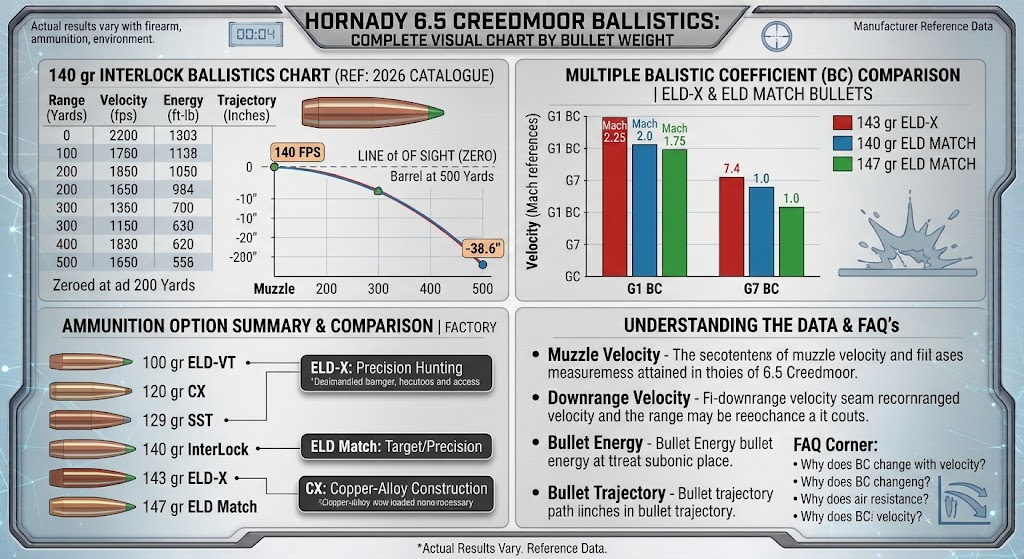
Hornady 6.5 Creedmoor Bullet Weight Comparison
Hornady’s ammunition range includes multiple bullet weights. Each design has a different purpose and should be considered separately when reviewing ballistic performance.
| Bullet Weight | Hornady Bullet | Ammunition Type | Item Number |
|---|---|---|---|
| 100 gr | ELD-VT | Varmint | 81504 |
| 120 gr | CX | Hunting | 81487 |
| 129 gr | SST | Hunting | 81509 |
| 140 gr | InterLock | Hunting | 81410 |
| 143 gr | ELD-X | Precision Hunter | 81499 |
| 147 gr | ELD Match | Match | 81501 |
The bullet weight alone does not determine a load’s performance. Bullet shape, construction, muzzle velocity and ballistic coefficient also affect its flight characteristics.
Hornady ELD-X and ELD Match Ballistic Coefficients
Hornady publishes different ballistic-coefficient values for selected ELD-X and ELD Match bullets. These values are measured at different Mach references to account for changes in aerodynamic performance as a bullet slows down.
| Bullet | Mach 2.25 G1 | Mach 2.25 G7 | Mach 2.0 G1 | Mach 2.0 G7 | Mach 1.75 G1 | Mach 1.75 G7 |
|---|---|---|---|---|---|---|
| 143 gr ELD-X | 0.623 | 0.314 | 0.604 | 0.303 | 0.584 | 0.294 |
| 140 gr ELD Match | 0.646 | 0.326 | 0.637 | 0.320 | 0.616 | 0.310 |
| 147 gr ELD Match | 0.697 | 0.351 | 0.662 | 0.332 | 0.637 | 0.321 |
The 147-grain ELD Match has the highest listed BC among these three bullets at the Mach 2.25 reference. However, BC alone does not determine the complete performance of an ammunition load.
What Makes Hornady 6.5 Creedmoor Different Loads?
ELD-X Hunting Ammunition
The 143-grain ELD-X is used in Hornady’s Precision Hunter ammunition. The bullet is designed for hunting applications and has a published G1 ballistic coefficient of 0.623 at Mach 2.25.
ELD Match Ammunition
Hornady offers both 140-grain and 147-grain ELD Match bullets for precision shooting. The 147-grain version has a higher published BC at the Mach 2.25 reference.
InterLock Ammunition
The 140-grain InterLock is another Hornady 6.5 Creedmoor option. Its factory ballistic data is included in the catalogue, making it possible to review its published velocity, energy and trajectory figures across multiple distances.
CX Ammunition
Hornady’s 120-grain CX is a copper-alloy bullet option. It provides another choice within the company’s 6.5 Creedmoor factory ammunition range.
How to Read Hornady 6.5 Creedmoor Ballistic Figures
Velocity: Measured in feet per second, velocity describes how quickly the bullet travels. It generally decreases as the bullet moves farther from the muzzle.
Energy: Measured in foot-pounds, energy represents the projectile’s kinetic energy. It is influenced by both bullet weight and velocity.
Trajectory: Trajectory measurements show the bullet’s position relative to the selected sighting reference. A negative figure indicates a position below that reference.
Ballistic Coefficient: BC is a measure used to describe aerodynamic efficiency. Hornady provides G1 and G7 values for selected bullets at different Mach references.
Hornady 6.5 Creedmoor Ballistics FAQs
What is the muzzle velocity of the Hornady 140-grain InterLock?
Hornady lists a muzzle velocity of 2,800 fps for its 140-grain InterLock factory load in the catalogue.
How much does a Hornady 6.5 Creedmoor bullet drop at 500 yards?
The published 140-grain InterLock trajectory figure is -38.6 inches at 500 yards, using the reference conditions in Hornady’s chart.
What is the 500-yard velocity of Hornady 140-grain InterLock?
Hornady lists 1,850 fps at 500 yards.
What is the 500-yard energy of Hornady 140-grain InterLock?
The catalogue lists 755 ft-lb at 500 yards.
Which Hornady 6.5 Creedmoor bullet has the highest BC in this comparison?
The 147-grain ELD Match has the highest Mach 2.25 BC in this comparison, with 0.697 G1 and 0.351 G7.
What is the BC of Hornady 143-grain ELD-X?
Its published Mach 2.25 values are 0.623 G1 and 0.314 G7.
Does Hornady make 120-grain 6.5 Creedmoor ammunition?
Yes. Hornady lists a 120-grain CX factory ammunition option.
What is the difference between G1 and G7 BC?
G1 and G7 are different reference models used to describe aerodynamic drag. Their values should not be compared as if they were the same scale.
Does barrel length affect 6.5 Creedmoor velocity?
Yes. Barrel length can influence the velocity achieved by a particular ammunition load. Actual results should be checked with the individual rifle rather than assumed to match catalogue figures.
Where can I find official Hornady ballistic information?
Hornady provides product specifications, ballistic-coefficient information and ballistic calculators through its official website.
Hornady 6.5 Creedmoor References
Ammunition specifications, bullet details and ballistic information are based on official Hornady publications.
View Official Hornady 6.5 Creedmoor Data ↗