When choosing between the .17 HMR (Hornady Magnum Rimfire) and the .22 WMR (Winchester Magnum Rimfire, or .22 Mag), the right choice comes down to your intended target and distance.
Here is the direct answer: Choose the .17 HMR if you are shooting smaller pests (like prairie dogs or groundhogs) at longer ranges (up to 170 yards), because its lighter bullet shoots significantly faster and flatter. Choose the .22 WMR if you are hunting larger, tougher varmints (like coyotes) at closer ranges (under 125 yards), because its heavier bullet carries much more kinetic energy for deeper penetration.
22 Mag vs 17 Hmr Ballistics Chart Comparison
Here is how the numbers stack up side-by-side:
| Feature | .17 HMR | .22 WMR (.22 Mag) |
| Bullet Diameter | 0.172 inches | 0.224 inches |
| Standard Bullet Weight | 17 grains | 40 grains |
| Muzzle Velocity | ~2,550 fps | ~1,910 fps |
| Muzzle Energy | ~245 ft-lbs | ~324 ft-lbs |
| Bullet Drop at 200 Yards* | -8.5 inches | -16.5 inches |
| Wind Drift (10 mph at 100 yds) | 3.33 inches | 4.90 inches |
| Effective Hunting Range | ~170 yards | ~125 yards |
| *Assuming a 100-yard zero. |
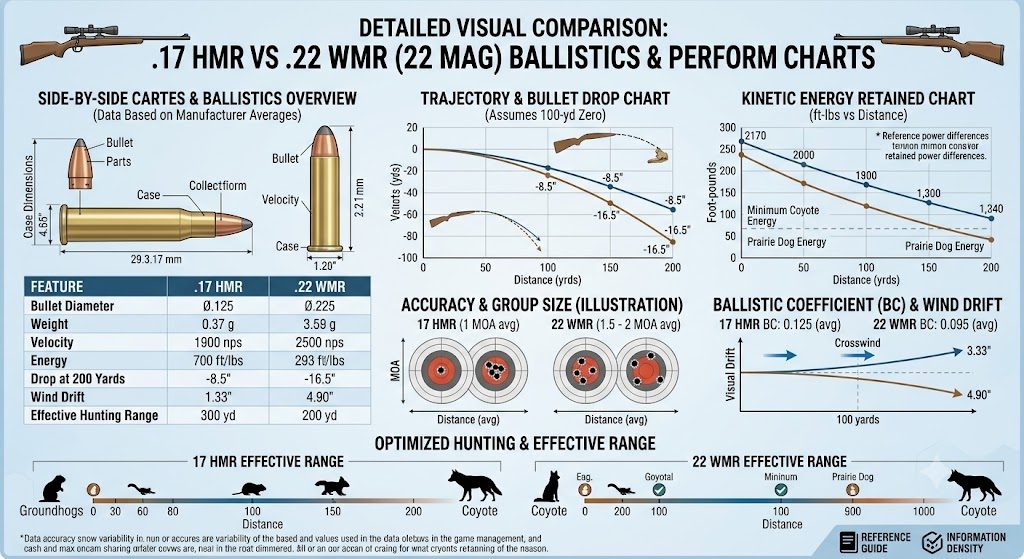
To see how these numbers translate to real-world performance, use this interactive tool to visualize the trajectory and energy curves of both cartridges over distance:
Key insight: The .17 HMR crosses the 100-yard mark moving faster and flatter, but the .22 WMR consistently retains more raw hitting power at every distance.
Explaining the Comparison
To really understand why these two cartridges perform so differently, it helps to look at how they are built and what happens when they fly downrange.
The Core Difference: Speed vs. Mass
The .17 HMR is actually just a .22 WMR casing that has been “necked down” (tapered at the opening) to hold a much smaller 0.172-inch bullet. Because it burns the same amount of powder to push a bullet that weighs less than half as much (17 grains vs. 40 grains), the .17 HMR achieves explosive speeds of over 2,500 feet per second.
However, physics dictates that mass drives kinetic energy. Because the .22 WMR uses a heavier bullet, it leaves the barrel hitting with roughly 324 foot-pounds of energy, compared to the .17 HMR’s 245 foot-pounds.
Trajectory and Wind Drift
Gravity acts on all bullets equally, but the faster a bullet gets to the target, the less time gravity has to pull it downward. This is why the .17 HMR shines at distance. If you zero both rifles at 100 yards and shoot a target at 200 yards, the .22 WMR will drop a massive 16.5 inches. The .17 HMR drops only 8.5 inches, making it far more forgiving if you misjudge the distance by a few yards.
The .17 HMR also features a more aerodynamic bullet design (a higher Ballistic Coefficient, or BC). This helps it cut through the wind better, drifting an inch and a half less than the .22 WMR in a 10-mph crosswind at 100 yards. When you are aiming at a target the size of a groundhog’s head, that 1.5-inch difference is the line between a hit and a miss.
Hunting Applications
Because the .17 HMR uses incredibly light, fast bullets, they tend to fragment violently the second they hit something. This is fantastic for humane, instant kills on thin-skinned small game like raccoons, woodchucks, and rabbits out to about 170 yards.
However, if you are hunting a coyote, violent surface fragmentation is a liability. You need a heavier, slower bullet that stays intact to penetrate thick bone and muscle. The 40-grain .22 WMR delivers the deep penetration required to ethically harvest larger predators, provided you keep your shots inside 125 yards.
Recoil and Cost
Both cartridges are rimfire, meaning they operate at low pressures and produce virtually zero recoil. The .17 HMR produces roughly 0.3 ft-lbs of felt recoil, and the .22 WMR produces 0.5 ft-lbs — both are so soft-shooting that a beginner won’t notice the difference. Cost is also a tie; both cartridges average between 35 and 40 cents per round, making them highly affordable for long days at the range or in the field.