When searching for a Burris Eliminator 4 ballistic chart, many shooters expect a single, universal table of bullet drops. However, the Burris Eliminator IV does not use one universal ballistic chart. Instead, it utilizes a highly advanced onboard ballistic calculator. To calculate precise holdovers, shooters must program the smart riflescope with their specific cartridge’s Ballistic Coefficient (BC), muzzle velocity, zero distance, and the correct Burris ballistic tables (Drop Number). Once programmed, the integrated laser rangefinder measures the target distance and instantly displays the exact illuminated aiming point. This guide covers how to program your scope, find your custom trajectory chart, and master the Eliminator IV setup.
Burris Eliminator 4 Ballistic Chart
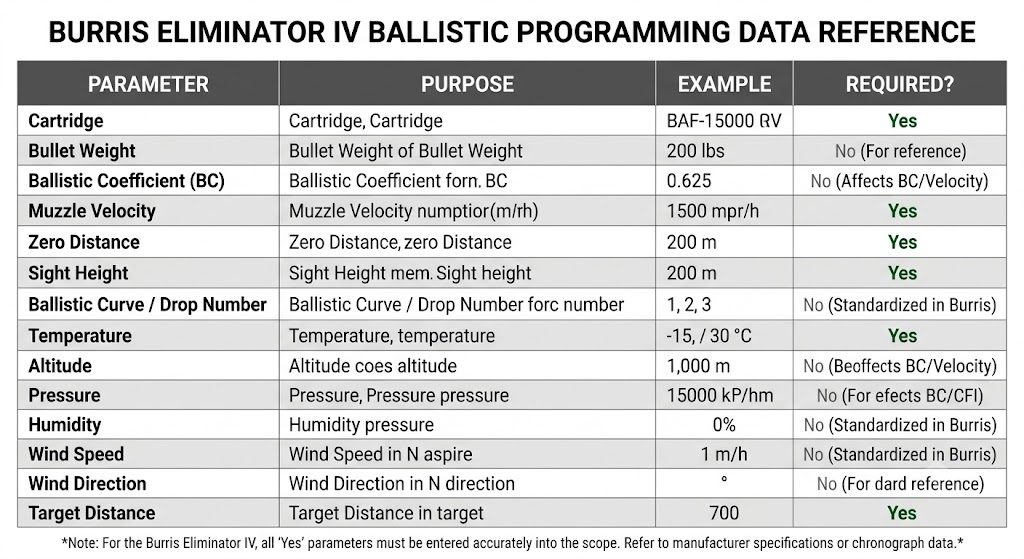
| Parameter | Purpose | Example | Required? |
|---|---|---|---|
| Cartridge | Identifies the ammunition type | 6.5 Creedmoor | No (For reference) |
| Bullet Weight | Mass of the projectile | 143 grains | No (Affects BC/Velocity) |
| Ballistic Coefficient (BC) | Measures aerodynamic drag | 0.625 (G1) | Yes |
| Muzzle Velocity | Speed of the bullet at the muzzle | 2700 fps | Yes |
| Zero Distance | Distance where the scope is zeroed | 100 yards | Yes |
| Sight Height | Distance from bore center to scope center | 1.5 inches | No (Standardized in Burris) |
| Ballistic Curve / Drop Number | Burris-specific trajectory profile | Drop Number 59 | Yes |
| Temperature | Ambient air temperature | 70°F | No (For field adjustments) |
| Altitude | Elevation above sea level | 1,000 ft | No (For field adjustments) |
| Pressure | Barometric pressure | 29.92 inHg | No (For field adjustments) |
| Humidity | Moisture in the air | 50% | No (For field adjustments) |
| Wind Speed | Velocity of crosswind | 10 mph | No (For wind hold reference) |
| Wind Direction | Angle of the wind | 3 O’clock | No (For wind hold reference) |
| Target Distance | Exact range to target | 450 yards | Yes (Provided by laser) |
Burris Eliminator IV Ballistic Programming Example
Note: This is an example trajectory only for the Hornady Precision Hunter 6.5 Creedmoor 143 gr ELD-X (2700 fps muzzle velocity, 100-yard zero). It is not the universal Burris ballistic chart. Actual results vary depending on rifle setup, barrel length, and environmental conditions.
| Range (yards) | Velocity (fps) | Energy (ft-lbs) | Bullet Drop (in) | MOA | MIL | Wind Drift (10 mph) | Time of Flight (sec) | Remaining Energy (%) |
|---|---|---|---|---|---|---|---|---|
| 100 | 2555 | 2073 | 0.0 | 0.0 | 0.0 | 0.6 | 0.11 | 89% |
| 200 | 2415 | 1852 | -4.4 | -2.1 | -0.6 | 2.5 | 0.23 | 80% |
| 300 | 2278 | 1648 | -15.2 | -4.8 | -1.4 | 5.8 | 0.36 | 71% |
| 400 | 2145 | 1461 | -33.4 | -8.0 | -2.3 | 10.6 | 0.49 | 63% |
| 500 | 2016 | 1290 | -59.7 | -11.4 | -3.3 | 17.2 | 0.64 | 56% |
| 600 | 1891 | 1135 | -95.2 | -15.2 | -4.4 | 25.7 | 0.79 | 49% |
| 700 | 1772 | 997 | -141.5 | -19.3 | -5.6 | 36.3 | 0.96 | 43% |
Burris Eliminator 4 Ballistic Chart Image
How the Burris Eliminator IV Ballistic System Works
The Eliminator IV is a comprehensive smart riflescope that eliminates the need for manual holdover calculations in the field.
- Integrated laser rangefinder: Instantly measures the exact distance to your target out to 2,000 yards.
- Built-in ballistic calculator: Processes the programmed ammunition data against the ranged distance.
- Smart Dope Card: Replaces traditional taped-on drop charts with digital, real-time aiming solutions.
- Internal inclinometer: Measures the steepness of your shooting angle.
- Automatic illuminated aiming point: Instantly displays a red dot on the vertical crosshair indicating the exact holdover.
- Wind hold reference: Displays windage offset values to help the shooter manually compensate for crosswinds.
- Angle compensation: Automatically adjusts the holdover solution for steep uphill or downhill shots.
How Burris Ballistic Tables Work
To calculate accurate holdovers, the Eliminator IV relies on specific trajectory profiles rather than a single universal matrix.
- Burris ballistic curves: The software groups thousands of factory loads into matching trajectory profiles.
- Ballistic tables: These are reference guides provided by Burris to help you match your ammunition to the correct internal curve.
- Drop Number: This is a two-digit or three-digit code that represents your bullet’s specific drop at a given distance (e.g., 500 yards or 750 yards).
- Why different cartridges require different tables: A slow, heavy .45-70 bullet drops drastically differently than a fast, light .22-250 bullet.
- Why one chart cannot work for every rifle: Even the exact same ammunition will have different muzzle velocities and bullet drop charts when fired from different barrel lengths.
Ballistic Coefficient (BC) Explained
Ballistic Coefficient is a mathematical representation of how well a bullet overcomes air resistance.
- G1 BC: The standard drag model used for flat-based bullets. Most factory ammunition boxes list the G1 BC.
- G7 BC: A more accurate drag model for modern, boat-tail bullets designed for long-range shooting.
- Why BC affects trajectory: A bullet with a high BC retains velocity longer, drops less, and drifts less in the wind compared to a low-BC bullet.
- Why accurate BC is critical for Eliminator IV programming: The scope’s software uses your inputted BC combined with the Drop Number to map the entire ballistic arc. If the BC is wrong, the illuminated aiming point will be inaccurate at extended ranges.
How to Program the Burris Eliminator IV
Proper Burris scope programming ensures perfect accuracy. Follow these steps:
- Mount and zero the scope perfectly at 100 yards (or your preferred zero distance).
- Choose yards or meters in the scope’s setup menu.
- Select the correct cartridge and specific load you intend to shoot.
- Determine the BC of your bullet from the manufacturer’s specifications.
- Enter the exact muzzle velocity into the scope.
- Select the correct Burris ballistic table by finding your specific Drop Number using the Burris Ballistic Tools.
- Confirm your zero at the initial distance.
- Verify the trajectory by shooting at multiple known distances (e.g., 300, 500, and 750 yards).
- Fine-tune the Drop Number in the scope if your real-world impacts are consistently high or low at long range.
How to Find the Correct Burris Ballistic Chart
Shooters can find their specific drop numbers and programming data through multiple avenues:
- Burris Ballistic Calculator: The official online tool and app (Burris Connect) where you can input your exact load to get the required programming codes.
- Burris manuals: The included literature features extensive tables of common factory loads and their corresponding Drop Numbers.
- Factory ammunition specifications: Box data provides the necessary BC and baseline muzzle velocity required for the Burris calculators.
- Chronograph data: Using a chronograph to get your rifle’s true muzzle velocity is the most accurate way to find your exact drop profile, rather than relying strictly on the box velocity.
Popular Burris Eliminator IV Ballistic Examples
| Cartridge | Typical Bullet | Bullet Weight (gr) | BC (G1) | Muzzle Velocity (fps) | Recommended Use |
|---|---|---|---|---|---|
| .223 Remington | Hornady V-MAX | 55 | 0.255 | 3240 | Varmint |
| 22-250 Remington | Nosler Ballistic Tip | 50 | 0.238 | 3800 | Varmint / Predator |
| .243 Winchester | Winchester Deer Season | 95 | 0.392 | 3100 | Medium Game |
| 6.5 Creedmoor | Hornady ELD-X | 143 | 0.625 | 2700 | Big Game / Target |
| .270 Winchester | Federal Trophy Copper | 130 | 0.459 | 3060 | Big Game |
| 7mm Remington Magnum | Barnes LRX | 145 | 0.486 | 3100 | Large Game |
| .308 Winchester | Federal Gold Medal SMK | 168 | 0.462 | 2650 | Target / Tactical |
| 30-06 Springfield | Nosler Partition | 180 | 0.474 | 2750 | Large Game |
| 300 Winchester Magnum | Berger VLD Hunting | 190 | 0.530 | 2900 | Large Game |
| 300 PRC | Hornady ELD Match | 225 | 0.777 | 2810 | Long Range / ELR |
| 338 Lapua Magnum | Lapua Scenar | 250 | 0.605 | 2950 | Extreme Long Range |
Factors That Affect Burris Ballistic Calculations
Your bullet drop chart is not static. The Eliminator IV’s holdover point is influenced by physical and environmental variables:
- Barrel length: Shorter barrels produce lower muzzle velocities, resulting in more bullet drop.
- Bullet weight: Heavier bullets generally start slower but retain energy better at distance.
- BC: Impacts how efficiently the bullet cuts through the air.
- Muzzle velocity: The foundation of the entire ballistic arc.
- Altitude: Thinner air at higher elevations creates less drag, causing bullets to impact higher.
- Temperature: Hotter powder burns faster (increasing velocity), and hotter air is thinner (reducing drag).
- Humidity: Humid air is actually less dense than dry air, slightly reducing bullet drag.
- Air pressure: Lower barometric pressure reduces drag.
- Wind: Affects horizontal drift; the scope provides wind values, but the shooter must make the lateral hold.
- Zero distance: A flawed 100-yard zero will compound exponentially at 800 yards.
Troubleshooting Incorrect Ballistic Readings
If your Eliminator IV is giving you an incorrect holdover, check for these common issues:
- Incorrect BC: Ensure you are entering a G1 or G7 BC correctly based on the scope’s prompt.
- Wrong muzzle velocity: Do not blindly trust the ammo box. Chronograph your rifle.
- Wrong ballistic curve: Double-check your Drop Number in the Burris Ballistic Tools.
- Incorrect zero: A zero that is off by just a half-inch at 100 yards can cause significant misses at 600 yards.
- Environmental changes: If you programmed the scope at sea level in the winter and are hunting at 8,000 feet in the summer, your trajectory will be drastically different.
- Different ammunition lots: Factory ammo can vary by 50 to 100 fps between different manufacturing lots.
- Scope setup mistakes: Ensure the scope is torqued correctly and perfectly level to avoid inducing cant.
Frequently Asked Questions
Does the Burris Eliminator IV have a universal ballistic chart?
No. It uses a built-in ballistic calculator. You must program the scope with your specific cartridge data (BC, velocity, and Drop Number) to generate a personalized trajectory chart.
How many ballistic tables does it support?
The Eliminator IV can accommodate thousands of different factory loads and custom handloads by utilizing customizable Drop Numbers that correspond to specific trajectory arcs.
How do I find my Burris ballistic curve?
You can find your specific Drop Number by using the Burris Ballistic Tools online, checking the included manual, or using the Burris Connect app.
Can I use handloads?
Yes. You can use any custom handload by inputting your specific bullet’s BC and your chronographed muzzle velocity to find the matching Burris Drop Number.
Can I update the scope for different ammunition?
Yes. You can reprogram the scope at any time if you switch cartridges, bullet weights, or brands of ammunition.
Does altitude affect calculations?
Yes. Altitude changes air density, which alters your bullet’s trajectory. If you experience drastic elevation changes from where you zeroed, you may need to recalculate your Drop Number.
How accurate is the Burris Eliminator IV?
When properly programmed with accurate BC, precise chronographed muzzle velocity, and a perfect 100-yard zero, the Eliminator IV provides highly precise aiming solutions out to its maximum effective range.
Can I use custom muzzle velocities?
Yes. In fact, relying on your rifle’s true, chronographed custom muzzle velocity rather than the generic box velocity is highly recommended for the best performance.