A ballistic coefficient measures how efficiently a bullet overcomes air resistance and maintains its velocity during flight. Using a ballistic coefficient chart helps shooters compare different projectiles to understand which bullets will drop less and resist wind deflection more effectively over long distances.
Table of Contents [Click to minimize]
Ballistic Coefficient Chart
| Caliber | Bullet Weight | Bullet Type | Manufacturer and Bullet Model | G1 Ballistic Coefficient | G7 Ballistic Coefficient | Drag Model or Source Notes |
| .22 LR | 40 gr | Solid Lead Round Nose | CCI Standard Velocity | .120 | Not verified | G1 published by manufacturer |
| .223 Remington | 55 gr | Full Metal Jacket Boat Tail | Hornady FMJ-BT | .243 | Not verified | G1 published by manufacturer |
| 6.5 Creedmoor | 143 gr | Polymer Tip Boat Tail | Hornady ELD-X | .625 | .315 | G1 and G7 published by manufacturer |
| 7mm Rem Mag | 180 gr | Very Low Drag Boat Tail | Berger VLD Hunting | .673 | .344 | G1 and G7 published by manufacturer |
| .308 Winchester | 175 gr | Hollow Point Boat Tail | Sierra MatchKing | .505 | .243 | G1 velocity dependent, G7 published |
| 9mm Luger | 115 gr | Jacketed Hollow Point | Hornady XTP | .129 | Not verified | G1 published by manufacturer |
| .45 ACP | 230 gr | Full Metal Jacket | Winchester White Box | .194 | Not verified | G1 published by manufacturer |
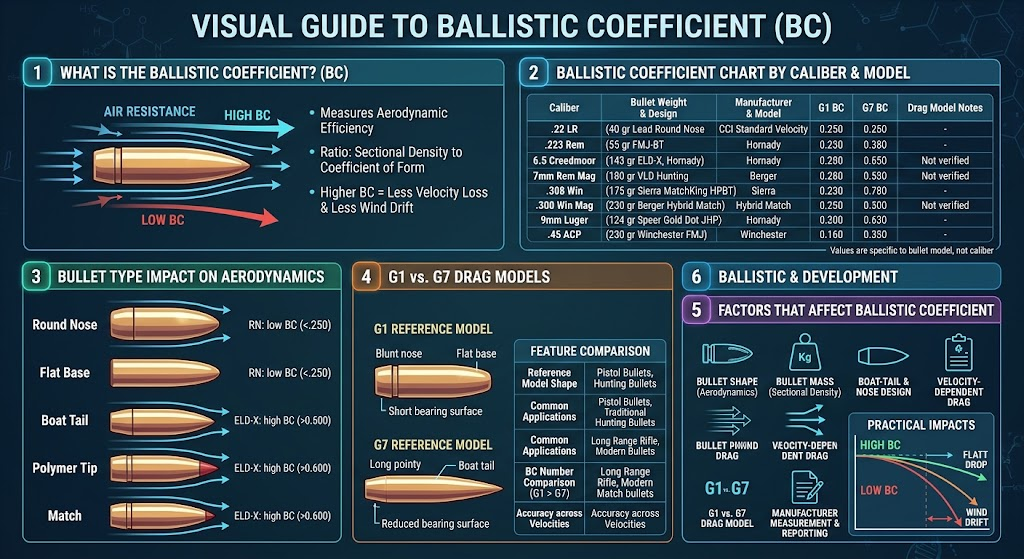
Chart Analysis and Statistics
- The verified G1 BC values in this table range from .120 for the .22 LR to .673 for the 7mm Berger VLD Hunting bullet.
- Differences between bullets of the same caliber are substantial, as seen when comparing short handgun projectiles to long, aerodynamic rifle projectiles.
- Heavier, longer bullet designs like the 180 grain 7mm VLD demonstrate significantly higher BC values than lighter, shorter designs like the 55 grain .223 bullet.
- The G1 values are consistently roughly double the G7 values for the same modern boat tail bullets.
- This bullet ballistic coefficient chart must be used to compare specific bullets rather than calibers alone because bullet shape and weight dictate the coefficient, not the diameter of the barrel.
Ballistic Coefficient Chart by Caliber
| Caliber | Bullet Weight | Bullet Design | Manufacturer and Model | G1 BC | G7 BC |
| .22 LR | 40 gr | Lead Round Nose | CCI Mini-Mag | .125 | Not verified |
| .223 Rem / 5.56 NATO | 77 gr | Hollow Point Boat Tail | Sierra MatchKing | .372 | .190 |
| .243 Winchester | 95 gr | Polymer Tip Boat Tail | Hornady V-MAX | .365 | Not verified |
| 6.5 Creedmoor | 140 gr | Polymer Tip Boat Tail | Hornady ELD Match | .646 | .326 |
| .270 Winchester | 130 gr | Spire Point Flat Base | Nosler Partition | .416 | Not verified |
| 7mm Rem Mag | 162 gr | Polymer Tip Boat Tail | Hornady ELD-X | .631 | .318 |
| .308 Winchester | 168 gr | Hollow Point Boat Tail | Sierra MatchKing | .462 | .218 |
| .30-06 Springfield | 180 gr | Soft Point Flat Base | Remington Core-Lokt | .383 | Not verified |
| .300 Win Mag | 210 gr | Very Low Drag Boat Tail | Berger VLD Target | .720 | .369 |
| 9mm Luger | 147 gr | Jacketed Hollow Point | Federal HST | .205 | Not verified |
| .45 ACP | 230 gr | Jacketed Hollow Point | Speer Gold Dot | .143 | Not verified |
Caliber and Design Comparisons
- Modern long range calibers like the 6.5 Creedmoor and .300 Winchester Magnum display the highest overall BC values when paired with heavy match bullets.
- Handgun calibers consistently show G1 BC values well below .250 due to their short, blunt designs.
- Within the 30 caliber family, the 168 grain boat tail shows a higher BC than the heavier 180 grain flat base bullet, proving shape is just as important as weight.
- Higher BC values reduce wind drift, but they do not automatically mean a bullet is more accurate or powerful at close ranges.
Bullet Ballistic Coefficient Chart by Bullet Type
| Bullet Type | Caliber | Bullet Weight | Manufacturer and Model | G1 BC | G7 BC | Notes |
| Round Nose | .30-30 Win | 170 gr | Hornady InterLock RN | .189 | Not verified | Blunt nose creates high drag |
| Flat Base | .270 Win | 130 gr | Sierra Pro-Hunter | .370 | Not verified | Good hunting bullet with moderate drag |
| Boat Tail | .308 Win | 165 gr | Nosler Ballistic Tip | .475 | Not verified | Tapered base reduces base drag |
| Hollow Point | 9mm Luger | 124 gr | Speer Gold Dot | .135 | Not verified | Wide cavity reduces aerodynamics |
| Polymer Tip | 6.5 CM | 143 gr | Hornady ELD-X | .625 | .315 | Tip resists deformation to maintain BC |
| Match | .300 Win Mag | 230 gr | Berger Hybrid Target | .718 | .368 | Optimized for maximum aerodynamic efficiency |
Design Impact on Aerodynamics
- Round nose and wide hollow point bullets demonstrate the lowest ballistic coefficients across all tested types.
- Polymer tipped and dedicated match bullets show the highest efficiency numbers.
- The transition from a flat base to a boat tail significantly improves the BC of rifle bullets by smoothing the airflow at the base of the projectile.
- Bullet design plays a primary role in published BC values, explaining why not every bullet in a specific category performs the same way in flight.
What Is the Ballistic Coefficient?
The ballistic coefficient is a numerical value that describes how efficiently a bullet moves through the air relative to a standard mathematical drag model. A higher number means the bullet cuts through the air better, loses velocity slower, and is less affected by wind drift.
- BC measures the ratio of a bullet’s sectional density to its coefficient of form.
- Long, sleek bullets with heavier mass relative to their diameter generally have higher BC values.
- Values vary between bullets of the same caliber because a flat nose bullet experiences much more air resistance than a sharply pointed bullet of the exact same weight.
- The G1 drag model represents a flat based projectile with a moderately pointed nose, while the G7 model represents a modern boat tail projectile with a long, sharp nose.
- Some bullets have different published BC values at different velocity ranges because their aerodynamic drag changes as they transition from supersonic to subsonic speeds.
- BC alone cannot predict a bullet’s complete trajectory because muzzle velocity, environmental conditions, and atmospheric pressure all play critical roles in where the bullet will impact.
How to Calculate Ballistic Coefficient
Figuring out how to calculate ballistic coefficient requires more than simply knowing the bullet weight and caliber. You need specific data about how the bullet behaves in flight over a known distance.
- Manufacturer-published BC: The most reliable method is to use the exact value provided by the bullet maker for that specific product, making sure to note whether it is a G1 or G7 value.
- Measured or modeled BC: You can estimate a bullet’s BC by measuring its exact velocity at the muzzle and then measuring its velocity again at a known distance downrange, such as 100 or 200 yards. By comparing how much speed the bullet lost over that distance against how much speed a standard reference projectile would lose, you can determine its relative efficiency.
A basic muzzle velocity measurement alone is insufficient. Calculating a reliable BC requires multiple data points and a clear understanding of the reference drag model being used.
To achieve a meaningful BC estimate, you need:
- Accurate muzzle velocity.
- Accurate remaining velocity at a specific downrange distance.
- The exact distance between the two velocity measurements.
- Atmospheric data including temperature, altitude, and barometric pressure.
- The specific reference drag model you are comparing the bullet against.
G1 vs. G7 Ballistic Coefficient
| Feature | G1 Ballistic Coefficient | G7 Ballistic Coefficient |
| Reference model | Based on a flat-based bullet with a short, blunt nose | Based on a boat-tail bullet with a long, sharp nose |
| Common applications | Pistol bullets, traditional hunting bullets, slug rounds | Long range rifle bullets, modern match projectiles |
| Bullet designs | Best suited for flat base and round nose designs | Best suited for low drag, boat tail designs |
| Comparing published values | Values are numerically higher and often velocity-dependent | Values are numerically lower and remain more stable across velocities |
Practical Differences in Drag Models
- G1 numbers will always look higher than G7 numbers for the exact same bullet.
- Using a G1 model for a modern boat tail bullet requires multiple different BC values at different speeds to remain accurate.
- The G7 model provides a more consistent, single value prediction for modern long range rifle bullets across their entire flight path.
- These values cannot be directly converted into one another without advanced ballistic software.
Factors That Affect Ballistic Coefficient
Bullet shape and aerodynamic design dictate how smoothly air flows over the projectile. A sharp, streamlined nose creates a smaller shockwave than a blunt, rounded nose, significantly reducing frontal air resistance.
Bullet mass and diameter work together to determine sectional density. A heavier bullet of the same diameter carries more momentum to push through the air, resulting in a higher ballistic coefficient than a lighter bullet of the identical shape.
Boat-tail and nose design are critical for rearward aerodynamics. A tapered boat-tail reduces the low pressure vacuum that forms behind the bullet in flight, which drastically cuts down on total drag and raises the BC value.
Velocity-dependent changes in drag occur because air behaves differently at supersonic speeds compared to subsonic speeds. As a bullet slows down, its drag profile changes, which means its actual ballistic coefficient fluctuates during flight.
The selected G1 or G7 model directly determines the published number. The BC is not an absolute physical property of the bullet; it is a comparative rating against a specific mathematical standard.
Manufacturer measurement and reporting methods also cause variations. Different companies test their bullets at different atmospheric conditions, barrel twist rates, and velocity bands, which leads to slight differences in published numbers for very similar projectiles.
Frequently Asked Questions
What is the ballistic coefficient?
The ballistic coefficient is a number that represents how efficiently a bullet travels through the air and resists aerodynamic drag compared to a standard reference projectile.
What is a ballistic coefficient chart?
A ballistic coefficient chart is a reference table that lists the published aerodynamic efficiency numbers for various specific bullets to help shooters compare their flight characteristics.
How do you read a ballistic coefficient chart by caliber?
You read it by locating your specific caliber, finding the exact bullet weight and design you are using, and looking at the corresponding G1 or G7 value to understand its relative aerodynamic efficiency.
How do you calculate ballistic coefficient?
You calculate it by measuring the bullet’s exact velocity at the muzzle and at a known distance downrange, then comparing that velocity loss against a standard reference drag model.
What is the difference between G1 and G7 ballistic coefficient?
The G1 coefficient is based on a flat based reference bullet with a blunt nose, while the G7 coefficient is based on a modern boat tail reference bullet with a long, sharp nose.
Does a higher ballistic coefficient mean better accuracy?
No, a higher number only means the bullet is better at resisting wind and maintaining speed; actual accuracy depends on the rifle barrel, ammunition consistency, and the shooter.
Do heavier bullets always have a higher ballistic coefficient?
Not always. While heavier bullets generally carry more momentum, a lighter bullet with a highly aerodynamic boat tail and polymer tip can have a better coefficient than a heavier flat nose bullet.
Why do bullets of the same caliber have different BC values?
They have different values because bullet shape, length, and base design impact air resistance just as much as the caliber diameter itself.
Where can you find a bullet’s ballistic coefficient?
You can find it printed on the ammunition box, published on the bullet manufacturer’s website, or listed in specialized reloading manuals and ballistic charts.
How does ballistic coefficient affect bullet trajectory?
A bullet with a higher coefficient will lose velocity more slowly, resulting in less vertical drop over distance and less horizontal deflection from crosswinds.