The 50 beowulf ballistics chart provides a complete overview of how this massive big bore cartridge performs in flight. Developed by Alexander Arms to deliver immense stopping power at close to medium distances, this heavy hitting caliber has become highly popular for hunting, self defense, and specialized tactical applications. By firing a heavy half inch diameter bullet from a standard AR 15 platform equipped with a modified upper receiver, the cartridge brings unprecedented kinetic energy to the modern sporting rifle.
Understanding the 50 beowulf ballistics chart is absolutely essential for anyone looking to maximize their accuracy and overall effectiveness in the field. Because this caliber relies on heavy projectiles traveling at moderate velocities, the trajectory features significant bullet drop at extended distances. Knowing precisely how your chosen ammunition behaves regarding velocity retention, energy transfer, and trajectory will ensure you make ethical shots during hunting or accurate hits during target practice.
50 Beowulf Ballistics Chart
| Bullet Weight | Bullet Type | Manufacturer | Muzzle Velocity | Velocity At 100 Yards | Velocity At 200 Yards | Velocity At 300 Yards | Velocity At 400 Yards | Velocity At 500 Yards | Muzzle Energy | Energy At 100 Yards | Energy At 200 Yards | Energy At 300 Yards | Energy At 400 Yards | Energy At 500 Yards | Trajectory At 100 Yards | Trajectory At 200 Yards | Trajectory At 300 Yards | Trajectory At 400 Yards | Trajectory At 500 Yards | Ballistic Coefficient | Sectional Density |
| 300 Grain | FTX | Alexander Arms | 1793 FPS | 1459 FPS | 1199 FPS | 1036 FPS | 936 FPS | 864 FPS | 2141 Foot Pounds | 1418 Foot Pounds | 959 Foot Pounds | 715 Foot Pounds | 584 Foot Pounds | 497 Foot Pounds | Plus 6.9 Inches | 0.0 Inches | Minus 31.1 Inches | Minus 94.5 Inches | Minus 197.5 Inches | 0.200 | 0.171 |
| 335 Grain | Full Metal Jacket | Alexander Arms | 1771 FPS | Not Available | Not Available | Not Available | Not Available | Not Available | 2333 Foot Pounds | Not Available | Not Available | Not Available | Not Available | Not Available | Not Available | Not Available | Not Available | Not Available | Not Available | 0.210 | Not Available |
| 350 Grain | Brass Spitzer | Alexander Arms | 1600 FPS | Not Available | Not Available | Not Available | Not Available | Not Available | 1990 Foot Pounds | Not Available | Not Available | Not Available | Not Available | Not Available | Not Available | Not Available | Not Available | Not Available | Not Available | Not Available | Not Available |
| 400 Grain | Jacketed Flat Point | Alexander Arms | 1800 FPS | Not Available | Not Available | Not Available | Not Available | Not Available | 2878 Foot Pounds | Not Available | Not Available | Not Available | Not Available | Not Available | Not Available | Not Available | Not Available | Not Available | Not Available | Not Available | Not Available |
| 300 Grain | Jacketed Hollow Point | Underwood Ammo | 1950 FPS | Not Available | Not Available | Not Available | Not Available | Not Available | 2533 Foot Pounds | Not Available | Not Available | Not Available | Not Available | Not Available | Not Available | Not Available | Not Available | Not Available | Not Available | Not Available | Not Available |
| 350 Grain | XTP Jacketed Hollow Point | Underwood Ammo | 1775 FPS | Not Available | Not Available | Not Available | Not Available | Not Available | 2449 Foot Pounds | Not Available | Not Available | Not Available | Not Available | Not Available | Not Available | Minus 17.7 Inches | Not Available | Not Available | Not Available | 0.145 | 0.200 |
| 420 Grain | Xtreme Penetrator | Underwood Ammo | 1650 FPS | Not Available | Not Available | Not Available | Not Available | Not Available | 2539 Foot Pounds | Not Available | Not Available | Not Available | Not Available | Not Available | Not Available | Minus 16.3 Inches | Not Available | Not Available | Not Available | 0.250 | Not Available |
| 350 Grain | Jacketed Hollow Point | Buffalo Bore | 1800 FPS | Not Available | Not Available | Not Available | Not Available | Not Available | 2517 Foot Pounds | Not Available | Not Available | Not Available | Not Available | Not Available | Not Available | Not Available | Not Available | Not Available | Not Available | Not Available | Not Available |
| 380 Grain | Hard Cast | Buffalo Bore | 1700 FPS | Not Available | Not Available | Not Available | Not Available | Not Available | 2438 Foot Pounds | Not Available | Not Available | Not Available | Not Available | Not Available | Not Available | Not Available | Not Available | Not Available | Not Available | Not Available | Not Available |
| 400 Grain | Jacketed Flat Nose | Buffalo Bore | 1675 FPS | Not Available | Not Available | Not Available | Not Available | Not Available | 2491 Foot Pounds | Not Available | Not Available | Not Available | Not Available | Not Available | Not Available | Not Available | Not Available | Not Available | Not Available | Not Available | Not Available |
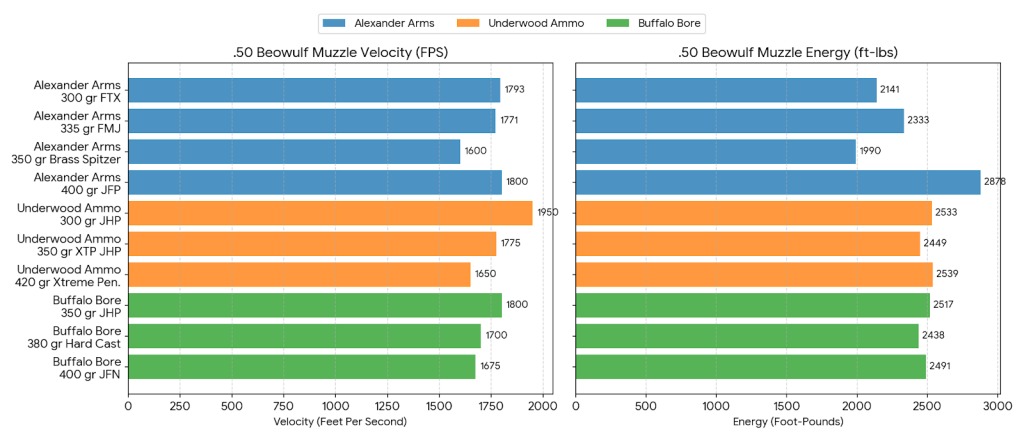
The following professional ballistics table presents live researched data for several representative factory loads currently available on the market. This data reflects actual manufacturer specifications from reputable companies like Alexander Arms, Underwood Ammo, and Buffalo Bore. When specific downrange data is not provided by the manufacturer, the cell is marked as Not Available to maintain absolute accuracy and prevent the use of fabricated numbers.
Understanding The Chart
Every single column in the chart serves a specific purpose in evaluating the overall effectiveness of the cartridge. By breaking down each metric, you can make informed decisions regarding which load is appropriate for your intended target and specific shooting distance.
Muzzle Velocity
Muzzle velocity represents the speed of the bullet at the exact moment it exits the barrel, measured in feet per second. Because this cartridge features incredibly heavy bullets, the muzzle velocities are generally lower than traditional intermediate cartridges like the 5.56 NATO. You will typically see speeds ranging from 1600 FPS to 1950 FPS depending on the powder charge and bullet weight. A higher muzzle velocity flattens the trajectory and reduces the amount of lead required for moving targets, which is vital for hunting fast moving game in dense brush.
Retained Velocity
Retained velocity is the speed the bullet maintains as it travels downrange at various intervals like 100, 200, 300, 400, and 500 yards. The heavy projectiles shed speed rapidly due to their large frontal area and modest aerodynamic design. For instance, the 300 grain FTX drops from 1793 FPS at the muzzle to 1199 FPS at 200 yards. Knowing your retained velocity is critical because many expanding hunting bullets require a minimum velocity threshold to open up properly upon impact. If the velocity falls below this threshold, the bullet acts like a solid point, significantly reducing terminal performance.
Kinetic Energy
Kinetic energy measures the destructive potential and stopping power of the projectile, expressed in foot pounds. Muzzle energy for this cartridge is massive, often exceeding 2500 foot pounds right out of the barrel. This metric is the primary reason hunters and law enforcement personnel choose this caliber over smaller options. However, just like velocity, energy drops quickly over distance due to air resistance. The energy maintained at 100 and 200 yards determines the effective range for taking down large game ethically. Understanding this energy curve ensures you do not attempt shots beyond the physical capabilities of the round.
Trajectory
Trajectory illustrates the bullet drop in inches relative to your line of sight at given distances. The trajectory data shows exactly how much you need to adjust your aim to hit targets at range. Given the heavy weight of these projectiles, the drop is pronounced after 150 yards. With a 200 yard zero, the bullet will strike low by nearly 31 inches at 300 yards. Memorizing this trajectory allows you to utilize holdovers effectively, transforming a close quarters brush gun into a capable medium range hunting rifle.
Ballistic Coefficient
The ballistic coefficient measures how well a bullet overcomes air resistance during flight. A higher number indicates a more aerodynamic profile that will retain velocity and energy better over distance. The bullets used in this cartridge are generally short and thick, resulting in relatively low ballistic coefficients hovering around 0.145 to 0.250. While these values are low compared to sleek target bullets designed for long range precision, they are perfectly adequate for the intended effective range of this specific cartridge.
Sectional Density
Sectional density is the ratio of a bullet mass to its cross sectional area. A higher sectional density generally correlates with much deeper penetration into the target. For hunters pursuing tough animals like feral hogs or bears, a solid sectional density ensures the bullet can punch through thick hide and heavy bone to reach vital organs. The 350 grain XTP offers a sectional density of 0.200, which provides excellent penetration capabilities for medium to large North American game.
Common Bullet Weights
The sheer variety of bullet weights available for this caliber is part of what makes it so versatile. Manufacturers have designed specialized projectiles for a wide array of applications ranging from thin skinned game to dangerous predators.
The 300 grain bullet is one of the lightest common weights available on the commercial market. Bullets like the 300 grain FTX offer the highest muzzle velocities, approaching 1800 to 1950 FPS. These are ideal for deer hunting and general target shooting because they provide the flattest trajectory and lowest recoil impulse within this caliber family. The lighter weight allows for rapid expansion upon impact.
The 325 grain and 335 grain bullets serve as mid weight options that perfectly balance velocity and raw mass. The 335 grain plated hollow points offer immense energy transfer while maintaining manageable recoil for fast follow up shots. They are exceptional for barrier penetration and hog hunting, delivering devastating results within 150 yards where their energy is maximized.
The 350 grain bullet is perhaps the most popular all around weight, particularly the proven 350 grain XTP. It offers a perfect blend of penetration and expansion. Traveling around 1775 FPS, it carries over 2400 foot pounds of energy and serves as an outstanding choice for elk, bear, and defensive applications. This weight retains enough momentum to pass through heavy muscle tissue easily.
The 400 grain and 420 grain bullets are true heavyweights designed for maximum penetration above all else. Bullets like the 420 grain Xtreme Penetrator rely on solid copper or brass construction to punch deeply without expanding. They travel at slower speeds, around 1650 FPS, but their massive momentum makes them unstoppable against heavy bone, thick barriers, and dangerous game where deep tissue damage is required.
Effective Range
The practical effective range of this ammunition depends entirely on what you are trying to accomplish. While the bullet can travel great distances before hitting the ground, its useful energy and trajectory limit its ideal applications to closer ranges.
For hunting applications, the effective range is generally considered to be 150 to 200 yards. Within this envelope, the bullet retains enough velocity for reliable expansion and enough kinetic energy to ensure a clean, ethical harvest on large North American game like moose, elk, and bear. Beyond 200 yards, the steep trajectory makes shot placement extremely difficult without precise laser rangefinders and complex holdover calculations, increasing the risk of wounding rather than dropping the animal.
For target shooting and competition shooting, enthusiasts often push the limits out to 300 or 400 yards just for the challenge of mastering the parabolic arc. Hitting steel plates at these distances requires an intimate understanding of your 50 beowulf ballistics chart and precise wind calls. The heavy, slow moving bullets are susceptible to wind drift over their long flight times, making extended range accuracy a true test of a marksman.
In self defense scenarios, the cartridge is devastatingly effective and the effective range easily covers any realistic engagement distance. The short range stopping power is virtually unmatched by any other AR 15 chambering. Because defensive engagements typically happen well within 50 yards, trajectory drop is a non issue. The massive energy transfer is fully realized at these close distances, easily defeating common barriers and stopping threats immediately.
Factors That Affect Ballistics
Understanding the baseline numbers on a chart is only half the battle. Several external and mechanical factors will alter the actual performance of your ammunition in the real world.
Barrel Length plays a massive role in performance. Most rifles in this caliber feature 16 inch barrels to maintain a compact profile for thick brush hunting. A longer barrel allows for a more complete powder burn, yielding slightly higher velocities. Conversely, shorter pistol length barrels will drop the muzzle velocity noticeably, steepening your trajectory curve and reducing your effective range.
Bullet Weight directly changes the flight path. Heavier bullets leave the muzzle slower but carry more momentum, making them slightly less affected by wind drift initially but more prone to rapid elevation drop. Lighter bullets shoot flatter but shed their kinetic energy much faster downrange.
Bullet Design changes how the air interacts with the projectile. A polymer tipped spitzer bullet cuts through the air more efficiently than a flat nosed solid cast lead bullet. This difference in physical design alters the ballistic coefficient, directly impacting retained velocity and bullet drop at 200 yards and beyond.
Altitude changes the air density your bullet must fly through. At higher elevations, the air is thinner and less dense. This reduced atmospheric drag allows the bullet to fly flatter and retain more energy than it would at sea level, effectively extending your hunting range slightly.
Temperature changes both the air density and the powder behavior. Cold air is denser than warm air, which increases drag and slows the bullet down faster in flight. Additionally, extremely cold temperatures can affect the burn rate of your gunpowder, potentially lowering your initial muzzle velocity right out of the chamber.
Humidity has a counterintuitive effect on ballistics. While it feels heavier to humans, humid air is actually less dense than dry air. High humidity will marginally decrease drag, allowing the bullet to fly slightly flatter, though the difference is usually negligible inside 200 yards.
Wind is the great equalizer for heavy caliber shooters. Because these bullets are slow, they spend more time in the air to reach the target. This increased flight time exposes them to lateral wind forces for a longer duration, resulting in noticeable horizontal drift at ranges beyond 150 yards.
Twist Rate inside the barrel determines how fast the bullet spins on its axis. A proper twist rate stabilizes the heavy projectile in flight. If the bullet is too heavy or long for the twist rate, it will tumble through the air, completely destroying accuracy and completely invalidating any ballistic chart data.
Zero Distance is the mechanical baseline you set for your optic. Where you set your sights to intersect the bullet path completely shifts your trajectory numbers. Your chosen zero dictates your holdovers and hold unders for every single other distance you shoot at.
Best Zero Distance
Selecting the optimal zero distance is crucial for maximizing the utility of your rifle. Because the trajectory resembles a rainbow at extended ranges, your zero dictates how much mental math you need to perform in the field while under pressure.
A 50 yard zero is incredibly popular for tactical applications and self defense setups. With a 50 yard zero, the bullet will typically stay within a two inch window of your line of sight out to about 125 yards. This allows for simple point and shoot engagement without worrying about holdovers in close quarters. It is the perfect setup for a red dot sight mounted on a brush gun.
A 100 yard zero is the traditional standard for most hunters. It provides a straightforward baseline where the bullet never travels significantly higher than the line of sight. From the muzzle to 100 yards, you essentially aim dead on. Past 100 yards, you simply hold higher on the target. This is the most intuitive setup for shooters who want predictable drop data without dealing with mid range apex heights.
A 150 yard or 200 yard zero utilizes the maximum point blank range concept. By zeroing further out, the bullet arcs above the line of sight during the first 100 yards before dropping back down to intersect the crosshairs. For example, with a 200 yard zero, a 300 grain bullet might strike nearly 7 inches high at 100 yards. This zero is best reserved for open terrain hunting where long shots are expected, but the shooter must actively remember to hold under the target on close range encounters to avoid shooting over the animal.
Comparison With Similar Cartridges
To truly appreciate the power and utility of this caliber, it helps to compare it against its closest competitors in the big bore arena. The following table highlights the major differences between the most popular heavy hitting rifle and pistol rounds.
| Cartridge | Average Velocity | Average Energy | Trajectory Drop At 200 Yards | Recoil Level | Effective Range | Hunting Performance |
| 50 Beowulf | 1800 FPS | 2500 Foot Pounds | Minus 17 Inches | High | 200 Yards | Devastating on heavy game in thick brush |
| 458 SOCOM | 1800 FPS | 2400 Foot Pounds | Minus 18 Inches | High | 200 Yards | Excellent penetration, optimized for suppressors |
| 450 Bushmaster | 2200 FPS | 2700 Foot Pounds | Minus 12 Inches | High | 250 Yards | Flatter trajectory, better for open field hunting |
| 45 70 Government | 2000 FPS | 2600 Foot Pounds | Minus 15 Inches | Very High | 200 Yards | Legendary performance, restricted to lever action |
| 50 Action Express | 1450 FPS | 1500 Foot Pounds | Minus 27 Inches | Moderate | 100 Yards | Handgun hunting, short range stopping power |
When comparing these massive calibers, the differences come down to platform mechanics and bullet selection. The 458 SOCOM offers a wider variety of specialized heavy bullets ideal for subsonic suppressed shooting, making it very quiet when paired with a silencer. The 450 Bushmaster utilizes a slightly smaller diameter bullet pushed at much higher velocities, resulting in a noticeably flatter trajectory that extends its hunting range by about 50 yards over the others.
The classic 45 70 Government delivers very similar ballistic performance but is generally chambered in traditional lever action rifles. While beautiful and classic, lever actions lack the modularity, high capacity, and rapid semi automatic follow up capabilities of the AR 15 platform. Finally, while the 50 Action Express shares common ancestry and bullet diameters, it is fundamentally a handgun cartridge. When fired from a large frame pistol, it produces significantly less velocity and energy than the rifle specific round, making it effective but severely limited in range.
Frequently Asked Questions
What is the effective range of this cartridge for deer hunting?
For an ethical harvest on deer, the effective range is generally 150 to 200 yards depending on your exact load. Beyond this distance, the bullet drops too rapidly and sheds too much energy to guarantee a clean kill without precise range finding equipment and expert knowledge of your ballistics chart.
Can I shoot this ammunition through a standard AR 15 lower receiver?
Yes, the cartridge is explicitly designed to function perfectly with a standard mil spec AR 15 lower receiver. You only need to swap the upper receiver to one chambered for the larger round and utilize a modified magazine to accommodate the larger diameter brass. The trigger, buffer tube, and stock remain exactly the same.
Is this cartridge good for home defense?
It provides unparalleled stopping power, making it incredibly effective for neutralizing threats immediately. However, the extreme kinetic energy presents a serious risk of over penetration through interior walls. This must be carefully considered in a home defense scenario where family members or neighbors might be in adjacent rooms.
Why does the trajectory drop so much after 200 yards?
The combination of a very heavy bullet and a relatively low muzzle velocity means the projectile is heavily affected by gravity over its long flight time. Furthermore, the thick, blunt bullet design creates substantial aerodynamic drag, bleeding speed quickly as it pushes through the air.
What is the best bullet weight for hog hunting?
The 335 grain plated hollow points and 350 grain XTP bullets are widely considered optimal for hog hunting. They offer the perfect balance of deep penetration through thick gristle plates and massive energy transfer upon expansion, ensuring the hog drops in its tracks.
Does barrel length significantly affect the ballistics?
Yes, barrel length changes the velocity drastically. While a 16 inch barrel provides excellent standard performance, dropping to a short 10 inch pistol barrel will reduce the muzzle velocity by several hundred feet per second. This reduction decreases the kinetic energy and steepens the trajectory curve noticeably.
How does the recoil compare to a standard 5.56 NATO rifle?
The recoil is substantially heavier than standard intermediate rounds. A standard 5.56 produces about 4.5 foot pounds of free recoil energy, whereas this massive big bore cartridge generates close to 30 foot pounds of free recoil. It feels much more similar to shooting a heavy 12 gauge shotgun slug than a standard sporting rifle.
Do I need special magazines to feed this ammunition?
While you can technically modify standard military style magazines, it is highly recommended to use dedicated magazines with properly modified feed lips to ensure reliable cycling. Due to the large diameter of the casing, the rounds single stack rather than double stack, turning a standard 30 round body into a 10 round capacity magazine.
What zero distance should I use for a red dot sight?
For a non magnified red dot optic primarily used for close quarters and brush hunting, a 50 yard zero is absolutely ideal. It keeps the bullet trajectory within a couple of inches of your point of aim out to 100 yards, eliminating the need for complex holdovers when you need to take a fast shot.
Why is the ballistic coefficient so low on these bullets?
Ballistic coefficient is mathematically determined by the shape, length, and mass distribution of the bullet. Because these projectiles are essentially short, fat cylinders designed specifically to fit within the restrictive magazine well constraints of the AR 15 platform, they simply cannot feature the long, sleek, aerodynamic profiles required for high ballistic coefficients.
Conclusion
Mastering the 50 beowulf ballistics chart is the key to unlocking the full potential of this devastating big bore cartridge. By studying the detailed trajectory numbers, retained velocity data, and energy metrics, hunters and competitive shooters can understand exactly where their bullet will strike at any given distance. While the steep drop curve requires precise knowledge of holdovers past 150 yards, the sheer kinetic energy delivered upon impact makes the learning curve entirely worthwhile for those who need massive stopping power.
Whether you are reloading your own specialized ammunition at home, or simply preparing for your next heavy game hunt in dense timber, referencing this real world performance data ensures you remain accurate and ethical. This unique caliber successfully merged the legendary stopping power of the 45 70 Government with the modern modularity of the AR platform, creating a specialized tool that continues to completely dominate short to medium range engagements.