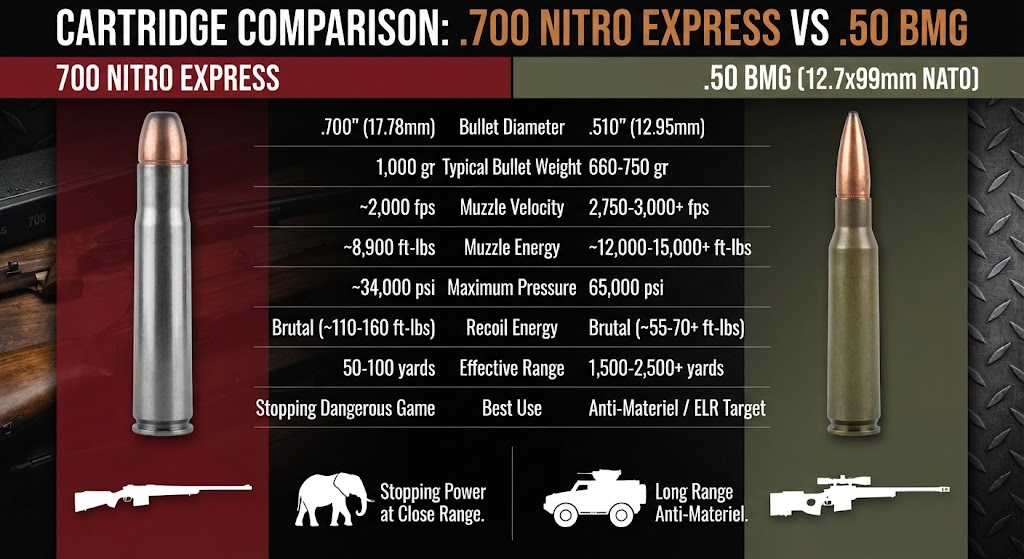
The main difference in the 700 Nitro Express Vs 50 Bmg comparison is that the 700 Nitro Express is a dedicated close-range elephant gun cartridge, whereas the 50 Bmg is an extreme long-range military anti-materiel round. While the Nitro Express uses a massive 1,000-grain bullet to stop charging dangerous game at fifty yards, the 50 Bmg utilizes extreme velocity to defeat armor and vehicles past a mile. Both require massive, specialized firearms and deliver punishing recoil, but their operational environments are completely opposite.
700 Nitro Express Vs 50 Bmg Comparison
| Feature | 700 Nitro Express | 50 Bmg (12.7x99mm NATO) |
|---|---|---|
| Bullet Diameter | 0.700 inches (17.78 mm) | 0.510 inches (12.95 mm) |
| Typical Bullet Weight | 1,000 gr | 650 gr to 800 gr (typically 660 or 750 gr) |
| Muzzle Velocity | ~2,000 fps | 2,750 to 3,000 fps |
| Muzzle Energy | ~8,900 ft-lbs | ~12,000 to 15,000+ ft-lbs |
| Momentum | ~285 lb-fps | ~260 to ~302 lb-fps |
| Maximum Pressure | ~34,000 psi (CIP) | 65,000 psi (MIL-SPEC / SAAMI) |
| Case Type | Straight-walled, rimmed | Bottlenecked, rimless |
| Firearm Platform | Heavy double rifles | Heavy sniper rifles, heavy machine guns |
| Trajectory | Steep drop past 100 yards | Flat out to 1,500+ yards |
| Recoil | Brutal (~110 to 160 ft-lbs) | Brutal (~55 to 70+ ft-lbs in a heavy rifle) |
| Effective Range | 50 to 100 yards (Dangerous game) | 1,500 to 2,500+ yards (Anti-materiel) |
| Ammo Availability | Extremely Low (Custom / boutique only) | Moderate to High (Commercial / surplus) |
| Ammo Cost | Astronomical ($50 to $100+ per round) | Expensive ($3.00 to $7.00+ per round) |
| Best Use | Stopping charging elephants / rhinos | Anti-materiel, vehicle disabling, ELR target |
The table above highlights two absolute behemoths built for entirely different centuries and purposes. The 700 Nitro Express was developed in the late 1980s by Jim Bell and William Feldstein when they wanted an elephant rifle more powerful than the legendary .600 Nitro Express. It is a massive straight-walled brass tube designed to be fired from a traditional side-by-side double rifle at point-blank range in the African bush.
The 50 Bmg was developed by John Browning during World War I to shoot down aircraft and destroy early tanks. It utilizes a massive bottlenecked case that generates nearly double the internal pressure of the Nitro Express, launching highly aerodynamic projectiles across battlefields to destroy hard targets.
700 Nitro Express Vs 50 Bmg Ballistics
To objectively evaluate the ballistic capabilities, we must examine their standard factory loads from their respective heavy rifle platforms.
- Load A (700 Nitro Express Solid): Holland & Holland 1,000-grain Full Metal Jacket Solid. Muzzle velocity is roughly 2,000 feet per second. Muzzle energy is roughly 8,900 foot-pounds.
- Load B (700 Nitro Express Soft Point): Holland & Holland 1,000-grain Soft Point. Muzzle velocity is roughly 2,000 feet per second. Muzzle energy is roughly 8,900 foot-pounds.
- Load C (50 Bmg Military Standard): M33 Ball 660-grain FMJ. Muzzle velocity is 2,910 feet per second. Muzzle energy is 12,427 foot-pounds.
- Load D (50 Bmg Match Grade): Hornady 750-grain A-MAX Match. Muzzle velocity is 2,820 feet per second. Muzzle energy is 13,248 foot-pounds.
700 Nitro Express Vs 50 Bmg Velocity
Velocity is the domain of the military cartridge. Because the 50 Bmg is designed for extreme long-range engagements, its case is highly bottlenecked to funnel massive pressure behind the bullet, consistently pushing 750-grain projectiles to nearly 2,900 feet per second.
The 700 Nitro Express is essentially a modern cannonball. It utilizes a straight-walled case pushing an impossibly heavy 1,000-grain chunk of lead and copper. Because double rifles operate at lower pressures to prevent the action from seizing in dangerous heat, the velocity is intentionally capped at exactly 2,000 feet per second.
700 Nitro Express Vs 50 Bmg Muzzle Energy
Muzzle energy dictates raw destruction, and the military anti-materiel round completely outclasses the elephant gun.
The 700 Nitro Express generates an awe-inspiring 8,900 foot-pounds of muzzle energy. This creates massive hydrostatic shock capable of dropping a 12,000-pound bull elephant in its tracks with a central nervous system hit.
However, the 50 Bmg generates between 12,000 and 15,000+ foot-pounds of muzzle energy. That massive 4,000 to 6,000 foot-pound advantage is why the 50 Bmg is used to destroy engine blocks and concrete bunkers rather than biological targets.
700 Nitro Express Vs 50 Bmg Momentum
Momentum calculates mass in motion, dictating a bullet’s ability to crush through dense bone and armor without being deflected.
Because the 700 Nitro Express fires a 1,000-grain bullet (significantly heavier than the 750-grain 50 Bmg bullet), it remains highly competitive in raw linear momentum despite its slower speed. A 1,000-grain bullet traveling at 2,000 fps yields roughly 285.7 pound-feet per second of momentum.
A 750-grain 50 Bmg bullet traveling at 2,820 fps yields roughly 302.1 pound-feet per second of momentum. The 50 Bmg still edges it out due to extreme speed, but both possess enough driving mass to punch through heavy barriers or massive animal skulls effortlessly.
700 Nitro Express Vs 50 Bmg Trajectory
Trajectory highlights the difference between a 50-yard brush gun and a 2,000-yard sniper rifle.
The 700 Nitro Express fires a flat-nosed, aerodynamically poor projectile. It is designed to be fired over open iron sights at distances measured in paces, not yards. Past 100 yards, the 1,000-grain bullet sheds velocity rapidly and plunges toward the earth.
The 50 Bmg utilizes highly aerodynamic, pointed match bullets that retain their extreme velocity for miles. It shoots incredibly flat out to 1,000 yards and remains supersonic and highly lethal out to 1,500 or even 2,000 yards in the hands of a trained sniper.
700 Nitro Express Vs 50 Bmg Recoil
Both cartridges produce recoil that is universally considered brutal and physically punishing, but they are managed differently.
The 700 Nitro Express is fired from a standing position using a custom-built double rifle weighing roughly 15 to 18 pounds. It generates an astonishing 110 to 160 foot-pounds of free recoil energy. Firing it is often described as being in a minor car accident, violently pushing the shooter backward.
The 50 Bmg generates roughly 60 to 70 foot-pounds of free recoil. However, it is fired from the prone position using a 35-pound tactical rifle equipped with a massive muzzle brake that redirects the explosive gases. While it produces a massive concussive blast that rattles the shooter’s teeth, the physical push into the shoulder is surprisingly manageable.
Which Has More Stopping Power: 700 Nitro Express Vs 50 Bmg?
Against a charging elephant or cape buffalo at 30 yards, the 700 Nitro Express provides superior stopping power. Its blunt, 0.700-inch diameter bullet transfers its massive energy immediately into the animal, whereas the pointed, armor-piercing 50 Bmg bullet would likely zip straight through soft tissue without fully expanding. Against vehicles or hardened targets, the 50 Bmg is vastly superior.
Which Is More Powerful: 700 Nitro Express Vs 50 Bmg?
Based on raw muzzle energy and extreme velocity, the 50 Bmg is significantly more powerful, generating roughly 13,000 foot-pounds of energy compared to the 8,900 foot-pounds of the 700 Nitro Express.
700 Nitro Express Pros And Cons
Pros
- The absolute zenith of dangerous game stopping power for traditional African safaris
- Massive 0.700-inch bullet creates a devastating wound channel without relying on expansion
- Low pressure ensures reliable extraction in extreme heat when facing dangerous game
- Unmatched bespoke craftsmanship and prestige in custom double rifles
Cons
- Recoil is physically dangerous to inexperienced shooters
- Ammunition is astronomically expensive (often exceeding $100 per single cartridge)
- Rifles are custom-made, incredibly heavy, and cost as much as luxury vehicles
50 Bmg Pros And Cons
Pros
- The ultimate global standard for extreme long-range and anti-materiel sniper use
- Massive kinetic energy (13,000+ ft-lbs) capable of disabling vehicles and light armor
- Ammunition is widely available via commercial manufacturers and military surplus
- High-BC bullets provide unmatched long-range precision past 1,500 yards
Cons
- Concussive muzzle blast is deafening and disruptive on standard shooting ranges
- Rifles are extremely heavy (30+ lbs) and difficult to transport
- Pointed FMJ bullets can cause extreme over-penetration on soft biological targets
Final Comparison
| Category | Winner | Reason |
|---|---|---|
| Velocity | 50 Bmg | Generates extreme internal pressure to drive bullets nearly 1,000 fps faster |
| Muzzle Energy | 50 Bmg | Higher speeds push kinetic energy well past 13,000 ft-lbs |
| Momentum | 50 Bmg | Higher velocity overcomes the weight deficit for superior linear mass-in-motion |
| Penetration | 50 Bmg | Pointed armor-piercing bullets effortlessly defeat steel plates and concrete |
| Trajectory | 50 Bmg | High BC and high velocity create a laser-flat curve out to extreme ranges |
| Recoil Control | 50 Bmg | Rifle weight and massive muzzle brakes make it manageable from the prone position |
| Effective Range | 50 Bmg | Accurate and lethal at distances measured in miles, not yards |
| Dangerous Game | 700 Nitro Express | Blunt 1,000-grain bullets anchor 12,000-pound animals immediately |
| Ammo Cost | 50 Bmg | Mass commercial production keeps prices exponentially lower than custom Nitro rounds |
| Ammo Availability | 50 Bmg | Ubiquitous global commercial and surplus availability |
| Overall Performance | Depends on Role | 700 NE for close-range elephant hunting; 50 Bmg for extreme long-range destruction |
700 Nitro Express Vs 50 Bmg: Which Should You Choose?
Selecting the winner in the 700 Nitro Express Vs 50 Bmg comparison is entirely dependent on your bank account and whether you are hunting the largest animals on earth or shooting steel at a mile.
Choose the 700 Nitro Express if you are a dedicated, well-funded dangerous game hunter heading to Africa, or a collector of extreme large-bore bespoke firearms. It provides the ultimate insurance policy against a charging elephant, delivering a 1,000-grain hammer blow that stops massive biological threats instantly.
Choose the 50 Bmg if you are an extreme long-range shooting enthusiast. It is the king of commercial anti-materiel power. It offers the unparalleled thrill of ringing steel targets at 2,000 yards, the convenience of buying relatively affordable commercial ammunition, and the ability to own a piece of proven military history.
FAQs
Is the 700 Nitro Express the largest hunting cartridge in the world?
It is one of the largest commercially standardized hunting cartridges in the world, specifically designed for dangerous game. While wildcat cartridges like the .950 JDJ are physically larger, the 700 Nitro Express remains the pinnacle of practical (though extreme) double-rifle hunting calibers.
Can you shoot a 50 Bmg standing up?
While it is physically possible for a very strong shooter to fire a 30-pound 50 Bmg rifle from a standing position, it is highly discouraged and incredibly inaccurate. The rifles are designed to be fired from a bipod in the prone position to safely manage the extreme weight and recoil.
Why is 700 Nitro Express ammo so expensive?
The ammunition is incredibly expensive because it is a niche, low-production caliber. The massive brass cases must be custom-drawn, the 1,000-grain bullets are specialty items, and the rounds are often hand-loaded to strict specifications for clients taking them on dangerous game hunts.
Can a 50 Bmg be used for hunting?
While it can be used for hunting, it is generally considered unethical and wildly impractical. The rifles are too heavy to carry through the woods, and the military-style bullets are designed to pierce armor, meaning they will pass straight through a game animal without expanding, causing unnecessary suffering or destroying massive amounts of meat.
Which cartridge kicks harder?
The 700 Nitro Express delivers a much harsher felt recoil to the shooter. Because it is fired standing up from a rifle that lacks a muzzle brake, the massive 110+ foot-pounds of free recoil energy is absorbed entirely by the shooter’s shoulder and torso.