The main difference between .360 Buckhammer and .35 Remington is that the .360 Buckhammer is a modern, straight-walled cartridge engineered specifically to comply with restricted-state hunting regulations while operating at higher pressures, whereas the .35 Remington is a legendary bottlenecked cartridge that has reliably taken deer and black bear for over a century operating at lower pressures.
Choosing between these two lever-action heavyweights comes down to understanding modern hunting legislation and internal ballistics. For decades, the .35 Remington was the undisputed king of the dense timber. However, as states like Ohio, Michigan, Iowa, and Indiana began restricting hunters to straight-walled cartridges to limit projectile travel distances in populated areas, hunters were forced to abandon their bottlenecked .35 Remingtons. Introduced in 2023 by Remington Ammunition in partnership with Henry Repeating Arms, the .360 Buckhammer was created to replicate—and slightly exceed—the terminal performance of the .35 Remington in a legal, straight-walled format.
In this comprehensive guide, we compare velocity, muzzle energy, recoil, trajectory, bullet drop, penetration, effective range, suppressor performance, barrel length performance, hunting capability, ammunition cost, and ideal use cases. By the end of this article, you will learn all of these differences in detail and confidently know which cartridge belongs in your lever-action rifle.
.360 Buckhammer vs .35 Remington Comparison Table
To understand how these cartridges perform, we first need to look at their physical dimensions, pressure limits, and baseline performance metrics. The data below represents standard factory loads from Remington (Core-Lokt) and Hornady (LEVERevolution).
| Specification | .360 Buckhammer (360 BHMR) | .35 Remington |
| Cartridge Type | Straight-Wall Centerfire Rifle | Bottleneck Centerfire Rifle |
| Parent Case | .30-30 Winchester | None (Original Design) |
| Bullet Diameter | .358 in (9.1 mm) | .358 in (9.1 mm) |
| Case Length | 1.800 in | 1.920 in |
| Overall Length | 2.500 in | 2.525 in |
| Typical Bullet Weights | 180 gr – 200 gr | 150 gr – 200 gr |
| Muzzle Velocity | 2,199 fps (200gr) – 2,399 fps (180gr) | 2,080 fps (200gr) – 2,225 fps (200gr LEVERevolution) |
| Muzzle Energy | 2,147 ft-lbs (200gr) – 2,300 ft-lbs (180gr) | 1,921 ft-lbs (200gr) – 2,198 ft-lbs (200gr LEVERevolution) |
| Maximum Pressure | 50,000 psi (SAAMI) | 33,500 psi (SAAMI) |
| Effective Range | 200 – 250 yds | 200 – 250 yds |
| Trajectory | Arced (Traditional Lever-Action) | Arced (Traditional Lever-Action) |
| Bullet Drop (300 yds) | ~28 to 32 inches | ~28 to 35 inches |
| Wind Drift | High (Due to round-nose bullets) | High (Unless using Flex-Tip bullets) |
| Recoil | Moderate-Heavy (approx. 14.5 ft-lbs) | Moderate (approx. 13.5 ft-lbs) |
| Barrel Length Performance | Excellent in 18 to 20-inch barrels | Excellent in 20-inch barrels |
| Suppressor Performance | Good (Lever actions lack gas blowback) | Good |
| Short Barrel Performance | Outstanding (Faster burning powder) | Good |
| Long Range Performance | Poor (Not designed past 250 yards) | Poor (Not designed past 250 yards) |
| Accuracy | 1.5 – 2 MOA | 1.5 – 2 MOA |
| Penetration | Excellent (Heavy mass, moderate speed) | Excellent (Heavy mass, moderate speed) |
| Expansion | Highly Reliable (Core-Lokt design) | Highly Reliable (Core-Lokt design) |
| Hunting Performance | Elite for Deer/Bear in restricted states | Legendary for Deer/Bear in timber |
| Home Defense | Not Recommended (Over-penetration) | Not Recommended (Over-penetration) |
| Tactical Use | None | None |
| AR-15 Compatibility | No (Rimmed case) | No (Rimless, but too long for AR-15) |
| Magazine Compatibility | Tubular Magazines (Requires flat nose) | Tubular Magazines (Requires flat nose) |
| Ammunition Cost | High | Moderate to High |
| Ammo Availability | Growing (Regional focus) | Seasonal / Patchy |
| Reloading | Yes (Straight-wall is easy to size) | Yes (Bottleneck requires lubrication) |
| Best Uses | Restricted-state deer hunting | Classic brush hunting, heirloom rifles |
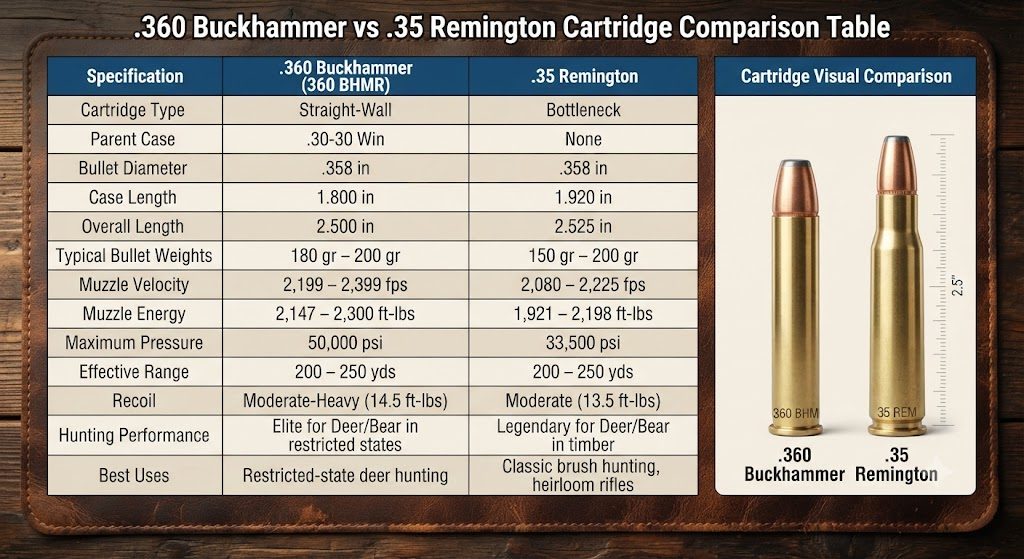
Understanding the Numbers
The technical differences between these cartridges are largely driven by their eras of development. The .35 Remington was introduced in 1906 for the Remington Model 8 semi-automatic rifle, and later made famous by the Marlin 336 lever-action. Because metallurgy in the early 1900s was relatively weak, SAAMI restricts the .35 Remington to a very conservative maximum pressure of 33,500 psi.
Fast forward to 2023. Remington Ammunition took the venerable .30-30 Winchester case, blew the walls out perfectly straight, and trimmed it to 1.800 inches (complying perfectly with states requiring straight-wall cases between 1.16 and 1.80 inches). Built for modern steel, the .360 Buckhammer operates at a stout 50,000 psi. This massive increase in pressure allows the slightly shorter .360 Buckhammer case to actually out-pace the larger .35 Remington case in raw velocity when using the exact same 200-grain, .358-caliber bullets.
Velocity Comparison
Velocity is the driving force behind the 200-yard terminal performance of these brush guns.
Muzzle Velocity Data (20-inch barrel):
- .360 Buckhammer (Remington 180gr Core-Lokt): 2,399 fps
- .360 Buckhammer (Remington 200gr Core-Lokt): 2,199 fps
- .35 Remington (Remington 200gr Core-Lokt): 2,080 fps
- .35 Remington (Hornady 200gr LEVERevolution): 2,225 fps
Analysis:
When comparing traditional soft-point, flat-nosed ammunition (like the Remington Core-Lokt), the .360 Buckhammer has a clear and undeniable advantage. By utilizing 50,000 psi of pressure, the Buckhammer drives a 200-grain bullet 119 fps faster than the classic .35 Remington. When stepping down to the 180-grain load, the Buckhammer nears 2,400 fps, which is incredibly fast for a heavy, straight-walled lever-action cartridge.
However, modern engineering has kept the .35 Remington relevant. Hornady’s LEVERevolution ammunition uses proprietary powder blends to safely achieve 2,225 fps out of the .35 Remington without exceeding SAAMI pressure specs. Even so, across standard loadings, the modern Buckhammer runs hotter.
Winner: .360 Buckhammer
The modern 50,000 psi pressure limit simply allows it to generate higher velocities than traditional .35 Remington factory loads.
Muzzle Energy Comparison
Muzzle energy dictates how much kinetic force the bullet carries to physically anchor large game like black bear and elk at close ranges.
Muzzle Energy Data (20-inch barrel):
- .360 Buckhammer (180gr Core-Lokt): 2,300 ft-lbs
- .360 Buckhammer (200gr Core-Lokt): 2,147 ft-lbs
- .35 Remington (200gr Core-Lokt): 1,921 ft-lbs
- .35 Remington (200gr LEVERevolution): 2,198 ft-lbs
Analysis:
The .35 Remington has been dropping North American game for over a century with roughly 1,900 foot-pounds of energy. It is a proven formula that works through massive tissue disruption caused by a wide .358-inch bullet.
Because the .360 Buckhammer was designed specifically to replace the .35 Remington in restricted states, Remington engineers made sure it hit harder. The 200-grain Buckhammer load generates 2,147 ft-lbs of energy—about a 12% increase over the standard .35 Remington Core-Lokt. The 180-grain Buckhammer load takes it even further, generating 2,300 ft-lbs. While Hornady’s specialty LEVERevolution ammo bridges the gap for the .35 Rem, standard factory comparisons heavily favor the new cartridge.
Winner: .360 Buckhammer
Operating at higher pressures yields more kinetic energy out of identical bullet weights.
Trajectory Comparison
Lever-action rifles utilizing tubular magazines are fundamentally limited by aerodynamics. You cannot safely load pointed (spitzer) bullets into a tubular magazine because the pointed tip of one bullet rests directly against the primer of the bullet in front of it. Under recoil, a pointed bullet can detonate the primer, causing a catastrophic chain-fire explosion inside the magazine tube.
Analysis:
Because both the .360 Buckhammer and the .35 Remington (traditionally) fire flat-nosed or round-nosed bullets, they suffer from terrible Ballistic Coefficients (BC). A round-nose bullet sheds velocity rapidly and plummets out of the sky.
If zeroed at 100 yards, a standard 200-grain .35 Remington drops roughly 8 to 9 inches at 200 yards. The .360 Buckhammer, starting out 120 fps faster, shoots slightly flatter, dropping roughly 6.5 to 7.5 inches at 200 yards. Neither is a flat-shooting cartridge by modern bolt-action standards, but the Buckhammer is slightly more forgiving.
Note: Hornady solved the tubular magazine problem by inventing the FTX (Flex Tip) bullet for the .35 Remington. The soft polymer tip safely rests against primers but provides a pointed, aerodynamic shape. This drastically flattens the .35 Remington’s trajectory, making it highly competitive with the Buckhammer.
Winner: .360 Buckhammer (With standard ammo)
With standard flat-nose ammo, the Buckhammer shoots flatter due to higher initial velocity.
Bullet Drop Comparison
Let’s look at the mathematical drop using standard 200-grain round-nose factory loads for both cartridges, assuming a 100-yard zero.
| Distance | .35 Remington (200gr Core-Lokt) | .360 Buckhammer (200gr Core-Lokt) |
| 50 Yards | +0.4″ | +0.3″ |
| 100 Yards | 0″ | 0″ |
| 150 Yards | -3.2″ | -2.5″ |
| 200 Yards | -9.5″ | -7.6″ |
| 250 Yards | -18.4″ | -14.8″ |
| 300 Yards | -32.5″ | -26.5″ |
Analysis:
At typical woods-hunting distances (inside 150 yards), the difference in bullet drop is less than an inch. You can hold dead-center on a deer’s vitals with either rifle and harvest the animal.
As you stretch to 200 yards, the .35 Remington drops nearly 10 inches, requiring the hunter to hold slightly high on the deer’s shoulder. The .360 Buckhammer drops roughly 7.6 inches, providing a slightly larger margin of error. Beyond 250 yards, both bullets are dropping like stones and running out of the velocity required to expand.
Winner: .360 Buckhammer
The higher starting velocity trims roughly two inches of drop at 200 yards.
Wind Drift Comparison
Wind deflection is mitigated by two factors: how fast the bullet reaches the target, and how aerodynamically slick the bullet is (its Ballistic Coefficient).
Analysis:
When firing 200-grain Core-Lokt bullets, both cartridges share the exact same poor aerodynamics (a BC of roughly .192). Therefore, the only variable is velocity. Because the .360 Buckhammer reaches the 200-yard target a fraction of a second faster, the wind has less time to push it off course.
However, if you load the .35 Remington with Hornady’s 200-grain LEVERevolution FTX bullet (BC of .300), the .35 Remington will easily defeat the .360 Buckhammer in a crosswind because the polymer-tipped bullet cuts through the air far more efficiently than the Buckhammer’s flat-nosed projectiles.
Winner: Tie
Buckhammer wins with standard ammo; .35 Remington wins when loaded with Hornady FTX.
Recoil Comparison
Lever-action rifles are typically light and handy (weighing around 7 pounds), meaning recoil is felt more sharply than in heavy magnum bolt-actions.
Analysis:
The .35 Remington has always been praised for its “push” rather than a sharp “kick.” Operating at a low 33,500 psi, a 7-pound Marlin 336 in .35 Remington generates roughly 13.5 foot-pounds of free recoil. It is highly manageable for most shooters.
The .360 Buckhammer operates at 50,000 psi and pushes the same mass faster. In a similarly weighted Henry lever-action rifle, the Buckhammer generates roughly 14.5 to 15.5 foot-pounds of free recoil. While it is certainly not punishing (it recoils similarly to a .308 Winchester), the Buckhammer has a noticeably sharper recoil impulse than the traditional .35 Rem.
Winner: .35 Remington
The lower operating pressure and lower velocity result in a milder recoil impulse.
Stopping Power Comparison
“Stopping power” on medium game relies on a bullet expanding reliably, destroying vital tissue, and creating a massive wound channel to facilitate rapid blood loss.
Energy Retention at 200 Yards:
- .360 Buckhammer (200gr Core-Lokt): Retains ~1,050 ft-lbs
- .35 Remington (200gr Core-Lokt): Retains ~900 ft-lbs
- .35 Remington (200gr LEVERevolution): Retains ~1,350 ft-lbs
Analysis:
Both cartridges fire massive, .358-caliber bullets. Unlike a .243 or .270 which relies on high velocity for hydrostatic shock, these cartridges rely on crushing bone and tearing tissue through sheer mass.
At 100 yards, a deer hit perfectly with either cartridge will not know the difference. Both create devastating, wide wound channels. However, the .360 Buckhammer retains the generally accepted 1,000 ft-lbs minimum for deer hunting out to 200 yards with standard ammo, whereas the .35 Remington Core-Lokt falls just below that threshold at 200 yards (though the Hornady LEVERevolution excels here).
Winner: .360 Buckhammer
With traditional soft-point ammunition, the Buckhammer delivers more kinetic energy at the point of impact.
Penetration Comparison
Deep penetration ensures the bullet can pass through a heavy shoulder blade and still reach the heart and lungs.
Analysis:
Sectional Density (SD) measures a bullet’s weight relative to its diameter. A 200-grain .358 caliber bullet has a Sectional Density of .223. This is moderately high, allowing the bullet to retain momentum and punch deep into tissue.
Because both cartridges utilize the exact same .358 caliber, 200-grain projectiles, their penetration capabilities are practically identical. The slight velocity advantage of the Buckhammer might drive it an inch or two deeper in ballistic gel, but on a whitetail deer or black bear, both cartridges frequently provide complete pass-throughs, leaving massive blood trails.
Winner: Tie
Both are legendary brush-busting penetrators.
Expansion Comparison
Hunting bullets must expand (mushroom) to be effective. If they do not expand, they act like an ice pick, slipping through the animal without causing a rapid kill.
Analysis:
Traditional cup-and-core bullets like the Remington Core-Lokt require roughly 1,600 fps of impact velocity to reliably expand.
- The .35 Remington (200gr Core-Lokt) drops below 1,600 fps at roughly 125 to 150 yards.
- The .360 Buckhammer (200gr Core-Lokt) drops below 1,600 fps at roughly 175 to 200 yards.
Because the .360 Buckhammer starts faster, it keeps the bullet above the critical expansion threshold for roughly 50 yards further downrange than the .35 Remington.
Winner: .360 Buckhammer
Higher initial velocity guarantees reliable expansion at slightly extended ranges.
Accuracy Comparison
Lever-action rifles utilizing tubular magazines and barrel bands are rarely 1-MOA precision rifles.
Analysis:
Both the .35 Remington and .360 Buckhammer typically shoot 1.5 to 2.5 inch groups at 100 yards. This is “minute of deer” accuracy, which is perfectly acceptable for the woods-hunting environments these rifles are designed for.
The .360 Buckhammer has a slight mechanical advantage purely because it is chambered in brand new, modern rifles manufactured with state-of-the-art CNC machinery (primarily by Henry Repeating Arms). Many older .35 Remington rifles have worn crowns, older triggers, and micro-groove rifling that can be finicky with certain bullet weights. Mechanically, however, neither cartridge is inherently more accurate than the other.
Winner: Tie
Both provide standard hunting accuracy perfectly suited for 150-yard engagements.
Effective Range Comparison
The maximum effective range of a lever-action brush gun is dictated by its trajectory and its retained energy.
Analysis:
The .35 Remington, when loaded with traditional flat-nose ammunition, is a strict 150-yard cartridge. If you load it with Hornady LEVERevolution, you can safely and ethically push it to 200 or 250 yards.
The .360 Buckhammer was engineered specifically to be a 200-yard straight-wall cartridge. It achieves this with standard flat-nose ammunition, hitting with over 1,000 ft-lbs of energy and remaining above the expansion velocity threshold right at the 200-yard marker.
Winner: .360 Buckhammer
It guarantees 200-yard terminal performance without requiring specialty polymer-tipped ammunition.
Suppressor Performance Comparison
Hunting with suppressors is rapidly becoming the standard to protect hunters’ hearing.
Analysis:
Lever-action rifles are excellent suppressor hosts because they have manually operated actions. Unlike an AR-15, there is no gas system blowing toxic gas and noise back into the shooter’s face.
Both cartridges are entirely supersonic (traveling over 1,125 fps), meaning a suppressor will not eliminate the sonic “crack” of the bullet breaking the sound barrier. However, threading a suppressor onto a lever-action .35 Remington or .360 Buckhammer completely tames the muzzle blast, making them a joy to shoot.
Winner: Tie
Both perform beautifully when suppressed, assuming the rifle’s barrel is threaded from the factory.
Short Barrel Performance Comparison
Brush guns are meant to be fast, handy, and maneuverable in dense timber.
Analysis:
The .35 Remington was designed over a century ago and typically uses medium-burn-rate rifle powders. While it performs wonderfully in a 20-inch barrel, chopping it down to 16 inches results in noticeable velocity loss and a significant muzzle flash as unburnt powder exits the barrel.
The .360 Buckhammer uses modern, fast-burning powders typical of straight-walled cartridges (similar to the .350 Legend or .450 Bushmaster). Because the powder burns rapidly inside the 1.800-inch case, the Buckhammer achieves its maximum ballistic potential in shorter barrels.
Winner: .360 Buckhammer
Modern fast-burning powders make the Buckhammer highly efficient in short, maneuverable woods rifles.
16-inch vs 10.5-inch Barrel Performance
(Note: Lever-action hunting rifles are practically never manufactured with 10.5-inch barrels due to NFA SBR regulations and the reduction in tubular magazine capacity. This comparison evaluates the classic 20-inch rifle barrel vs the 16-inch “Trapper” style carbine barrel).
20-inch vs 16-inch Barrel Performance:
- .35 Remington: Dropping from a 20-inch to a 16-inch barrel typically costs the .35 Remington between 100 and 150 fps. This velocity loss drops the cartridge’s reliable expansion range down to roughly 100 yards.
- .360 Buckhammer: Because of the straight-wall design and fast-burning powder, dropping from 20 inches to 16 inches only sacrifices roughly 50 to 75 fps. The Buckhammer retains its lethal velocity much better in “Trapper” style carbines.
Winner: .360 Buckhammer
The Buckhammer is drastically more efficient in 16-inch carbines.
Home Defense Comparison
Lever-action rifles are viable defensive tools in jurisdictions where semi-automatic rifles are heavily restricted.
Analysis:
Neither of these cartridges is ideal for suburban home defense. Firing a 200-grain .358 caliber bullet at 2,000+ fps indoors poses a massive over-penetration risk. These heavy bullets will easily punch through an intruder, through the drywall, and into neighboring rooms or adjacent houses. Furthermore, the muzzle blast from both cartridges inside a hallway without ear protection will cause permanent hearing damage.
Winner: Tie
Use a 12-gauge shotgun loaded with buckshot, or an AR-15 loaded with light, fragmenting 5.56 NATO for home defense. Leave the heavy .35 calibers for the woods.
Hunting Comparison
This is where these cartridges earn their keep.
Analysis:
- Whitetail Deer: Both are absolute hammers. The massive .358 diameter bullets create blood trails that look like they were poured from a bucket. For a hunter sitting in a tree stand in a dense forest where shots rarely exceed 75 yards, there is zero practical difference between the two.
- Black Bear: Bear hunting over bait is typically a close-range affair. The .35 Remington has been a favorite of Maine and Canadian bear guides for a century. The .360 Buckhammer simply hits them with slightly more energy.
- Restricted States: This is the defining factor. If you hunt in Ohio, Indiana, Iowa, southern Michigan, or other straight-wall-only zones, the .35 Remington is illegal to use because it is a bottlenecked cartridge. The .360 Buckhammer is perfectly legal.
Winner: .360 Buckhammer
It delivers slightly better ballistics and is legally permitted in straight-wall restricted hunting zones.
Tactical / Duty Use Comparison
Analysis:
Neither cartridge has any application in modern law enforcement or military roles. They are fired from manually operated, low-capacity lever-action rifles, are slow to reload (loading via a side gate), and have poor aerodynamic ballistics compared to modern intermediate cartridges like the 5.56 NATO or .300 Blackout.
Winner: Tie
Not applicable.
AR-15 Compatibility
The modern hunting market is heavily driven by AR-15 platform compatibility.
Analysis:
Neither cartridge works in a standard AR-15.
- The .35 Remington is a rimless cartridge, but its overall length (2.525 inches) is far too long to fit into an AR-15 magazine well (which has a maximum length of 2.260 inches).
- The .360 Buckhammer is also too long, and more importantly, it utilizes a rimmed case (inherited from its .30-30 parent). Rimmed cases do not stack or feed reliably from standard box magazines.
Winner: Tie
If you want a straight-walled AR-15 cartridge, you must look at the .350 Legend or .450 Bushmaster.
Magazine Compatibility
Lever-action rifles traditionally utilize tubular magazines mounted beneath the barrel.
Analysis:
Both cartridges were explicitly designed for tubular magazines. The .35 Remington functions flawlessly in the classic Marlin 336. The .360 Buckhammer was designed in tandem with Henry Repeating Arms to cycle flawlessly through their Side Gate lever actions.
Because both cartridges share similar overall lengths and bullet diameters, a tubular magazine holding 5 rounds of .35 Remington will generally hold 5 rounds of .360 Buckhammer.
Winner: Tie
Both function perfectly in their respective lever-action platforms.
Ammo Cost Comparison
Analysis:
The .35 Remington is a legacy cartridge. Major manufacturers like Federal, Remington, and Winchester only produce it in seasonal “batches.” When it is out of season, .35 Remington can skyrocket to $3.00+ per round on the secondary market. When in season, it usually costs around $1.75 to $2.25 per round.
The .360 Buckhammer is a new, proprietary cartridge currently manufactured primarily by Remington Ammunition and Federal Premium. Because it requires modern, high-pressure brass and is targeted specifically at the hunting market, it is not cheap. Boxes typically run $35 to $45 (roughly $1.75 to $2.25 per round).
Winner: Tie
Neither cartridge is cheap to shoot. They are dedicated hunting rounds, not high-volume plinking ammunition.
Ammo Availability Comparison
Analysis:
The .35 Remington has suffered from extreme availability issues over the last decade. As ammunition companies prioritize massive military contracts (5.56, 9mm) and modern high-volume hunting rounds (6.5 Creedmoor), legacy cartridges like the .35 Rem are pushed to the back burner, resulting in severe seasonal shortages.
Because the .360 Buckhammer is a massive corporate initiative by Remington and Henry to capture the Midwest straight-wall market, they are pumping millions of rounds into the supply chain. During deer season in Ohio, Michigan, or Iowa, you will find end-caps full of .360 Buckhammer at big box sporting goods stores, while .35 Remington will be nowhere to be seen.
Winner: .360 Buckhammer
Modern industry backing ensures it will remain on shelves, particularly in straight-wall states.
Reloading Comparison
Reloading allows hunters to bypass supply chain shortages and tune ammunition to their specific rifles.
Analysis:
The .35 Remington is a traditional bottlenecked cartridge. Reloading it requires lubricating the cases before running them into the resizing die to prevent them from getting stuck. Furthermore, the .35 Remington has a notoriously tiny shoulder, which can cause headspacing issues if the reloader bumps the shoulder too far back during sizing.
The .360 Buckhammer is a reloader’s dream. Straight-walled cartridges do not require the intricate shoulder-bumping of bottlenecked cases. You can use carbide sizing dies (which do not require case lube), significantly speeding up the reloading process. Furthermore, the Buckhammer uses the same standard .358 caliber bullets as the .35 Rem, meaning projectile components are identical.
Winner: .360 Buckhammer
Straight-walled cases are inherently easier, faster, and less finicky to reload than bottlenecked cases with minimal shoulders.
Pros and Cons
.360 Buckhammer
Pros
- Fully legal for hunting in straight-wall restricted states (OH, MI, IA, IN).
- Drives 200-grain bullets over 100 fps faster than standard .35 Rem.
- Retains over 1,000 ft-lbs of energy at 200 yards.
- Easy to reload due to the straight-wall, lube-free carbide die compatibility.
- Performs exceptionally well in 16-inch short-barreled carbines.
Cons
- Higher 50,000 psi pressure results in a slightly sharper recoil impulse.
- Limited rifle availability (currently dominated by Henry).
- Ammunition is expensive.
.35 Remington
Pros
- A century of proven, legendary performance on deer and bear.
- Extremely mild, pleasant recoil impulse.
- Hornady LEVERevolution ammo vastly improves its trajectory and range.
- Chambered in millions of classic, heirloom-quality rifles (like the Marlin 336).
Cons
- Illegal to use in straight-wall restricted hunting zones.
- Ammunition is produced in seasonal batches, leading to severe shortages.
- Drops below reliable expansion velocity faster than the Buckhammer.
- Reloading the tiny shoulder requires meticulous care.
Final Verdict
Choosing between the .360 Buckhammer and the .35 Remington is a matter of geography and rifle preference.
- For Hunters in Restricted States (OH, MI, IA, IN): .360 Buckhammer. The .35 Remington is illegal here. The Buckhammer was literally invented to solve this exact problem, giving you .35 Rem performance legally.
- For Classic Marlin 336 Owners: .35 Remington. If you live in a state without straight-wall restrictions (like PA, NY, or ME) and you own your grandfather’s Marlin, there is absolutely no reason to buy a new rifle. The .35 Rem is still a legendary brush gun.
- For 200-Yard Shots: .360 Buckhammer. The extra 120 fps ensures reliable bullet expansion out to 200 yards with traditional Core-Lokt ammo.
- For Reloaders: .360 Buckhammer. The straight-walled case is infinitely easier and faster to reload.
- For Short-Barreled Carbines: .360 Buckhammer. The fast-burning powder maximizes velocity in 16-inch Trapper-style lever actions.
- For Recoil-Sensitive Shooters: .35 Remington. Operating at a mere 33,500 psi, it remains one of the most pleasant medium-bore lever guns to shoot.
FAQ
Is .360 Buckhammer more powerful than .35 Remington?
Yes. Because it operates at a much higher pressure (50,000 psi vs 33,500 psi), the .360 Buckhammer drives identical 200-grain bullets roughly 119 fps faster, resulting in about 12% more kinetic energy at the muzzle than standard factory .35 Remington loads.
Why was the .360 Buckhammer created?
The .360 Buckhammer was created specifically to give hunters in states with straight-wall cartridge restrictions (like Ohio, Michigan, and Iowa) a modern lever-action cartridge that replicates the ballistic performance of the legendary .35 Remington, which is illegal in those areas due to its bottlenecked shape.
Can I shoot .360 Buckhammer in my .35 Remington rifle?
No. Absolutely not. The chamber dimensions are completely different. The .360 Buckhammer is a straight-walled, rimmed case, while the .35 Remington is a bottlenecked, rimless case. Attempting to mix them will cause a catastrophic firearm failure.
Which cartridge has less recoil?
The .35 Remington has slightly less recoil. It operates at a significantly lower pressure and produces lower velocity, resulting in a milder “push” against the shoulder compared to the slightly sharper kick of the high-pressure Buckhammer.
Is .360 Buckhammer good for deer?
It is elite for deer. Firing a massive .358 caliber bullet, it creates a massive wound channel and leaves exceptional blood trails. It is highly effective out to 200 yards.
Is the .35 Remington obsolete?
The .35 Remington is not ballistically obsolete, but it is suffering from modern logistical and legal issues. The rise of straight-wall regulations and the ammunition industry’s reluctance to produce it year-round have made it increasingly difficult to use and feed, though it remains a beloved classic.
Can I use pointed bullets in these rifles?
No, not traditional pointed bullets. Both cartridges are fired from lever-action rifles with tubular magazines. Loading pointed bullets can cause a chain-fire explosion in the magazine. You must use flat-nose, round-nose, or specialized polymer-tipped bullets (like Hornady FTX).
What is the parent case of the .360 Buckhammer?
The .360 Buckhammer is based on the venerable .30-30 Winchester case. Remington engineers simply blew the case walls out perfectly straight to accept a .358 caliber bullet and trimmed the length to 1.800 inches to comply with state hunting laws.
Which cartridge is better for black bear?
Both are exceptional black bear cartridges when hunting over bait or with hounds at close ranges. The .360 Buckhammer gets a slight edge simply because it retains more kinetic energy and deeper penetration capability at impact.
Will .360 Buckhammer fit in an AR-15?
No. The .360 Buckhammer utilizes a rimmed case designed for lever-action rifles and single-shot rifles. Rimmed cartridges do not stack or feed properly from the box magazines used in the AR-15 platform.