The main difference in the 300 Prc Vs 300 Weatherby Mag comparison is that the Weatherby is a historic belted magnum designed to push traditional hunting bullets at absolute maximum velocities, whereas the PRC is a modern, beltless cartridge engineered specifically to seat ultra-heavy, high-aerodynamic bullets further out of the case. While the Weatherby shoots flatter at traditional hunting ranges, the PRC completely dominates extreme long-range ballistics with superior wind deflection and downrange energy retention.
300 Prc Vs 300 Weatherby Mag Comparison
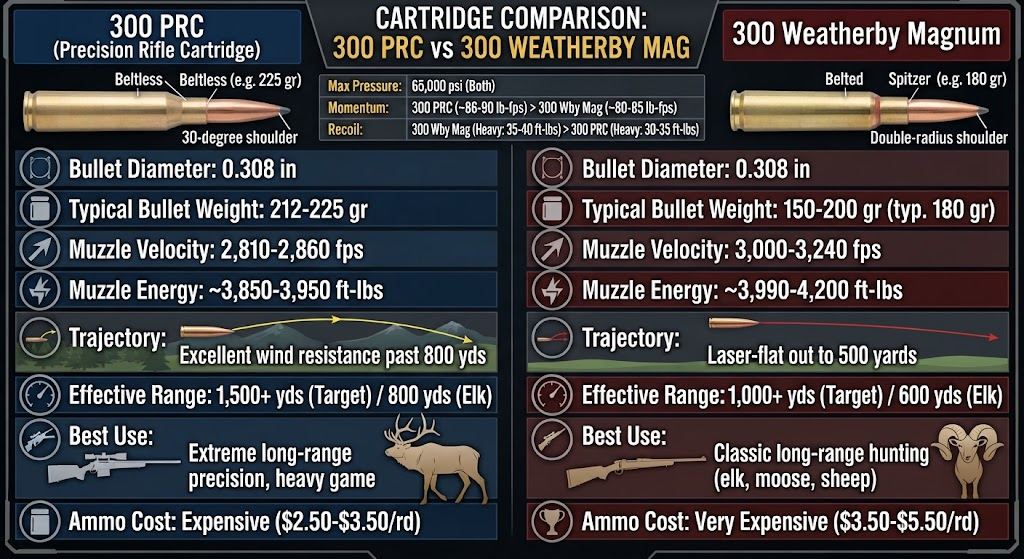
| Feature | 300 PRC (Precision Rifle Cartridge) | 300 Weatherby Magnum |
| Bullet Diameter | 0.308 inches (7.82 mm) | 0.308 inches (7.82 mm) |
| Typical Bullet Weight | 212 gr to 225 gr | 150 gr to 200 gr (typically 180 gr) |
| Muzzle Velocity | 2,810 to 2,860 fps | 3,000 to 3,240 fps |
| Muzzle Energy | ~3,850 to 3,950 ft-lbs | ~3,990 to 4,200 ft-lbs |
| Momentum | ~86 to ~90 lb-fps | ~80 to ~85 lb-fps |
| Maximum Pressure | 65,000 psi (SAAMI) | 65,000 psi (SAAMI) |
| Case Type | Beltless, 30-degree shoulder | Belted, double-radius shoulder |
| Standard Twist Rate | Fast (1:8 to 1:8.5) | Standard (1:10) |
| Trajectory | Excellent wind resistance past 800 yds | Laser-flat out to 500 yards |
| Recoil | Heavy (~30 to 35 ft-lbs) | Heavy (~35 to 40 ft-lbs) |
| Effective Range | 1,500+ yards (Target) / 800 yds (Elk) | 1,000+ yards (Target) / 600 yds (Elk) |
| Ammo Availability | Moderate (Growing commercial precision) | Moderate (Established but expensive) |
| Ammo Cost | Expensive ($2.50 to $3.50/rd) | Very Expensive ($3.50 to $5.50/rd) |
| Best Use | Extreme long-range precision, heavy game | Classic long-range hunting (elk, moose, sheep) |
The table above illustrates the generational shift in magnum cartridge design. Designed by Roy Weatherby in 1944, the 300 Weatherby Magnum uses a massive belted case with a unique double-radius shoulder to hold an enormous powder charge, relying on sheer velocity to achieve its legendary knockdown power.
Introduced by Hornady in 2018, the 300 PRC took a highly calculated, modern approach. It ditched the belt (which can cause headspace and accuracy issues), adopted a 30-degree shoulder, and lengthened the throat of the chamber. This allows shooters to load incredibly long, heavy (212-to-225-grain) high-Ballistic Coefficient bullets entirely outside the powder column. Furthermore, standard 300 PRC rifles mandate a faster 1:8 twist barrel to stabilize these massive projectiles, whereas older Weatherby rifles typically use a 1:10 twist that struggles to stabilize bullets heavier than 200 grains.
300 Prc Vs 300 Weatherby Mag Ballistics
To objectively evaluate the ballistic capabilities, we must examine real-world premium factory ammunition fired from standard 24-to-26-inch magnum hunting barrels.
- Load A (300 PRC Standard Hunting): Hornady 212-grain ELD-X. Muzzle velocity is 2,860 feet per second. Muzzle energy is 3,850 foot-pounds. Ballistic Coefficient (G1) is 0.663.
- Load B (300 PRC Heavy Match): Hornady 225-grain ELD Match. Muzzle velocity is 2,810 feet per second. Muzzle energy is 3,945 foot-pounds. Ballistic Coefficient (G1) is 0.777.
- Load C (300 Weatherby Mag Classic Hunting): Weatherby Select Plus 180-grain Barnes TTSX. Muzzle velocity is 3,240 feet per second. Muzzle energy is 4,195 foot-pounds. Ballistic Coefficient (G1) is 0.484.
- Load D (300 Weatherby Mag Heavy Hunting): Weatherby Select 200-grain ELD-X. Muzzle velocity is 3,000 feet per second. Muzzle energy is 3,996 foot-pounds. Ballistic Coefficient (G1) is 0.597.
300 Prc Vs 300 Weatherby Mag Velocity
Velocity is the absolute domain of the Weatherby cartridge.
Because the Weatherby was designed around standard 150-grain to 180-grain hunting bullets, its massive powder boiler room accelerates them to blistering speeds. A 180-grain bullet leaving a 300 Weatherby Mag barrel easily breaks 3,240 feet per second.
The 300 PRC pushes significantly heavier bullets (212 to 225 grains), so its initial muzzle velocity is slower, generally hovering around 2,800 to 2,860 feet per second. However, because those 300 PRC bullets are vastly more aerodynamic, they lose speed much slower in flight, eventually overtaking the Weatherby’s velocity at extreme long ranges (typically past 800 yards).
300 Prc Vs 300 Weatherby Mag Muzzle Energy
Muzzle energy represents the raw kinetic work capacity of a projectile.
The 300 Weatherby Magnum holds the initial advantage, generating an earth-shattering 4,000 to 4,200 foot-pounds of energy at the muzzle. This delivers devastating hydrostatic shock on large animals like elk and moose at traditional hunting distances (under 500 yards).
The 300 PRC generates roughly 3,850 to 3,950 foot-pounds of muzzle energy. While slightly lower at the muzzle, the 300 PRC’s heavy, high-BC bullets retain their kinetic energy much better over distance, delivering superior knockdown power past the 600-yard mark.
300 Prc Vs 300 Weatherby Mag Momentum
Momentum calculates mass in motion, which dictates a bullet’s ability to crush through dense bone and heavy shoulder muscles without being deflected.
Because the 300 PRC fires substantially heavier projectiles (212 to 225 grains compared to 180 grains), it generates superior linear momentum. A 225-grain bullet traveling at 2,810 fps yields approximately 90.3 pound-feet per second of momentum, giving the 300 PRC an incredibly deep, bone-crushing penetration profile on the largest North American game.
300 Prc Vs 300 Weatherby Mag Trajectory
Understanding external ballistics highlights the difference between initial velocity and long-range aerodynamics. The calculations below assume a 200-yard zero and matched scope heights.
| Distance | 300 PRC (212 gr at 2,860 fps) Drop | 300 Weatherby (180 gr at 3,240 fps) Drop |
| Muzzle | -1.5 inches | -1.5 inches |
| 200 Yards | 0.0 inches (Zero) | 0.0 inches (Zero) |
| 400 Yards | -17.5 inches | -13.2 inches |
| 600 Yards | -52.8 inches | -42.5 inches |
| 800 Yards | -110.2 inches | -94.8 inches |
| 1000 Yards | -195.4 inches | -178.5 inches |
Inside 1,000 yards, the sheer speed of the 300 Weatherby keeps it shooting flatter. However, drop is easily corrected by dialing a scope turret. Wind drift is the true enemy of extreme long-range shooting, and this is where the 300 PRC shines.
Assuming a 10 mph crosswind at 1,000 yards, the highly aerodynamic 212-grain 300 PRC drifts roughly 51 inches. The 180-grain Weatherby bullet, bleeding speed rapidly due to its lower Ballistic Coefficient, drifts nearly 68 inches. The PRC makes cheating the wind drastically easier.
300 Prc Vs 300 Weatherby Mag Recoil
Both of these cartridges generate punishing, heavy recoil that requires proper technique and often a muzzle brake to manage comfortably.
Fired from identical 9-pound rifles, the 300 Weatherby Magnum generates roughly 35 to 40 foot-pounds of free recoil energy, producing a very sharp, violent kick due to the massive powder charge.
The 300 PRC generates roughly 30 to 35 foot-pounds. Pushing a heavier bullet slower typically results in a recoil impulse that is slightly more of a heavy “shove” than a violent snap, but both are firmly in the heavy magnum category and will induce flinching in inexperienced shooters.
300 Prc Vs 300 Weatherby Mag Penetration & Expansion
Both cartridges are absolute masterclasses in big game hunting.
The 300 Weatherby Magnum’s extreme velocity causes hunting bullets (like copper solids or bonded lead) to expand violently on impact, creating massive wound channels that drop elk instantly.
The 300 PRC utilizes long, heavy-for-caliber bullets that act like flying javelins. They penetrate incredibly deep through heavy bone and maintain enough velocity to expand reliably on game well past 800 yards, whereas lighter bullets might drop below the minimum expansion threshold at those extreme ranges.
Which Has More Stopping Power: 300 Prc Vs 300 Weatherby Mag?
Inside 500 yards, the 300 Weatherby Magnum possesses slightly more stopping power due to its massive initial kinetic energy and violent hydrostatic shock. Past 600 yards, the 300 PRC is superior because its heavy, high-BC bullets retain significantly more kinetic energy at extreme distances.
Which Is More Powerful: 300 Prc Vs 300 Weatherby Mag?
At the muzzle, the 300 Weatherby Magnum is more powerful, generating roughly 4,200 foot-pounds of raw kinetic energy compared to the PRC’s 3,900 foot-pounds.
300 PRC Pros And Cons
Pros
- Modern beltless case headspaces perfectly off the shoulder for extreme match-grade accuracy
- Standard 1:8 twist barrels effortlessly stabilize 212-grain and 225-grain bullets
- Unmatched wind resistance and energy retention at 1,000+ yards
- Ammunition is slightly cheaper and easier to find at modern commercial retailers
Cons
- Heavier bullets drop slightly more inside 500 yards than traditional hyper-velocity magnums
- Generates heavy recoil that demands a muzzle brake or suppressor for range days
300 Weatherby Mag Pros And Cons
Pros
- Legendary track record of taking every species of heavy game on the planet
- Blistering 3,200+ fps velocities create a laser-flat trajectory for standard hunting ranges
- Generates an awe-inspiring 4,200 ft-lbs of muzzle energy
- Supported by premium factory ammunition crafted directly by Weatherby
Cons
- Belted case can lead to case stretching and shorter brass life for handloaders
- Standard 1:10 twist barrels struggle to stabilize the modern ultra-heavy 220+ grain bullets
- Ammunition is exceptionally expensive and often requires ordering online
Final Comparison
| Category | Winner | Reason |
| Velocity | 300 Weatherby Mag | Massive powder capacity drives standard 180gr bullets past 3,200 fps |
| Muzzle Energy | 300 Weatherby Mag | Produces 200 to 300 more foot-pounds of raw kinetic energy at the muzzle |
| Momentum | 300 PRC | Ultra-heavy 212gr and 225gr bullets carry superior linear driving mass |
| Penetration | 300 PRC | Heavier, longer bullets crush deeper through dense bone without deflecting |
| Trajectory (Drop) | 300 Weatherby Mag | Faster initial speed means it shoots flatter out to 1,000 yards |
| Wind Resistance | 300 PRC | High-BC bullets cut through crosswinds vastly better at long range |
| Recoil Control | 300 PRC | Kicks slightly less violently than the massive Weatherby powder charge |
| Effective Range | 300 PRC | Retains lethal expansion velocities and energy well past 1,000 yards |
| Accuracy Potential | 300 PRC | Beltless design and modern chamber geometries yield tighter tolerances |
| Ammo Cost | 300 PRC | Commercial Hornady production keeps prices slightly more manageable |
| Overall Performance | Depends on Role | Weatherby for classic 400-yard hunting; PRC for extreme 1,000-yard precision |
300 Prc Vs 300 Weatherby Mag: Which Should You Choose?
Selecting the winner in the 300 Prc Vs 300 Weatherby Mag matchup depends entirely on the distances you plan to shoot and your preference for modern precision versus classic velocity.
Choose the 300 PRC if you are building an extreme long-range hunting or precision target rifle. It is the pinnacle of modern .30-caliber ballistics. By utilizing a beltless case and a fast-twist barrel to launch ultra-heavy bullets, it dominates the wind at 1,000 yards and hits with the momentum of a freight train, making it the superior choice for ethical shots at extreme distances.
Choose the 300 Weatherby Magnum if you want one of the most proven, flat-shooting hunting cartridges ever invented for practical hunting distances (0 to 500 yards). It requires less elevation adjustment in the field, delivers overwhelming hydrostatic shock to anchor massive bulls instantly, and carries an undeniable legacy of North American big game success.
FAQs
Is 300 PRC more powerful than 300 Weatherby Mag?
At the muzzle, no. The 300 Weatherby Magnum produces roughly 4,200 foot-pounds of kinetic energy, out-powering the 300 PRC’s 3,900 foot-pounds. However, the 300 PRC retains its power much better, surpassing the Weatherby in kinetic energy at extreme long ranges.
Can I shoot 225-grain bullets in a 300 Weatherby?
Generally, no. Most factory 300 Weatherby Magnum rifles have a 1:10 barrel twist rate, which is too slow to properly stabilize long, modern 225-grain bullets. The 300 PRC mandates a faster 1:8 twist specifically to handle these massive projectiles.
Which is better for elk hunting?
Both are incredible elk slayers. The 300 Weatherby is arguably better for standard 300-yard shots because it shoots flatter and hits harder. The 300 PRC is better if you anticipate taking a highly technical shot on an elk across a canyon at 700+ yards where wind drift is a major factor.
Which cartridge has worse recoil?
The 300 Weatherby Magnum typically generates slightly more recoil. Its massive powder charge creates a very sharp, violent impulse, whereas the 300 PRC produces a slightly slower, heavy shove. Both require proper recoil management.
Why does the 300 PRC not have a belt?
Modern cartridge designers removed the belt because it is an antiquated feature originally designed to headspace cartridges with sloping shoulders (like the H&H Magnums). Beltless cartridges headspace securely off the shoulder, improving chamber alignment, accuracy, and reloadable brass life.